

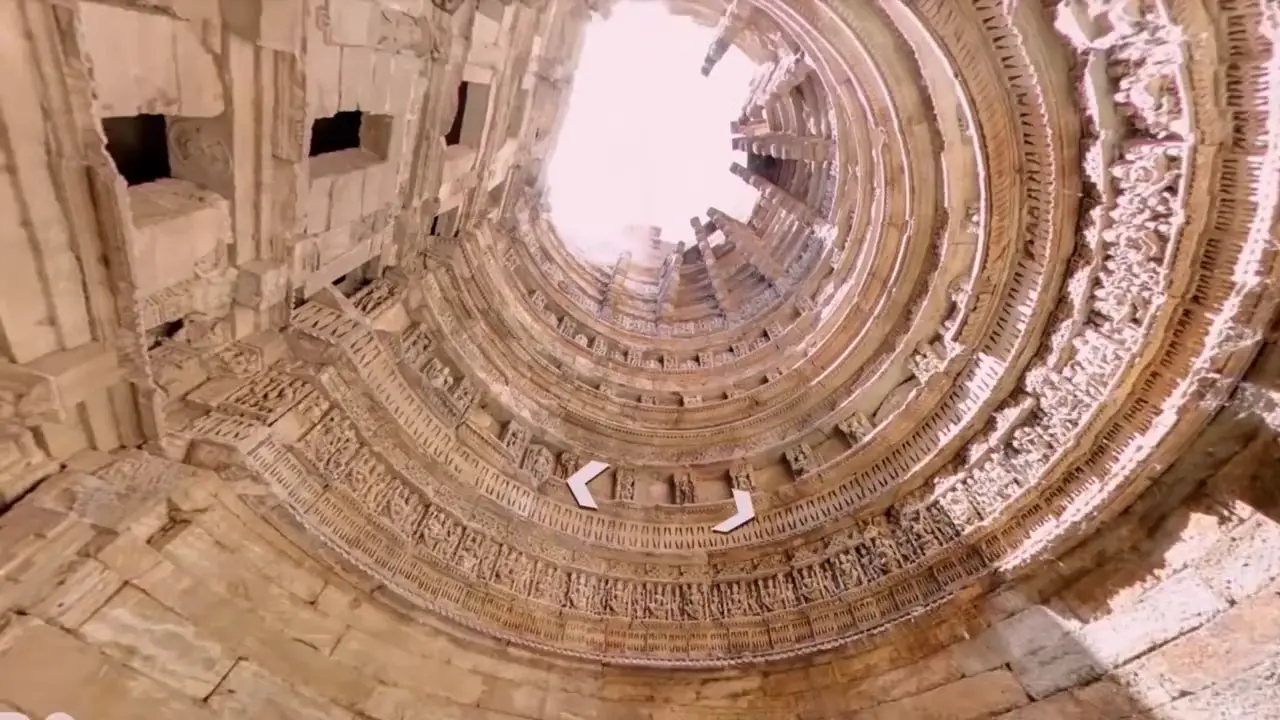
Gujarat is home to hundreds of stepwells called "vavs." Adalaj plunges about 80 m through five storeys and was built in sandstone in the Solanki style by Rana Veer Singh of the Vaghela dynasty, completed in 1499. Rani ki Vav descends seven levels, carries over 500 principal and 1,000-plus minor sculptures, and is conceived as an inverted temple. Chand Baori in Rajasthan features 13 levels and 3,500 steps descending 30 m. Sophisticated underground engineering!
Gujarat's historic stepwells showcase sophisticated underground engineering
Key facts
- Stepwell totals vary by source, but the supplied results list about 100 or more than 200 in Gujarat, not around 1,500. Nearly 2,000 refers to India as a whole.
- Adalaj Vav descends roughly 80–81 m through five storeys. The approximately 20 m by 60 m dimensions describe its upper level, not the stepwell's full depth. An inscription records its completion in 1499 by Rana Veer Singh of the Vaghela dynasty, using the Solanki style.
- Rani ki Vav descends seven levels and measures about 64 m long, 20 m wide and 30 m deep. It has more than 500 principal and more than 1,000 minor sculptures and is conceived as an inverted temple.
- Chand Baori at Abhaneri, Rajasthan, has 13 levels and 3,500 steps descending 30 m, with overall dimensions of roughly 30 m by 35 m.
Sources
Adalaj Stepwellen.wikipedia.org
It was built in 1498 in the memory of Rana Veer Singh of the Vaghela dynasty. Construction started 1499 Completed 16 January 1499. Five storied deep well ...
Architecture - Adalaj Stepwell - Ahmedabad, Gujaratdsource.in
Adalaj stepwell is five stories deep, built-in sandstone in the Solanki architectural style. A stepwell is built on an intricately carved large number of ...
Adalaj Stepwellincredibleindia.gov.in
Adalaj Stepwell begins in the late 15th century, in what was then called Dandai Desh. Construction began in 1498, but fate had other plans. fell to Sultan ...
Architecture and Art: A Deep Dive into the Adalaj Stepwellgiftcityclub.com
The Adalaj Stepwell history is as poignant as the carvings on its walls. The construction was initiated in 1498 by Rana Veer Singh, a Hindu ...
The Fascinating Story of Adalaj Stepwell in Gujaratdizcoverpraveg.com
built in 1499, The stepwell descends five stories deep and features three sets of entrance stairs that converge at a large platform on the ...
Stepwellen.wikipedia.org
Stepwells, also known as vav (in Gujarati) or baori (in Hindi), are wells, cisterns or ponds with a long corridor of steps that descend to the water level.
A window into the future of India's rural stepwellsrwsn.blog
Gujarat's Directorate of Archaeology and Museums has been pivotal in efforts to clean the stored water in the state's vavs, and has vav as an ...
Stepwells - MANAS | UCLA Social Sciences Computingsouthasia.ucla.edu
The vavs or baolis (step-wells) of Gujarat consist of two parts: a vertical shaft from which water is drawn and the surrounding inclined subterranean ...
Was this story useful?
Keep exploring
Every site on this page sits on the globe, and the people who research them are on the Discord.
3D Globe · Sites by country · Story Archive · Research Library · Weekly Journal · Search
AI-generated text · images from the original sources · always verify with the sources.