

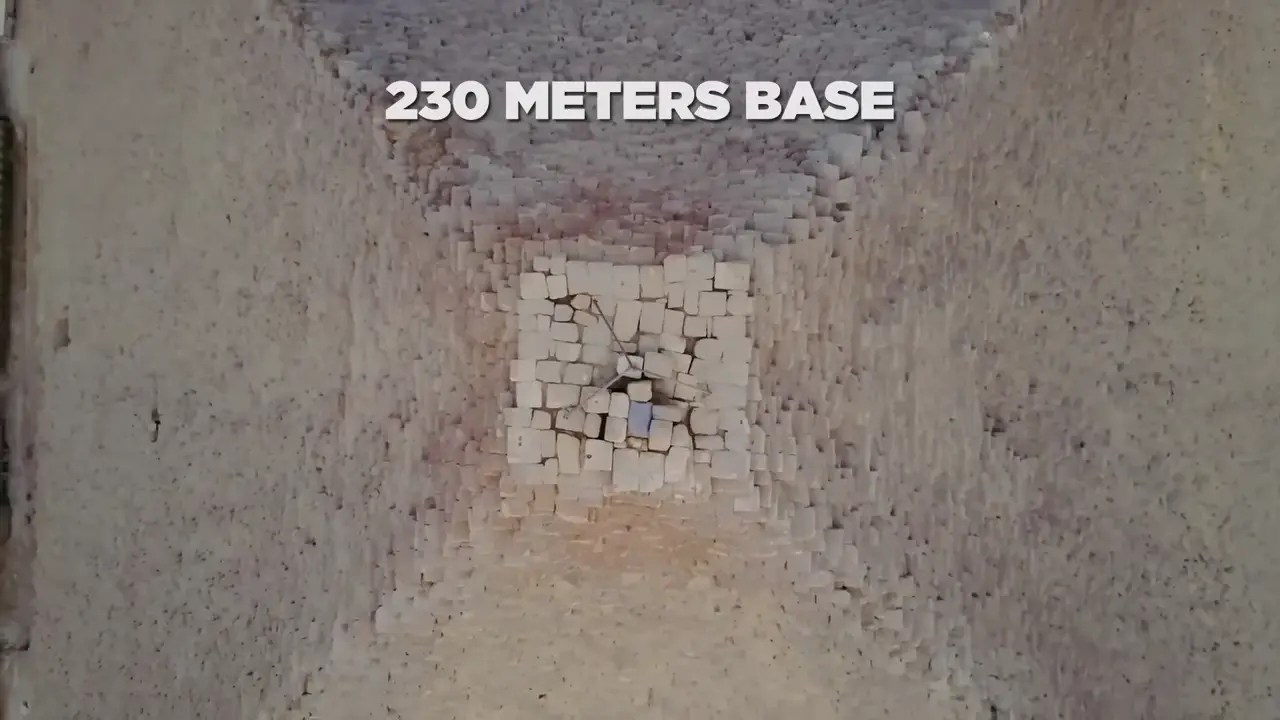
Great Pyramid mathematical constants and construction. Great Pyramid base is 230m on each side, 140m in height Oriented to True North with variation of only 1/500th of a degree Base is slightly octagonal - an indentation visible in satellite images

The Great Pyramid's base measures approximately 230m on each side, oriented to True North with an error of about 3 minutes of arc (roughly 0.05 degrees). The royal cubit (0.5236m) shows connections to Pi and the golden ratio through the pyramid's design. Granite slabs weighing 12-70 tons were transported from Aswan quarries over 800+ km. Egyptologists acknowledge the sophisticated mathematical and engineering knowledge evident in the pyramid's construction, including the slightly octagonal base indentation visible in satellite images and precise alignment techniques.

Key facts corrected:

- Height is approximately 146.5m, not 140m

- Alignment variation is approximately 1/15th of a degree (not 1/500th), or 3 arcminutes (0.05 degrees)

- Outer casing stones typically weighed 2-15 tons, with 200-400 tons being far too high

- Aswan quarries are approximately 800-900 km away, consistent with the claim

Key Facts

  • Great Pyramid base is 230m on each side, 140m in height
  • Oriented to True North with variation of only 1/500th of a degree
  • Base is slightly octagonal - an indentation visible in satellite images
  • Outer wall stones weigh between 200-400 tons
  • King's chamber made of granite slabs weighing 12-70 tons from Aswan, 900 km away
  • Great Pyramid dimensions in cubits: 440 cubits at base, 280 cubits in height
  • Royal cubit equals 0.5236m - connected to Pi and the golden ratio
  • Egyptologists claim Egyptians only had basic mathematical knowledge and did not know Pi

Related site: Great Pyramid of Giza — view location, images, and history on the Ancient Nerds map.