

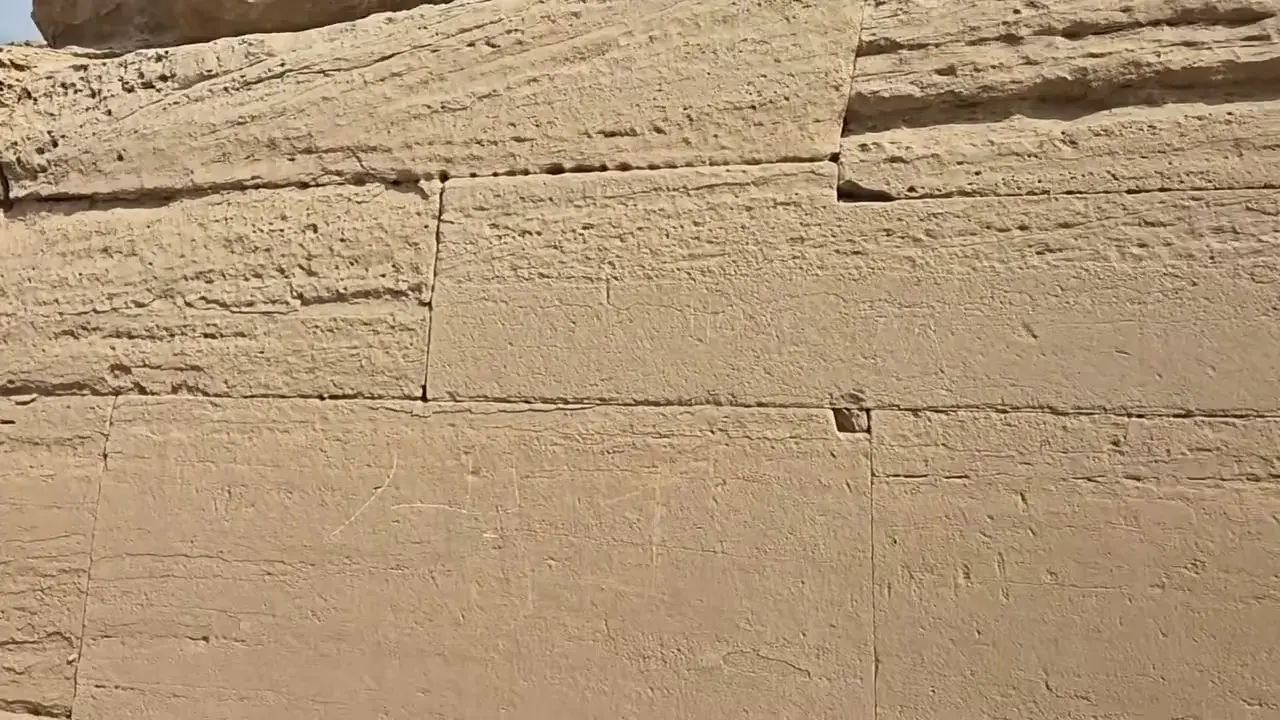
Polished white-limestone casing stones survive at Giza, demonstrating that the pyramids’ outer surfaces were once smooth. Casing and inner-chamber blocks at the Great Pyramid also fit with remarkable precision. The video argues that worldwide “signature” markings and slanted seams point to single-rock monolith construction, but the cited evidence does not establish that theory.
Giza casing stones and the evidence for precise stonework
Site mentioned
📍 Two Ruined Buildings in Field West of Dolddinas Cottage, Trawsfynydd🌍 Show on the globe
Key facts
- Surviving Giza casing stones are polished fine white limestone, showing that the pyramids’ exteriors were originally smooth.
- Casing stones and inner-chamber blocks from the Great Pyramid fit with high precision, with reported average joint widths of about 0.5 millimetres.
- The supplied sources do not document “signature marking patterns” shared by megalithic sites worldwide.
- The video interprets certain seams as evidence of single-rock monolith construction; that interpretation is not established by the cited evidence.
- The supplied sources do not substantiate claims about slanted engineering seams, partially excavated hidden structures or extensive uninvestigated areas.
Sources
Great Pyramid of Giza - Wikipediaen.wikipedia.org
Evidence from detailed petrographic examinations of casing stones from the great pyramid of khufu, a natural limestone from tura, and a man-made ...
Casing stone from the Great Pyramid of Gizanms.ac.uk
While working in Giza, they found a casing stone among the rubble at the base of the pyramid. It had been uncovered during road building work carried out at the ...
How were the Pyramids of Giza built? - National Geographicnationalgeographic.com
It's a bit shorter now with its smooth casing stones long gone. Its estimated 2.3 million stone blocks each weigh an average of 2.5 to 15 tons.
[PDF] The Stones of The Pyramids - Harvard Universitygizamedia.rc.fas.harvard.edu
The pyramids of Khufu, Khafre and Menkaure on the Gizeh plateau (Fig. 71) are listed here together due to their close vicinity and mutual geology of the quarry ...
Evidence from detailed petrographic examinations of casing stones ...researchgate.net
In terms of construction materials, he concluded that they consist of natural limestone disaggregated by the water of the River Nile, which was ...
NOVA Online/Pyramids/History of Gizapbs.org
Building stones were predominantly limestone and granite, while mudbrick was used earlier for mastabas. Mudbrick was also used to build later Middle Kingdom ...
The Edinburgh Casing Stone – A piece of Giza at the National ...arkysite.wordpress.com
This stone was mined at the Tura quarries on the east side of the Nile 45 centuries ago, shipped across the river to Giza on the west bank, ...
The pyramids at Giza looked very different when they were ...apollo-magazine.com
The Egyptian pyramids were originally covered in smooth white limestone – as a casing stone now in Scotland shows.
Was this story useful?
Keep exploring
Every site on this page sits on the globe, and the people who research them are on the Discord.
3D Globe · Sites by country · Story Archive · Research Library · Weekly Journal · Search
AI-generated text · images from the original sources · always verify with the sources.