

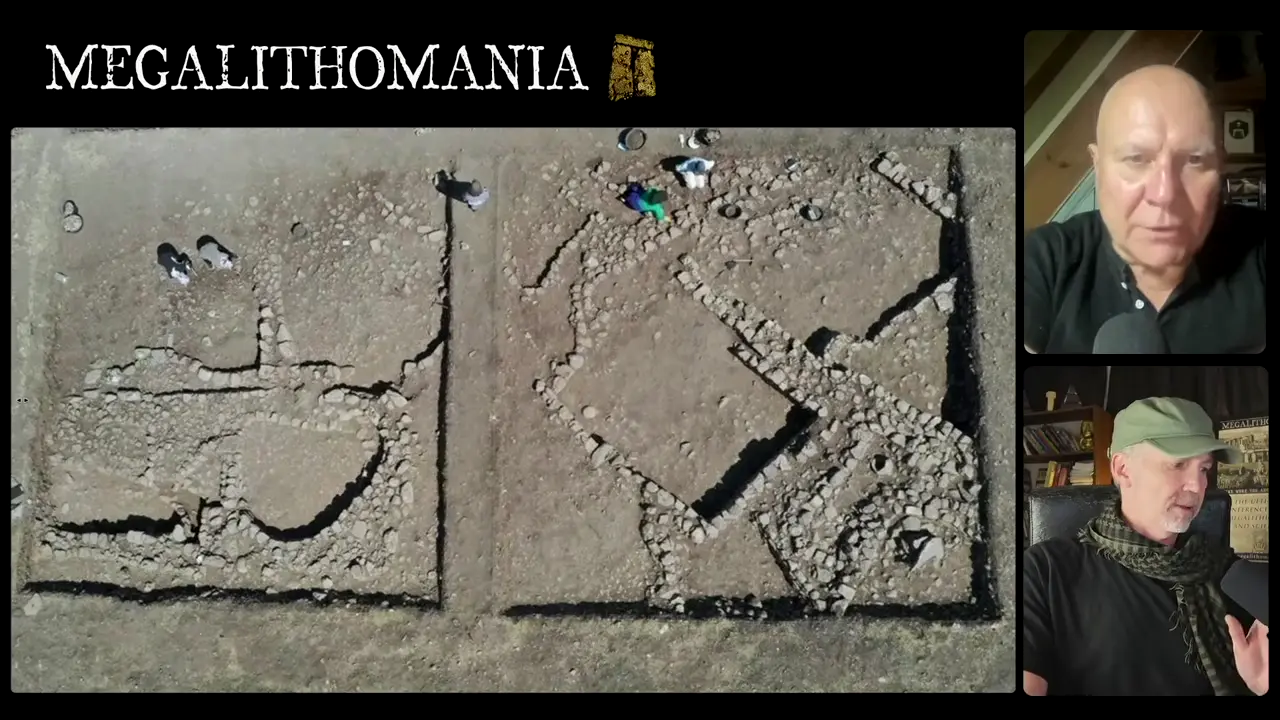
Excavation at Göbekli Tepe began in 1994–95. Northern-area work started in 2021 after olive trees planted in 2004 were removed and continued in 2026, exposing rectilinear structures dated to roughly 8,500–8,000 BC. They overlap the final main-enclosure phase; the Lion Pillars Building is broadly contemporary. Their function remains unresolved: researchers initially saw possible dwellings, while the video argues that the absence of an on-mound water source points to temporary ritual or dream-incubation spaces. The video also cites 2012–2014 GPR maps showing three large buried enclosures, but radar cannot date them directly to 9,600 BC or earlier. It criticizes reconstruction at Enclosures C and D as a tourism-driven obstacle to deeper excavation.
Göbekli Tepe’s 2026 northern dig uncovers late rectilinear structures
 Türkiyeunverified
Key facts
- Excavation at Göbekli Tepe began in 1994–95. Work in the northern area started in 2021 after olive trees planted in 2004 were removed; the 2026 campaign is a continuation.
- The northern rectilinear structures date to roughly the 9th or early 8th millennium BC, about 8,500–8,000 BC. They are later than the earliest enclosures but overlap the main enclosure-building phase, so a uniform 1,000–1,500-year gap after all main enclosures is misleading.
- The Lion Pillars Building is broadly contemporary with the later enclosure and rectilinear-building horizon.
- The structures’ function remains unresolved. Researchers initially described them as possible dwellings pending examination of their floors; the video argues that the lack of an on-mound water source indicates temporary ceremonial, dream-incubation or healing spaces.
- The 2012–2014 GPR surveys mapped three large buried anomalies interpreted as enclosures. The video suggests they may date to 9,600 BC or earlier, but GPR cannot date structures directly.
- Enclosure C has been reconstructed and reconstruction work is under way at Enclosure D. The video presents tourism-led reconstruction as hindering deeper excavation and frames it as a conflict with Türkiye’s Ministry of Culture and Tourism.
Sources
Did People Live at Göbekli Tepe? The 2026 Rectangular Buildingsatlasanatolia.com
August 2026 excavations north of Göbekli Tepe found 9th-millennium rectangular buildings. Karul: first impression dwellings, pending floor ...
News - Intact Burials Excavated at Göbekli Tepearchaeology.org
A kidney-shaped pit was found to contain the remains of a woman, a young man, and an adolescent girl. The remains of a young woman were found in ...
Göbekli Tepe: the north side of the mound is being excavated for the ...ancientcontent.com
This year, for the first time, work has begun in the northern section, in an area of roughly 80 by 70 meters.
New excavations at Göbeklitepe unearth rectangular structureshurriyetdailynews.com
Structures that have been uncovered in a new excavation area at Göbeklitepe offer clues about the site's settlement pattern and daily life.
New Excavations At Göbekli Tepe Are Challenging Old Theories About The ...iflscience.com
The new excavations at Göbekli Tepe Part of the latest work at Göbekli Tepe is focusing on an 80-by-70-meter (262-by-229-foot) plot, just a ...
Was this story useful?
Keep exploring
Every site on this page sits on the globe, and the people who research them are on the Discord.
3D Globe · Sites by country · Story Archive · Research Library · Weekly Journal · Search
AI-generated text · images from the original sources · always verify with the sources.