

Tell Qaramel reveals FIVE main occupation phases spanning at least 2,000 years of continuous habitation. Architecture evolved from OVAL houses in earlier phases to RECTANGULAR ones later — over 60 dwellings found, each around 9-10 square meters with hard clay floors and low perimeter benches. Researchers consider it the most important pre-Pottery Neolithic site for studying how settlement layouts evolved over generations. The site shows remarkable continuity in community life across millennia.
Four archaeological horizons show 2,000 years of continuous occupation and architectural evolution
 SyriaGeneral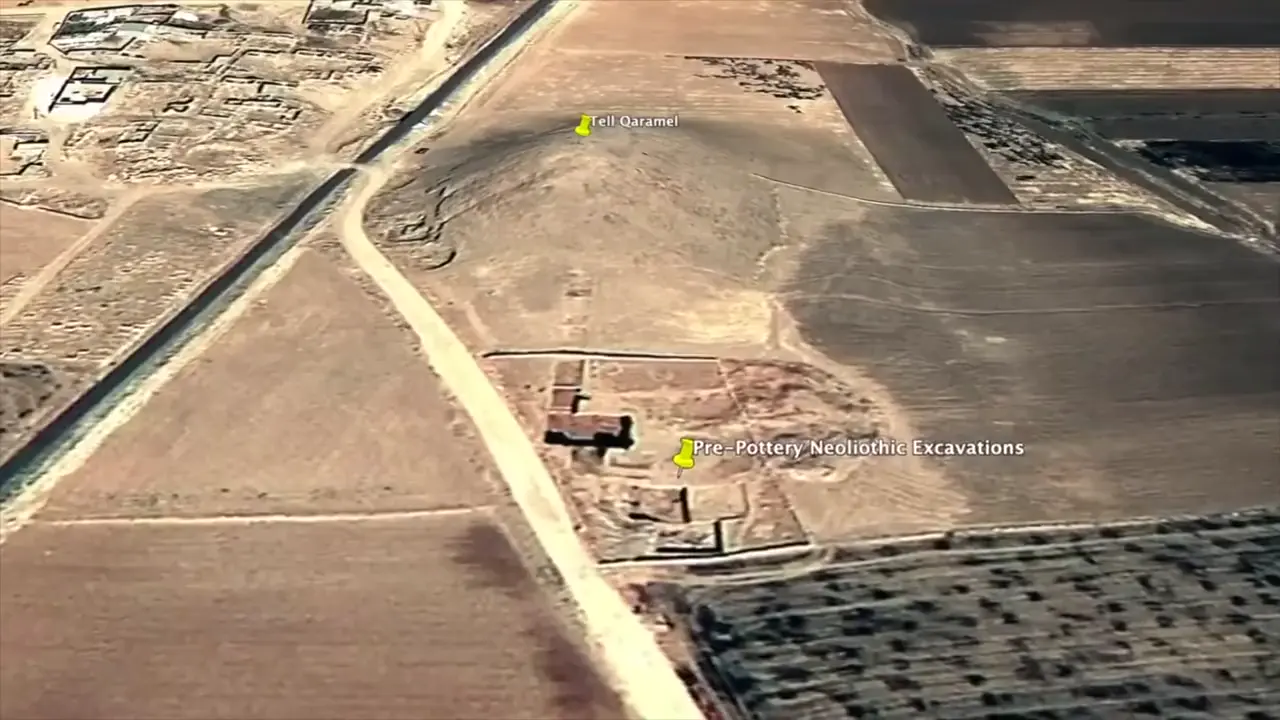
Site mentioned
Key facts
- Five archaeological horizons identified: H0 to H4
- H0 Epipaleolithic phase dates 18,890-12,980 years ago (inconclusive)
- H1 dates 12,890-11,670 years ago
- H2 dates 12,670-11,250 years ago
- H3 dates 11,820-10,710 years ago
- H4 dates 11,310-10,780 years ago
- Continuous occupation for at least 2,000 years
- Construction evolved from oval in H1 and H2 to rectangular in H3
- Over 60 circular and oval houses found
- Dwellings 9-10 square meters with hard clay floors and low perimeter benches
- Site considered most important pre-Pottery Neolithic site for studying settlement evolution
Sources
Tell Qaramel - Centrum Archeologii Śródziemnomorskiejpcma.uw.edu.pl
The settlement excavated in Tell Qaramel covers almost 3.5 ha and includes relics from the Proto-Neolithic and early Pre-Pottery Neolithic (PPNA).
EB IVB pottery from Tell Qaramel (western Syria)journals.openedition.org
Tell Qaramel is located in western Syria, on the western bank of the Queiq River valley. Although the site, excavated between 1999 and 2011 by a ...
Tell Qaramel - Wikipediaen.wikipedia.org
Tell Qaramel is a tell, or archaeological mound, located in Aleppo Governorate, Syria, 25 km north of Aleppo in the Queiq river basin.
Tell Qaramel - Archaeological site north of Aleppo, Syria - Around Usaroundus.com
Tell Qaramel is an archaeological site in Aleppo Governorate, Syria, featuring several stone towers and structures that span a fertile river ...
Tell Qaramel and the Neolithic Cult of Severed Heads - AllThatHistoryallthathistory.com
The site of Tell Qaramel is truly ancient, from the dawn of civilization. Who were these people, and why were they fixed on this site, ...
Was this story useful?
Keep exploring
Every site on this page sits on the globe, and the people who research them are on the Discord.
3D Globe · Sites by country · Story Archive · Research Library · Weekly Journal · Search
AI-generated text · images from the original sources · always verify with the sources.