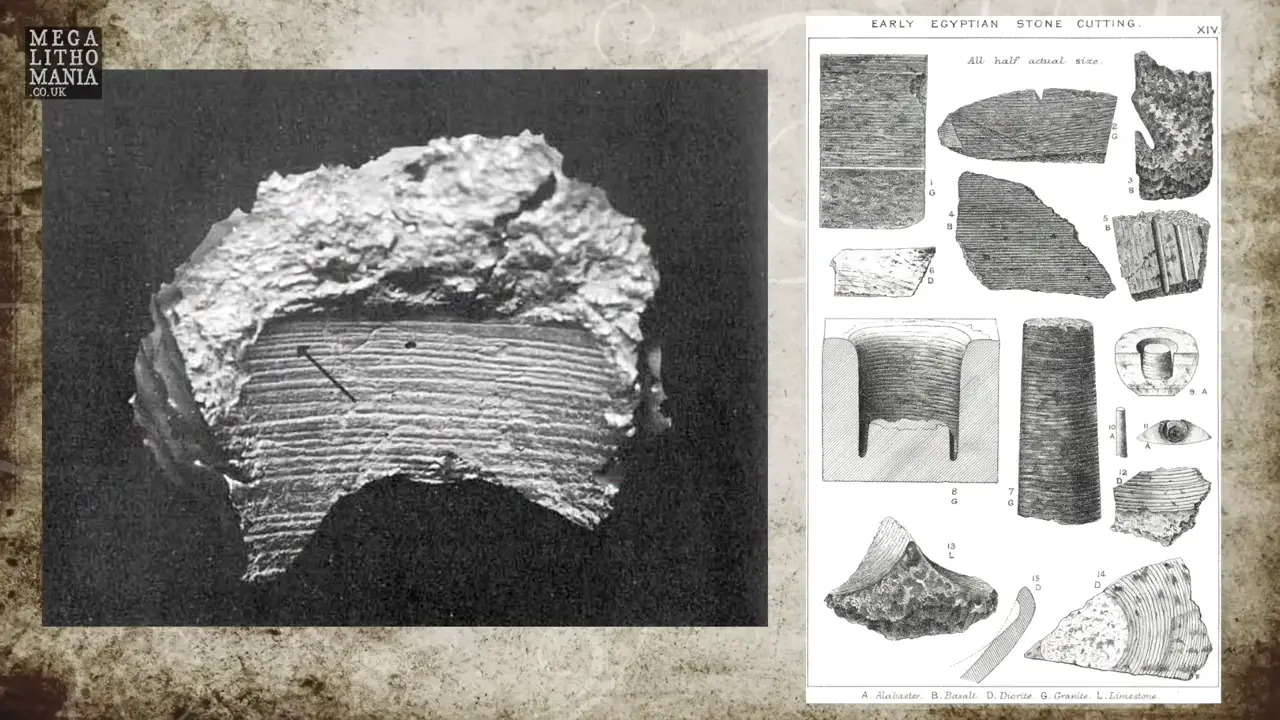
Flinders Petrie documented tubular drill holes and striations on Egyptian artifacts in 1883. The drill holes measured 24 cm long with diameters of 5.3 cm. No tubular copper barrels or wooden drill shafts have been found in the archaeological record from ancient Egypt. Petrie also noted lathe marks on objects predating conventional dating for lathe invention.
Researchers have observed that the witness marks on drill cores indicate high-speed boring techniques, though the exact methods and tools remain subjects of study in Egyptian archaeology.
Sources
Sir William Flinders Petrie: Archaeologist Extraordinairenewcreation.blogSir William Matthew Flinders Petrie was as eccentric as he was brilliant. Petrie was among the first to treat archaeology as a science.
Expedition Magazine | Ancient Egyptian Stone-Drilling - Penn Museumpenn.museumThe granite core published by Petrie was made by the ancient Egyptians using a tubular drill. Note the similarity of the concentric lines (arrow) found on the ...
William F. Petrie's Lost Technology of Ancient Egyptian Core#7gizapower.comThey do not address the remarkable geometry and exactness of the ancient Egyptians statues, and they have ignored evidence presented by Flinders Petrie in 1883 ...
Ancient Egyptian Copper Coring Drills - Hall of Maathallofmaat.comNo tubular copper barrels or the wooden drill-shaft used for coring of rock have been found in the archaeological record from ancient Egypt, or from Mesopotamia ...
AI-generated text · images from the original sources · always verify with the sources.