

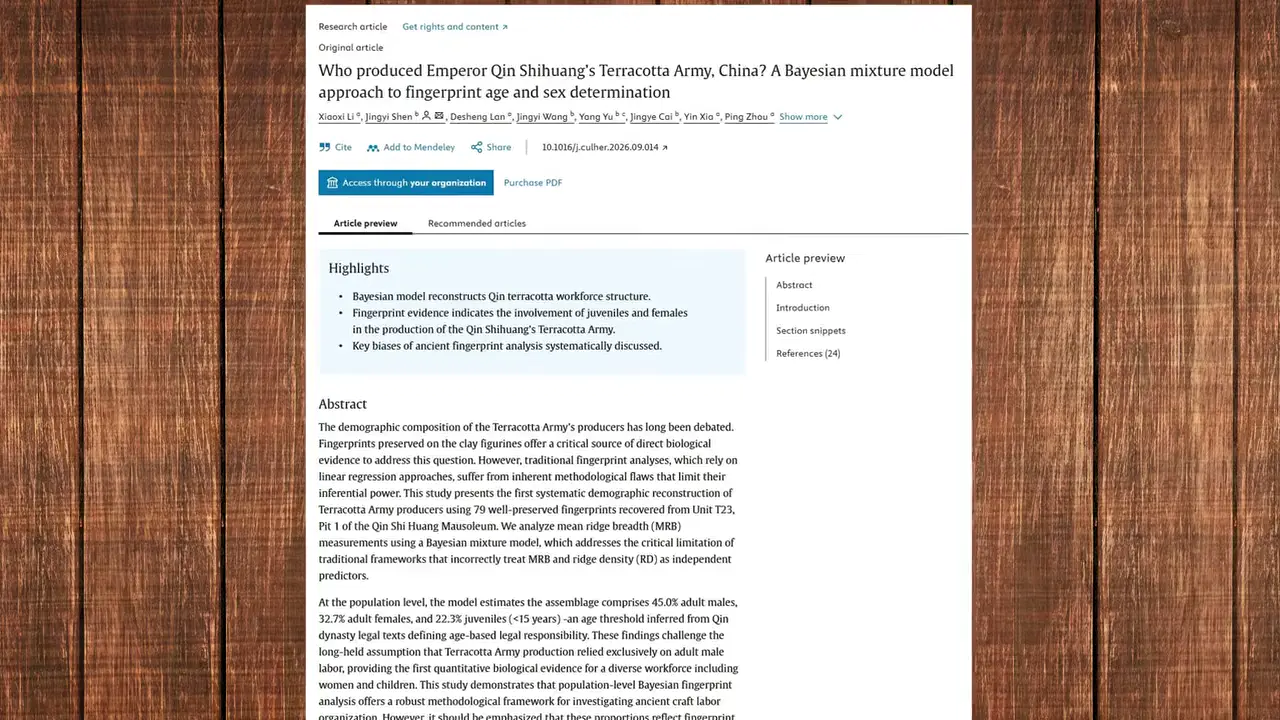
Researchers from the Emperor Qin Shi Huang's Mausoleum Site Museum and Shandong University analyzed fingerprint ridges pressed into the clay of 36 terracotta warriors from Pit One, using 79 clear prints. Ridge spacing shifts with age and sex, and a statistical mixture model put roughly 45% of the prints on adult men, 33% on adult women and 22% on children under 15 — suggesting women and youngsters worked on the Qin army 🏺 The authors are careful: this is a small sample from a vast project, it leans on modern comparison data, and the mix could be skewed by who happened to leave visible prints. Still, it lines up with other Qin-era state crafts like lacquer production.
Fingerprints on terracotta figures show women and children helped make the Qin army
Site mentioned
Key facts
- The Terracotta Army forms part of the burial complex of China's first emperor, Qin Shi Huang, dating to the 3rd century BCE.
- A team from the Emperor Qin Shi Huang's Mausoleum Site Museum and Shandong University examined fingerprints pressed into the clay of the figures.
- The study used 79 clear prints on 36 figures from a single excavation unit in Pit One, measuring the spacing between fingerprint ridges, which varies with age and sex.
- A statistical mixture model attributed about 45% of sampled prints to adult men, about 33% to adult women and about 22% to people under 15.
- The authors note the sample covers a small part of a much larger project, depends on modern comparison data, and that differences in who left visible prints could exaggerate female and juvenile shares.
- Women and young people were already documented in other Qin-state supervised crafts, including lacquer production.
Sources
Fingerprints in the Terracotta Army's clay show women and children ...archaeologymag.com
Who produced Emperor Qin Shihuang's Terracotta Army, China? ...sciencedirect.com
Was this story useful?
Keep exploring
Every site on this page sits on the globe, and the people who research them are on the Discord.
3D Globe · Sites by country · Story Archive · Research Library · Weekly Journal · Search
AI-generated text · images from the original sources · always verify with the sources.