

In 1956, Maurice Ewing and William L. Donn published 'A Theory of Ice Ages' in Science (June 15, 1956). Their theory proposed that an open Arctic Ocean (a 'polar sea') played a central role in driving glacial cycles, with the freezing or opening of this sea triggering ice ages. This was later published as 'Theory of Ice Ages III' with more quantitative detail. The paper did not document an abrupt Atlantic temperature jump ~11,000 years ago, nor did it identify any such shift as the most significant climate change in 60-80,000 years. These specific claims do not appear in Ewing and Donn's cited publications.
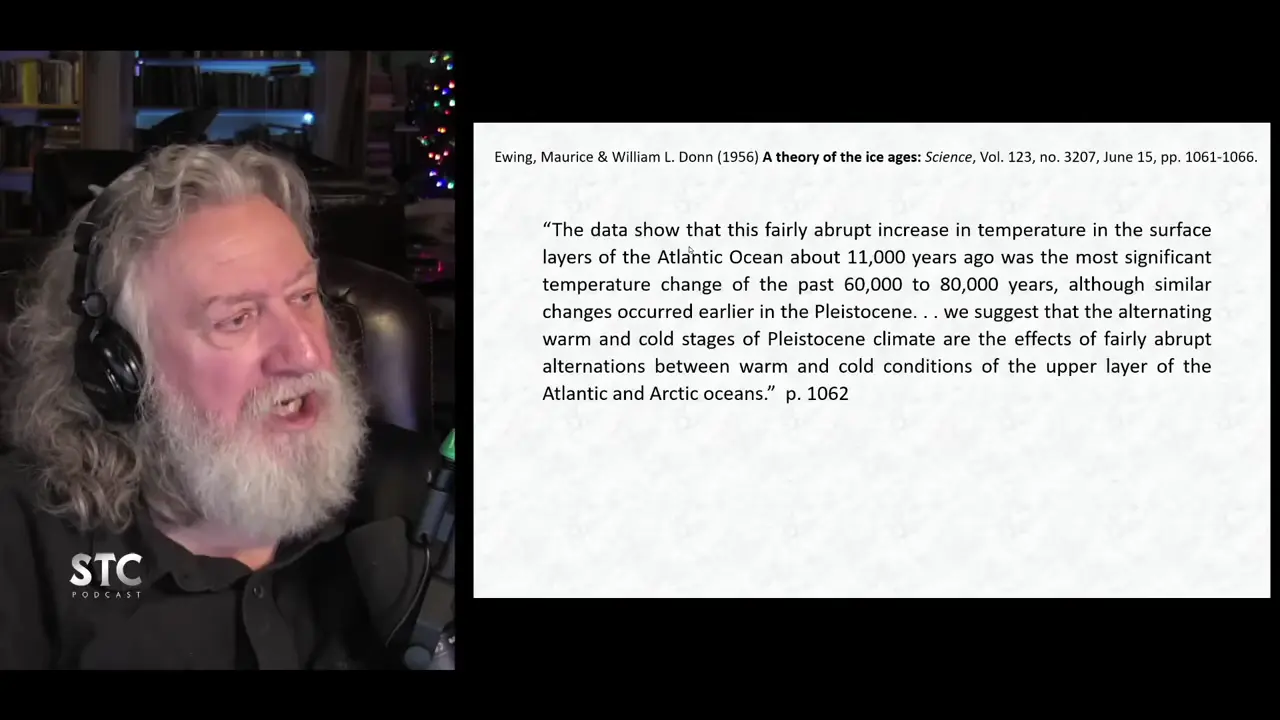
Ewing Documents Abrupt Temperature Change 11,000 Years Ago
Key facts
- Maurice Ewing and William L. Dawn published 'Theory of Ice Ages' in Science magazine summer 1956
- Their data showed an abrupt temperature increase in Atlantic Ocean surface layers about 11,000 years ago
- This was identified as the most significant temperature change of the past 60-80,000 years
- Ewing acknowledged similar changes occurred earlier in Pleistocene
- Despite evidence, Ewing stated no external influences or catastrophic events were required
- Ewing remained committed to uniformitarianism despite evidence of abrupt change
Sources
howtube.com
Linked in video description
Was this story useful?
Keep exploring
Every site on this page sits on the globe, and the people who research them are on the Discord.
3D Globe · Sites by country · Story Archive · Research Library · Weekly Journal · Search
AI-generated text · images from the original sources · always verify with the sources.