

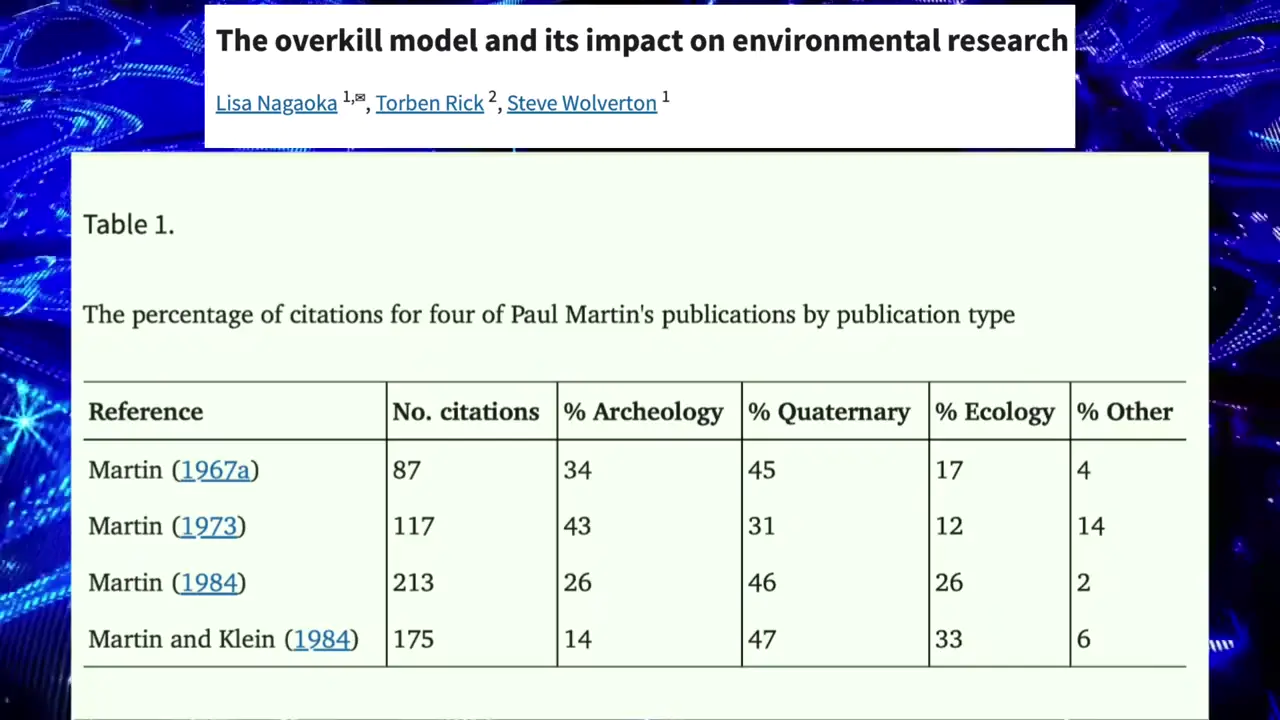
A 2018 paper by L. Nagaoka, T. Rick, and S. Wolverton titled 'The Overkill Model and Its Impact on Environmental Research' (Ecology and Evolution 8(19): 9683–9696) examines citation patterns of the Overkill Hypothesis across disciplines. The paper investigates how this contested hypothesis—proposed by Paul Martin to explain late Pleistocene megafaunal extinctions—is cited differently in ecology versus archaeology literature, with implications for how the theory is applied in contemporary environmental arguments 📚🔬
Key findings from citation analysis:
- Ecology papers are more likely to present the Overkill Hypothesis as established fact rather than a contested scenario
- Archaeology papers more frequently engage with the ongoing debate about the cause of megafaunal extinctions
- The paper analyzes how citation practices contribute to misuse of the hypothesis in environmental research
- The overkill hypothesis continues to be invoked in discussions about de-extinction proposals and arguments for human responsibility in ecological restoration
Key facts claimed:
- Ecology papers are 5x more likely than archaeology papers to present the Overkill Hypothesis as factual
- Over 60% of archaeology papers citing Overkill debate the cause of extinctions
- Only 20% of ecology papers debate the cause, while 32% say humans caused it
- A 2018 paper titled 'The Overkill Model and Its Impact on Environmental Research' (Nagaoka, Rick, and Wolverton, 2018) criticizes this misuse
- The hypothesis is used to argue for 'ecological reparations' and de-extinction proposals