


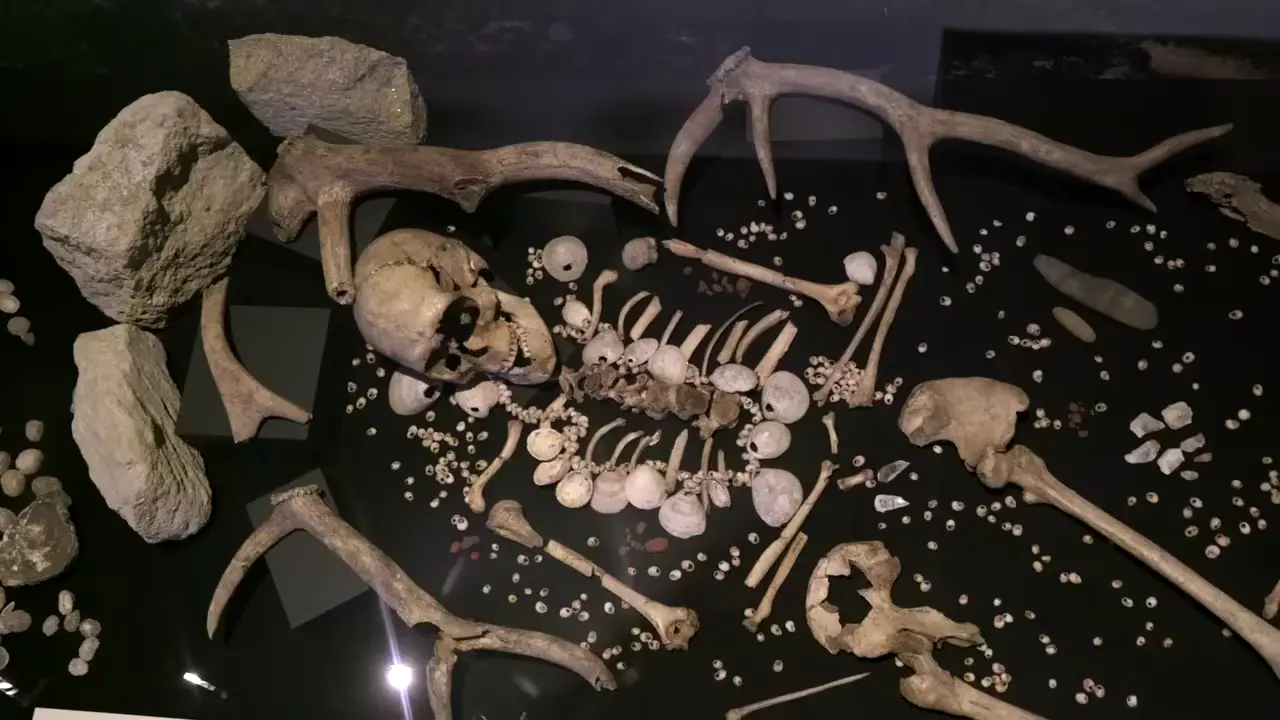
Two small islands off Brittany preserve remarkable late Mesolithic cemeteries. At Téviec and Hoëdic, burials dated to around 4800 BC included collective graves, some covered with stone slabs, and rich grave goods such as Dentalium shell beads and worked antler and bone objects.
The famous double burial of two adult women—the "Ladies of Téviec"—was excavated in the late 1920s by Stéphane and Suzanne Péquart. Both women, roughly 25–35, showed evidence of violent death. Téviec's ten multiple graves held at least 23 people; Hoëdic's grave held six.
The video presents these as the earliest deliberately quarried stone slabs used in burials. Published scholarship supports their importance as early stone-covered Mesolithic graves, but not an unqualified first-ever megalithic claim.
A 2010 Muséum de Toulouse exhibition drew about 100,000 visitors; its Paris showing at the Musée de l'Homme drew more than 200,000.