
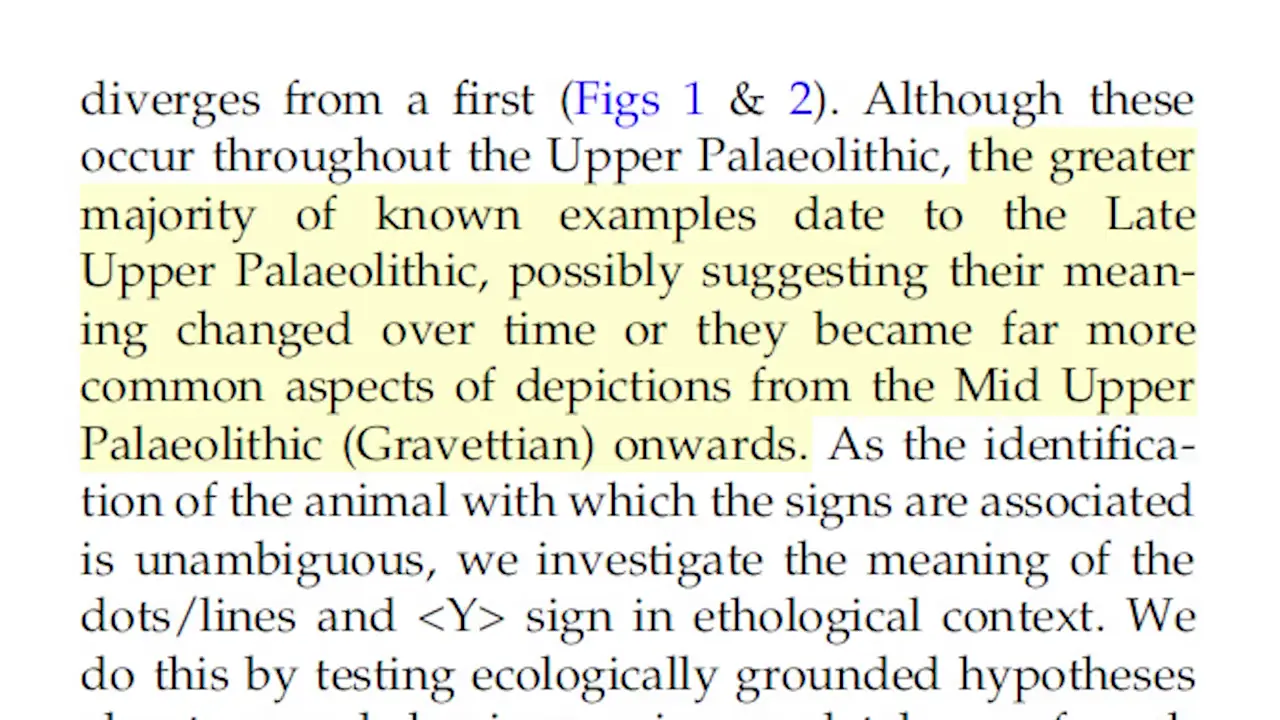
Across hundreds of European cave art sites, about 66% of animal figures are paired with symbols. Researchers suggest dots and lines functioned as tally marks (an external memory system), while a Y-shaped symbol served as a qualifier modifying the animal and its number. This practice became more common from the Gravettian period onward across Europe.
Dots, lines, and Y symbols paired with animal figures across European cave art
Key facts
- Approximately 66% of animal figures across hundreds of European cave art sites are paired with symbols
- Dots and lines function as tally marks (called artificial memory systems or external memory systems)
- The Y symbol serves as a qualifier interacting with the animal figure and the associated number
- Symbol use became more prevalent from the Gravettian period onward across Europe
Sources
'Humans were not centre stage': how ancient cave art puts ...theguardian.com
The cave art suggests that humans once had better ways to spend their time. If they were humans; and the worldwide gallery of known cave art ...
The Lascaux Paintings: 5 Facts About the Stunning Cave Arthistory.com
No evidence exists that people ever lived in the Lascaux cave, and it remains a mystery why prehistoric artists chose to decorate it. “One of ...
Counts, Coups, and Tally Marks: Evidence of Notational ...rex.libraries.wsu.edu
by TH Lewis · Cited by 1 — Rock art productions frequently include a series of "counts," "coups," or "tallies" associated with a representational or symbolic theme. These tallies may be ...
Dots and Lines in Palaeolithic Cave Paintingsdonsmaps.com
Dots and lines are the most ubiquitous abstract symbols in Palaeolithic art, whether on the walls of caves or on suitable pieces of bone and ivory.
The Superior Visual Perception Hypothesis - PMC - NIHpmc.ncbi.nlm.nih.gov
by PO Folgerø · 2021 · Cited by 13 — Cave Art demonstrates an ability to perceive anatomical details and motion similar to how Savant Art shows savant perceptual ability and memory today.
Was this story useful?
Keep exploring
Every site on this page sits on the globe, and the people who research them are on the Discord.
3D Globe · Sites by country · Story Archive · Research Library · Weekly Journal · Search
AI-generated text · images from the original sources · always verify with the sources.