

The Diolkos was a 6-8 km limestone paved road across the Isthmus of Corinth, featuring two grooves cut 1.6 m apart, nearly matching modern railroad gauge, an astonishing 2,400 years before locomotives existed. Built around 600 BC by the tyrant Periander after priests forbade a canal, workers would winch 25-ton warship hulls across on wheeled cradles using up to 180 men on ropes, completing the journey in about 3 hours. Ancient writers recorded seven crossings over 14 centuries, from Sparta hauling 21 ships in 412 BC to Byzantine Admiral Nikephoros Ouranos surprising Cretan pirates in 872 AD. Yet contrary to popular accounts, substantial stretches of the road have been identified and mapped by archaeologists working with the German Archaeological Institute at Athens, and ancient testimony from Herodotus, Thucydides, and Polybius confirms its historical use. A 2 million euro barrier built in 2023 protects what remains.
Diolkos: ancient paved ship-hauling road across the Isthmus of Corinth
 GreeceHeritage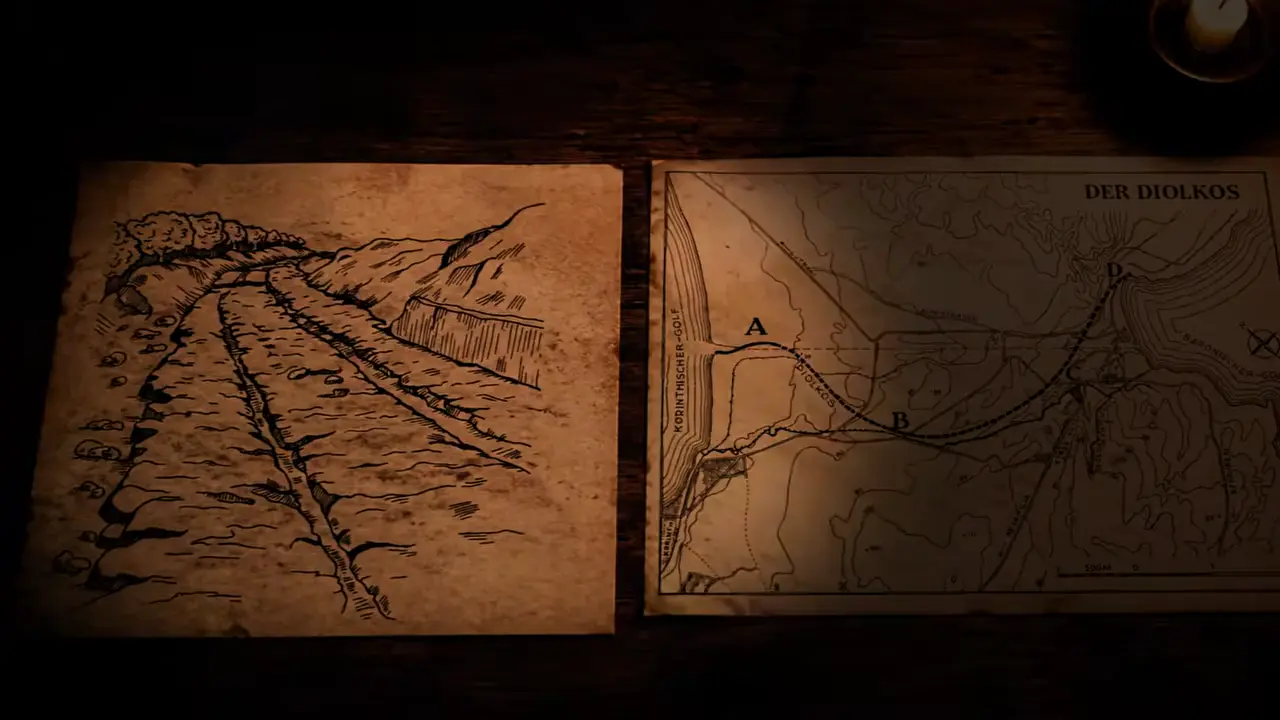
Site mentioned
Key facts
- The Diolkos (called the 'Holocaust') was a 6-8 km limestone paved road across the Isthmus of Corinth, with two grooves cut into the rock 1.6 m apart, nearly the gauge of a modern railroad, 2,400 years before the first locomotive
- According to tradition, the tyrant Periander built it around 600 BC after priests forbade a canal, claiming the two seas must never touch
- Workers would strip a warship of its masts, winch its 25-ton hull onto a wheeled cradle, and put up to 180 men on ropes; crossing time was about 3 hours
- Ancient writers recorded seven crossings over 14 centuries: in 412 BC, Sparta dragged 21 warships across; in 30 BC, Octavian hauled his fleet across chasing Antony and Cleopatra; and in 872 AD, Byzantine Admiral Nikephoros Ouranos used it to surprise a Cretan pirate fleet
- Of the road's six supposed kilometers, barely one has ever been found; archaeologist Nicolas Verdantis uncovered it in 1956 but died before fully publishing his findings
- Naval engineers warn a trireme hauled over land would risk cracking under its own weight, and historian David Petraglia argues the bustling ship highway is mostly a modern invention
- In 67 AD, Nero broke ground on a canal with a golden pickaxe and 6,000 prisoners of war; the canal finally opened in 1893, slicing the ancient road in half
- In 2023, Greece built a 2 million euro barrier to protect the surviving remains from the wake of every passing ship
Sources
Diolkosen.wikipedia.org
The Diolkos was a paved trackway near Corinth in Ancient Greece which enabled boats to be moved overland across the Isthmus of Corinth.
Finding the Diolkoscorinthianmatters.org
The road is visible here on Wikimapia. To reach the stretch of the diolkos near the bridge, drive east along the coastal road from the center of New Corinth.
Ancient Diolkos Stone Road Allowed Ships to Go From ...greekreporter.com
The Diolkos stone road is a marvel of engineering from Ancient Greece, allowing ships to travel from the Ionian Sea to the Aegean Sea.
The ancient Diolkosvisitpeloponnese.com
The Diolkos was a road that stretched from the beach at Schinounda to the western end of today's canal. The road was 8 km long and 3.5-5 m wide, and curved ...
Ancient Greeks Built a Road and Primitive Railway to Haul ...history.com
Beginning as early as 600 B.C., the ancient Greeks created the Diolkos, an ambitious road partially paved with stone, that spanned across the ...
Was this story useful?
Keep exploring
Every site on this page sits on the globe, and the people who research them are on the Discord.
3D Globe · Sites by country · Story Archive · Research Library · Weekly Journal · Search
AI-generated text · images from the original sources · always verify with the sources.