

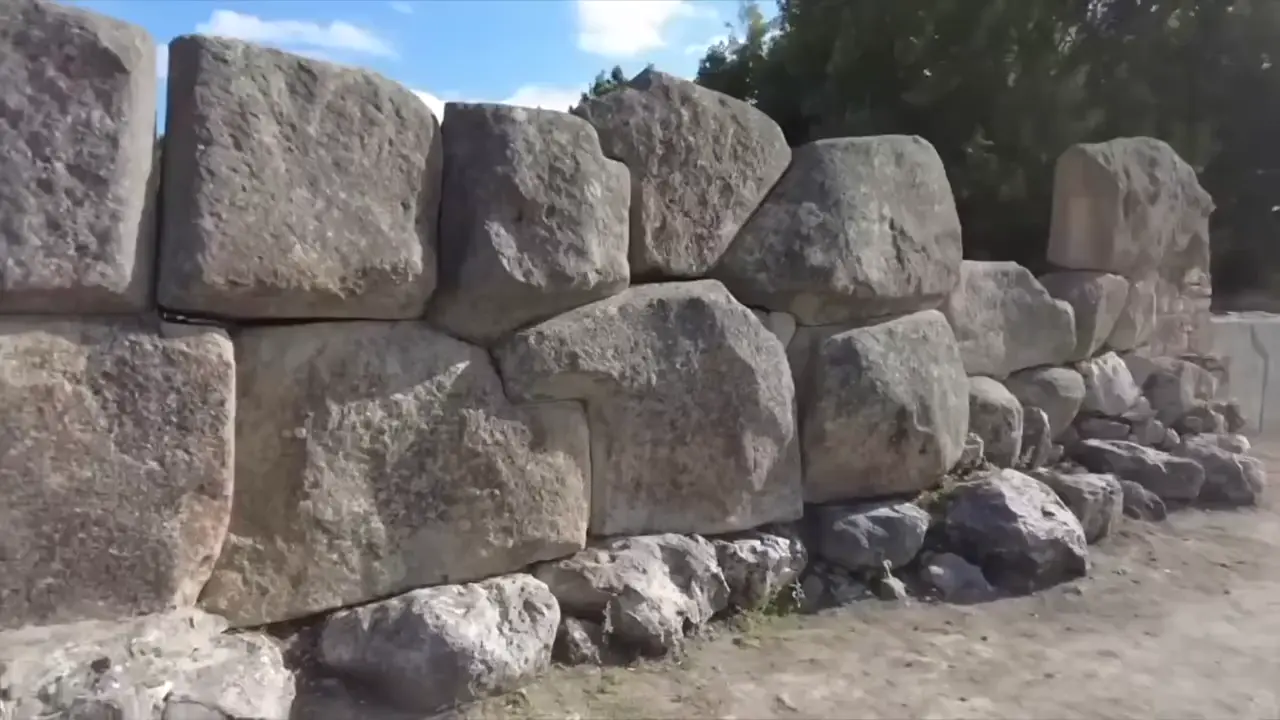
Cyclopean masonry was an important achievement of Mycenaean engineering. Builders laid enormous limestone blocks without mortar, roughly fitting them together with minimal clearance. The technique was used in fortifications, including at Mycenae. The video argues that these builders possessed unmatched, lost technology that later Romans could not replicate, but the cited evidence supports only the construction method—not those claims.
Cyclopean masonry: Mycenaean builders fitted massive stones without mortar
Key facts
- Cyclopean masonry used enormous stone blocks, often limestone, laid together without mortar.
- The technique was used in Mycenaean architecture and fortifications, including at Mycenae.
- The blocks were roughly fitted together with minimal clearance; describing them as 'bent' or 'melted together' is rhetorical, not a documented technique.
- The cited evidence does not establish that Cyclopean builders were antiquity's finest engineers or that their technology remained unmatched and lost for millennia.
- The cited evidence also does not support the claims that Romans could not replicate Cyclopean masonry or that all such works resisted floods, earthquakes and cannon fire.
Sources
Cyclopean Masonry - Brown Universitywebhelper.brown.edu
Cyclopean masonry is a term used to describe a type of megalithic architecture entailing the working of unusually large blocks of stone, ...
Cyclopean masonry - Wikipediaen.wikipedia.org
Cyclopean masonry is a type of stonework found in Mycenaean architecture, built with massive limestone boulders, roughly fitted together with minimal clearance
Masonry Techniques of the Inca's Master Buildersearthasweknowit.com
The Inca's precise stonework is often depicted as shrouded in mystery. Yet their construction methods were documented by early Spanish chroniclers.
Cyclopean Masonry (Architecture/Ancient Building) – Study Guidestudyguides.com
What is Cyclopean masonry in ancient architecture? Massive stone construction using enormous unworked or roughly dressed boulders fitted together without mortar ...
The Art and Science of Cyclopean Masonry In Mycenaeolympia-museum.gr
Cyclopean Masonry In Mycenae is a form of construction using immense limestone blocks, often several tons in weight, laid together without ...
This Ancient Architecture Technique Inspires New ...taradigm.com
With the ancient architecture method of dry stone walls and cyclopean masonry, innovative architects create new structures out of old waste.
Cyclopean masonry | Ancient, Stone, Architecturebritannica.com
Cyclopean masonry, wall constructed without mortar, using enormous blocks of stone. This technique was employed in fortifications where use of large stones ...
Why We Should Be Building Like Ancient Greeksfastcompany.com
In his project Cyclopean Cannibalism, Clifford updates an ancient building technique, in which laborers would build walls using misshapen stones ...
Was this story useful?
Keep exploring
Every site on this page sits on the globe, and the people who research them are on the Discord.
3D Globe · Sites by country · Story Archive · Research Library · Weekly Journal · Search
AI-generated text · images from the original sources · always verify with the sources.