

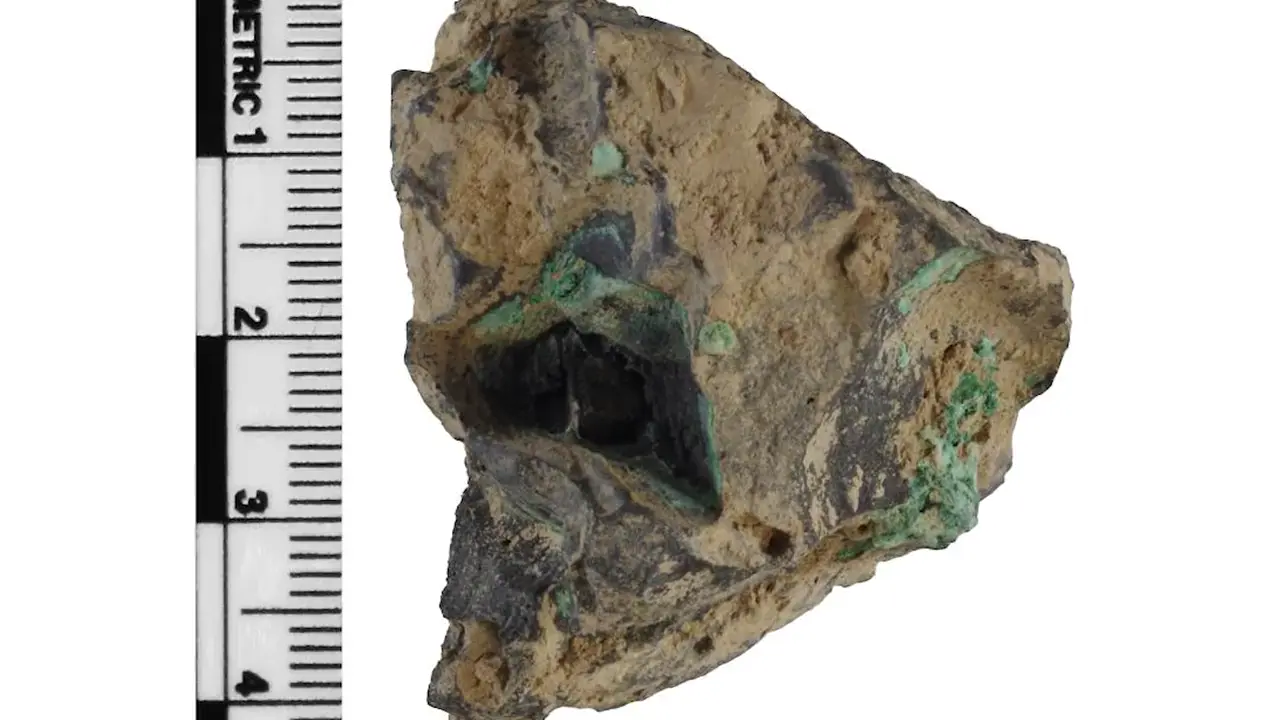
X-ray CT scans of Early Bronze Age copper slag from Tepe Hissar in northeastern Iran revealed 3D pores, copper prills, flow and layered structures, and arsenic-bearing phases. The researchers interpret the evidence as showing deliberate, repeated copper smelting by the late third millennium BCE—an established, skilled metallurgical tradition.
CT scans reveal evidence of Early Bronze Age copper smelting at Tepe Hissar
Site mentioned
📍 Tepe Hissar 1967-1991 - Portrait of a man on the ruins of Tepe Hisar🗺️ More sites in Iran (Islamische Republik)🌍 Show on the globe
Key facts
- An MIT-led team used X-ray computed tomography and complementary analyses on Early Bronze Age copper slag from Tepe Hissar in northeastern Iran.
- The slag dates to the late third millennium BCE, roughly 5,000 years ago—not 1967–1991.
- Three-dimensional scans mapped pore networks, copper prills or droplets, flow and layered structures, and mineral-filled cracks.
- The imaging helped identify arsenic-bearing phases, including iron arsenides, within the slag.
- The researchers interpret the repeated, structured evidence as showing deliberate, systematic copper smelting and an established metallurgical tradition rather than accidental processing.
Sources
X-ray diffraction spectra of slag H76-S37A Several of the ...researchgate.net
MIT study uses medical CT imaging to reconstruct ...thebrighterside.news
Was this story useful?
Keep exploring
Every site on this page sits on the globe, and the people who research them are on the Discord.
3D Globe · Sites by country · Story Archive · Research Library · Weekly Journal · Search
AI-generated text · images from the original sources · always verify with the sources.