

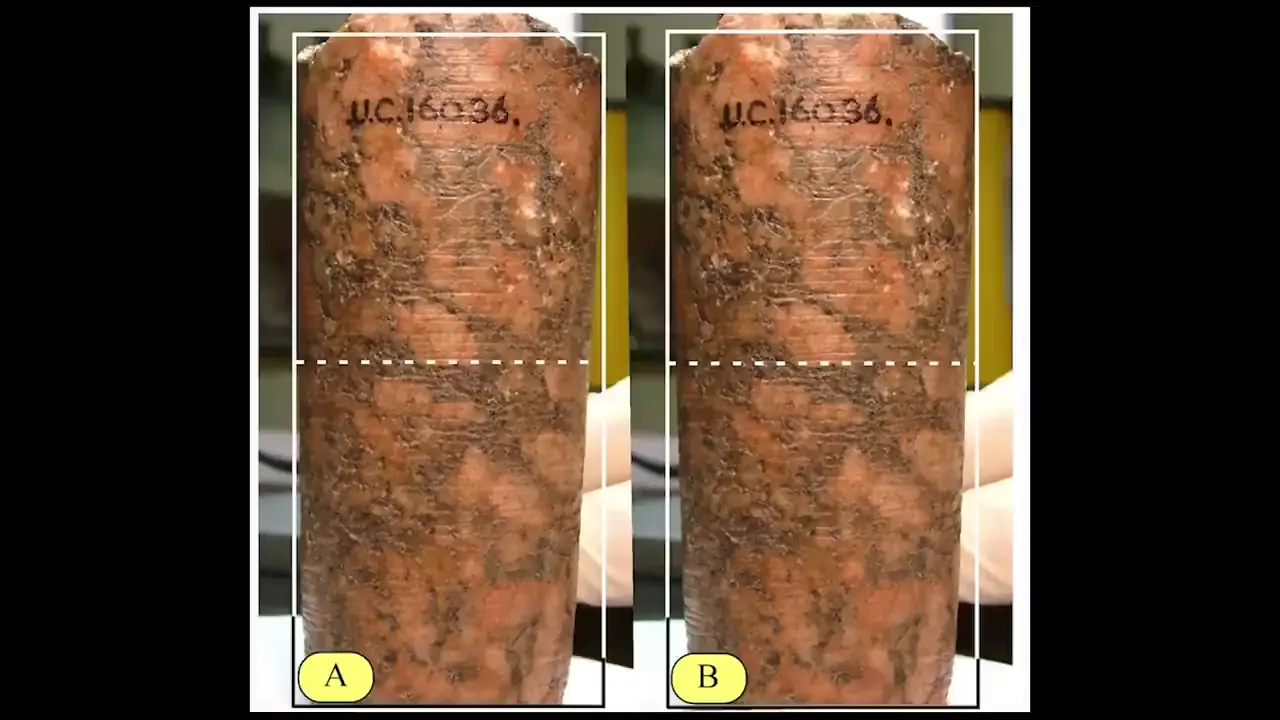
3D scans offer new evidence on Predynastic Egyptian stone-vessel striations. The video argues that the marks are spiral rather than horizontal and that later dynastic alabaster copies were less symmetrical than the originals. But Petrie's "core 7" is a granite core from a tubular-drill hole found at Giza in 1881–82—not a Predynastic vase. The relevant 2025 Heritage Science study is by Max Fomitchev-Zamilov. Scans strengthen the evidence; they do not make the presenter's wider interpretation unfakeable or automatically settled.
3D scans offer new evidence on Predynastic Egyptian vase striations
Site mentioned
📍 Petrie Museum
Key facts
- Petrie Museum's "core 7" is a granite core from a tubular-drill hole found by Flinders Petrie at Giza in 1881–82, not a Predynastic vase. Its helical groove belongs to debates about ancient drilling.
- A 2025 Heritage Science study by Max Fomitchev-Zamilov investigated Predynastic Egyptian stone vessels using 3D scanning.
- The video interprets the scans as showing spiral rather than horizontal striations and presents later dynastic alabaster copies as less symmetrical than the originals. These are the presenter's interpretations, not a guarantee that scanning has settled every manufacturing question.
- The museum worker's comments about Mohs hardness are anecdotal and do not establish how the vessels were made.
Sources
Egyptian stone vases: high-precision or complete delusion ...veronicasart.com
This article focuses on Ben van Kerkwyk (UnchartedX) claims about super-precision in ancient Egyptian stone vases. Recent research proves ...
Initial Geometric Analysis of The Pre-Dynastic Vase - unsigned.iounsigned.io
An extremely accurate and high-resolution mesh, obtained via structured-light scanning, has just recently been released of vase-like object.
Expedition Magazine | Ancient Egyptian Stone-Drillingpenn.museum
The granite core published by Petrie was made by the ancient Egyptians using a tubular drill. stone statuettes exhibited at the Cleveland Museum.
Privacy & Cookie Settingscollections.ucl.ac.uk
Granite core from tubular drill hole, found by Flinders Petrie at Giza in 1881-82 and numbered by him as 'core 7'. The circumference of one end is greater ...
Chris Dunn Visit to Petrie Museum Part Two Posted 12 ...gizapower.com
It was Petrie's description of the helical groove that made Core #7 stand apart from modern cores. It was one of the principle characteristics
Egyptian Core 7 - Advanced Primitive Machininggsjournal.net
Based on the chemistry of minerals, Petrie's "Infamous Core #7" is shown to have been produced easily by milling techniques far less advanced than those ...
Max Fomitchev-Zamilovnature.com
by M Fomitchev-Zamilov · 2025 — Predynastic Egyptian stone vessels offer unique insight into the technological sophistication of early cultures. Thousands of stone vessels ...
Was this story useful?
Keep exploring
Every site on this page sits on the globe, and the people who research them are on the Discord.
3D Globe · Sites by country · Story Archive · Research Library · Weekly Journal · Search
AI-generated text · images from the original sources · always verify with the sources.