

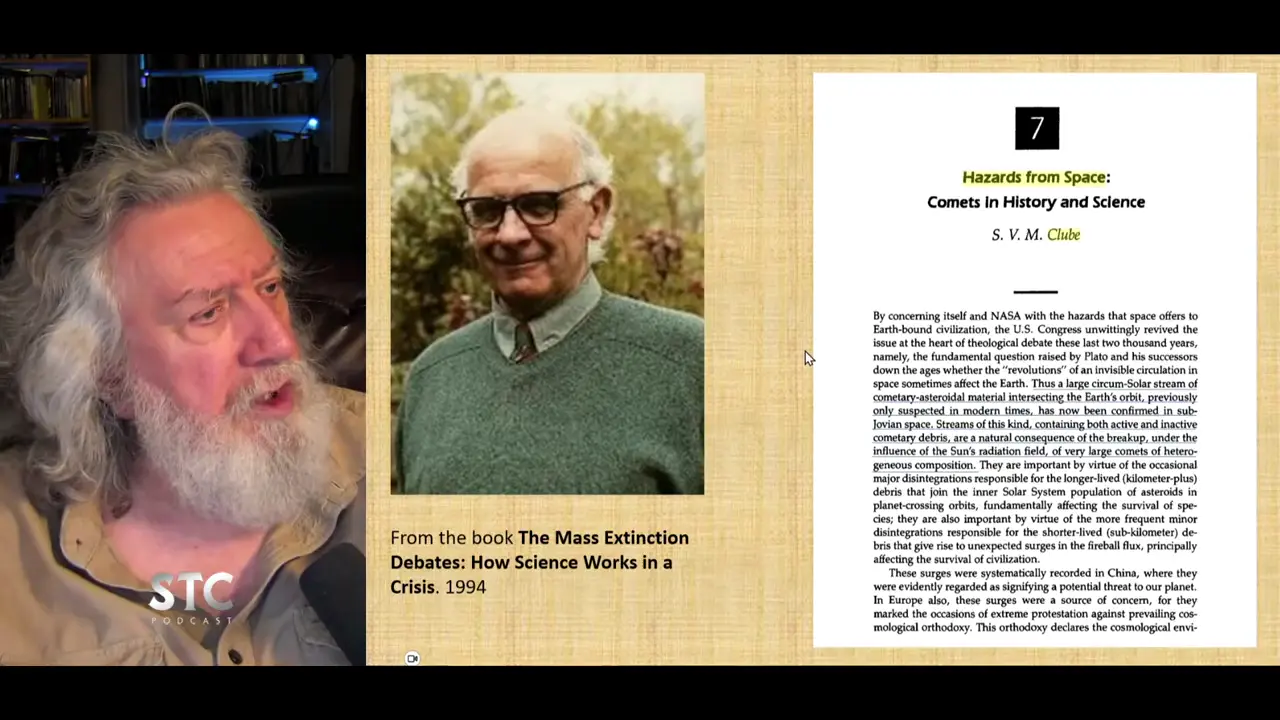
In the 1970s, Victor Clube and colleague William Napier proposed that cometary impacts played a far bigger role in civilizational history than mainstream science acknowledged. Clube argued large heterogeneous comets break up under solar radiation — major disintegrations produce kilometer-plus debris threatening species, while minor ones threaten civilizations. Real-world proof: Comet Shoemaker-Levy 9 fragmented into 21 separate nuclei after passing within Jupiter's Roche limit.
Clube's neo-catastrophist research on giant comets and Taurid stream
Key facts
- Victor Clube, along with colleagues William Napier and William Asher, proposed in the 1970s that cometary impacts played a greater role in planetary and civilizational history than mainstream science recognized
- Clube published "Comets in History and Science" and "Hazards from Space" (1994), arguing that large comets of heterogeneous composition break up under solar radiation
- Major disintegrations produce kilometer-plus debris affecting species survival; minor disintegrations produce sub-kilometer debris affecting civilization survival
- Clube co-authored works as early as 1979-1980 describing the comet life cycle and disintegration process
- Comet Shoemaker-Levy 9 was a single nucleus that fragmented into 21 separate nuclei after passing within Jupiter's Roche limit
Sources
Victor Clube - Wikipediaen.wikipedia.org
Review: Ancient tales of death and disaster | New Scientistnewscientist.com
Comets, Clues and Our Cosmic Story, Acts of Sciencepages.scistarter.org
A History of Comets | Comet Encounter: Chapter 5pbslearningmedia.org
Victor Clubewiki.naturalphilosophy.org
Was this story useful?
Keep exploring
Every site on this page sits on the globe, and the people who research them are on the Discord.
3D Globe · Sites by country · Story Archive · Research Library · Weekly Journal · Search
AI-generated text · images from the original sources · always verify with the sources.