

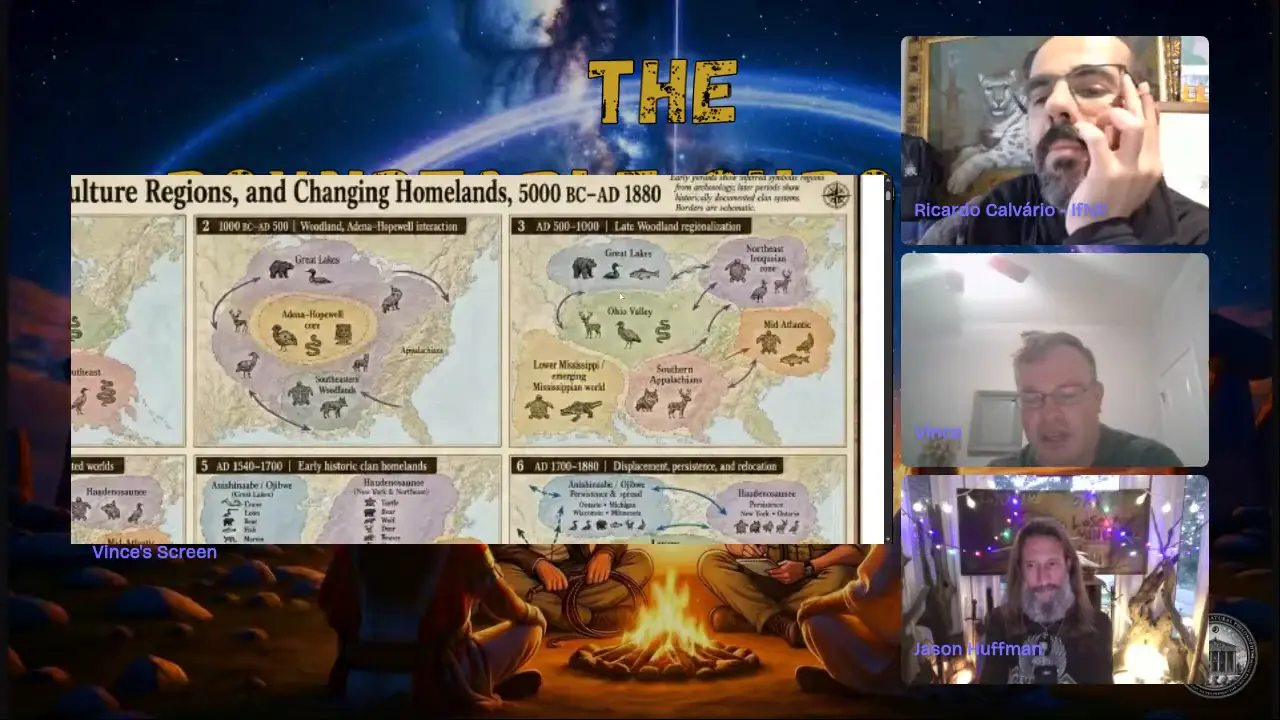
Clan symbols shifted dramatically across millennia: Late Archaic Great Lakes bears and ducks, Adena-Hopewell snakes and turkeys, then Iroquoian appearances and Mississippian Cherokee clans. De Soto's 1540 arrival disrupted identification patterns, while Moundville emptied from introduced disease. Jaguar effigies appear in NC artifacts.
Clan symbols evolved across North America from 5000 BC to 1540 AD
Key facts
- 5000-1000 BC Late Archaic: Great Lakes bears/ducks/fish, Ohio Valley deer/turkey/snakes, Southwest turtles/fish
- 1000 BC-500 AD Woodland era: Adena-Hopewell core with snakes and turkey, plus wolves, turtle, deer
- 500-1000 AD Middle Woodland: Northeast Iroquoian appears, Lower Mississippi alligators
- 1000-1540 AD Mississippian: Cherokee region develops with wolf, deer, bird, long hair, wild potato clans
- 1540 marks arrival of De Soto, which changed clan symbol identification patterns
- Moundville became empty after disease brought by conquistadors
- Jaguar effigies found in North Carolina artifacts
Sources
Indiana Woodland Culture - State Parks - IN.govin.gov
Some archaeologists see the Hopewell as the pinnacle of the Adena. The Adena-Hopewell had a social hierarchy. The cultural evolution from hunter-gatherers to ...
Hopewell tradition - Wikipediaen.wikipedia.org
The Hopewell tradition, also called the Hopewell culture and Hopewellian exchange, describes a network of precontact Native American cultures
Culture | Hopewell Ceremonial Earthworkshopewellearthworks.org
The Hopewell culture was not a single group of people, but instead a spiritual movement that linked many distinct communities, likely with differing languages.
Ancient DNA from the Ohio Hopewellohiohistory.org
This confirms the inference that the people of the Hopewell culture were the descendants of people of the Adena culture (circa 800 BC to AD ...
[PDF] the early indigenous cultures and native americans in the southeast usuc.edu
Ohio Adena and Hopewell cultures extended across. Eastern and Midwestern America. The small red squares represent the Adena burial mounds. The large number ...
Was this story useful?
Keep exploring
Every site on this page sits on the globe, and the people who research them are on the Discord.
3D Globe · Sites by country · Story Archive · Research Library · Weekly Journal · Search
AI-generated text · images from the original sources · always verify with the sources.