

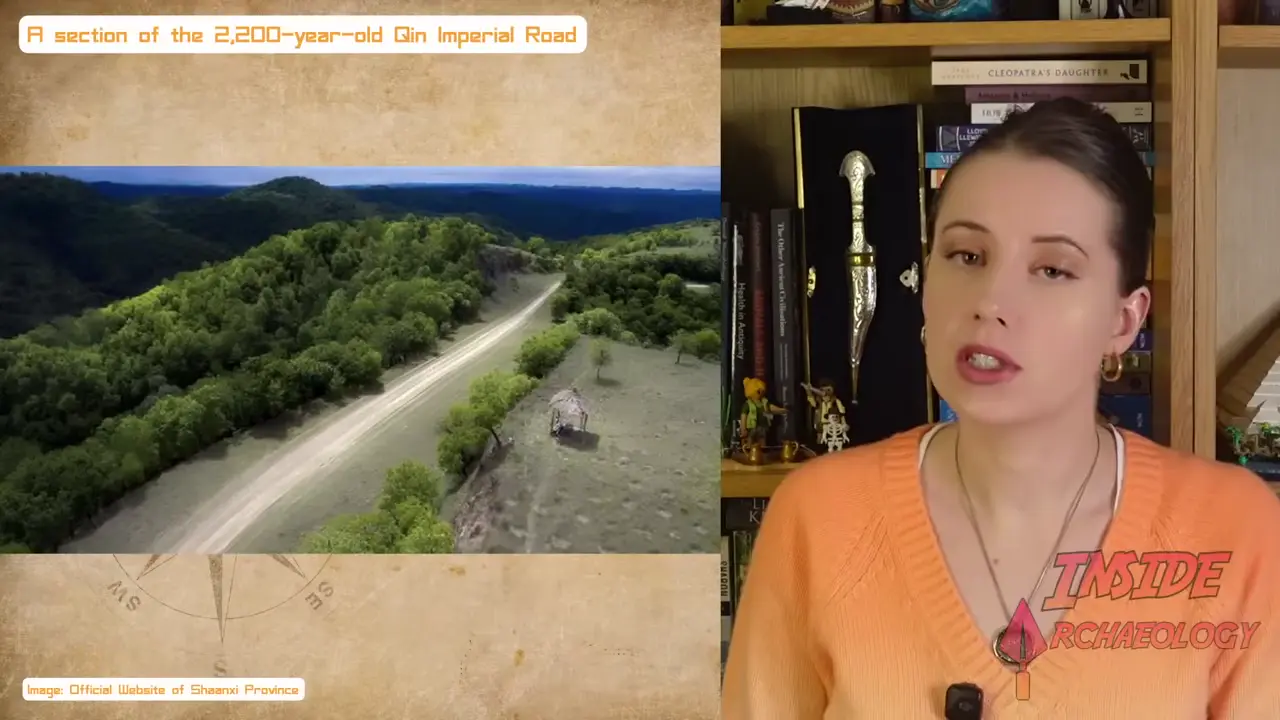
China's first imperial highway discovered - 2,200-year-old Qin road with advanced construction. Newly identified 13 km stretch of Qin Imperial Road in Shaanxi Province, China Part of vast transportation corridor originally extending nearly 900 kilometers across northern China Built more than 2,200 years ago, described as ancestor of modern highways

🛤️ China's first imperial highway discovered! Over 2,200-year-old Qin road was part of vast transportation network spanning hundreds of kilometers. Built by Qin Shi Huang for military deployment. True engineering marvel.

Key facts:

- Newly identified 13 km stretch of Qin Straight Road (Qin Zhi Dao) discovered in Yulin, Shaanxi Province, China

- Part of vast transportation corridor originally extending nearly 900 kilometers across northern China

- Built in 212 BC, over 2,200 years ago, described as ancestor of modern highways

- Evidence of four-lane width, with some sections significantly wider

- Connected Yunyang (today's Chunhua county) extending northward toward the frontier

Key Facts

  • Newly identified 13 km stretch of Qin Imperial Road in Shaanxi Province, China
  • Part of vast transportation corridor originally extending nearly 900 kilometers across northern China
  • Built more than 2,200 years ago, described as ancestor of modern highways
  • Road width averaged 40 meters, expanding to 60 meters in some sections - equivalent to four lanes of modern traffic
  • Ran straight north to south connecting Qin capital Xianyang with Juian on northern border
  • Construction techniques included straight-cut trenches, rammed earth slope reinforcements, compacted road beds, and filled valleys
  • Historical records attribute construction to Qin Shi Huang, China's first emperor
  • Project reportedly completed in only 5 years
  • Designed to allow rapid military deployment against Xiongnu nomads on northern frontier
  • Small auxiliary postal relay station found nearby, active during Qin and Han dynasties
  • Supported military logistics, communication, governance, and trade
  • Discovered by comparing historical records with satellite imagery identifying linear vegetation features
  • Nine separate trench sections found in unmistakable straight line with compacted earth layers and hardened traffic surfaces