

In 1999, explorer Carlo Bergmann walked southwest from Dakhla Oasis and found 27 stations running dead straight for 250 miles, a highway built by ancient Egyptians 4,200 years ago. Donkey caravans moved between depots stocked with 30-liter jars holding at least 13,000 liters of water hidden beneath the sand. The biggest caravans ran 100 animals hauling 5 tons of cargo, and since a donkey survives about 3 days without drinking, the stations sit almost exactly that far apart. The road points toward the Gilf Kebir plateau, once connected to the kingdom of Yam mentioned in Harkhuf's tomb inscription. Some archaeologists believe that 8,000 years ago, when the Sahara was green, its people helped build Egypt itself after the rains failed. An entire lost logistics network buried under centuries of sand!
4,200-year-old Egyptian water-jar highway stretching 250 miles across the Sahara
 EgyptSurvey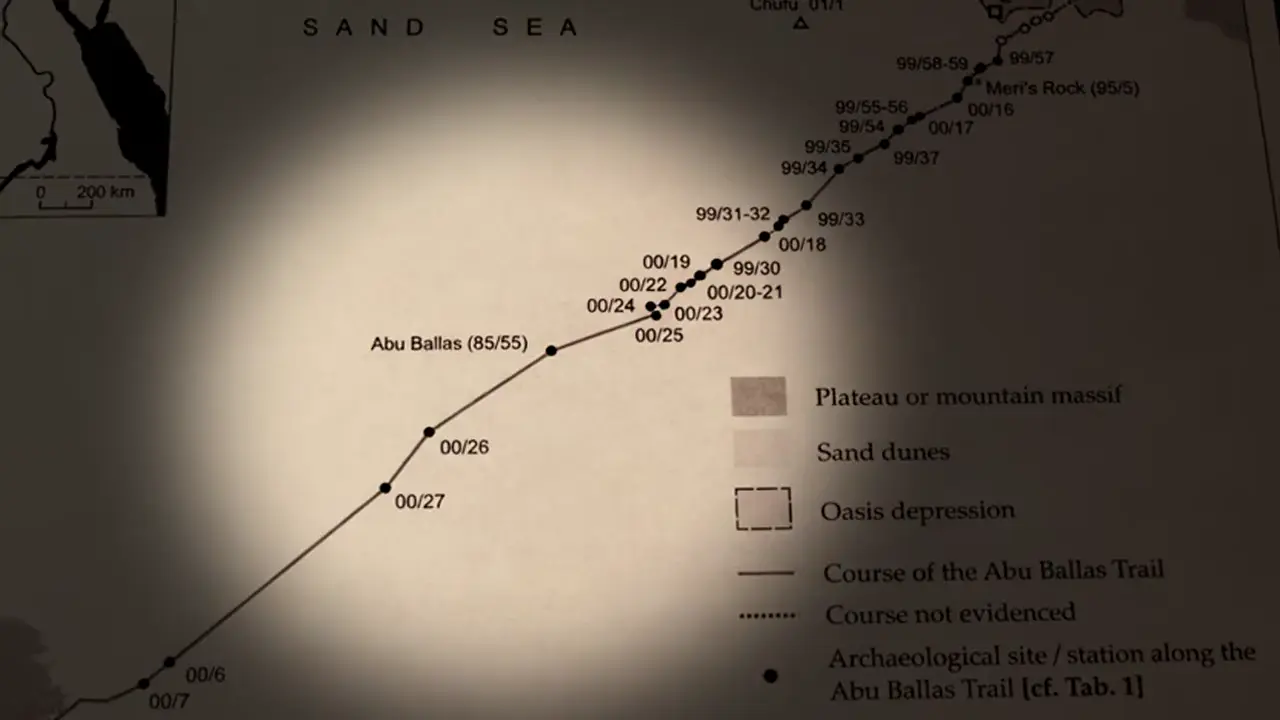
Site mentioned
Key facts
- In 1874, German explorer Gerhard Rohlfs passed through Dakhla Oasis and recorded stories of raiders who appeared from the empty desert around 1770
- An Egyptian prince excavated the twin hills and uncovered hundreds of clay jars, some still standing in neat rows, naming the site Abu Ballas ('father of pots')
- In 1988, a German lab dated the pottery and found some jars to be thousands of years old, far older than any raid
- In 1999, explorer Carlo Bergmann walked southwest from Dakhla and found 27 stations running dead straight for 250 miles, a highway built by the ancient Egyptians 4,200 years ago
- Donkey caravans moved between depots stocked with 30-liter jars, holding at least 13,000 liters of water hidden in the sand; the biggest caravans ran 100 animals and hauled 5 tons of cargo
- A donkey survives about 3 days without drinking, and the stations sit almost exactly that far apart
- The road runs away from Egypt into nothing, pointing at the Gilf Kebir plateau, a dead empty plateau the size of Puerto Rico
- A caravan leader named Harkhuf bragged in his tomb inscription that he came home from Yam with 300 donkeys laden with incense, ebony, and every good product
- In 2007, explorers found a pharaoh's inscription carved into a mountain more than 400 miles from the Nile, showing the people of Yam bringing tribute
- In 2013, an expedition pushed into Chad to find where the road went next and found nothing
- 8,000 years ago, the Sahara had rain, lakes, grass, and people; some archaeologists believe that when it dried, those refugees helped build Egypt itself
Sources
Abu Ballas: The Pottery Hillamusingplanet.com
In 1917, British surveyor Dr. John Ball made an unusual discovery in the Libyan desert in Egypt. About 180 km south-west of the Dakhla Oases ...
Abu Ballasen.wikipedia.org
Abu Ballas (the pottery hill) is an archaeological site in the Libyan Desert of Egypt. Both hills are covered with Egyptian pottery. The site was discovered in ...
The Pharaonic pottery of the Abu Ballas Trailresearchgate.net
Slipping and polishing jars diminishes the porosity of the vessels, an essential quality for a desert environ- ment. Besides the large storage jars, both sites ...
After 5000 BC: The Libyan desert in transitionsciencepress.mnhn.fr
by R Kuper · 2006 · Cited by 66 — 6. Rocker stamp decorated pottery from site Chufu 02/14 (Abu. Ballas Region, Egypt). Fig. 6. Poterie décorée à l ...
The Pharaonic pottery of the Abu Ballas Trailsemanticscholar.org
The Pharaonic pottery of the Abu Ballas Trail: 'Filling stations' along a desert highway in southwestern Egypt
Was this story useful?
Keep exploring
Every site on this page sits on the globe, and the people who research them are on the Discord.
3D Globe · Sites by country · Story Archive · Research Library · Weekly Journal · Search
AI-generated text · images from the original sources · always verify with the sources.