

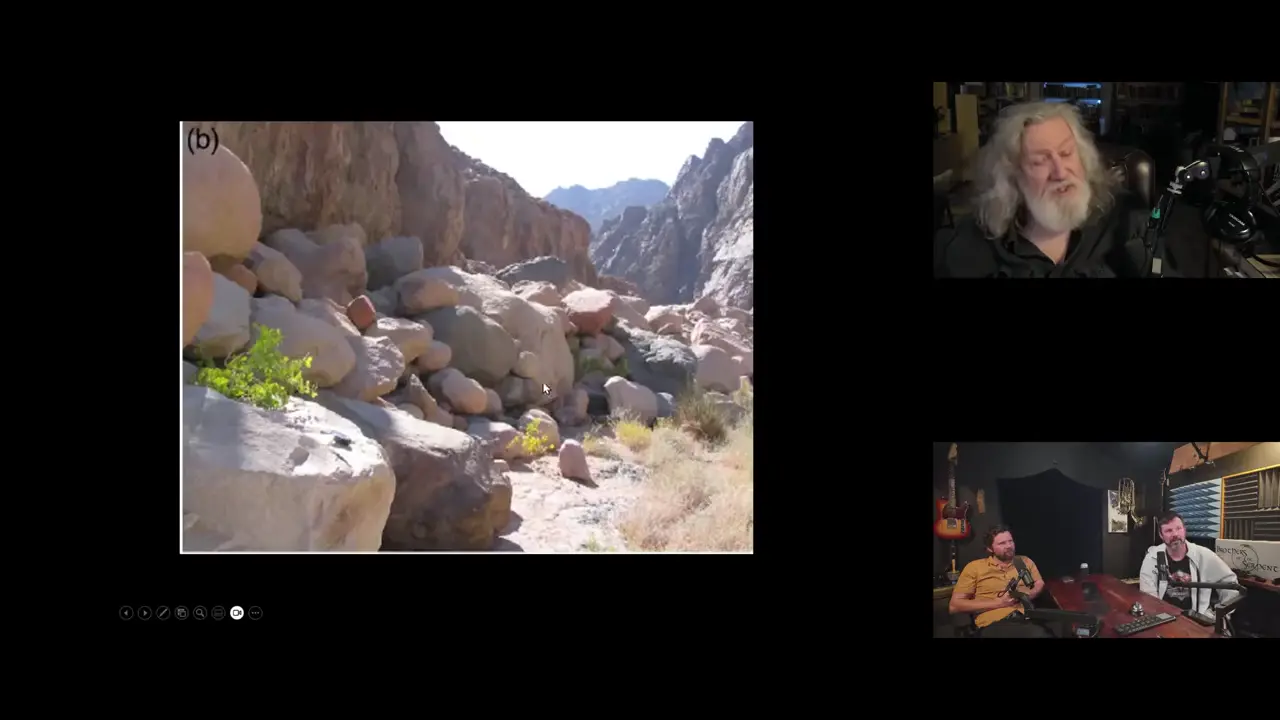
Boulder deposits at wadi mouths across Arabia show evidence of catastrophic flood events. For scale, the Bonneville Flood in Idaho documented extremely large discharge rates, estimated at ~17 million cubic meters per second (approximately 600 million cubic feet per second). Large boulders weighing 10-12 tons were transported as mud flow deposits, their rounding indicating long transport distances while sharp corners show recent breakage. Cliff formations in the region display dramatic erosional features, though hoodoo formations typically represent erosional rather than depositional features. Similar fossil flood features appear worldwide at comparable scales.
Catastrophic floods deposited 40-50 million cubic feet per second boulders
Key facts
- Boulder deposits at wadi mouths in Arabia show catastrophic flood evidence
- 40 million cubic feet per second flow rates documented in Bonneville Flood (Idaho) for comparison
- Large boulders (10-12 tons) transported as mud flow deposits, not water alone
- Rounding of boulders indicates transport distance; sharp corners show recent breakage
- Cliff formations showing hoodos are deposited material from catastrophic flows
- Such features show minimal modification by subsequent erosion, indicating recent catastrophic origin
- Fossil flood features visible worldwide at similar scales
Sources
randallcarlson.com
Linked in video description
Was this story useful?
Keep exploring
Every site on this page sits on the globe, and the people who research them are on the Discord.
3D Globe · Sites by country · Story Archive · Research Library · Weekly Journal · Search
AI-generated text · images from the original sources · always verify with the sources.