

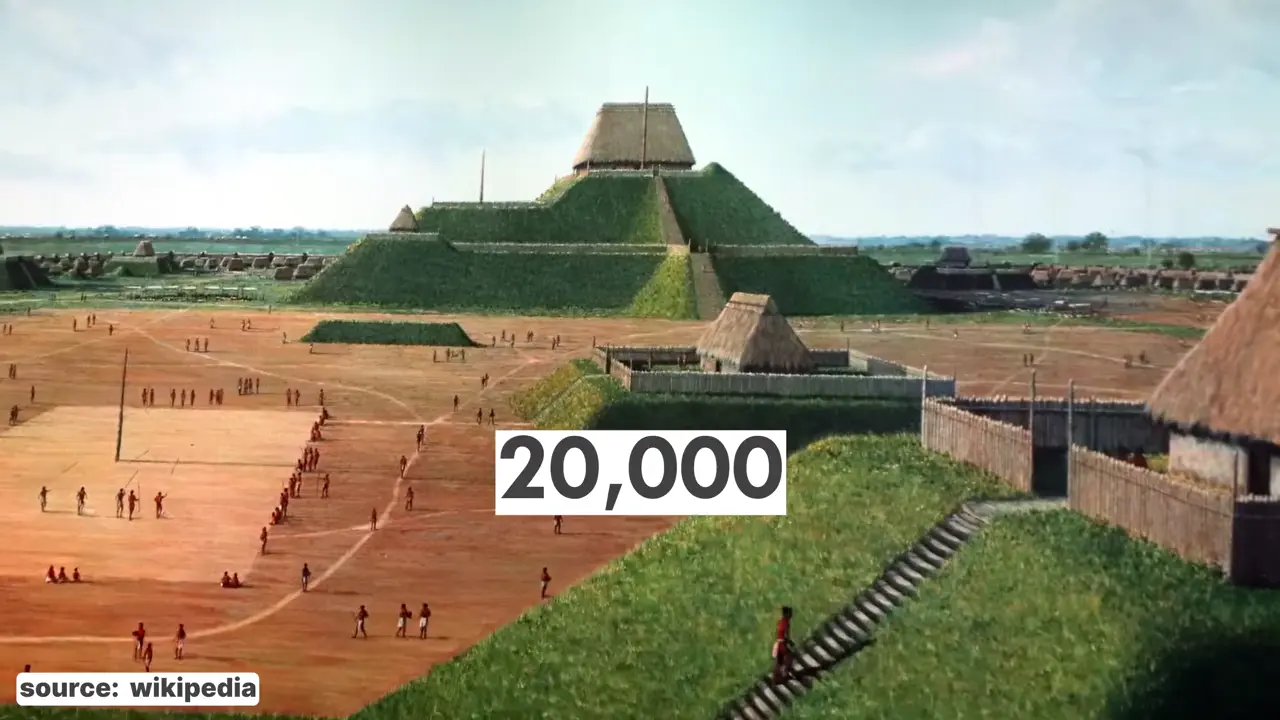
Cahokia was truly massive for its time — about 20,000 people at its core, with estimates of 40,000–50,000 or more across Greater Cahokia. It remained the largest Mississippian center. But 1150 marks a long decline, not abandonment: fewer than 5,000 remained by 1200 and no more than about 2,000 by 1250, with occupation continuing into the 1300s. Cahokia did not invent Mississippian society; it became the largest city in a broader tradition that began earlier. Largely autonomous communities continued to share trade and ceremonial traditions across the Mississippian world. Post-contact epidemics and warfare caused catastrophic population losses, but did not erase every Mississippian people.
Cahokia was declining by 1150, not abandoned; occupation continued into the 14th century
 USAGeneral
Key facts
- At its peak around 1100, Cahokia's core held nearly 20,000 people; estimates for Greater Cahokia range from about 40,000–50,000 to more than 50,000.
- Cahokia was in a long decline by 1150, not abandoned then. Fewer than 5,000 people remained by 1200, no more than about 2,000 by 1250, and occupation continued into the 1300s.
- No later Mississippian city matched Cahokia's peak population, although other Mississippian centers supported populations of several thousand.
- The Mississippian cultural tradition predated Cahokia. Cahokia became its largest city, while related communities continued across much of the eastern and central United States for centuries.
- Mississippian communities were diverse and generally autonomous, linked by trade and shared ceremonial traditions; not every settlement was a formal capital-based city-state.
- Epidemics and warfare after European contact caused catastrophic population losses, but did not eliminate all Mississippian peoples or communities.
Sources
Cahokia - Illinois State Archaeological Surveyisas.illinois.edu
Cahokia: A Pre-Columbian American Citygilderlehrman.org
Cahokia Mounds State Historic Sitecahokiamounds.org
Cahokiaen.wikipedia.org
Was this story useful?
Keep exploring
Every site on this page sits on the globe, and the people who research them are on the Discord.
3D Globe · Sites by country · Story Archive · Research Library · Weekly Journal · Search
AI-generated text · images from the original sources · always verify with the sources.