
Bronze Age water burials and metal deposits reveal ritual practices of the Lusatian Chełmno group

LIVE: Prehistoric Archaeology News From Around the World
Source: LIVE: Prehistoric Archaeology News From Around the World by The Prehistory Guys

Site mentioned

📍 Papava Biscopier

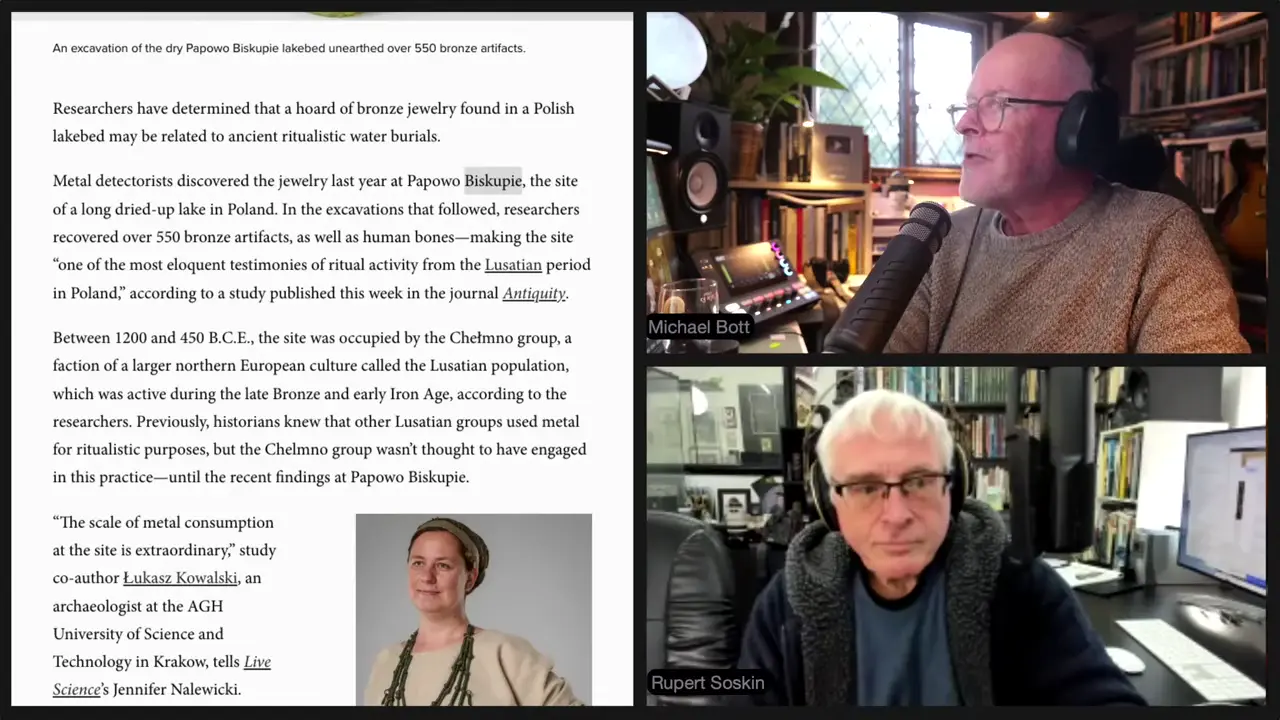
550+ bronze artifacts recovered from the dried lake bed at Papowo Biskupie in north-central Poland alongside 33+ individuals! The Chełmno group of the Lusatian culture buried metal jewelry, including a glass bead from the eastern Mediterranean, at what researchers call an extraordinary scale of metal ritual consumption.

The site was used from roughly 1,400 to 780 BCE, with bodies of infants, children, adolescents and adults buried alongside arm and neck ornaments, oval and tube-shaped beads and swallowtail pendants. The jewelry was deposited in the lake after the bodies, and the eastern Mediterranean glass bead — made of low-magnesium glass — points to long-distance trade networks. The find shows a cultural shift as new ritual traditions were adopted, and reveals that the Chełmno group, previously not associated with metal ritual deposits, was practising them on an extraordinary scale.

Key facts

  • Over 550 bronze artifacts recovered from the dried lake bed at Papowo Biskupie in north-central Poland
  • Human skeletal remains from at least 33 individuals, including infants, children, adolescents and adults
  • Radiocarbon dating shows bones from 1,400-780 BCE
  • Site occupied by the Chełmno group, one of the northernmost communities of the Lusatian culture
  • Active during the late Bronze Age and early Iron Age
  • Artifacts include arm and neck ornaments, oval and tube-shaped beads, and swallowtail pendants
  • A glass bead from a necklace was sourced from the eastern Mediterranean region
  • The bead's low-magnesium composition indicates participation in long-distance trade
  • Metal jewelry was deposited in the lake sometime after the bodies were buried
  • Evidence of a cultural shift with the adoption of new ritual traditions
  • The Chełmno group was previously not thought to engage in metal ritualistic practices
  • Researchers describe the scale of metal consumption at the site as extraordinary

Related stories

Sources

popsci.com
Pompeii Collections: Bronze Statuesslsc.org
Bronze Age Artefactsbarakatgallery.eu
Bodies and Treasure Found in Polish Lake Could Be ...smithsonianmag.com
Conserving a Monumental Drunken Satyr Bronze Statue ...sbma.net
When a Statue Is Not a Statue || Artistry in Bronzegetty.edu
Was this story useful?

← All stories

Keep exploring

Every site on this page sits on the globe, and the people who research them are on the Discord.

3D Globe · Sites by country · Story Archive · Research Library · Weekly Journal · Search

AI-generated text · images from the original sources · always verify with the sources.