

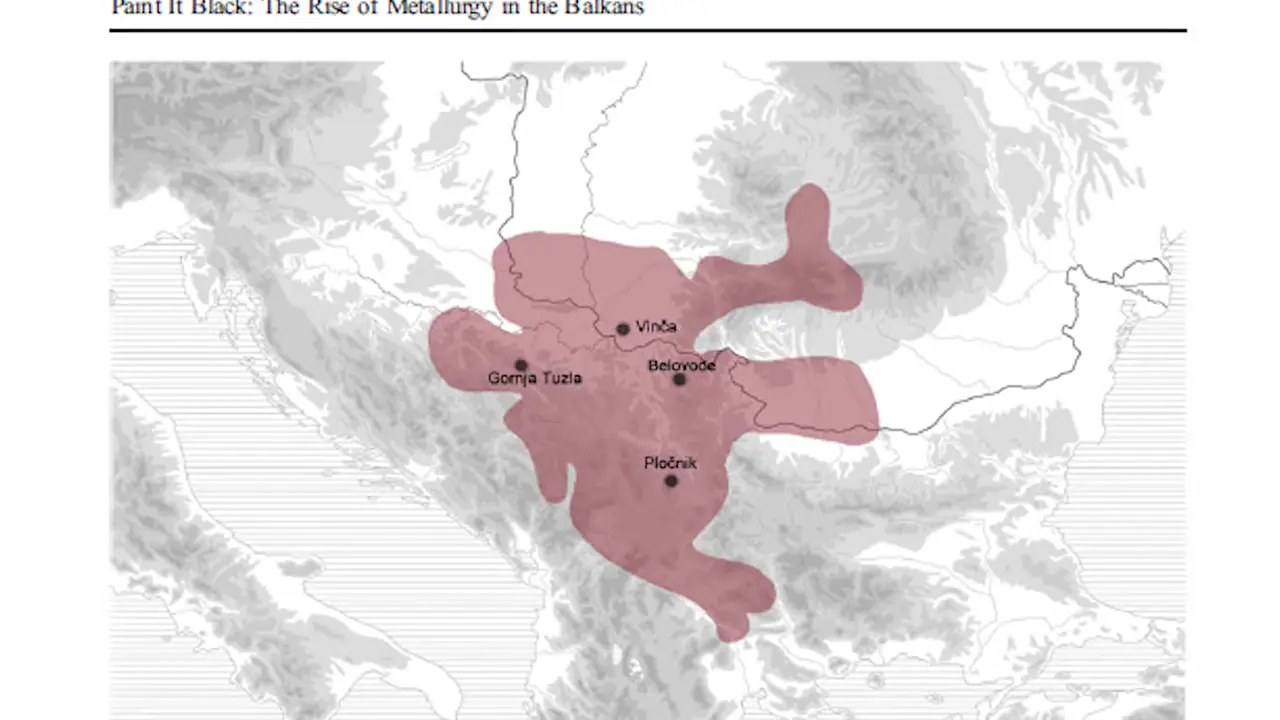
University of Belgrade archaeometallurgist Miljana Radivojević and colleagues found copper slag, malachite beads and metal droplets in Vinča-period contexts at Belovode and Pločnik. Slag and droplets indicate copper smelting at Belovode as early as the 49th century BC (c. 4900 BC), Europe's earliest known and one of the world's earliest secure examples. The findings appeared in a 2010 Antiquity article and a 2021 monograph—not a 2010 Journal of Archaeological Science paper. Rudna Glava was among the earliest known copper mines and was worked on a substantial scale. Pločnik's tin-bronze foil dates to c. 4650 BC, over 1,000 years before the conventional Bronze Age, though early tin-bronze production there was short-lived. Copper remained mainly an ornamental material and did not replace stone tools. The video argues that miners favoured black and green ores for aesthetic reasons and interprets the ornaments as status display; these motives are not established findings. 🔥⚒️
Belovode: among the world's earliest secure copper-smelting sites, c. 4900 BC
Site mentioned
📍 Локалитет Беловоде код Петровца на Млави🌍 Show on the globe
Key facts
- University of Belgrade archaeometallurgist Miljana Radivojević and colleagues investigated Belovode and Pločnik, recovering copper slag, malachite beads and metal droplets in Vinča-period contexts. The slag and droplets are the direct evidence for smelting.
- The results appeared in the 2010 Antiquity article "On the origins of extractive metallurgy: new insights from western Serbia" and were revisited in the 2021 monograph "The Rise of Metallurgy in Eurasia," not a 2010 Journal of Archaeological Science paper.
- Belovode's securely dated smelting evidence dates to the 49th century BC, or c. 4900 BC. It is Europe's earliest known secure evidence and one of the world's earliest known examples.
- The video argues that miners favoured black and green copper ores for aesthetic reasons; that motive is not an established archaeological finding.
- Rudna Glava—not "Rudnik Glava"—was among the earliest known copper mines and was exploited on a substantial scale.
- The tin-bronze foil from Pločnik dates to c. 4650 BC, over 1,000 years before the conventional European Bronze Age. Early tin-bronze production at the site was short-lived.
- Early copper was chiefly used for ornaments and did not displace stone tools; the video's reading of the ornaments as status display is an interpretation.
Sources
link.springer.com
Linked in video description
link.springer.com
Linked in video description
nature.com
Linked in video description
nature.com
Linked in video description
nature.com
Linked in video description
Vinča Culture | National Museum Kraljevonmkv.rs
At the site Rudna Glava traces of metal mining were discovered, and at the site Belovode in Eastern Serbia, copper was smelted more than 7000 ...
(PDF) Belovode-Pločnik, New Contributions regarding the ...academia.edu
Belovode-Pločnik, New Contributions regarding the Copper Metallurgy in the Vinča Culture.
On the origins of extractive metallurgy: new evidence from ...sciencedirect.com
by M Radivojević · 2010 · Cited by 420 — This paper contributes to the debate on the origins of extractive metallurgy by presenting remains of copper smelting discovered recently in Belovode, a Vinča…
Was this story useful?
Keep exploring
Every site on this page sits on the globe, and the people who research them are on the Discord.
3D Globe · Sites by country · Story Archive · Research Library · Weekly Journal · Search
AI-generated text · images from the original sources · always verify with the sources.