

Material scientist Michel Barsoum of Drexel University published research confirming at least some blocks were made with geopolymer. He found silicon-rich binding material (likely from sand or clay) mixed with limestone minerals (calcium and magnesium). These materials do not combine this way in nature. The binding material looks disordered and glass-like, unlike natural limestone's neat crystal structures. His studies provide evidence that these blocks are not natural limestone but an early form of concrete.
Barsoum Confirms Some Blocks Are Geopolymer
 EgyptTheory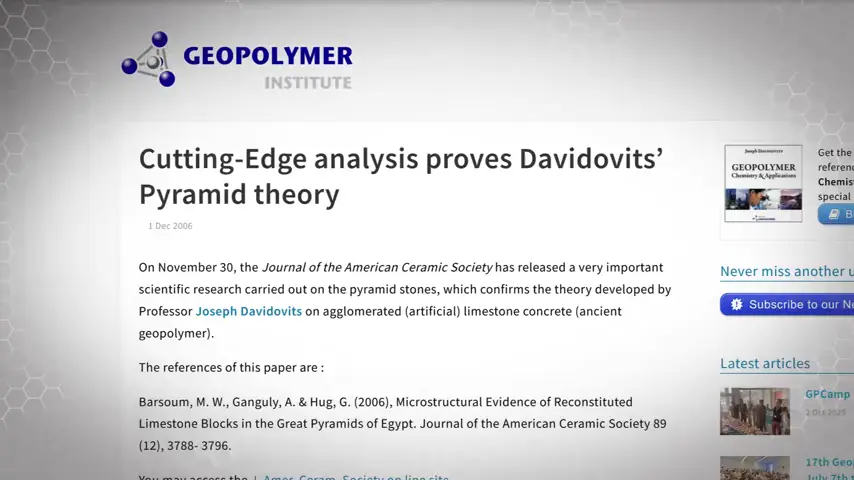
Site mentioned
Key facts
- Material scientist Michel Barsoum published a pivotal study in 2006 proving at least some limestone blocks were made with geopolymer
- He found silicon-rich binding material (likely from sand or clay) mixed with limestone minerals (calcium and magnesium)
- These materials do not combine this way in nature
- The binding material looks disordered and glass-like, unlike natural limestone's neat crystal structures
- Pyramid stones contain much more water than normal Egyptian limestone (which is dry)
- Minerals inside pyramid blocks were found in a hydrated form, which doesn't happen in natural limestone but occurs when minerals form quickly from water
- Salt was found inside pyramid stones - historical accounts mention salt crystals coating passages when the pyramid was entered in the 9th century
- Some pyramid blocks show magnetic alignment consistent with being cast in place while hardening
- This suggests builders used both natural stone and cast blocks, especially higher up where lifting heavy stones was difficult
Sources
NATURE report on pyramid limestone concrete - Geopolymer Institutegeopolymer.org
The paper by Michel Barsoum of Drexel University in Philadelphia, Pennsylvania, and his colleagues is the latest entry in a decades-long ...
Microstructural Evidence of Reconstituted Limestone Blocks in the ...researchgate.net
Utilizing MSWIFA in construction materials has been widely researched, with geopolymer cement emerging as a promising alternative to traditional Portland cement ...
Experimental Validation of Low-Temperature Alkali Silicate ...researchhub.com
It is purported that these monuments have been made with geopolymeric binders, created by chemically altering locally available minerals rather ...
Barsoum's Geopolymer Formulageopolymerhouses.wordpress.com
Dr. Barsoum, a material scientist from Drexil University in Philadelphia, gives his recipe for pyramid blocks in the following radio interview.
Joseph Davidovits | - Atlantipediaatlantipedia.ie
Joseph Davidovits (1935- ) is a French scientist who has worked on geopolymers since the 1970s. which can be used to create cement that is economically and ...
Was this story useful?
Keep exploring
Every site on this page sits on the globe, and the people who research them are on the Discord.
3D Globe · Sites by country · Story Archive · Research Library · Weekly Journal · Search
AI-generated text · images from the original sources · always verify with the sources.