

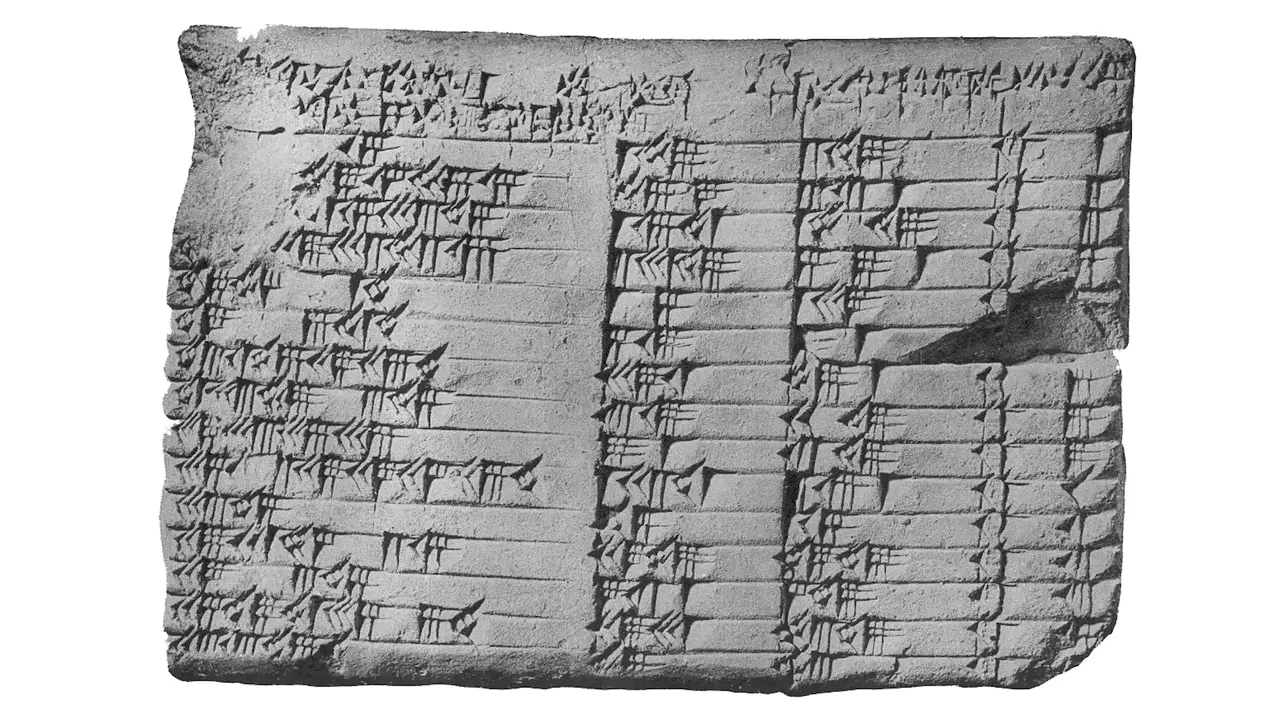
Pythagoras left no writings—the earliest Greek axiomatic proof appears in Euclid's Elements around 300 BCE. But Babylonian tablet YBC 7289 shows a remarkably accurate √2 approximation, and Plimpton 322 plus seven other Old Babylonian tablets (c. 2000-1600 BCE) already used right-triangle relationships, pre-dating Pythagoras by over a millennium.
Babylonian tablets show Pythagorean theorem preceded Pythagoras by over 1,000 years
Key facts
- Pythagoras lived in the 6th century BCE and left no writings
- The earliest surviving proof of the theorem in a Greek axiomatic system appears in Euclid's Elements, written around 300 BCE
- Attribution to Pythagoras appears much later in the 5th century CE, nearly 1,000 years after his lifetime
- Babylonian tablet YBC 7289 shows a square with diagonals; a scribe marked one side as 30 and used a remarkably accurate approximation of the square root of 2
- Plimpton 322 contains 15 sets of numbers corresponding to right triangles
- At least 7 Old Babylonian tablets used the squares of the sides of right triangles; these date from about 2000-1600 BCE
- Indian Shulba Sutras attributed to Baudhayana (conventionally dated to ~8th century BCE) also state and use the Pythagorean relationship
Sources
How did the Babylonians know √2 up to six digits? - The Palindromethepalindrome.org
YBC 7289myslu.stlawu.edu
How the estimate of 2 on YBC 7289 may have been calculatedsciencedirect.com
Babylon and the Square Root of 2 | Azimuth - WordPress.comjohncarlosbaez.wordpress.com
The secret teachings of pythagoraswillbuckingham.com
Pythagoras - Stanford Encyclopedia of Philosophyplato.stanford.edu
Pythagoras - Knowinotheochem.ru.nl
Was this story useful?
Keep exploring
Every site on this page sits on the globe, and the people who research them are on the Discord.
3D Globe · Sites by country · Story Archive · Research Library · Weekly Journal · Search
AI-generated text · images from the original sources · always verify with the sources.