

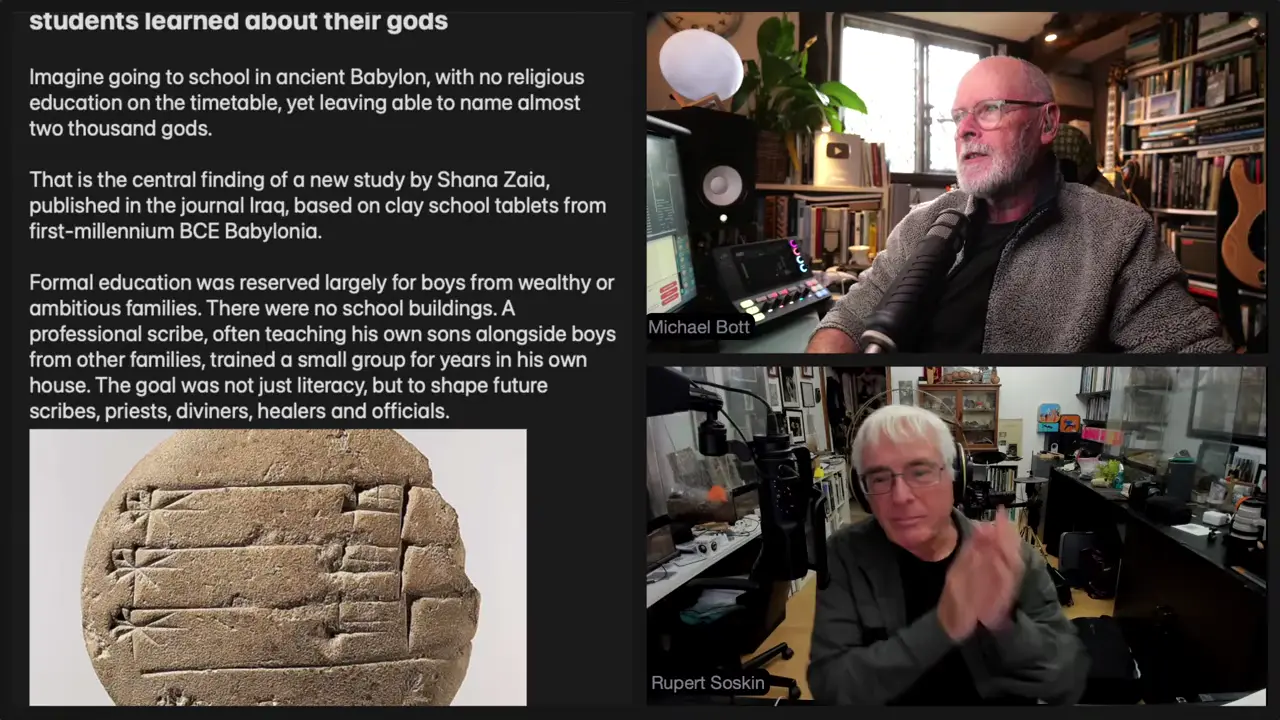
A new study in the journal Iraq, based on clay school tablets from first-millennium BCE Babylonia, finds pupils leaving school could name almost 2,000 gods — though religion was never taught as a subject. Beginners copied lists of 200+ divine names; advanced students worked through An = Anum, nearly 2,000 equations matching Sumerian names with Akkadian ones. 📜 Some homework became temple offerings — an exercise on one face, a prayer on the other.
School tablets show Babylonian pupils learned gods by copying cuneiform god lists
Key facts
- A new study published in the journal Iraq, based on clay school tablets from first-millennium BCE Babylonia, finds that pupils leaving school could name almost 2,000 gods despite religion never being a separate subject
- Formal education was largely reserved for boys from wealthy or ambitious families; there were no school buildings, and a professional scribe typically trained a small group, including his own sons, for years in his own house
- The goal was not literacy as such but to shape future scribes, priests, diviners, healers and officials, with religion woven into complex cuneiform writing exercises
- Beginners copied a god list of over 200 divine names; advanced pupils tackled the god list known as An = Anum, written as equations, running to almost 2,000 entries across seven tablets matching Sumerian names with their Akkadian equivalents
- Many of the gods listed had cults that had long died out; the point was to master the signs and learn how the divine world was ordered, and only a handful of deities were studied in depth
- In northern Babylonia lessons centred on Babylon and its patron god Marduk: pupils copied a hymn to Marduk of over 200 lines, the seven-tablet creation epic Enuma Elish in which Marduk defeats the primeval goddess Tiamat and takes up residence in the Esagila, and Tintir, a text listing the city's temples and gates
- Schools at Nippur largely ignored the Marduk material and taught different local traditions, and Uruk followed Nippur's lead, indicating two rival educational spheres rather than a single imperial syllabus
- Young pupils sometimes collected clay from a sacred place with an incantation, then shaped a tablet carrying an ordinary exercise on one side and a prayer on the other, so a finished piece of homework could become a votive offering in a temple
Sources
An = Anumen.wikipedia.org
While the forerunner has only 473 entries, over 2000 names are listed in An = Anum (2123 in the most complete known copy). However, this should ...
An = Anum and Related Lists: God Lists of Ancient ...dokumen.pub
It clearly intends to encompass the entire classical Babylonian pantheon with its roughly 2000 entries. It is hierarchically organized, beginning with heaven ...
An = Anum and Related Listscdn.mohrsiebeck.com
His intention was to produce a definitive edition of the “Great. God List”, known to the ancients as An = Anum; to present alongside it several related lists; ...
An = Anum and Related Listsapi.pageplace.de
His intention was to produce a definitive edition of the “Great. God List”, known to the ancients as An = Anum; to present alongside it several related lists; ...
An = Anumwikiwand.com
While the forerunner has only 473 entries, over 2000 names are listed in An = Anum (2123 in the most complete known copy). However, this should ...
Was this story useful?
Keep exploring
Every site on this page sits on the globe, and the people who research them are on the Discord.
3D Globe · Sites by country · Story Archive · Research Library · Weekly Journal · Search
AI-generated text · images from the original sources · always verify with the sources.