

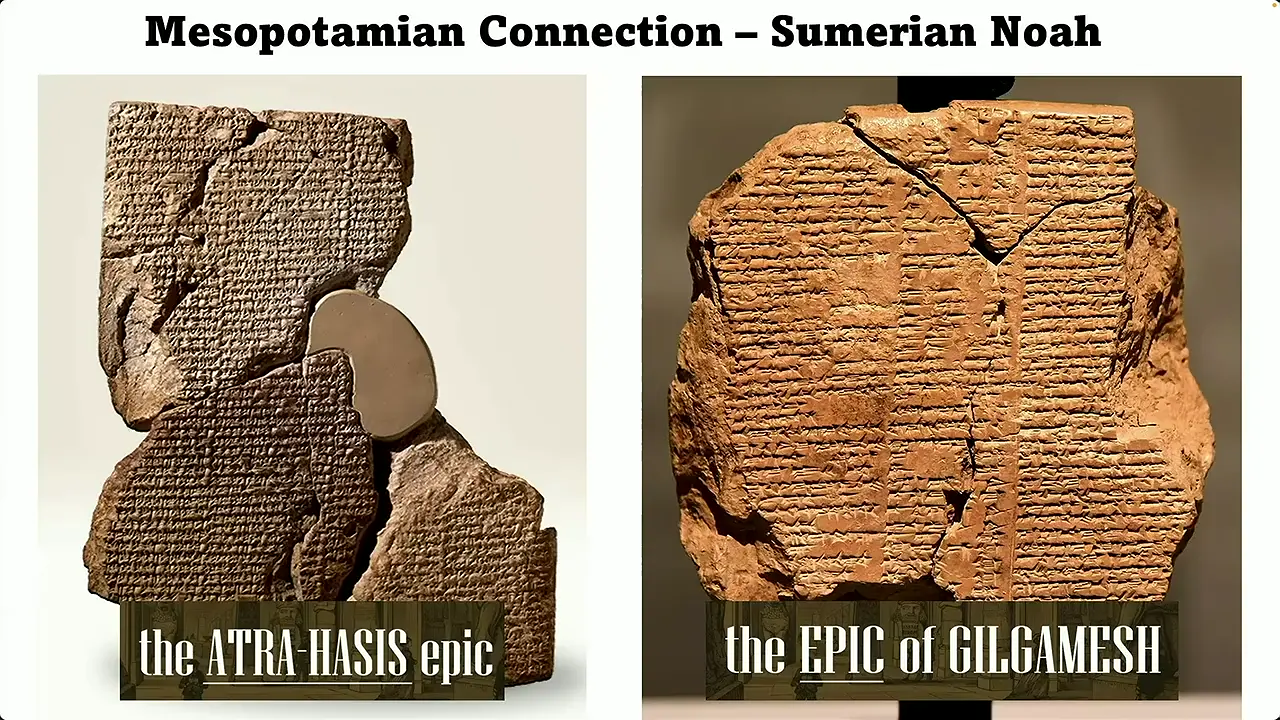
The British Museum's Babylonian Map of the World — the oldest surviving map — has a mislabelled fragment that, once reinserted in the 1990s, revealed text naming Ararat as the ark's landing place. The Gilgamesh tablet has Ziusudra sealing a cedar ark with bitumen for 7 days and nights 🗺️
Babylonian Map of the World names Ararat as the ark's landing place
Key facts
- The Penn Museum tablet known as the Death of Gilgamesh (Bilgames) records Gilgamesh, king of Uruk, seeking immortality and travelling to the underworld, where he meets Ziusudra.
- The tablets describe Ziusudra as priest-king of Shuruppak, the last city of an older world, warned by Enki, the 'snake god' of the Anunnaki, through a reed wall beside a marsh.
- Ziusudra is told to build an ark of cedar planks sealed with bitumen, take his family including three sons, and two of each kind of animal; the flood lasts seven days and seven nights and birds are released to find land.
- The British Museum's Babylonian Map of the World, described as the oldest surviving map, had a mislabelled fragment identified in the 1990s; once reinserted into the map's triangular composition the text could be read and it names Ararat as the landing place of the ark.
- The presenter states that only two Mesopotamian tablets mention the me - the Gilgamesh text and Enki and the World Order, where Ishtar/Anunnaki refer to the me as the holy laws of heaven and earth.
- Assyriologist Samuel Noah Kramer rendered the phrase as 'commandments and rights'; the presenter argues the correct sense is 'divine laws of heaven and earth'.
- The video argues the flood was regional rather than global, since human populations continued elsewhere, and that Gilgamesh brought the me back to Sumer but kept it rather than passing it on, after which the knowledge was lost.
Sources
thestageoftime.com
Linked in video description
thestageoftime.com
Linked in video description
thestageoftime.com
Linked in video description
What Do We Know About the People Buried in the Royal ...penn.museum
Gilgamesh was an historical figure, ruler of the city of Uruk (Erech) about sixty kilometres to the northwest of Ur, about the time of the royal tombs at Ur.
The Death of Gilgameshjstor.org
by SN Kramer · 1944 · Cited by 59 — The Epic of Gilgamesh is the longest and most significant literary creation of the ancient Babylonians. by the University of Pennsylvania during the years 1889 ...
Penn Museum New Digital Portalalmanac.upenn.edu
It was a bitter cold night in Philadelphia on January 8, 2014, but Dr. Steve Tinney, deputy director and associate curator-in-charge of the ...
The Museum Journal | The Epic Of Gilgamishpenn.museum
The epic of Gilgamish was written with the major motif of showing how not even a demigod who partakes of the nature of mankind can by the most heroic efforts ...
Great Voyages: Gilgamesh: Journeys to the End of the Worldcollections.penn.museum
Gilgamesh was a figure of legend in ancient Mesopotamia (modern day Iraq) from as early as 4,500 years ago. In this lecture, Dr. Tinney recounts some of ...
Was this story useful?
Keep exploring
Every site on this page sits on the globe, and the people who research them are on the Discord.
3D Globe · Sites by country · Story Archive · Research Library · Weekly Journal · Search
AI-generated text · images from the original sources · always verify with the sources.