

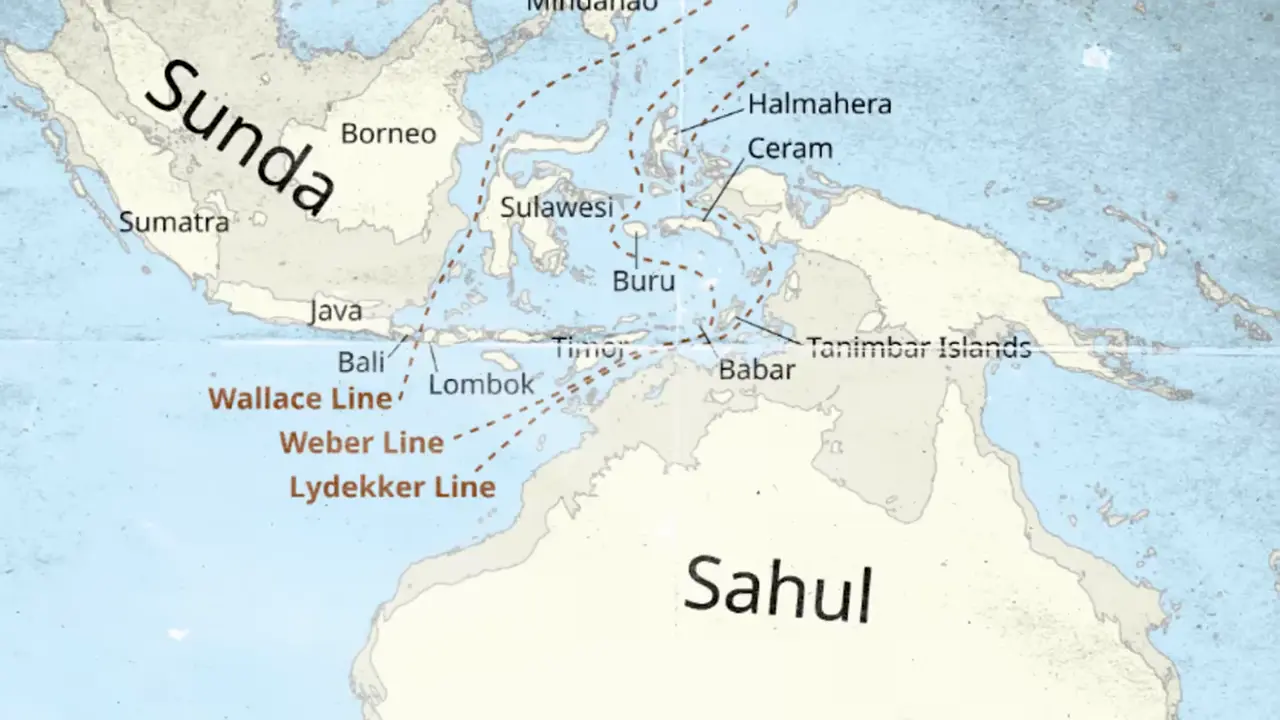
Stone tools from Luzon (~700,000 years old), Flores (~1 million) and Sulawesi (1.04–1.48 million) show hominins reached islands east of the Wallace Line. Its deep channels stayed submerged, though the required gaps were not all 100 km. The artifacts establish water crossings—not that they were planned voyages. The video argues these hominins were intentional “master mariners” and that this removed a key obstacle to the later human arrival in Australia. The 160-breeding-individual figure is a model-dependent estimate, not a fact established by the tool dates.
Ancient tools show hominins crossed water into Wallacea by about 1 million years ago
Key facts
- Stone tools and a butchered rhinoceros from Callao Cave on Luzon date to roughly 700,000 years ago.
- Stone artifacts on Flores date to around 1 million years ago, while Sulawesi artifacts date to roughly 1.04–1.48 million years ago.
- Reaching these islands east of the Wallace Line required water crossings, but the necessary gaps were not uniformly 100 km wide.
- The finds establish that hominins crossed water; they do not establish whether the crossings were accidental or intentional.
- The figure of at least 160 breeding individuals is a model-dependent population estimate, not a result established by dating the tools.
- The video argues that these hominins were intentional “master mariners” and that their crossings removed a key objection to the later human arrival in Australia; those conclusions remain the video's interpretation.
Sources
lens.monash.edu
Linked in video description
worldhistory.org
Linked in video description
nature.com
Linked in video description
New species of ancient human discovered in the Philippinesnationalgeographic.com
In 2018, Mijares and his colleagues announced the discovery of stone tools and a butchered rhinoceros skeleton that are more than 700,000 years ...
New Species of Early Human Discovered in the Philippinesleakeyfoundation.org
... Luzon, recent excavations near Callao Cave produced evidence of a butchered rhinoceros and stone tools dating to around 700,000 years ago.
Multifaceted analyses of lithic artifacts from Callao Cave in ...sciencedirect.com
by T Yamaoka · 2021 · Cited by 6 — These stone-tool manufacturing and usage characteristics suggest that the hunter-gatherers who left the assemblages did not clearly distinguish between cores ...
Homo luzonensisdonsmaps.com
Lookout Tools, Shells and Bones. Tools from the stone age Tools ・ stone tools made by Homo habilis. Callao Cave, Luzon, the Philippines ・ are ...
Homo luzonensisen.wikipedia.org
a lack of tools in the cave could either have resulted from the use of organic material for tools rather than stone, or the processing of meat
Was this story useful?
Keep exploring
Every site on this page sits on the globe, and the people who research them are on the Discord.
3D Globe · Sites by country · Story Archive · Research Library · Weekly Journal · Search
AI-generated text · images from the original sources · always verify with the sources.