

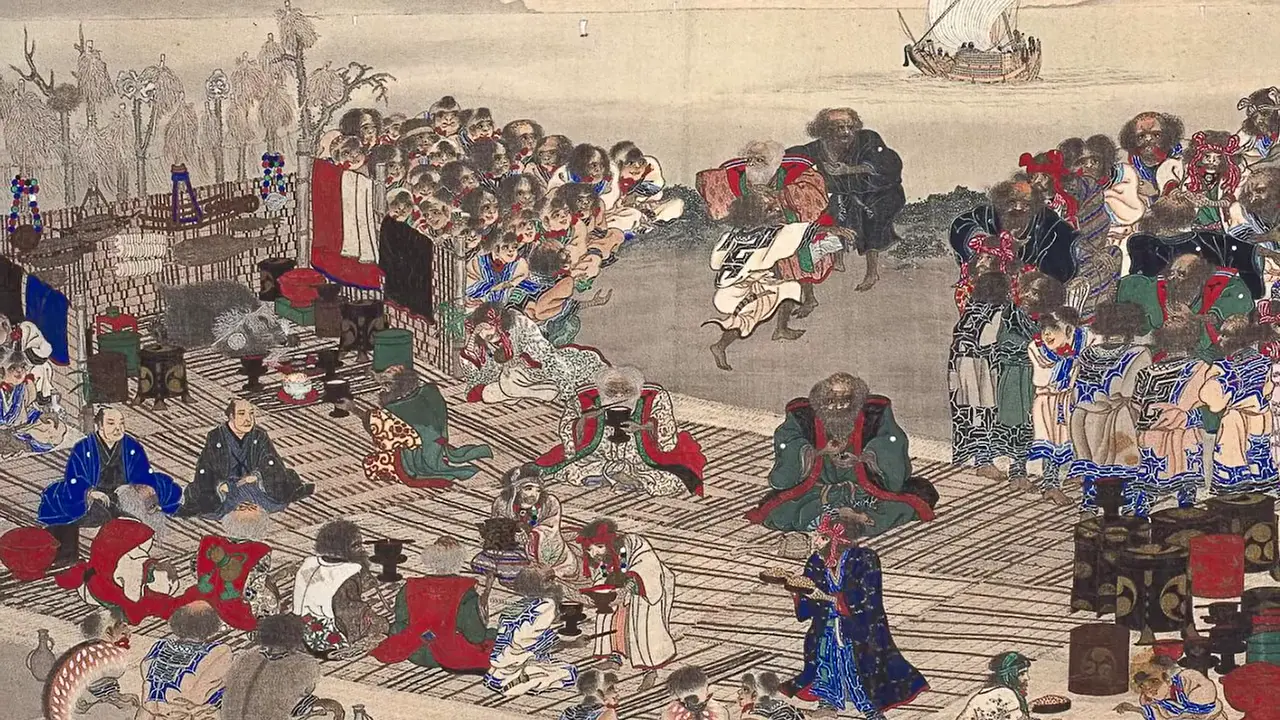
The Ainu bear feast is Hallowell's best-documented ceremony: the bear is a kamui returning to its mountain master, kept in a timber cage until two or three years old, its blood drunk and smeared by hunters, and no dog may touch a morsel. The dead bear enters by the rear door. 🐻
Ainu kamui rite: bear kept as honoured guest, blood drunk, dog excluded
Key facts
- Hallowell describes the Ainu of northeastern Asia, in southeastern Russia and northern Japan, as holding what the paper treats as the best known bear ceremony, and defines kamui as covering deities, natural forces such as volcanoes, earthquakes, winds and tsunamis, and the bear.
- Kamui are not themselves objects of worship; offerings and prayers are made to their masters or owners, in the bear's case the mountain kamui who is master of the bears, conceived as both a man and an unusually large real bear whose fellow tribesmen are all other bears.
- Slaughter is understood as the departure of the animal's soul to its master, with a return to earth expected, completing a cycle of profound importance.
- The Ainu also capture cubs; Hallowell relays an account, doubted by many, of a hunter's wife suckling them, and cubs were kept in strongly built timber cages until two or three years old and then killed for the feast.
- Among the Shangalan Ainu the older women take turns lamenting before the cage on the day before the feast; hunters drink the bear's blood and smear it on their bodies and clothes, and everyone must eat at least a morsel, since refusal shows they are not Ainu.
- Women may eat bear meat but some parts stay reserved for the hunters and their friends, and a dog must never eat even the tiniest morsel of flesh.
- The dead bear is brought into the dwelling through a rear door rather than the front, a custom Hallowell says also appears among the Lapp (Sami) and the Micmac of eastern North America.
- At the close of the ceremony the hide is stuffed with grass, carried around the house following the sun's course and sent toward the rising sun, on the platform of the storehouse.
- The presenter notes that Ainu kamui and Japanese kami appear to share a root, but that as of a 2022 paper linguists were still debating any connection.
Sources
The Ainu Bear Ceremonyvideo.alexanderstreet.com
In the bear ceremony, now no longer performed, a specially reared bear was reverently killed and its flesh and blood eaten by the participants.
Waking the Bear | Exchange for Local Observations and ...eloka.nsidc.org
It has been nearly a century since A. I. Hallowell's classic work first introduced the academic world to bear ceremonialism as a circumpolar phenomenon.
Windows to the Ainu World · Iyomante - Mellon Projectsglam.uoregon.edu
Afterward the bear was skinned and dressed as a “doll,” and a large banquet with singing and dancing was held to celebrate the bear's return to the spirit realm ...
The Ainu “Bear-Sending” Ceremonyoceanicartsociety.org.au
The person who captured the bear cub or acquired it from someone else placed it in a cage when it grew a little older, raised it for one or two years usually ( ...
The Ainu Bear Ceremony and the Logic behind Hunting ...diva-portal.org
by T Yamada · 2018 · Cited by 13 — This paper aims to reveal the Ainu conception of the bear and bear ceremony, which enables them to hunt the deified bear, in terms of the ...
Was this story useful?
Keep exploring
Every site on this page sits on the globe, and the people who research them are on the Discord.
3D Globe · Sites by country · Story Archive · Research Library · Weekly Journal · Search
AI-generated text · images from the original sources · always verify with the sources.