

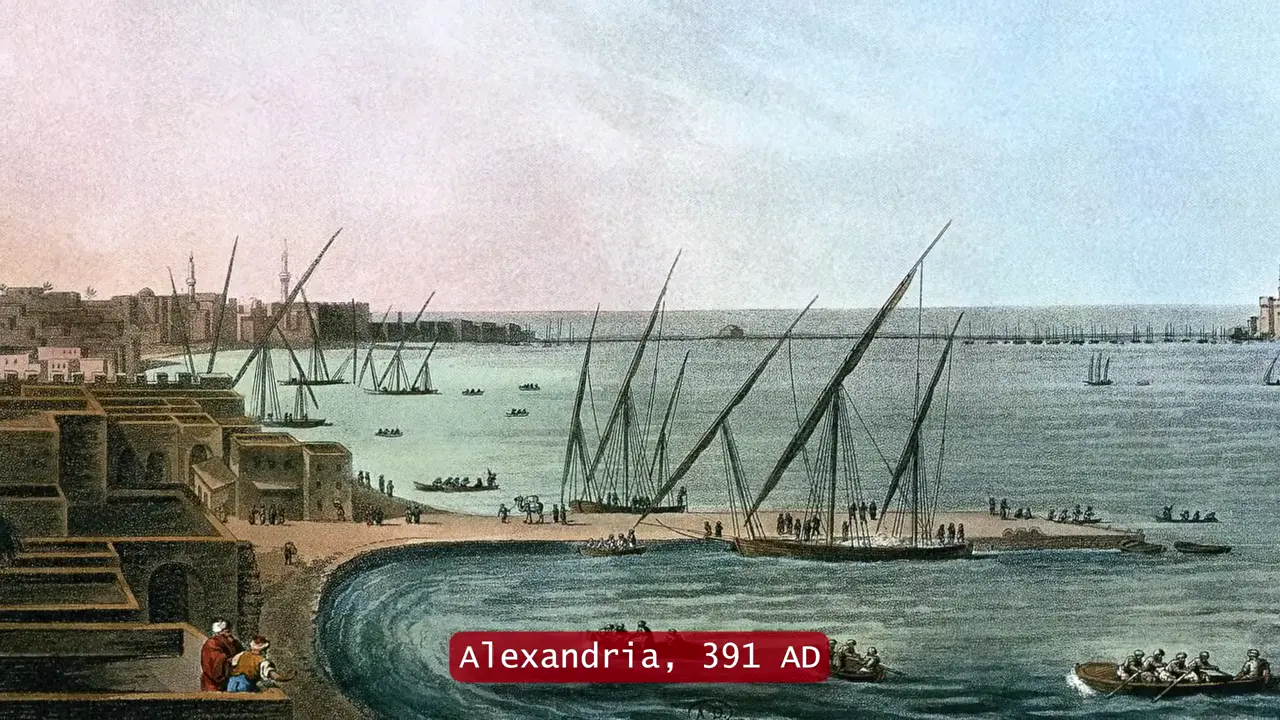
In 391 AD, a soldier with an axe climbed a 100-step stair into Alexandria's Serapeum and struck the giant statue of Serapis, so vast one hand brushed each wall. The head was hacked off, mice poured from the hollow neck, and the sky did not fall. No confirmed fragment of the colossus has ever been found. ⚱️
391 AD: Serapis colossus destroyed in the storming of Alexandria's Serapeum
 EgyptGeneral
Key facts
- In Alexandria in 391 AD, a soldier with an axe climbed a 100-step stairway into the city's grandest temple while a silent crowd of pagans and Christians waited.
- Inside stood a colossus so vast that one hand brushed each wall, guarded by a prophecy that if a human hand struck the statue the earth would split open and the sky would come down.
- The video reports a legend that King Ptolemy II dreamed of a giant statue, then had it tracked down and hauled back to Alexandria from the Black Sea coast, while an older rival story credits an Egyptian king whose sculptor Briaxis made the statue and coated it with a paste infused with gold, silver, lead, sapphire, emerald and topaz, said to contain pigment from the funeral rites of Osiris and the sacred bull Apis.
- The colossus was a statue of Serapis, described as the colour of the Nile at night - a manufactured god, Osiris remade with the face of Zeus so that Greeks and Egyptians could share one deity.
- His home, the Serapeum, was part temple and part library at the heart of Alexandria, and the gauge measuring the Nile's yearly flood was kept inside its walls.
- Chroniclers describe the priests as engineers, with a chamber plated in gold, silver and bronze, a hidden window that let a sunbeam land on the statue's lips once a year, and an iron sun hanging mid-air lifted by a magnet hidden in the ceiling; a pagan historian writing while the temple stood said only the capital in Rome compares.
- The video notes that every account of these engineering marvels comes from Christian writers who catalogued each device as evidence that the pagan priests were conmen.
- In 380 Emperor Theodosius made Christianity Rome's official religion; 11 years later he ordered a crackdown on old pagan rites, Bishop Theophilus confiscated and paraded pagan relics through the streets, and riots broke out with pagan defenders barricading inside the Serapeum.
- The temple was stormed; the official dismissed the prophecy as 'the dribbling of a tipsy old woman' and ordered the soldier to swing - the axe sank into the jaw, the head was hacked off, and the sky did not fall.
- According to a later chronicler, mice poured out of the hollow neck, indicating it was not solid stone; the limbs were dragged by ropes through the streets and burned, and the torso was hauled to the amphitheater and set ablaze.
- Rufinus, a church historian writing soon afterwards, said the god went up 'as easily as drywood'.
- A later pagan chronicler called the event more than an exorcism - a heist in which the victors carried off temple statues and treasures, only the stone floor being spared as too heavy to move; no source says whether the colossus was stripped of gold or jewels before burning.
- Images of Serapis were then chiseled from walls, entrances, doorposts and windows, crosses replaced them and churches rose over the ruins; no confirmed fragment of the original colossus has ever been found.
Sources
The Temple of Serapis (Serapeum) in Alexandriapenelope.uchicago.edu
The destruction of the Serapeum in Alexandria in 391 CE: Christianity's shift from persecuted to persecutorfabriziomusacchio.com
The Christian Destruction of the Roman Serapeum - Serapea of Ancient Egypt - CUNYserapeaegypt.commons.gc.cuny.edu
What happened to the Great Library at Alexandria?worldhistory.org
Serapeum of Alexandriaen.wikipedia.org
Was this story useful?
Keep exploring
Every site on this page sits on the globe, and the people who research them are on the Discord.
3D Globe · Sites by country · Story Archive · Research Library · Weekly Journal · Search
AI-generated text · images from the original sources · always verify with the sources.