

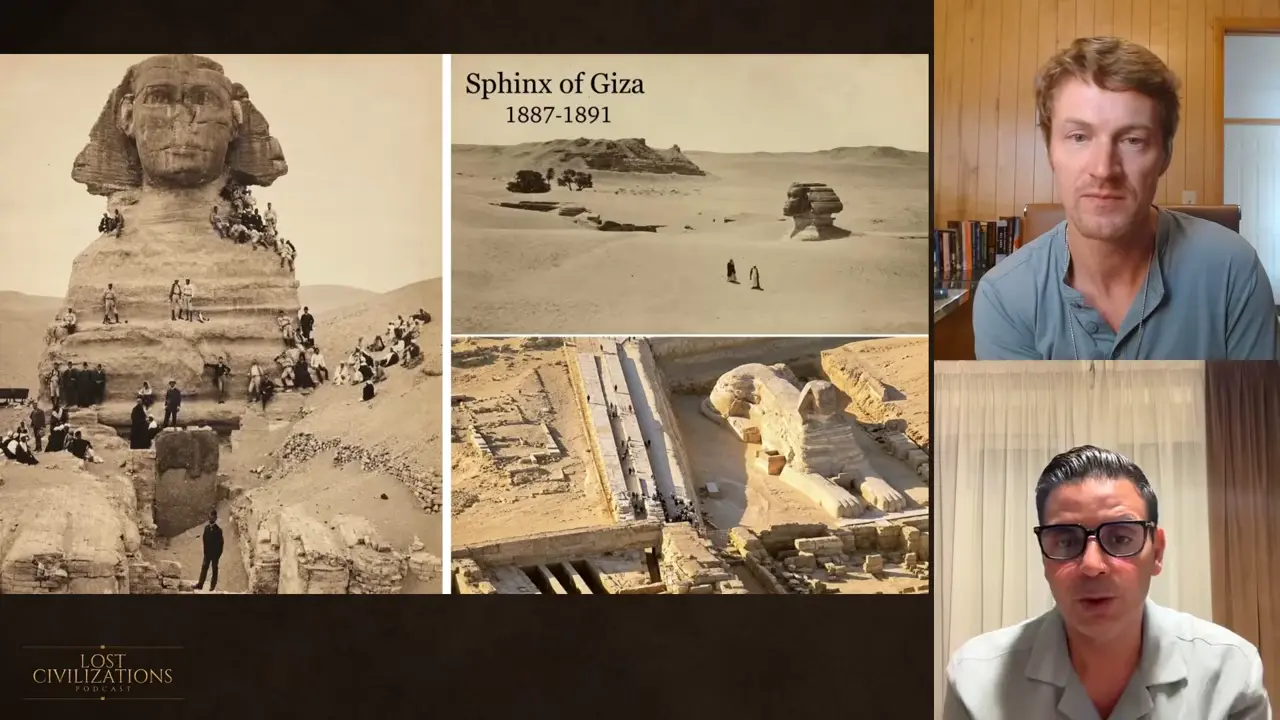
In the 1990s, Robert Schoch and geophysicist Mohamed Ibrahim surveyed the Great Sphinx using seismic methods and ground-penetrating radar. The work mapped rectilinear subsurface anomalies. Ibrahim argues the geometry may be artificial, but the surveys did not confirm a box-shaped room or void beneath the right paw. The Hall of Records story comes from Edgar Cayce’s 1940s readings, not archaeology.
1990s radar survey mapped anomalies beneath the Sphinx—not a confirmed void
 EgyptTheory
Key facts
- Robert Schoch, a Boston University anthropologist, and geophysicist Mohamed Ibrahim conducted seismic and ground-penetrating radar work at the Great Sphinx in the 1990s. Seismic reflection and GPR are distinct techniques.
- The surveys mapped rectilinear subsurface anomalies. They did not confirm a box-shaped room, chamber or void, and the results do not establish a location beneath the right paw.
- Mohamed Ibrahim interprets the geometry as artificial; that is his interpretation, not an established archaeological conclusion.
- Hawass's team drilled at the Sphinx site, but the claim that a borehole was deliberately positioned away from the anomaly is a disputed interpretation by Ibrahim and Matt Lerch.
- The claimed rear, tail and head entrances and the description of a sealed interior with a wooden floor are not established by the cited sources and should be attributed to the video.
- Edgar Cayce—spelled Cayce, not Casey—made the Hall of Records claim in the 1940s, not more than a century ago. It is not archaeological evidence.
Sources
Radar Scan Fuels Viral Claim of Hidden Twin Sphinx ...bioscience.com.pk
Robert M. Schoch's research worksresearchgate.net
Robert M. Schoch: Research Highlightsrobertschoch.com
Was this story useful?
Keep exploring
Every site on this page sits on the globe, and the people who research them are on the Discord.
3D Globe · Sites by country · Story Archive · Research Library · Weekly Journal · Search
AI-generated text · images from the original sources · always verify with the sources.