

'Shuruppak paradox': a 1931 Penn dig in Iraq hit Uruk 6-7 ft down, Shuruppak 14 ft below — yet dated it a millennium later. German and American teams argued over strata 🏺
1931 Penn Museum dig finds Shuruppak beneath the Uruk layer but dated later
 IraqGeneral
Site mentioned
Key facts
- In 1931 a University of Pennsylvania (Penn Museum) expedition of American and German archaeologists went to southern Iraq to search for Shuruppak, the city of the flood hero Ziusudra, a place then generally regarded in the tablets as mythical or allegorical.
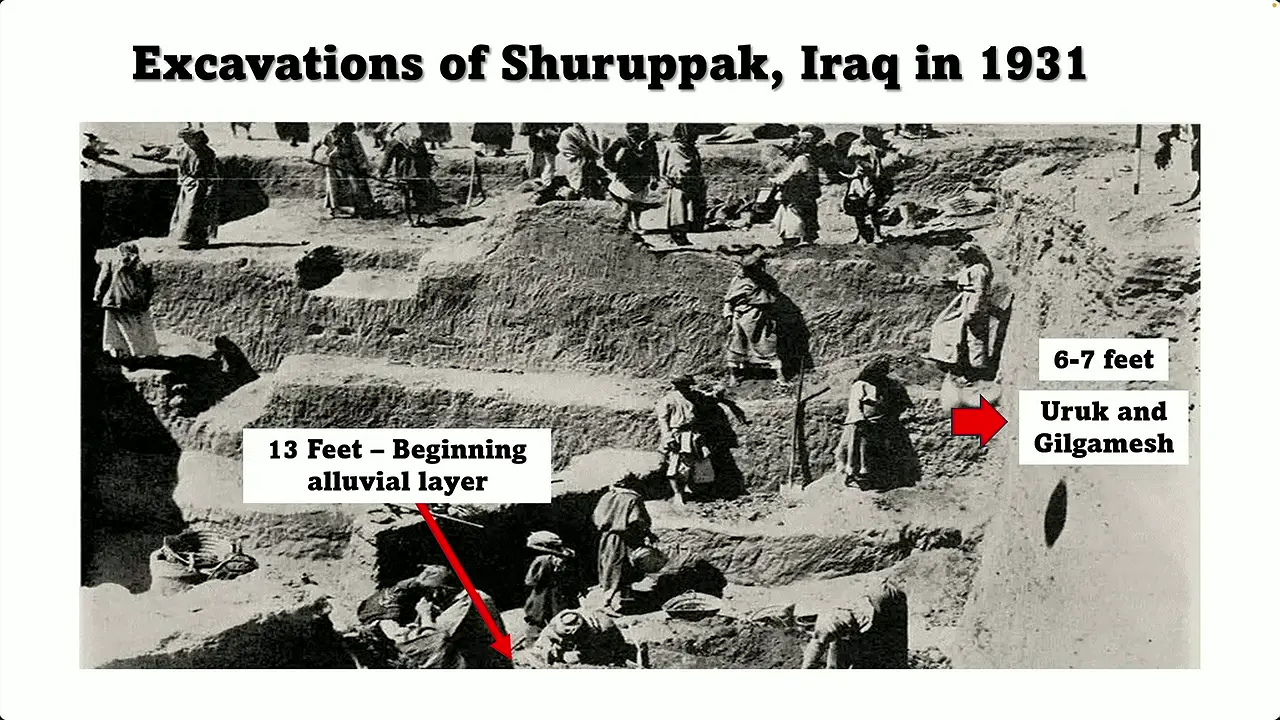
- Field photographs from the excavation show trenches cut to roughly 20 feet; the excavators reached an Uruk-period settlement layer at about 6-7 feet and Shuruppak some 14 feet below that.
- Beneath the upper occupation they encountered a thick flood deposit and below it the remains of Shuruppak; the Uruk/'Gilgamesh' city and a third uppermost site layer were built over the same tell.
- The original excavation correspondence and reports are held in the Penn Museum archives, where the presenter says German and American team members argued over which of strata one, two and three the material belonged to.
- The excavation assigned Shuruppak a date more than a thousand years later than Uruk even though it lay deeper in the sequence - the discrepancy the presenter calls the Shuruppak paradox.
- The report acknowledged a flood layer beneath the site that matches the flood narratives in the tablets, but described the story as a fairy tale rather than a historical event.
- The presenter argues from the tablets that the first five cities, including Eridu and Shuruppak, are Sumerian while Uruk belongs to a Neo-Assyrian re-emergence thousands of years later, so the Sumerian city cannot be the younger one.
- Roughly 70 percent of the expedition personnel left after arrival in Iraq because nothing was expected beneath Shuruppak.
- Fine pottery and artwork from Shuruppak are held in the Iraq Museum.
- The presenter links his flood scenario to the 'Adams event' hypothesis, in which he says Neanderthals went extinct.
Sources
thestageoftime.com
Linked in video description
thestageoftime.com
Linked in video description
thestageoftime.com
Linked in video description
Digging Iranthepenngazette.com
In the summer of 1931, the Penn Museum. The primary goal was to excavate Tepe Hissar, a 6,000-year-old site located about 200 miles east of ...
Expedition Magazine | The Thrill of Discoverypenn.museum
... Shuruppak) from February to May 1931. The site had been excavated by the Germans in 1902–1903 and Schmidt found great difficulty working there due to the ...
SETTLEMENT PATTERNS AT SHURUPPAKcambridge.org
by HP Martin · 1983 · Cited by 15 — There have been two major excavations at Shuruppak, by the University of Pennsylvania in 1931—when Erich Schmidt conducted limited excavations at four points ...
Shuruppaken.wikipedia.org
Excavation dates 1900, 1902-1903, 1931, University of Pennsylvania excavated Shuruppak. The excavation recovered 96 tablets and fragments—mostly from pre- ...
Mediterranean and Near Eastern Fieldwork at Pennaamw.sas.upenn.edu
The highlight of the excavations was the discovery of a series of five Canaanite and hybrid Egypto-Canaanite temples. Burials contemporary with these city ...
Was this story useful?
Keep exploring
Every site on this page sits on the globe, and the people who research them are on the Discord.
3D Globe · Sites by country · Story Archive · Research Library · Weekly Journal · Search
AI-generated text · images from the original sources · always verify with the sources.