

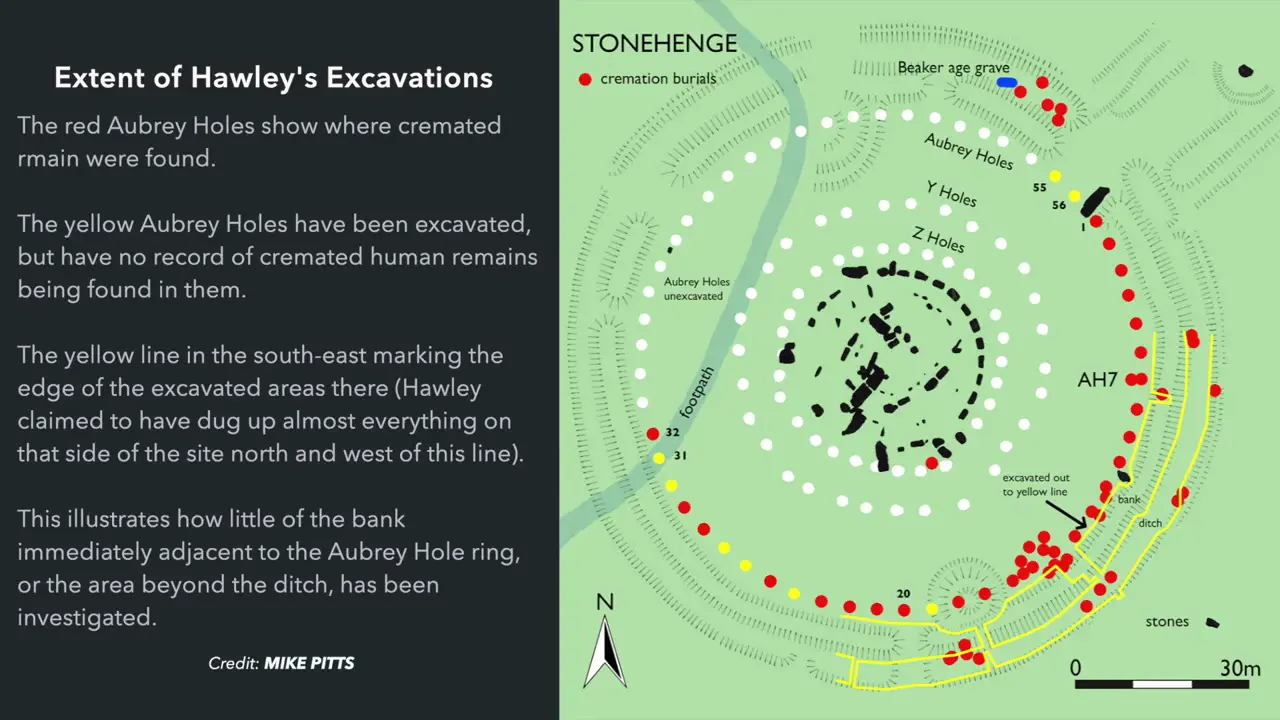
In the 1920s Colonel William Hawley and Robert Newell ran the largest excavation ever at Stonehenge, expanding John Aubrey's list of just 7 holes to 56 and naming them (X, Y and Z before that). Over half were dug, yielding ~60 cremation deposits (later revised to ~58 people) from upper fills and the ditch 🪨
1920s excavation identifies 56 Aubrey holes and dozens of cremations at Stonehenge
 EnglandExcavation
Site mentioned
Key facts
- Colonel William Hawley and Robert Newell carried out the 1920s excavation of Stonehenge, described as the largest excavation ever undertaken at the site.
- John Aubrey had previously recorded only seven Aubrey holes from his own drawings; Hawley and Newell confirmed and expanded the list to 56, and it was they who named them (earlier undefined holes were known as the X, Y and Z holes).
- Over half of the Aubrey holes were excavated in the 1920s campaign; fewer than half remain unexcavated.
- Roughly 60 cremation deposits (later revised to about 58 individuals) were recovered from upper fills and the ditch of Stonehenge.
- Bone pins associated with the cremations and the circular arrangement of burnt bone led to the inference that remains were originally held in leather or cloth bags.
- The 1920s campaign followed earlier work in which Hawley helped re-erect fallen stones and secure them with timber posts.
Sources
Timeline: History of Stonehengetimetoast.com
The enigmatic 'Newall boulder' excavated at Stonehenge in 1924: New data and correcting the recordsciencedirect.com
(PDF) Cunnington's bluestone samples | Ixeracademia.edu
(PDF) Stonehenge, Amesbury, Wiltshire – Chronological Modellingresearchgate.net
Was this story useful?
Keep exploring
Every site on this page sits on the globe, and the people who research them are on the Discord.
3D Globe · Sites by country · Story Archive · Research Library · Weekly Journal · Search
AI-generated text · images from the original sources · always verify with the sources.