

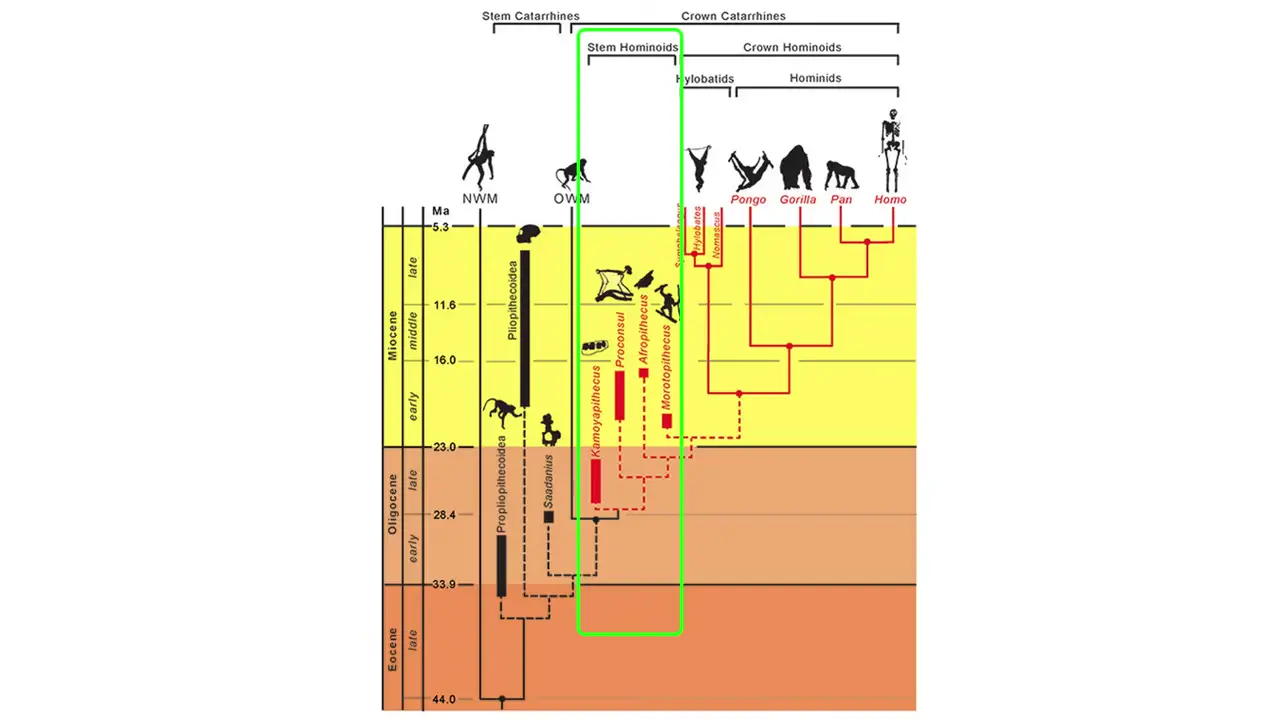
Researchers have described Masripithecus moghraensis, a roughly 17–18-million-year-old ape from Wadi Moghra in northern Egypt. Its robust lower jaw, large canines and rounded, textured molars suggest a flexible fruit-based diet. Tip-dated phylogenetic analyses place it close to the base of the crown ape radiation and closer to living apes than other known Early Miocene East African apes. The study proposes that northern Afro-Arabia, rather than East Africa, may have hosted the early divergence of crown hominoids. Wadi Moghra was then a wooded river-and-estuary environment, not the desert it is today.
17–18-million-year-old Egyptian ape challenges an East African origin for crown apes
Site mentioned
📍 Wadi Magra
Key facts
- The fossil is Masripithecus moghraensis, from the Moghra Formation at Wadi Moghra in northern Egypt, and is dated to roughly 17–18 million years ago.
- The specimen is a robust lower jaw with relatively large canines and rounded, heavily textured molars, suggesting a flexible fruit-based diet.
- Tip-dated phylogenetic analyses place Masripithecus close to the base of the crown ape radiation and closer to living apes than other known Early Miocene East African apes.
- The study proposes that a northern Afro-Arabian setting may better explain the early divergence of crown Hominoidea than East Africa.
- In the Early Miocene, Wadi Moghra was a wooded landscape with river and estuarine systems, unlike today's desert.
Sources
18 million-year-old fossils of ape found in Africa, but ... - Live Sciencelivescience.com
The ancestor of apes was long thought to come from East Africa, but newly discovered fossils in Egypt may prompt a rethink.
Masripithecus: A new Miocene ape from Egypt sheds light ... - Phys.orgphys.org
The researchers' analysis found that Masripithecus is more closely related to the living apes than are any species known from the Early Miocene ...
Newly discovered primate species could redraw the ape family treenationalgeographic.com
An 18-million-year-old jawbone discovered in Egypt challenges the long-held view that East Africa was the cradle of our modern ape ancestors. A ...
These 17-Million-Year-Old Fossils Could Rewrite the Evolutionary ...smithsonianmag.com
The new discovery suggests that Masripithecus is distinct from creatures of the same age found in the more southern location, and that apes ...
18-Million-Year-Old Ape Fossil From Egypt Suggests Modern Apes ...discovermagazine.com
Their analysis found that Masripithecus is more closely related to living apes than any species currently known from the Early Miocene of East ...
2026] Masripithecus moghraensis • An Early Miocene Ape ...novataxa.blogspot.com
Here, we describe a fossil ape from North Africa, a new genus (Masripithecus) from the Early Miocene (~17 million to 18 million years) of ...
Ancient ape fossil in Egypt challenges the story of human ...sciencedaily.com
Their results indicate that Masripithecus was more closely related to living apes than any Early Miocene species currently known from East ...
Masripithecusen.wikipedia.org
Masripithecus (Egyptian Arabic: مصري بيثيكوس ) (mean: Egyptian ape) is an extinct genus of hominoid primate known from the Early Miocene Moghra Formation of ...
Was this story useful?
Keep exploring
Every site on this page sits on the globe, and the people who research them are on the Discord.
3D Globe · Sites by country · Story Archive · Research Library · Weekly Journal · Search
AI-generated text · images from the original sources · always verify with the sources.