

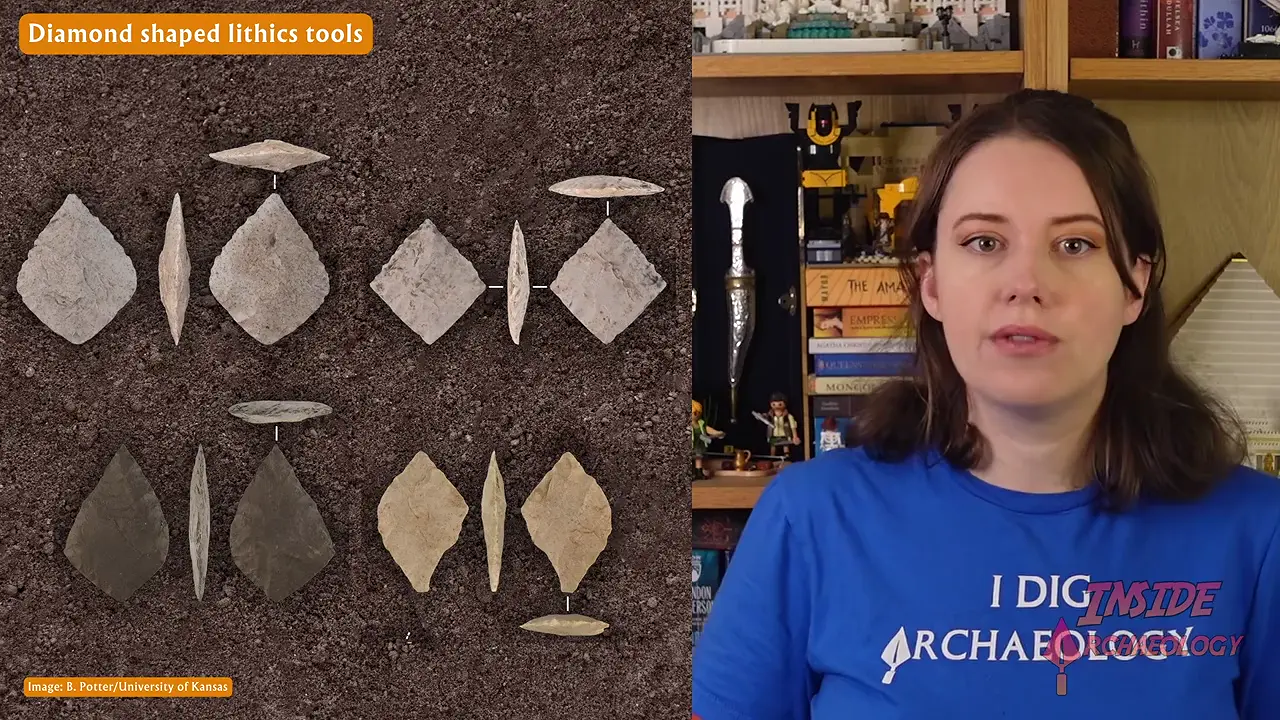
Shag Shag Thulti, 55 km south of Fairbanks on the Tanana River, yields 66 radiocarbon dates and three late Pleistocene occupation phases. Its oldest layer has diamond-shaped stone points tapering at both ends — some with ground edges near the base for hafting — quite unlike typical Alaskan early points 🪶
13,800-year-old Alaskan points match Siberian tools; possible earliest North American shelter
Site mentioned
📍 Shag Shag Thulti
Key facts
- The tools come from the site of Shag Shag Thulti, located 55 km south of Fairbanks, Alaska, on a bluff overlooking the Tanana River.
- The name means 'they were there' in the local Alaska Native Athabaskan language.
- 66 radiocarbon dates establish three phases of late Pleistocene settlement at the site.
- The oldest phase yielded worked stone and bone artifacts, thousands of animal bones from many species and preserved activity areas, unparalleled for sites of this age in the region.
- Highlights are diamond-shaped stone points tapering to both ends, several with carefully ground edges near the bases suggesting hafting to a handle, unlike typical triangular or teardrop-shaped Alaskan early points.
- Similarly shaped tools from two sites in northeastern Siberia date to roughly the same period.
- Both the Alaskan and Siberian assemblages lack microliths, the smallest stone tools usually under 5 cm long.
- Stone from 25 obsidian artifacts was sourced from 370 km away, implying extensive travel or a wide trade network.
- An oval feature of charcoal-rich sediment in the earliest occupation layer contained a hearth, a shallow pit, numerous artifacts and a possible post hole, implying a south-facing partial shelter or lean-to, potentially the earliest evidence of a human shelter in North America.
- A nearby concentration of charcoal, animal bones and fire-affected stones may be an earth oven used to cook meat and obtain dietary fat.
- No human remains were recovered for DNA analysis, so the number of populations that crossed into Alaska remains unresolved.
Sources
nature.com
Linked in video description
frontiersin.org
Linked in video description
bbc.co.uk
Linked in video description
arkeonews.net
Linked in video description
unitru.edu.pe
Linked in video description
sheffield.ac.uk
Linked in video description
What is a shabti?nationaltrust.org.uk
A shabti (also known as a shawabti or an ushabti) is a generally mummiform figurine of about 5–30cm found in many ancient Egyptian tombs.
2300-Year-Old Twelve-Legged Terracotta Sarcophagus ...arkeonews.net
Archaeologists in Chennai, Tamil Nadu, have uncovered a rare 2300-year-old terracotta sarcophagus with twelve legs in Pallavaram,
Was this story useful?
Keep exploring
Every site on this page sits on the globe, and the people who research them are on the Discord.
3D Globe · Sites by country · Story Archive · Research Library · Weekly Journal · Search
AI-generated text · images from the original sources · always verify with the sources.