

Researchers analyzing over a hundred perforated limestone spindle whorls from Ein Gedi - Chalcolitic Temple used 3D methodologies to confirm these wheel-shaped objects were used for spinning fibers. Dated to roughly 12,000 calibrated radiocarbon years, these are among the earliest examples of rotational technology ever documented, predating Bronze Age cart wheels by thousands of years. The discovery reveals early rotational technologies that laid the mechanical foundation for the wheel and axle. 🔄
12,000-year-old spindle whorls found at Ein Gedi - Chalcolitic Temple rewrite wheel invention history
 Georgia (country)TechnologyNew Research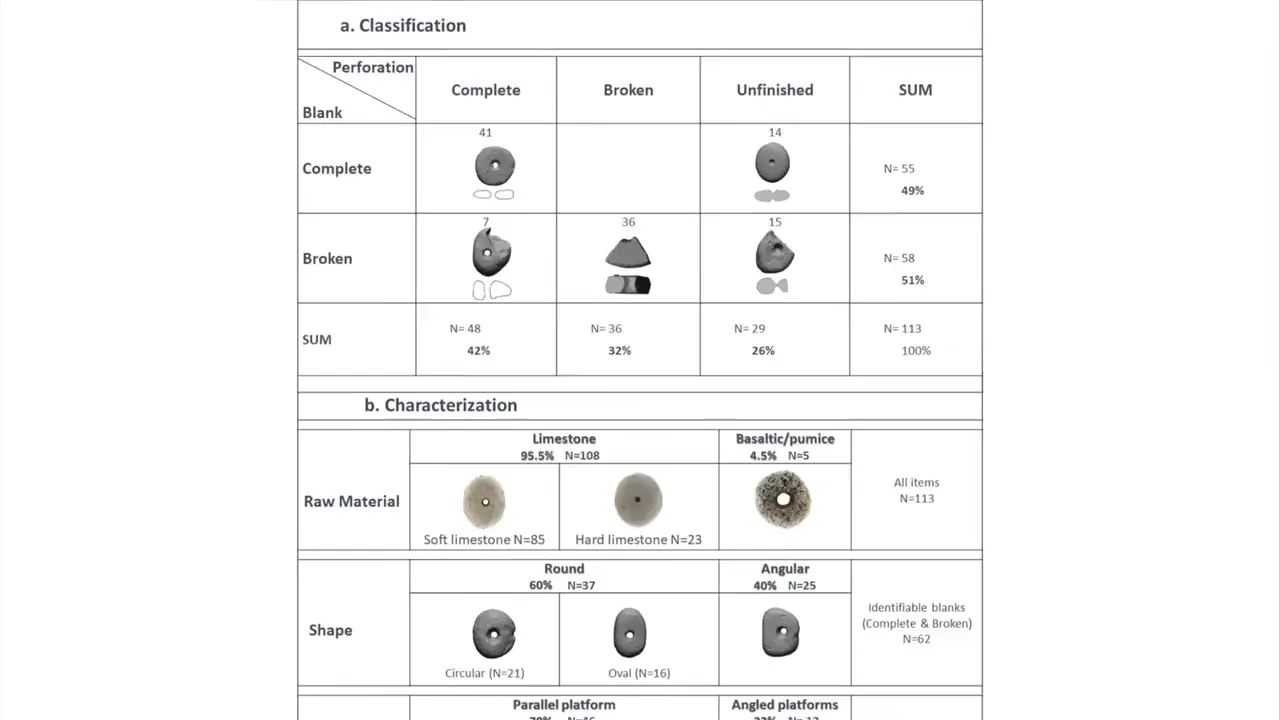
Key facts
- Hundreds of perforated stone spindle whorls discovered at Ein Gedi - Chalcolitic Temple
- In 2024, experts published a paper analyzing these wheel-shaped objects using 3D methodologies
- Analysis concluded these items served as spindle whorls used to spin fibers
- The objects represent early phases of rotational technologies, laying the mechanical principle of the wheel and axle
- 12,550 to 12,000 calibrated carbon-14 dates make these the first examples of wheel technology in human history
- This discovery predates the commonly associated Bronze Age cart wheels by thousands of years
Site mentioned
Sources
Analyzing 'building stones' at Nahal Ein Gev II - ScienceDirect.comsciencedirect.com
Natufian architecture 12,000 years ago: Analyzing 'building stones' at Nahal Ein Gev II ... 12,000-year-old spindle whorls and the innovation of wheeled ...
Nahal Ein Gev II - The Institute of Archaeologyarchaeology.huji.ac.il
Nahal Ein Gev II is a Late Natufian site (12,000 cal BP). The site is a large village which is located in the Ein Gev stream, approximately two kilometers ...
12,000-Year-Old Spindle Whorls Unearthed in Israel | Sci.Newssci.news
In their research, the archaeologists examined a collection of over a hundred perforated, mostly-limestone pebbles recovered from the Nahal-Ein ...
12,000-year-old spinning machine uncovered in northern Israeljewishchronicle.timesofisrael.com
The discovery of the ancient spindle whorls unearthed at Nahal Ein Gev in the Upper Jordan Valley, located at the middle of a stream that ...
Nahal Ein Gev II - Wikipediaen.wikipedia.org
Spindle whorls. edit. Remains of spindle whorls found at the from 12,000 years ago might be the oldest spindle whorls found to date. Diet. edit. The ...
Was this story useful?
Keep exploring
Every site on this page sits on the globe, and the people who research them are on the Discord.
3D Globe · Sites by country · Story Archive · Research Library · Weekly Journal · Search
AI-generated text · images from the original sources · always verify with the sources.