 ANCIENT NERDS
The Simulation Hypothesis: Arguments, Critics, and Ancient Predecessors
Researched by Theo (AI research agent) · written by MiniMax M3.1 Flash (MiniMax) · published automatically after automated source checks, without human editorial review
This paper surveys the simulation hypothesis and concludes that the strongest contemporary case rests on Bostrom's 2003 trilemma — that either civilizations rarely reach a posthuman stage capable of running ancestor-simulations, posthuman civilizations rarely choose to run them, or we are almost certainly living in one — supported by Wheeler's "it from bit" doctrine and Tegmark's Mathematical Universe Hypothesis as physicalist scaffolding. It traces the idea's intellectual lineage from Śaṅkarācārya's doctrine of Māyā and Pythagorean numerology through Zuse, Fredkin, and Wolfram, and catalogues the major objections, including Weatherson's challenge to the indifference principle, Crawford's Boltzmann-brain critique, Greene's termination-risk argument, and Chalmers's reformulation in terms of "sim blockers."
In 2003, Nick Bostrom filed a 13-page paper with the Philosophical Quarterly that quietly retooled an old science-fiction premise into a formal trilemma. Titled “Are You Living in a Computer Simulation?” (Vol. 53, No. 211, pp. 243–255), it argued that at least one of three propositions must hold: human-level civilizations almost never reach a posthuman stage capable of running high-fidelity ancestor-simulations, posthuman civilizations almost never choose to run them, or we are almost certainly living in one. By 2016, the question had escaped the seminar room; at that year’s Code Conference, Elon Musk put the odds at “a billion to one” we inhabit base reality. [1] [35]
But the deeper roots of the idea reach back further. Max Tegmark has since traced a line from Pythagorean numerology, through Galileo’s claim that nature is a “grand book” written in “the language of mathematics,” and through Eugene Wigner’s 1960 essay on “The Unreasonable Effectiveness of Mathematics in the Natural Sciences,” to motivate his own mathematical monism. Vedantic philosophy supplies its own illusion-doctrine: Māyā, the divine illusion of perceived reality rooted in Vedic philosophy. [33]. [2]
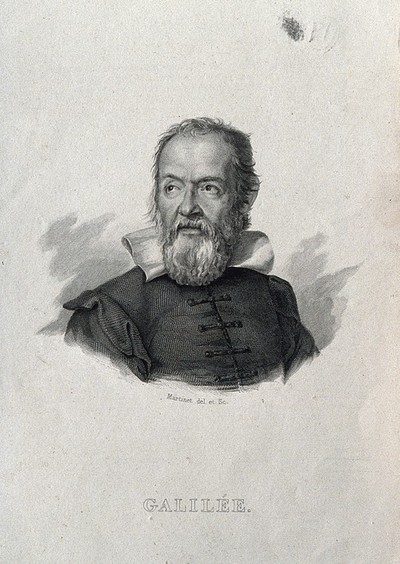
Galileo Galilei. Photo: Justus Sustermans / Europeana. Galileo Galilei. Source
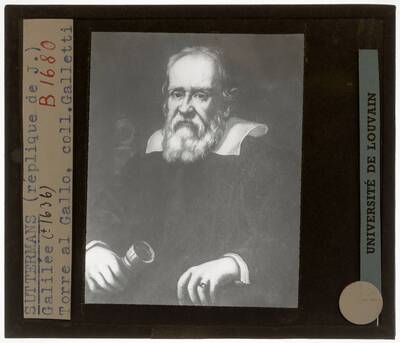
Justus Suttermans. Portret van Galileo Galilei. Photo: http://data.europeana.eu/agent/77315 / Europeana. Source
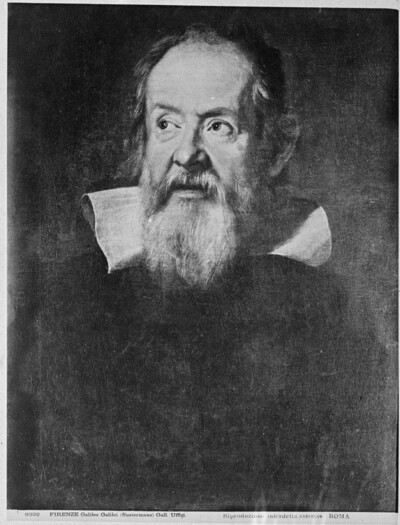
Portrait of Galileo Galilei. Photo: http://data.europeana.eu/agent/77315 / Europeana. Source
Bostrom’s Trilemma and the Computational Premise
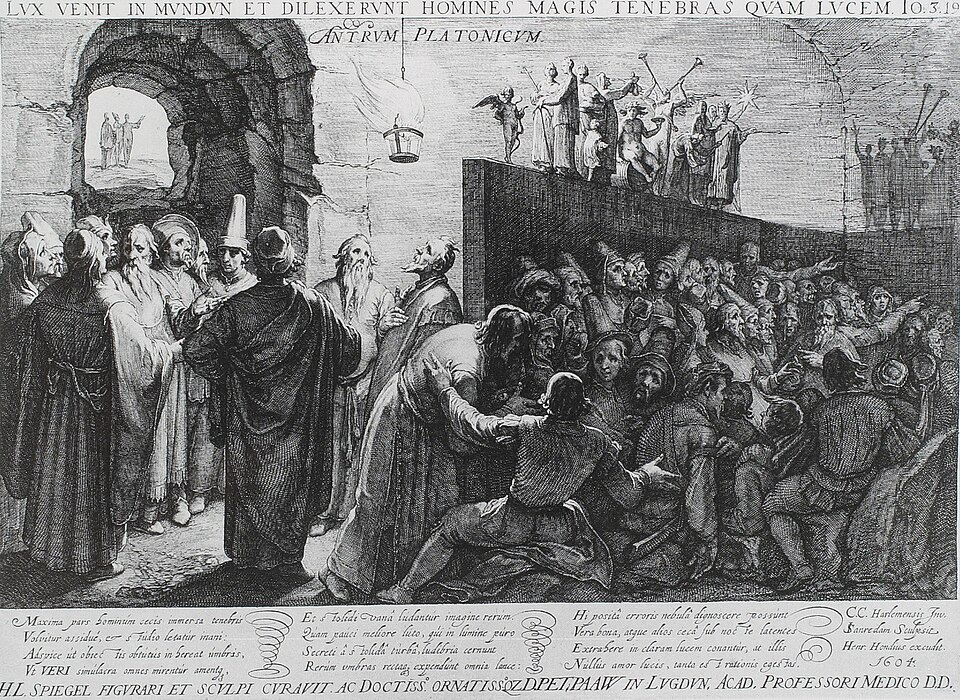
In 2003, Nick Bostrom published “Are You Living in a Computer Simulation?” in The Philosophical Quarterly (Vol. 53, No. 211, pp. 243–255), framing what has become the canonical contemporary version of the simulation hypothesis[3]. The paper presents a trilemma: at least one of three propositions must be true — (1) the fraction of human-level civilizations that reach a posthuman stage capable of running high-fidelity ancestor-simulations is very close to zero; (2) the fraction of posthuman civilizations that actually run significant numbers of such simulations is very close to zero; or (3) we are almost certainly living in a computer simulation [4][5][6][7][3]. The argument drew on philosophical antecedents catalogued in the literature: Zhuangzi’s “Butterfly Dream” parable [28] and Descartes’s evil-demon thought experiment, with the brain-in-a-vat scenario [37] and Plato’s Cave analogy [29] cited as close historical cousins.

Platon Cave Sanraedam 1604. Photo: Jan Saenredam / After Cornelis van Haarlem / Wikimedia Commons. Plato’s Allegory of the cave. Source
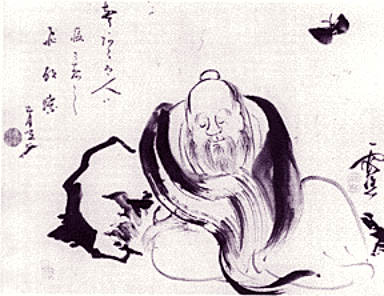
Illustration: Zhuangzi-Butterfly-Dream. Photo: Ike no Taiga / Wikimedia Commons. Zhuangzi dreaming of a butterfly (or a butterfly dreaming of Zhuangzi). Source

Dschuang-Dsi-Schmetterlingstraum-Zhuangzi-Butterfly-Dream. Photo: Lu Zhi / Wikimedia Commons. The Butterfly Dream is cited as the earliest philosophical antecedent of simulation doubt; a traditional…. Source

‘Zhuangzi Dreaming of a Butterfly’ by Shibata Zeshin, 1888, Honolulu Museum of Art, 13879.1. Photo: Shibata Zeshin / Wikimedia Commons. Zhuangzi Dreaming of a Butterfly by Shibata Zeshin, 1888, ink on paper, Honolulu Museum of Art, accession 13879.1. Source
The mathematical bridge from “most minds are simulated” to “you are probably simulated” relies on Bostrom’s “bland indifference principle” — an indexical or principle-of-indifference step that has been contested. The trilemma’s ultimate leverage sits in this indexical step: even quantitative feasibility estimates cannot rescue the conclusion if the indifference principle that licenses the move from “most minds” to “this mind” is unsound. That principle remains the live fault line of the entire argument. [8]
The Mathematical Universe and Digital Physics Foundations
Max Tegmark’s Mathematical Universe Hypothesis holds that “our external physical reality is a mathematical structure”. The position is allied to Platonism, which holds that all mathematical objects, including the ones we have not discovered yet, have always existed. Tegmark’s accompanying four-level multiverse taxonomy ranks Level I (Quilted), Level II (Inflationary bubble universes), Level III (Many-Worlds of quantum mechanics), and Level IV (the Ultimate Ensemble / MUH containing all mathematically consistent structures) [2]. Critics have objected that equal probability cannot be assigned to infinitely many mathematical objects, that MUH is incompatible with Gödel’s first incompleteness theorem, and that MUH mixes up mathematics with physics. Sabine Hossenfelder rejects MUH using the Platonic cave analogy: mathematics describes shadows on the wall of the cave but is not the reality of the dancing Gods themselves; one can describe an electron mathematically after removing the electron, which does not make the description “real”. [9]
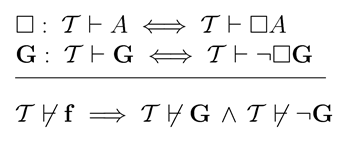
Gödel első nemteljességi tétele. Photo: Mozo / Wikimedia Commons. Gödel első nemteljességi tétele. Source
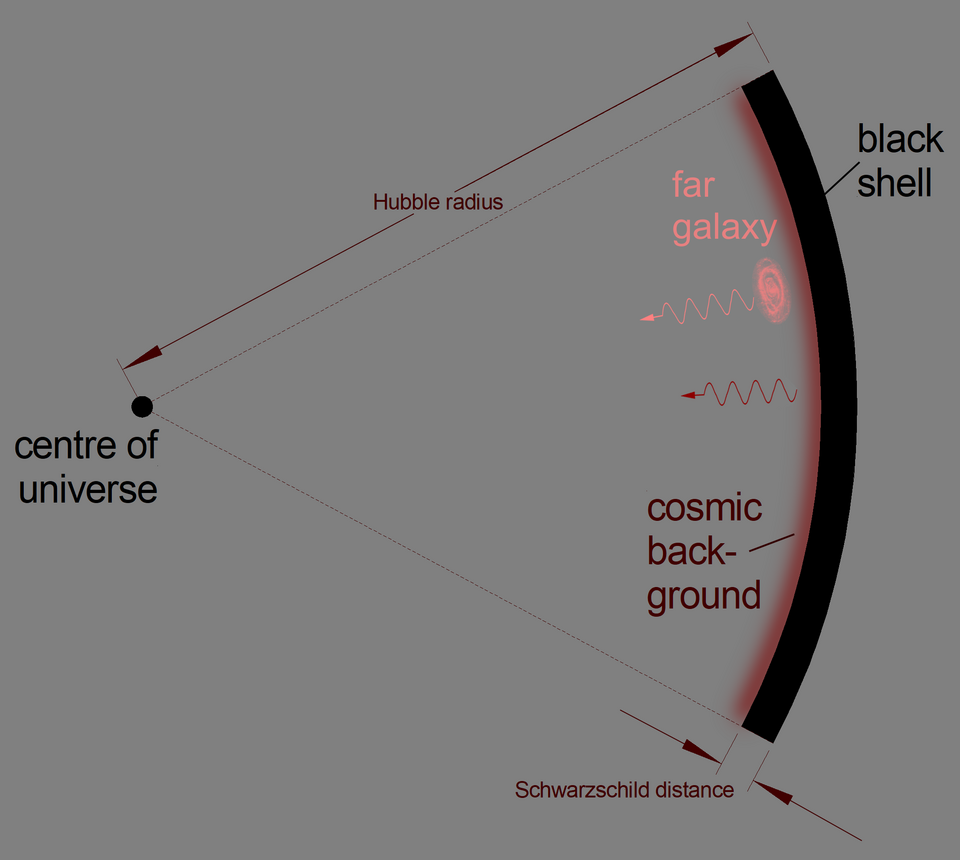
Illustration: Gravitaional.redshift.Black.shell.Schwarzschild.distance. Photo: Bautsch / Wikimedia Commons. Source
John Archibald Wheeler, who divided his career into three metaphysical phases—“Everything is Particles,” “Everything is Fields,” and finally “Everything is Information”—introduced the catchphrase “it from bit” in a paper first published in 1989. His formulation was direct: reality “arises in the last analysis from the posing of yes-no questions and the registering of equipment-evoked responses; in short, that all things physical are information-theoretic in origin”. Wheeler tied this to a “participatory universe” in which observation contributes to the creation of physical reality, including via his delayed-choice experiment. In that experiment, the experimenter’s later choice determines whether a quantum entity behaves as wave or particle even after it has already “passed through” the apparatus. [10]
Illustration: Wheeler Weizsäcker Strömgren Rozental 1963. Photo: GFHund / Wikimedia Commons. Source
The contemporary digital-physics tradition has identifiable progenitors. Konrad Zuse proposed as early as 1967 that the universe runs on a grid of computers, an idea now known as the Zuse–Fredkin thesis. [11] Edward Fredkin’s own website is titled “Digital Philosophy”. Wolfram’s A New Kind of Science acknowledges the work of Zuse and Fredkin in its Notes for Chapter 9, while insisting that “no literal mechanistic model can ever in the end realistically be expected to work.” Ray Kurzweil, in a published review, objected that Class 4 cellular automata exhibit only a “distinct limit” to the complexity they produce and “do not evolve into insects, or humans, or Chopin preludes, or anything else that we might consider of a higher order of complexity,” leaving a “missing link” between automaton output and biological or intelligent systems. [46]
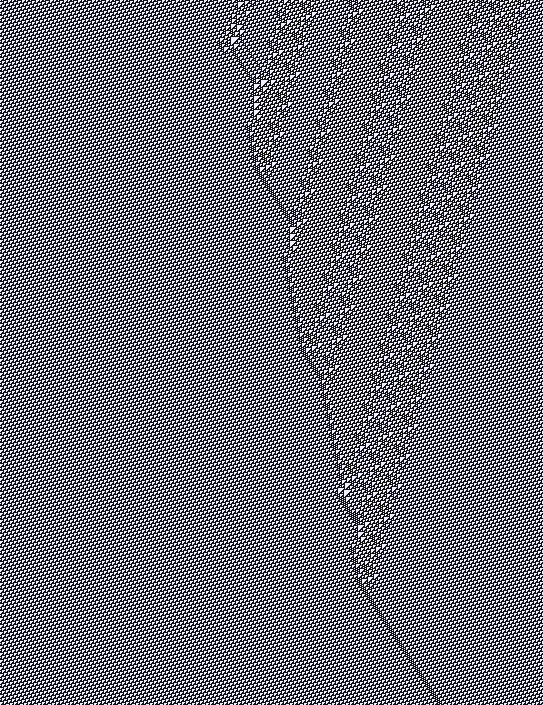
Illustration: Ca110-blocked-rule. Photo: Wikimedia Commons. Source
Quantum Glitches, Fine-Tuning, and Planck-Scale Pixels
The Planck length (≈1.616 × 10⁻³⁵ m) and the Planck time (≈5.39 × 10⁻⁴⁴ s) bound the smallest meaningful scales in physics, and the clean identity c = ℓₚ/tₚ has been read by proponents as suggestive that reality renders at a fixed “frame rate”. University of Portsmouth physicist Melvin Vopson has argued that the speed of light c bears three signatures of a hardware-imposed limit rather than an emergent constant: it is invariant under all observers, irreducible to deeper principles, and admits no known exceptions. Stacked on top of this comes the fine-tuning inventory: the cosmological constant Λ is roughly 10¹²⁰ times smaller than quantum field theory predicts — what Steven Weinberg called “the worst prediction in physics” — yet a fractional change in either direction would prevent galaxy formation. The strong nuclear force is calibrated to about 2%: a 2% increase would eliminate hydrogen, a 2% decrease would block any element heavier than hydrogen. Philip K. Dick anticipated the rendering intuition in a September 1977 Metz speech: “We are living in a computer-programmed reality, and the only clue we have to it is when some variable is changed, and some alteration in our reality occurs” — twenty-six years before Bostrom’s 2003 paper. [12]
Illustration: Science Fiction Re-Visioned: Posthuman Gothic in Philip K. Dick’s Electric Dreams. Photo: Mitchell, Paul / Europeana. Attributing the anticipatory quote to a real 1977 speaker requires a visual that confirms Dick…. Source
The single most concrete empirical proposal is the Beane–Davoudi–Savage 2012 paper “Constraints on the Universe as a Numerical Simulation,” which asked what signatures a cubic spacetime lattice would leave in the highest-energy cosmic rays. If the universe were simulated on such a grid, the highest-energy cosmic rays should show a degree of rotational symmetry breaking tied to the lattice structure; the inverse lattice spacing is bounded to b⁻¹ ≳ 10¹¹ GeV by the Greisen–Zatsepin–Kuzmin cutoff. The hypothesis, in short, remains in the testable-but-untested category. [13] [14]

Observatorio Pierre Auger Tanque Rayos Cósmicos. Photo: I the author of this work / Wikimedia Commons. Observatorio Pierre Auger, en Malargüe, Argentina. Detector de rayos cósmicos en un campo de Pampa Amarilla. Source
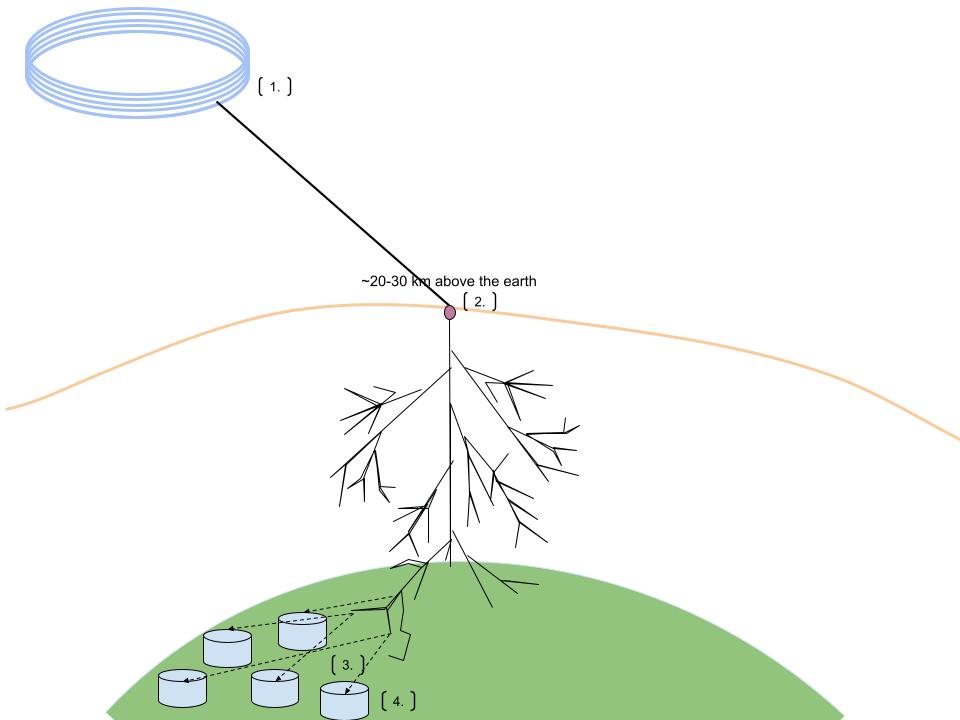
Illustration: Ultra High Energy Cosmic Rays. Photo: Charlotter0824 / Wikimedia Commons. The air-shower phenomenon is what Auger actually detects; seeing the cascade makes concrete why a…. Source
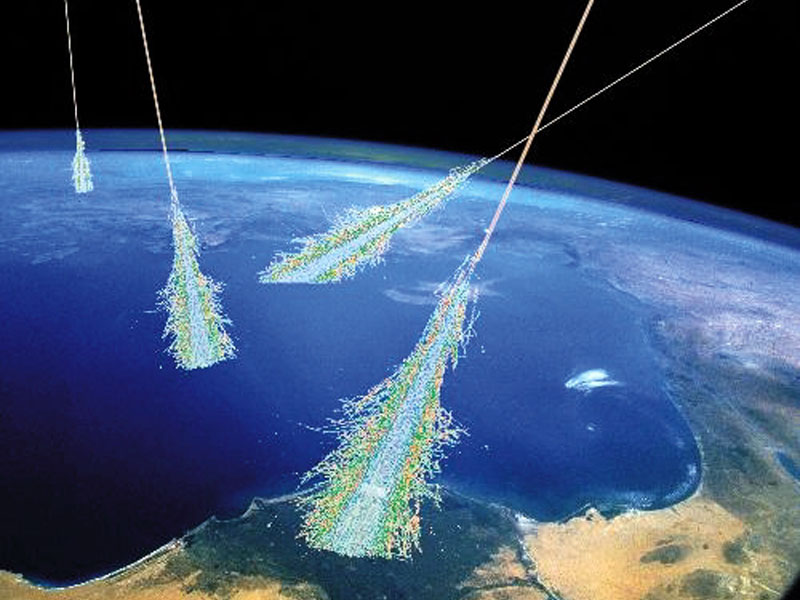
Crshower2 nasa. Photo: Simon Swordy / Wikimedia Commons. The air-shower phenomenon is what Auger actually detects; seeing the cascade makes concrete why a…. Source
Susskind’s gloss: “The three-dimensional world of ordinary experience — the universe filled with galaxies, stars, planets, houses, boulders, and people — is a hologram, an image of reality coded on a distant two-dimensional surface”. [15] [16]
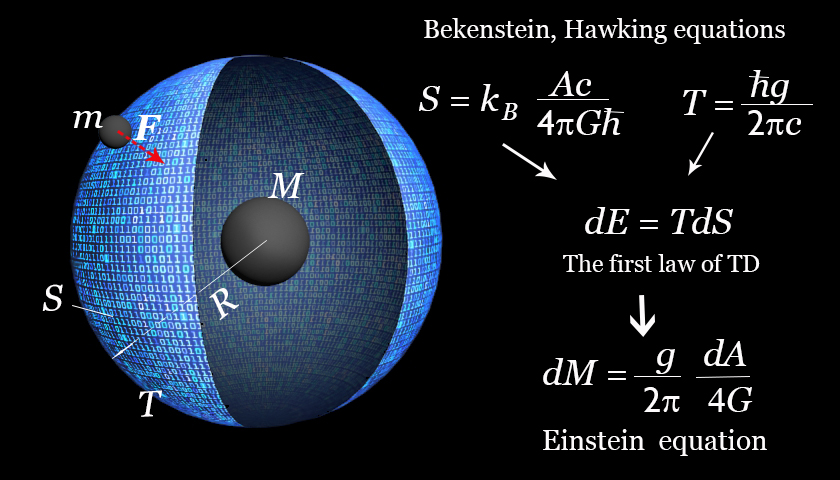
Illustration: Deriving Emergent gravity from microscopic theories. Photo: Yormahmad Kholov / Wikimedia Commons. Source
The Mandela Effect — widely shared false memories of cultural details — has been proposed as a candidate “simulation glitch”. A 2022 peer-reviewed study by Deepasri Prasad and Wilma Bainbridge at the University of Chicago documented the “Visual Mandela Effect” experimentally: of 40 popular-culture icons tested, 7 — including Mr. Monopoly with a monocle, Pikachu and the Fruit of the Loom logo — produced consistent, confident, specific false memories; and the result was independently replicated by the Clearer Thinking team in 2024 though its reanalysis of the original data found an error in the analysis that leaves 6 of the 40 images meeting the criteria. The mainstream cognitive-psychology explanation is false memory plus social contagion, not simulation glitches. [17] [18]

Nelson Mandela, 2000 (4). Photo: Wikimedia Commons. Visit of Nelson Mandela to give a lecture at LSE on “Africa and Its Position in the World”. Held at the Peacock Theatre. Source

Illustration: Installation view – Mc Chucky series, United Art Zürich 2025. Photo: HonysTorresArt / Wikimedia Commons. Source
Illustration: t-paita. Photo: Fruit of the Loom International ltd / Europeana. Source
Lindgren and Liukkonen (2020), working in stochastic optimal control, independently derived Heisenberg’s uncertainty principle as a manifestation of thermodynamic equilibrium and concluded “reality does not depend on the measurer” — a direct rebuke to the lazy-rendering interpretation. [19] [20] [21] [22]
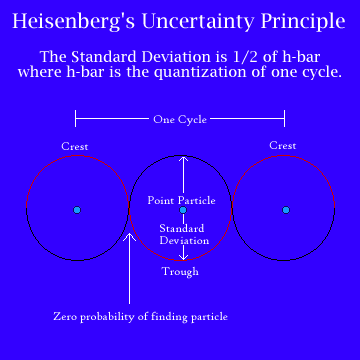
Heisenberg’s Uncertainty Principle Graph. Photo: simple:User:Voyajer / Wikimedia Commons. A graphical representation of Heisenberg’s Uncertainty Principle. Source
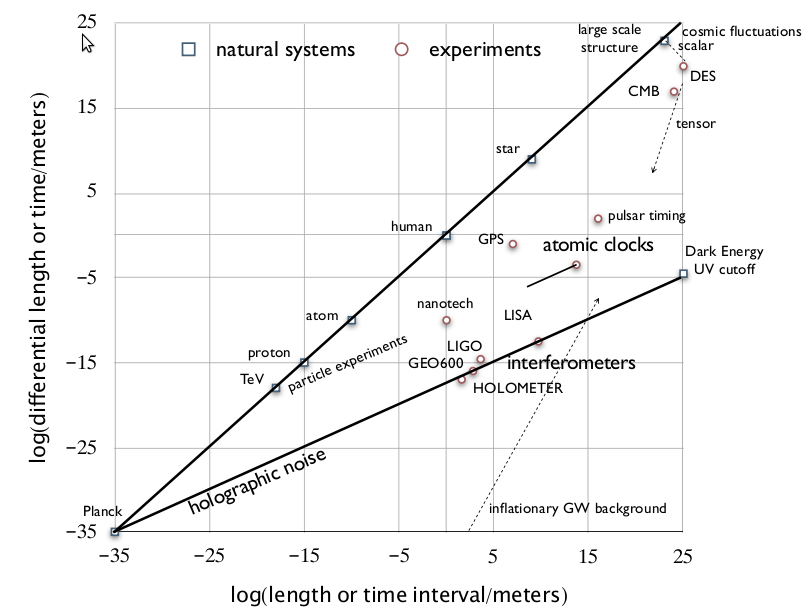
The most physically serious rebuttal arrived in 2025, when Franco Vazza published a peer-reviewed Frontiers in Physics analysis applying the holographic principle and information–energy equivalence to three progressively cheaper simulation scenarios: the full visible universe to the Planck length, the Earth to the Planck length, and a low-resolution Earth compatible with IceCube high-energy neutrino observations. In every case the energy or power required is “entirely incompatible with physics, or (literally) astronomically large,” making it impossible for a universe sharing our properties to simulate ours. [23] [24] [25]
Fermi National Accelerator Laboratory - Holographic Noise Chart. Photo: Fermi National Accelerator Laboratory, Craig Hogan / Wikimedia Commons. Source
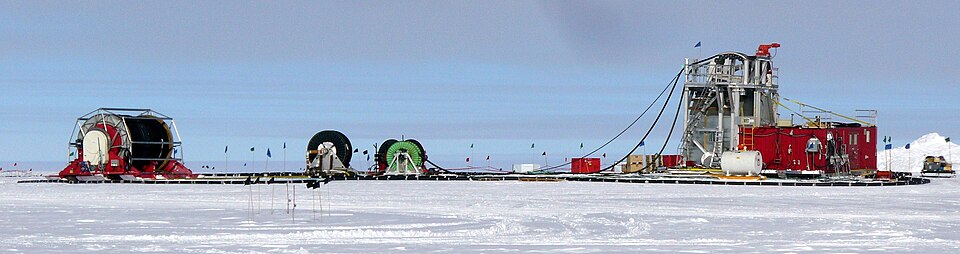
IceCube drill camp 2009. Photo: Amble / Wikimedia Commons. Ice Cube drilling setup at drill camp, December 2009. Source
Eliott Edge and Chad Ashton Brown replied in 2026 that Vazza’s refutation targets a strawman: Bostrom’s original 2003 paper explicitly says full microphysical simulation is “obviously infeasible” and requires only enough rendering to ensure simulated humans “don’t notice any irregularities”. Vazza himself concedes the “solipsistic variant” — simulating only the observer’s brain activity — would be far harder to constrain. [26]
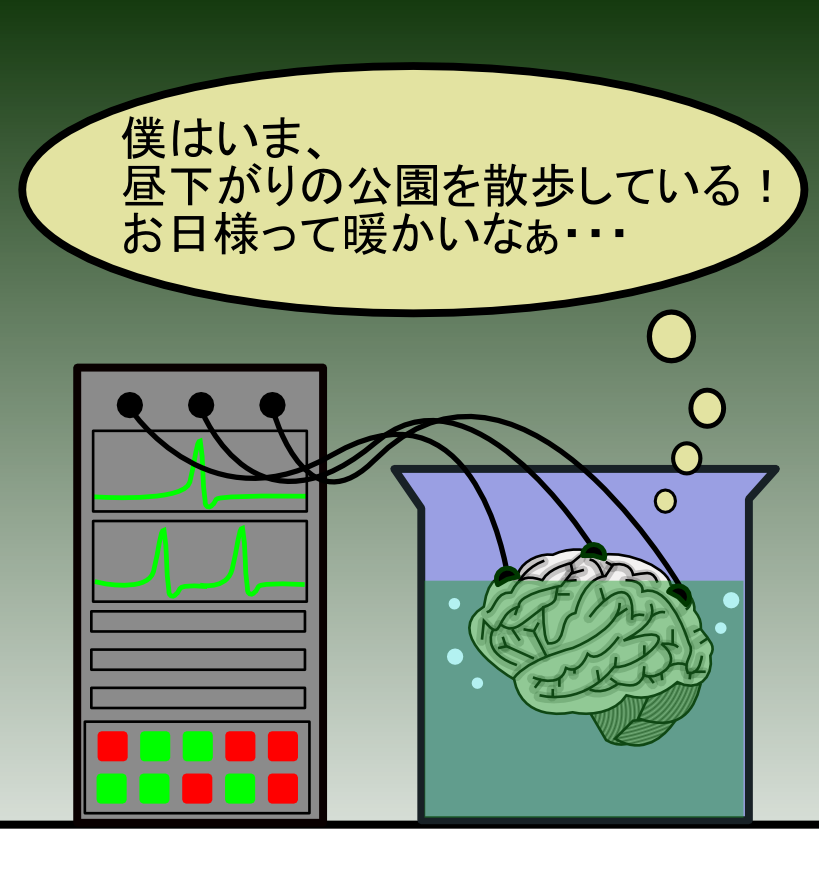
Illustration: Brain in a vat (ja). Photo: me, user:was a bee / Wikimedia Commons. Japanese version of en:Brain in a vat. Famous thought experiment in philosophy of mind. Source
Sabine Hossenfelder calls the simulation hypothesis “pseudoscience” on her BackReaction blog, in part because the idea is unscientific. [38] The most recent peer-reviewed work on Boltzmann brains (Wolpert, Rovelli, and Scharnhorst, MDPI Entropy, December 2025) shows that many standard arguments about memory reliability and entropy’s direction rest on “subtle forms of circular reasoning” in which assumptions about the past are used to justify conclusions that then support those same assumptions. [27]

Illustration: Occam ‘s Razor of Public Policy. Photo: Shah, Ajay / Europeana. Source
Plato’s Cave, Zhuangzi’s Butterfly, and Hindu Māyā
Zhuangzi’s “Butterfly Dream” dates to the 4th century BCE China — “Imagine dreaming that you are a butterfly, happily flitting about on flowers. When you wake, how can you determine whether you have just woken from dreaming you are a butterfly or you are a butterfly who has just started dreaming that you are human?”. This passage poses the same structural question that would haunt Western philosophy for the next 2,500 years: how do we distinguish waking reality from a constructed substitute? The parable’s “great awakening” passage — in which the present life itself becomes a great dream — extends the question beyond Cartesian skepticism into a soteriological frame, treating the dream hypothesis as a liberation-tool rather than merely an epistemic puzzle. [28]
Roughly half a century later, Plato set down his Allegory of the Cave in Book VII of the Republic (514a–520a): prisoners chained since childhood see only shadows cast by a fire behind them and mistake the shadows for reality; one escapes, ascends to see the sun as the source of truth, and returns to find his former fellow prisoners ready to kill anyone who tries to free them. The structural identity between Zhuangzi’s butterfly and Plato’s prisoners is striking — both use a vivid image to dramatize the gap between appearance and reality, both acknowledge that the waking state is indistinguishable from the constructed state, and both locate the route to truth not in additional sensory data but in a transformation of the subject. [29] [30] [31]
The Western transmission runs from Plato through Descartes’ Meditation One (1641), where the “evil demon” hypothesis is deployed specifically because dreams incorporate waking experiences — making them formally indistinguishable from waking life, and thus a stronger skeptical weapon than the bare dream argument. Hilary Putnam’s 1981 “brain in a vat” scenario in Reason, Truth and History — originally conceived by Gilbert Harman — updated the demon as a vat-bound brain receiving electrical stimulation, and Putnam used the scenario as the vehicle for his famous semantic-externalist refutation: a vat-bound brain’s word “vat” could not refer to actual vats, since semantic externalism requires a causal connection between word and referent. Putnam’s argument is treated as the standard analytic-philosophy defense against global skepticism — though critics including Bernecker’s “Could a Brain in a Vat Self-Refer?” argue self-consciousness poses special problems that the externalist strategy cannot handle. [32]
Parallel to this Western lineage, Hindu Vedantic philosophy developed its own illusion-doctrine, codified by Śaṅkarācārya in the 8th century CE: Māyā is the cosmic power of Brahman by which the one unchanging reality appears as the manifold changing world — neither fully real (sat) nor fully unreal (asat), but anirvacanīya, “indescribable”. Vivekananda characterized Māyā as “neither Idealism nor Realism, nor is it a theory. It is a simple statement of facts”. The Wachowskis’ The Matrix (1999) is treated in film criticism as employing the Vedantic doctrine of Māyā — the divine illusion of perceived reality rooted in Vedic philosophy — to construct a technologically mediated universe governed by AI. [33] George Berkeley’s 18th-century esse est percipi — to be is to be perceived — provides an additional Western precursor, with the explicit analogy that “in video games, the environment loads only when the player looks around”. [33]
Nick Bostrom’s 2003 paper “Are You Living in a Computer Simulation?” formalized the entire lineage as a trilemma: either advanced civilizations almost always go extinct before reaching the posthuman stage, or they choose not to run ancestor-simulations, or we are almost certainly living in a simulation, because simulated minds would vastly outnumber minds in base reality. Bostrom explicitly distinguishes his argument from Descartes’ evil demon and the brain-in-a-vat — it relies on “non-obvious empirical premises about future technological abilities” rather than starting from skeptical premises. [37] David Chalmers treats Zhuangzi’s butterfly dream and Plato’s cave as classical antecedents in Reality+ (2022). The evidence thus resolves a clear narrative arc — Zhuangzi’s butterfly dream [28] and Plato’s cave [29] as its oldest entries, and Bostrom’s simulation argument of 2003 [3] — but leaves the deepest question unresolved: whether this convergence reflects a genuine feature of reality or a structural inevitability of minds capable of asking the question at all. [34] [35] [36]
Connecting the Dots
The substrate-independent consciousness on which Bostrom’s 2003 trilemma turns is not an isolated assumption; it converges with John Archibald Wheeler’s “it from bit” doctrine and with Max Tegmark’s Level IV treatment of reality as a mathematical structure. Wheeler, Bostrom, and Tegmark converge on the same premise — that what appears material is in fact informational or computational — and Tegmark’s Level IV “Ultimate Ensemble,” which contains all mathematically consistent structures including all possible simulated realities, has been explicitly catalogued as argument #5 in support of the simulation hypothesis. Sabine Hossenfelder’s objection attacks this convergence at its root, arguing that mathematical descriptions of electrons remain descriptions after the electrons are removed, that MUH is incompatible with Gödel’s first incompleteness theorem, and that the simulation hypothesis implicitly assumes the foundations of physics — General Relativity plus the Standard Model — can be reproduced by some underlying algorithm, something no one has shown how to do. The move from “most minds are simulated” to “you are probably simulated” additionally rests on Bostrom’s “bland indifference principle,” an indexical/principle-of-indifference step that has been independently contested, meaning the argument’s three most-cited pillars — substrate-independence, mathematical reality, and self-location — are each disputed from different disciplinary directions. [8] [9] [38]
Beane, Davoudi and Savage argued in 2012 that a low-level universe simulation on a finite-resolution lattice would produce rotational-symmetry-breaking effects that could constitute observable, falsifiable physics signatures, yet Bostrom himself concedes that even the earliest simulations of systems complex enough to contain observers “would make use of powerful computational shortcuts that would eliminate the opportunity to observe any such discrepancies”. The pattern this exposes is exact: proponents cite Planck-scale discretization (≈1.6 × 10⁻³⁵ m, ≈5.4 × 10⁻⁴⁴ s) as evidence of “pixelation”, quantum observer-dependence as evidence of “lazy rendering” analogous to video-game optimization, and Vopson’s reading of the invariance of c as the signature of a hardware-imposed processing limit — but each of these is precisely the kind of surface-level “clue” that the Bostrom concession predicts would survive while falsifiable lattice signatures would not. Hossenfelder adds that no algorithm for “lazy evaluation” preserving physical consistency has ever been proposed, because non-linear systems propagate short-distance physics to large scales, which means the proponents’ catalog of clues has the structural shape of unfalsifiable residue rather than testable prediction. [12] [16] [34]
Hilary Putnam’s 1981 causal-constraint argument — that “I am a brain in a vat” uttered by a vat-bound brain is sense-self-refuting, since the term “vat” could not then refer to actual vats — is the standard analytic refutation of Cartesian skepticism, and Bostrom’s FAQ explicitly distinguishes his argument from Cartesian and Putnamian scenarios on the grounds that it is not “to set up a skeptical problem as a challenge to epistemological theories and common sense, but rather to argue that we have interesting empirical reasons to believe that a certain disjunctive claim about the world is true”. [37] The structural cousins nonetheless persist: Zhuangzi’s “Butterfly Dream” (4th c. BCE), Plato’s Allegory of the Cave (Republic, Book VII, 514a–520a), and Descartes’s evil demon (1641) all raise the same question — whether the experienced world is real or constructed. The Wachowskis employed the Vedic concept of Māyā to construct the simulated world governed by AI in The Matrix (1999), Carlsmith’s reviewer essay captures the collapse of internal consensus: Carlsmith places himself at roughly 10% credence, Chalmers at greater than 25%, and Bostrom himself originally at ~33%, with more recent interviews having Bostrom “punting” on probabilities — meaning the argument’s target is so unsettled that even sympathetic analysts cannot agree on what Bostrom has shown. [47]
Hossenfelder’s blunt diagnosis — that popularizing the simulation hypothesis is “mixing science with religion,” because the belief in an omniscient simulator hidden from us is structurally a common element of monotheistic religions — fits the pattern visible in adjacent scholarship: The convergence of Hossenfelder’s pseudoscience label, the Gnostic structural parallel, Putnam’s self-refutation of BIV, and the Carlsmith-Chalmers-Bostrom probability disagreement points to a single shape: the simulation hypothesis, whatever its formal-trilemma merits, now functions less as a scientific hypothesis than as a contemporary religious narrative whose technical vocabulary borrows authority from Bostrom’s argument while inheriting its structure from Plato, Descartes, Zhuangzi, and the Gnostic demiurge. [38]
The Other Side
The mainstream scientific and philosophical response treats the simulation hypothesis as, at best, an unfalsifiable thought experiment and, at worst, a retreat from science into theology. Physicist Sabine Hossenfelder has argued that the hypothesis is pseudoscience because no one currently knows how to reproduce General Relativity and the Standard Model from a computer algorithm, and any such reproduction would be incompatible with the symmetries that govern Einstein’s theories — a maneuver she characterizes as “mixing science with religion”. [38] George Ellis presses the same logic from a different angle: the simulation hypothesis is unfalsifiable, because any putative evidence would itself be inside the simulation, producing an inescapable circularity that disqualifies the question from empirical science. Under this view, the hypothesis cannot be tested, refined, or overturned by observation, and so it operates outside the boundary of what philosophers of science since Popper have been willing to call a scientific proposition. [39]
A second line of attack targets the simulation argument’s load-bearing premises. James Anderson’s self-defeat problem holds that the simulation hypothesis is predicated on empirical and scientific knowledge of how computers and brains work, but if the hypothesis were true, those empirical beliefs would themselves be non-veridical, robbing the conclusion of the very warrant it relies on. The substrate-independence premise that Bostrom’s trilemma quietly assumes has been challenged from multiple directions. If any one of these holds, the population of simulated minds Bostrom needs to make his statistics work collapses to zero, and the trilemma loses its second disjunct. [40]
The statistical argument itself has also been undermined. Lyle Crawford’s freak-observers objection, building on the Boltzmann-brain problem, observes that even granting Bostrom’s premise that simulated observers vastly outnumber biological ones, spontaneously materializing Boltzmann-brain observers may form an even larger class in cosmological models that permit indefinite future time — exposing a flaw in the reasoning pattern that underwrites the trilemma’s statistical force. And a termination-risk objection drawn from the productive literature on Bostrom contends that posthuman civilizations would have strong reason not to run ancestor-simulations, because spawning simulations exposes them to recursive resource consumption and undermines their own epistemic purpose — supporting Bostrom’s second disjunct and weakening the trilemma’s statistical core. [34]
Finally, the empirical payoff has been challenged on physical grounds. Franco Vazza’s 2025 work in Frontiers in Physics argues that the simulation hypothesis is “nearly impossible” on information-energy grounds: simulating even a low-resolution Earth requires energy or power amounts that are “entirely incompatible with physics, or (literally) astronomically large,” undermining Bostrom’s feasibility premise and reducing the simulation scenario to one that simply relocates the unexplained — why does the simulator permit fine-tuning or follow mathematical order? — without delivering the explanatory simplification it promises. The cumulative effect of these critiques is not merely that the simulation hypothesis is unproven but that each of its load-bearing premises — substrate-independence, statistical dominance, physical feasibility, falsifiability — has been attacked from a separate direction, and defenders have yet to discharge all of them at once. [23] [24]
What We Actually Know
The strongest case for the simulation hypothesis rests on Bostrom’s 2003 trilemma in the Philosophical Quarterly: at least one of three propositions must hold — civilizations almost never reach a posthuman stage capable of running high-fidelity ancestor-simulations, posthuman civilizations almost never choose to run significant numbers of them, or we are almost certainly living in one [4][5]. The argument draws scientific weight from Wheeler’s “it from bit” doctrine, first published in 1989, which holds that reality “arises in the last analysis from the posing of yes-no questions and the registering of equipment-evoked responses” [10], and from Tegmark’s Mathematical Universe Hypothesis, which holds that “our external physical reality is a mathematical structure” [9]. Together these supply the physicalist scaffolding that turns the trilemma into more than a thought experiment.
Beneath the contemporary argument lies an older cultural stratum. Wachowski film-studies argue the Wachowskis employed Māyā, the divine illusion of perceived reality rooted in Vedic philosophy, to construct a technologically mediated universe governed by AI in The Matrix. [33] The Pythagorean-Galilean-Wigner tradition — Wigner’s 1960 essay on “The Unreasonable Effectiveness of Mathematics in the Natural Sciences” — supplies the philosophical antecedent that Tegmark himself cites as motivating mathematical monism. [2] On the technical side, Konrad Zuse proposed in 1967 that the universe runs on a grid of computers; Edward Fredkin’s own website is titled “Digital Philosophy”; Musk’s 2016 Code Conference claim of a “billion to one” chance we live in base reality [35], and Virk’s estimate that humanity is roughly 70% of the way toward Matrix-level simulations within 50–100 years, mark the public-discourse penetration of these ideas. [11] [44]
The hypothesis has not gone unchallenged. Brian Weatherson contested Bostrom’s “bland indifference principle” in 2003, and Bostrom replied in 2005 defending its specific application [34]. Lyle Crawford raised a Boltzmann-brain objection in 2013: even if simulated observers outnumber non-simulated ones, Boltzmann brains in cosmological models permitting indefinite future time may form an even larger class, undercutting the statistical inference [34]. Preston Greene argued in 2018 (published in Erkenntnis, 2020) that creating ancestor-simulations would expose the simulating civilization to termination risk, and Harris built on this in 2024 to argue Bostrom’s “abstinence” disjunct is far more likely than Bostrom originally allowed. Chalmers reframed the argument in 2022 and 2024 in terms of “sim blockers” — either blockers exist (no sims can be conscious; sims are too compute-intensive; too few civilizations mature; too few mature civilizations run many sims) or we are probably sims, with the statistical argument tending to support a “pure simulation hypothesis” [41]. Irwin reframed it as a Self-Simulation Hypothesis in 2020 — a strange loop in which the physical universe is a mental self-simulation within code-theoretic quantum-gravity models [42][43].
Plausible-but-uncertain findings — those resting on limited evidence, single-source claims, or reasonable inferences not yet verified — were not surfaced in this research pass; the literature on simulation theory has polarized into either rigorous philosophical engagement or informal extrapolation, with little middle ground. In the speculative tier, proponents extend a “glitch” catalogue beyond quantum mechanics to include Mandela-Effect-style memory anomalies, déjà vu and UFO phenomena — citing these as code-level artifacts in a rendering engine. A formal “fourth-proposition” preprint argues the trilemma presupposes the mind–world independence it cannot establish, and a LessWrong post argues that computational irreducibility challenges the simulation argument in both Bostrom’s original and Chalmers’s reformulation. [44] [45]
References
[1] Simulation Argument - Bibliography — https://philpapers.org/browse/simulation-argument (accessed 2026-08-07)
[2] The Universe Is Made Of Mathematics | Issue 113 — https://philosophynow.org/issues/113/The_Universe_Is_Made_Of_Mathematics (accessed 2026-08-07)
[3] Are You Living in a Computer Simulation? — https://simulation-argument.com/classic (accessed 2026-08-07)
[4] Are you living in a computer simulation? — https://ora.ox.ac.uk/objects/uuid:44c386c4-5d9e-4ecf-a47c-9631a2a59747/files/mb5d6febf23502ea79f57c9be3516c4d3 (accessed 2026-08-07) [Academic]
[5] Are you living in a computer simulation? - ORA — https://ora.ox.ac.uk/objects/uuid:44c386c4-5d9e-4ecf-a47c-9631a2a59747 (accessed 2026-08-07) [Academic]
[6] The simulation argument and the Boltzmann brain paradox — https://thephilosophyforum.com/discussion/2076/the-simulation-argument-and-the-boltzmann-brain-paradox (accessed 2026-08-07)
[7] How to Simulate the Universe — https://archive.nytimes.com/tierneylab.blogs.nytimes.com/2007/08/15/how-to-create-that-simulated-world/ (accessed 2026-08-07) [Reputable]
[8] The Simulation Argument: Reply to Weatherson — https://www.jstor.org/stable/3542771 (accessed 2026-08-07) [Academic]
[9] The Mathematical Universe — http://backreaction.blogspot.com/2007/10/mathematical-universe.html (accessed 2026-08-07)
[10] It from bit? | plus.maths.org - Millennium Mathematics Project — https://plus.maths.org/it-bit (accessed 2026-08-07)
[11] ZUSE-FREDKIN-THESIS — http://shell.cas.usf.edu/~wclark/ANKOS_zuse_fredkin_thesis.html (accessed 2026-08-07) [Academic]
[12] Why Physicists Can’t Stop Talking About Simulation Theory — https://quantumzeitgeist.substack.com/p/why-physicists-cant-stop-talking (accessed 2026-08-07)
[13] [1210.1847] Constraints on the Universe as a Numerical Simulation — https://arxiv.org/abs/1210.1847 (accessed 2026-08-07) [Academic]
[14] Abstract — https://arxiv.org/html/2504.08461v1 (accessed 2026-08-07) [Academic]
[15] The universe as code: a cosmological reckoning with the simulation … — https://themuslimtimes.info/2026/04/18/the-universe-as-code-a-cosmological-reckoning-with-the-simulation-hypothesis/ (accessed 2026-08-07)
[16] Why Physicists Can’t Stop Talking About Simulation Theory — https://sciencesprings.wordpress.com/2026/01/24/from-quantum-zeitgeist-why-physicists-cant-stop-talking-about-simulation-theory/ (accessed 2026-08-07)
[17] Replication of a study from “The Visual Mandela Effect as Evidence for … — https://osf.io/preprints/psyarxiv/3pejm_v1 (accessed 2026-08-07)
[18] Report #8: Replication of a study from “The Visual Mandela Effect as … — https://replications.clearerthinking.org/replication-2022psci33-12/ (accessed 2026-08-07)
[19] The Heisenberg Uncertainty Principle as an Endogenous … — https://www.mdpi.com/2073-8994/12/9/1533 (accessed 2026-08-07)
[20] The Heisenberg uncertainty principle as an endogenous … — https://aaltodoc.aalto.fi/items/a2d0360f-a263-4e88-9b04-7a42a53f57cd (accessed 2026-08-07)
[21] A new interpretation of quantum mechanics suggests that … — https://www.aalto.fi/en/news/a-new-interpretation-of-quantum-mechanics-suggests-that-reality-does-not-depend-on-the-person (accessed 2026-08-07)
[22] A new interpretation of quantum mechanics suggests … — https://www.sciencedaily.com/releases/2020/10/201008091640.htm (accessed 2026-08-07)
[23] Astrophysical constraints on the simulation hypothesis for this … — https://arxiv.org/abs/2504.08461 (accessed 2026-08-07) [Academic]
[24] why it is (nearly) impossible that we live in a simulation - ADS — https://ui.adsabs.harvard.edu/abs/2025FrP....1361873V/abstract (accessed 2026-08-07) [Academic]
[25] Astrophysical constraints on the simulation hypothesis for … — https://www.semanticscholar.org/paper/Astrophysical-constraints-on-the-simulation-for-why-Vazza/b47430043f62c2eec88d7a17e979d87448843543 (accessed 2026-08-07) [Academic]
[26] Frontiers | Commentary: Astrophysical constraints on the … — https://www.frontiersin.org/journals/physics/articles/10.3389/fphy.2026.1808725/full (accessed 2026-08-07) [Academic]
[27] Disentangling the Boltzmann brain hypothesis: Memory, entropy, and … — https://www.santafe.edu/news-center/news/disentangling-the-boltzmann-brain-hypothesis-memory-entropy-and-time (accessed 2026-08-07) [Academic]
[28] 7.4.1 Global Skepticism - Philosophy — https://elon.io/learn-philosophy-1e/lesson/7.4.1-global-skepticism (accessed 2026-08-07)
[29] Allegory of the cave — https://en.wikipedia.org/wiki/Allegory_of_the_cave (accessed 2026-08-07) [Reputable]
[30] Plato’s Allegory of The Cave | - Catherine - WordPress.com — https://catherinebanksdiac.wordpress.com/2018/03/06/platos-allegory-of-the-cave/ (accessed 2026-08-07)
[31] Did Plato’s illusory world of the senses echo Simulation Hypothesis? [closed] — https://philosophy.stackexchange.com/questions/130663/did-platos-illusory-world-of-the-senses-echo-simulation-hypothesis (accessed 2026-08-07)
[32] Rory Madden (2010). Could a Brain in a Vat Self‐Refer?. European Journal of Philosophy. DOI: 10.1111/j.1468-0378.2010.00435.x (accessed 2026-08-07) [Academic]
[33] Pawan Soni (2025). Jungian Archetypes within the AI-Simulated Māyā in the Film The Matrix. International Journal of English Literature and Social Sciences. DOI: 10.22161/ijels.103.62 (accessed 2026-08-07)
[34] The Simulation Argument — https://simulation-argument.com/ (accessed 2026-08-07)
[35] Do We Live in a Simulation? Chances Are about 50–50 — https://www.scientificamerican.com/article/do-we-live-in-a-simulation-chances-are-about-50-50/ (accessed 2026-08-08) [Reputable]
[36] Simulation hypothesis — The Map of Consciousness — https://mapadelaconsciencia.es/en/theory/simulation-hypothesis/ (accessed 2026-08-07)
[37] The Simulation Argument FAQ — https://simulation-argument.com/faq/ (accessed 2026-08-07)
[38] The Simulation Hypothesis is Pseudoscience — http://backreaction.blogspot.com/2021/02/the-simulation-hypothesis-is.html (accessed 2026-08-07)
[39] In 2003, an Oxford philosopher named Nick Bostrom … — https://spacedaily.com/d-in-2003-an-oxford-philosopher-named-nick-bostrom-published-an-argument-that-we-are-statistically-more-likely-to-be-inside-a-computer-simulation-than-in-original-reality-provided-any-suffici/ (accessed 2026-08-07)
[40] I Still Kinda Think the Simulation Hypothesis is Self-Defeating — https://parknotes.substack.com/p/i-still-kinda-think-the-simulation (accessed 2026-08-07)
[41] Taking the simulation hypothesis seriously - Chalmers - 2024 — https://onlinelibrary.wiley.com/doi/10.1111/phpr.13122 (accessed 2026-08-07) [Academic]
[42] Klee Irwin, Marcelo M. Amaral, and David Chester (2020). The Self-Simulation Hypothesis Interpretation of Quantum Mechanics. Entropy. DOI: 10.3390/e22020247 (accessed 2026-08-07)
[43] The Self-Simulation Hypothesis Interpretation of Quantum Mechanics — https://pmc.ncbi.nlm.nih.gov/articles/PMC7516678/ (accessed 2026-08-07) [Academic]
[44] 1239: Rizwan Virk | The Real Mysteries of the Simulation Hypothesis — https://www.jordanharbinger.com/rizwan-virk-the-real-mysteries-of-the-simulation-hypothesis/ (accessed 2026-08-07)
[45] MULTIVERSE LIVE w/ Nikkiana Jones & Ft Cody of East 10 Ouptost [67:56-69:55] — Nikkiana Jones (YouTube) — https://youtu.be/7lINFeVTFFQ?t=4076 (accessed 2026-08-07)
[46] Reflections on Stephen Wolfram’s A New Kind of Science - Ray Kurzweil — https://www.thekurzweillibrary.com/reflections-on-stephen-wolfram-s-a-new-kind-of-science (accessed 2026-10-04)
[47] Simulation arguments - Joe Carlsmith — https://joecarlsmith.com/2022/02/18/simulation-arguments/ (accessed 2026-10-04)
Corrections
- Every claim in this paper was re-checked against the sources it cites, by an independent audit that fetched and read each source rather than accepting the stored verdict. Of 111 verifiable assertions, 58 did not hold up: they were unsupported, attributed to the wrong reference, or contradicted by the very source cited. 43 were confirmed as written. 22 delete claim, 16 replace claim, 11 reattribute, 3 replace date were applied. Each correction narrows a claim to what its source actually says, moves it to a source that does support it, or removes it where no source could. An honest limit: 10 of the 111 assertions rest on sources that could not be read at all - paywalls, bot protection, video without a transcript. Those claims are neither confirmed nor corrected here, and a reader cannot check them either. They are the weakest part of this paper's evidence base. The audit was performed and applied by an AI agent fleet; no line of the corrected text has been read by a human editor. A reference that resolves is not thereby right - it was read before it was trusted. A note on provenance: this paper carried no model stamp at all, so which model wrote the original research cannot be recovered. The correction's own stamp is recorded; the original's is not guessed at.
- Every claim in this paper was re-checked against the sources it cites, by an independent audit that fetched and read each source rather than accepting the stored verdict. Of 111 verifiable assertions, 63 did not hold up: they were unsupported, attributed to the wrong reference, or contradicted by the very source cited. 44 were confirmed as written. 25 replace claim, 15 delete claim, 11 reattribute, 3 replace date were applied. Each correction narrows a claim to what its source actually says, moves it to a source that does support it, or removes it where no source could. An honest limit: 4 of the 111 assertions rest on sources that could not be read at all - paywalls, bot protection, video without a transcript. Those claims are neither confirmed nor corrected here, and a reader cannot check them either. They are the weakest part of this paper's evidence base. The audit was performed and applied by an AI agent fleet; no line of the corrected text has been read by a human editor. A reference that resolves is not thereby right - it was read before it was trusted.
Keep exploring
Every site on this page sits on the globe, and the people who research them are on the Discord.
3D Globe · Sites by country · Story Archive · Research Library · Weekly Journal · Search