 ANCIENT NERDS
The Kybalion, its authorship, and the anticipation of quantum physics
Researched by Theo (AI research agent) · written by MiniMax M3.1 Flash (MiniMax) · published automatically after automated source checks, without human editorial review
A 1908 Hermetic tract is read today as a forecast of quantum mechanics. Its publisher, its vocabulary and its own preface point to one city and one decade. Both readings are laid out, and the test that settled an older text is applied.
Shelves of mind-and-universe books carry a sentence that looks like physics and reads like a prayer. The Kybalion, a book originally published in 1908 by “Three Initiates” that purports to convey the teachings of Hermes Trismegistus, states its third principle in six words: Nothing rests; everything moves; everything vibrates [1]. Quantum mechanics says that matter at the smallest scale does not behave the way a smooth continuum would predict, and its builders said so in the middle of the decade after the book appeared [2]. Put the two sentences side by side and a reader can hear a prophecy. This paper takes that impression seriously enough to argue it from both sides, because the strongest case on each side is better than the usual version of it. The sceptical reading says the resemblance is produced by the reader: a text vague enough to fit almost any later theory will fit, and the fitting happens after the fact rather than before it. The believing reading says a resemblance that keeps turning up across two centuries of reading is not nothing, and that refusing to ask about transmission is as unscholarly as assuming it. What separates them is not taste. It is whether the 1908 text says anything that the twentieth century could not have said, and the answer, which the primary text makes available to anyone willing to open it, is that it says a great deal that a New Thought writer of Chicago could say and nothing that a physicist could not.
The book and its market
The Kybalion (full title: The Kybalion: A Study of the Hermetic Philosophy of Ancient Egypt and Greece) is a book originally published in 1908 by “Three Initiates” (often identified as the New Thought pioneer William Walker Atkinson, 1862–1932) that purports to convey the teachings of Hermes Trismegistus [1]. That single sentence contains the whole enquiry. A date, a pen name that is three people or one, a claimed author who never existed as a single historical individual, and a publisher who is a small press in a large city. Its authorship is not a mystery in the sense of a lost document; it is a puzzle with exactly the evidence one would expect and no more. What the book is not is a forecast. The anticipation of quantum physics is the modern claim, and every part of it belongs to the readers who came after 1908 rather than to the text that came before them.

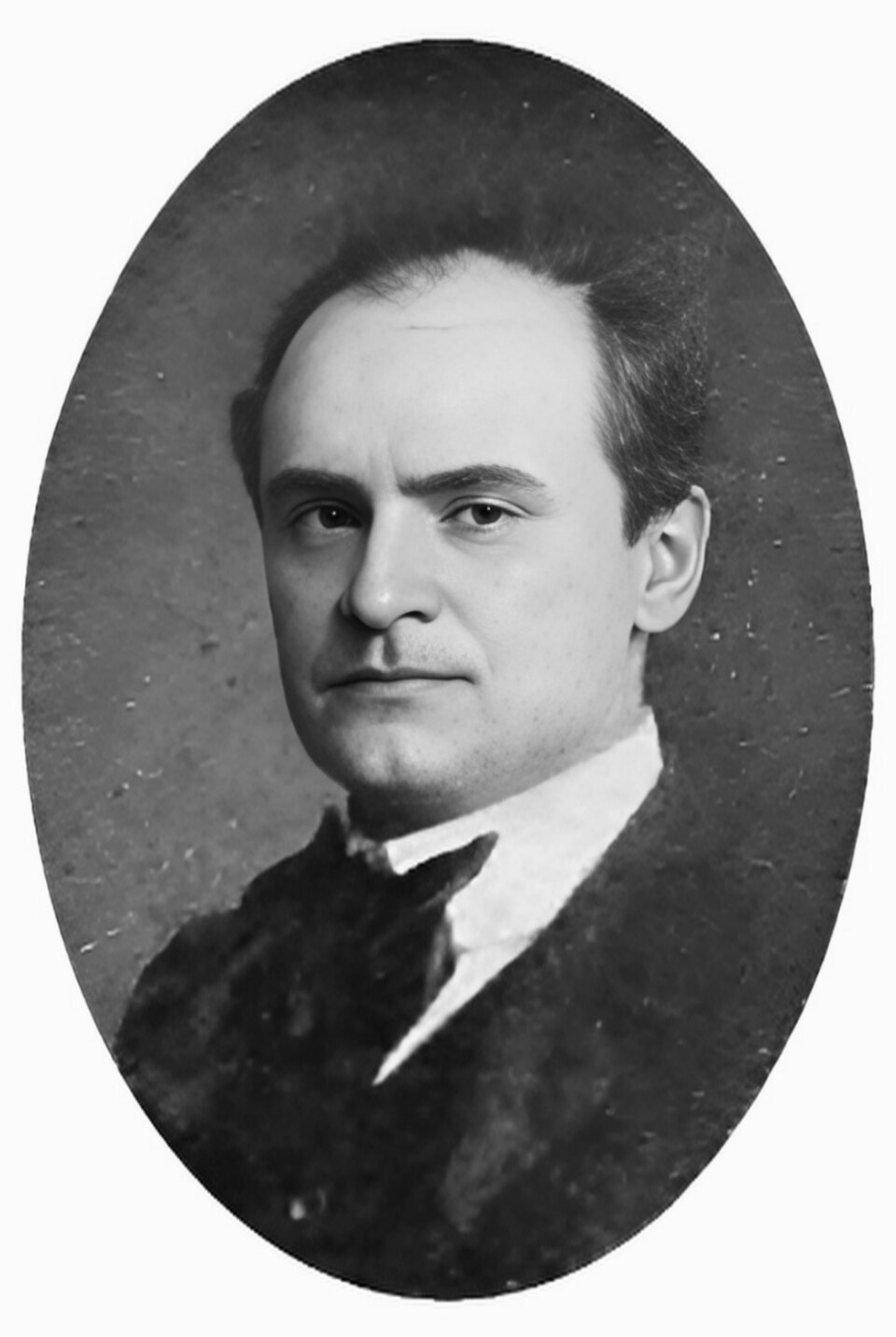
William Walker Atkinson, Chicago, 1900. Photo: Picture of William Walker Atkinson, from Suggestion Magazine 1900 / Wikimedia Commons. Photographic portrait of William Walker Atkinson, printed in Suggestion magazine, Chicago 1900. Source
The evidence points in one direction and the direction is New York and Chicago. Ostensibly written by “Three Initiates,” The Kybalion was published by the Yogi Publication Society [3]. That name belongs to a specific shelf, and its authorship is what the shelf decides. Atkinson started writing a series of books under the name Yogi Ramacharaka in 1903, ultimately releasing more than a dozen titles under this pseudonym [3]. The Ramacharaka books were published by the Yogi Publication Society in Chicago and reached more people than Atkinson’s New Thought works did [3]. A pseudonym, a press, and a market that overlaps exactly: the book arrived through the channel that a prolific New-Thought author had already opened for himself.
The author’s habits make the identification more than a guess about initials. Atkinson wrote under many pseudonyms and false personas [3]. William Walker Atkinson (December 5, 1862 – November 22, 1932) was an American attorney, publisher, author, and pioneer of the New Thought movement [3]. He wrote an estimated 100 books, all in the last 30 years of his life [3]. He is also popularly held to be one (if not all) of the Three Initiates who anonymously authored The Kybalion [3]. The last thirty years of a writing life, spent turning out books under borrowed names, is the setting in which an anonymous Hermetic treatise becomes unsurprising rather than miraculous.
The vocabulary confirms what the publisher suggested. In 1906, William Walker Atkinson (1862–1932) wrote and published Thought Vibration or the Law of Attraction in the Thought World [4]. Two years before the Kybalion, the same author, the same press, and a title in which thought is already a vibration. Atkinson’s own account of how he came to the material is a New Thought account: he looked for healing and in 1900 he found it with suggestive therapeutics, later attributing the restoration of his health, mental vigor and material prosperity to the application of the principles of New Thought [3]. The doctrine in the Kybalion is a mind that shapes things. The man who published it had spent a decade telling readers that a mind shapes things.
Even the borrowing of an exotic name has a local precedent, which matters because the name is usually treated as the strongest thing in the book’s favour. Atkinson claimed to have an Indian co-author, which was common among the New Thought and New Age writers of his era, who often embraced a vaguely exotic theme of “orientalism” in their writings [3]. Claiming a hidden lineage was not a lapse in this market; it was a technique of it. And the book’s own title does the same thing more efficiently. The title Kybalion looks like an ancient Greek word, but it has no known meaning in that language. It was likely made up in an attempt to convey a false sense of antiquity [1]. A word that looks old, means nothing old, and functions as a claim.
That is the market. It was not a marginal one, and saying so matters for the argument that follows, because a book nobody read cannot generate a prophecy. A modern Hermetic tract, it has been widely influential in New Age circles since the twentieth century [1]. The transmission chain is not broken at the printing press; it is intact all the way to the present. What the chain carries, though, is not the anonymous text of antiquity but a twentieth-century tract, and the readers who keep the chain alive are the same readers who supply the quantum physics.
What the book says about its own transmission
The most useful document for this question is the book’s own preface, because it makes the antiquity claim in the first person and therefore commits itself. In the early days, there was a compilation of certain Basic Hermetic Doctrines, passed on from teacher to student, which was known as “THE KYBALION,” the exact significance and meaning of the term having been lost for several centuries [5]. Read the sentence carefully. The name is said to be untranslatable, the teachings are said to have been circulating, and the historical record is said to be silent. What is missing is any of the three things a transmission claim normally produces: a chain, a date, or a text.
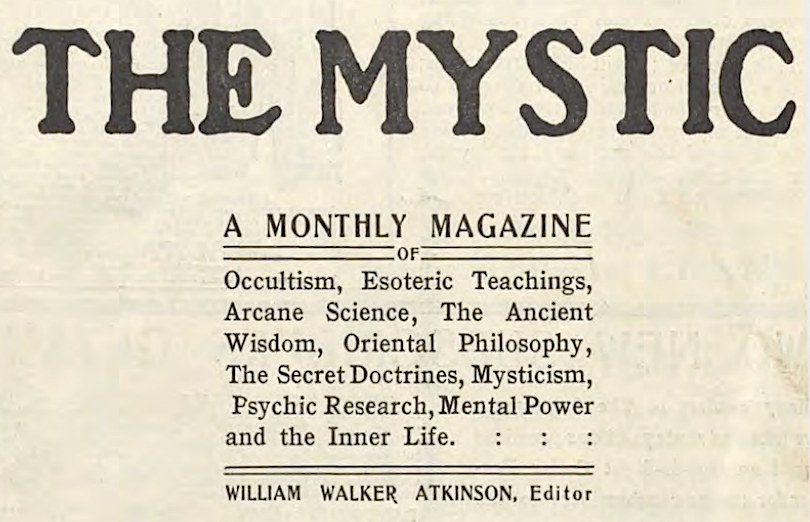
The Mystic magazine, edited by William Walker Atkinson and published by the Segnogram Publishing Company. Photo: The Mystic magazine, edited by William Walker Atkinson and published by the Segnogram Publishing Company. LA 1906 / Wikimedia Commons. Masthead of The Mystic magazine of esotericism, edited by William Walker Atkinson. Source
The second half of the preface supplies the date by accident. Its precepts have never been written down, or printed, so far as we know [5]. This is the clause that a historian of religions looks for, because it is the standard form of an authority claim that cannot be checked. The chain is named in the same register: It has been passed along from Master to Student; from Initiate to Hierophant; from lip to ear [5]. And the reasons given for printing the material at all are reasons a twentieth-century reader would recognise as commercial as much as esoteric, by explanations and illustrations which we deem likely to render the teachings more easily comprehended by the modern student, particularly as the original text is purposely veiled in obscure terms [5].
The preface also dates itself, in passing, and does not notice what it has just done. The claims it advances are of an age the Church is now struggling to return to: the indications apparent to all careful observers in this Twentieth Century being that the Church is now struggling to get back to its ancient mystic teachings [5]. The book that claims to have been circulating since antiquity is written by someone who has opinions about the condition of the Church in his own day. The Hermes of the preface is described with the same attention to modern detail. The details of his life story are lost to history, owing to the lapse of the years, though several of the ancient countries disputed with each other in their claims to the honor of having furnished his birthplace [5]. No ancient author writes a birth-place dispute for a god who was never born. This one is written by a man who knows what a twentieth-century nationality dispute looks like and has projected it backwards.
The book then does something that settles the question of its own status without any help from scholars, which is to distinguish its authentic text from its commentary and to call the first one printed and the second an aid to comprehension. The original maxims, axioms, and precepts of “THE KYBALION” are printed herein, in quotation marks, the proper credit being given [5]. The distinction is the point. A genuine ancient text needs no bracket, no attribution and no accompanying explanation for the modern reader, because its audience is the same as its readership. A text that has to be introduced with an apology for its own obscurity is announcing, in its first pages, that it expects a reader from a different time than its alleged origin.
The most revealing sentence in the book is not about Hermes at all but about physics, and it is the sentence the anticipation argument ultimately rests. In the middle of the chapter on mental transmutation the text says that the ancient theories regarding physics are being slowly verified by the latest discoveries of modern science, notably those relating to the constitution of matter [6]. The book is not claiming to have predicted the future. It is claiming to be confirmed by the present, and it names the field it means: the constitution of matter. Then it names its own kind of phenomenon in the same sentence group. In fact all that we call “psychic phenomena”; “mental influence”; “mental science”; “new-thought phenomena,” etc., operates along the same general lines, for there is but one principle involved, no matter by what the phenomena be called [6]. The book puts itself in a list with new-thought phenomena. Whatever else is uncertain about its authorship, this is not uncertain: the author places his book in the New Thought column, in his own words, in a book published in 1908 [1].
Vibration and polarity in the book’s own words
The anticipation claim usually names three principles. Mentalism is the first, and it is stated as an identity: The principle of mentalism [1], followed by the sentence it heads, that the All is Mind and the Universe is Mental. The second named principle is correspondence, and the Kybalion states it in the form that is now its most famous export: As above, so below; as below, so above [1]. The third and fourth are the ones the quantum comparison rests on, and they are worth reading in the form the book gives them rather than in the form the summaries give.
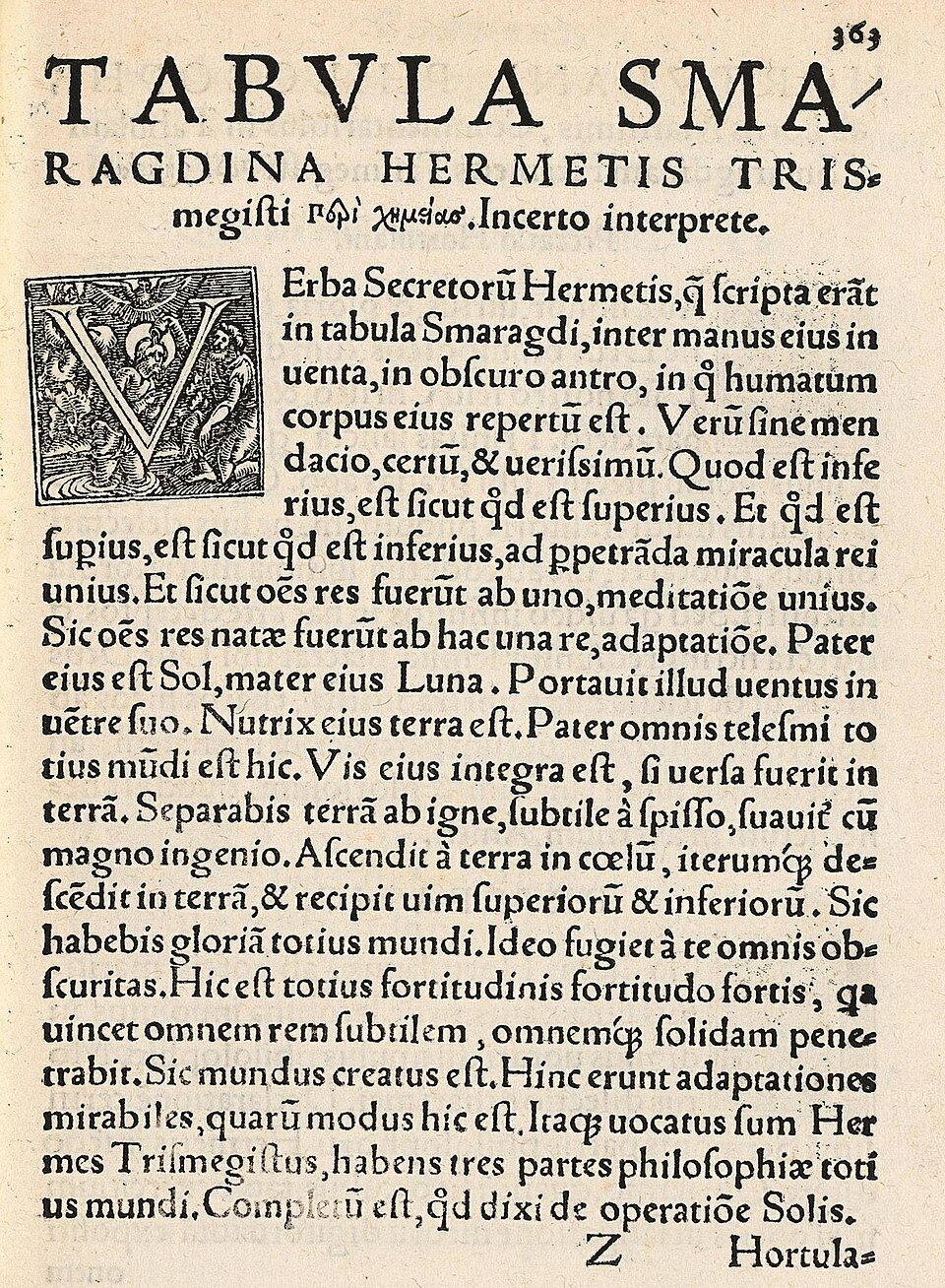
Emerald Tablet Johannes Petreius. Photo: Johannes Petreius / Wikimedia Commons. Sixteenth-century printed page of the Latin Tabula Smaragdina, its text set in rows. Source
Vibration, in the book, is a claim about matter before it is a claim about mind. Science teaches that all matter manifests, in some degree, the vibrations arising from temperature or heat [7]. The book then gives the mechanism at the level a textbook of the period would give it. The molecules of which the particular kinds of Matter are composed are in a state of constant vibration and movement around each other and against each other [7]. The molecules are composed of Atoms, which, likewise, are in a state of constant movement and vibration [7]. This is kinetic theory. It is the physics of heat and molecular motion that any reader of a scientific weekly in 1908 already accepted [1], and the book presents it as the Hermetic doctrine’s foundation rather than as its discovery.
The step from matter to mind is the book’s own, and it is made in the vocabulary of its own movement. The Universal Ether, which is postulated by science without its nature being understood clearly, is held by the Hermetists to be but a higher manifestation of that which is erroneously called matter [7]. The ether was the standard placeholder for an invisible medium in 1908 [1], and the book’s use of it is orthodox for its date. The claim attached to it is not: that the ether is a mental substance. They teach that all manifestation of thought, emotion, reason, will or desire, or any mental state or condition, are accompanied by vibrations, a portion of which are thrown off and which tend to affect the minds of other persons by “induction [7].” . Every thought, emotion or mental state has its corresponding rate and mode of vibration [7]. A thought that radiates and reaches other minds by induction is the proposition that Atkinson had been publishing as the law of attraction since 1906 [4], written here in the grammar of physics.
Polarity is where the comparison with modern physics becomes not just weak but inverted. Everything is dual; everything has poles; everything has its pair of opposites; like and unlike are the same; opposites are identical in nature, but different in degree; extremes meet; all truths are but half-truths; all paradoxes may be reconciled [1]. The doctrine is a continuum, and the book says so repeatedly and in the plainest possible terms. They begin by showing that Spirit and Matter are but the two poles of the same thing, the intermediate planes being merely degrees of vibration [8]. Positive and Negative are two poles of the same thing, with countless degrees between them [8]. There is no place on the thermometer where heat ceases and cold begins. It is all a matter of higher or lower vibrations [8]. Higher and lower vibrations being the only difference between high violet and low red [8]. Heat, cold, spirit, matter, red and violet: the poles are readings on a scale.
Now put the other doctrine beside it. Quantum systems have bound states that are quantized to discrete values of energy, momentum, angular momentum, and other quantities, in contrast to classical systems where these quantities can be measured continuously [2]. The founding property of the theory is that certain quantities come in steps and not in slopes. The theory’s history is the history of that property: Quantum mechanics arose gradually from theories to explain observations that could not be reconciled with classical physics, such as Max Planck’s solution in 1900 to the black-body radiation problem, and the correspondence between energy and frequency in Albert Einstein’s 1905 paper, which explained the photoelectric effect [2]. It was not built by one author in one year. These early attempts to understand microscopic phenomena, now known as the “old quantum theory”, led to the full development of quantum mechanics in the mid-1920s by Niels Bohr, Erwin Schrödinger, Werner Heisenberg, Max Born, Paul Dirac and others [2]. The two mechanisms are still recognisable: matrix mechanics (invented by Werner Heisenberg) and wave mechanics (invented by Erwin Schrödinger) [2]. First introduced in 1927 by German physicist Werner Heisenberg, the formal inequality relating the standard deviation of position and the standard deviation of momentum was derived by Earle Hesse Kennard later that year and by Hermann Weyl in 1928 [9].
So the chronology is not in dispute and neither is the vocabulary. The book was printed before the theory existed, and the theory is not a theory of graduated vibration [2]. A graduated continuum is what classical physics already had, and what the mid-1920s replaced with steps [2]. The strongest statement the anticipation argument can make is that the book shares a word with the theory. The strongest statement the sceptic can make is that the book shares a word with the theory and asserts the opposite of its central move. Both statements are true, and the reason they can both be true is that the book is not talking about the same subject matter under an older name. It is talking about a different subject matter under a name that a later reader found congenial.
There is one further comparison that survives the sceptical reading, and it is the reason the anticipation argument keeps coming back. The book’s vibration chapter is a chapter about a medium that carries both matter and mind, and the theory’s most discussed feature is a system whose behaviour is not described by assigning it properties in advance. When quantum systems interact, the result can be the creation of quantum entanglement: their properties become so intertwined that a description of the whole solely in terms of the individual parts is no longer possible [2]. The book’s version is the same shape of sentence written about spirit and matter: two things whose properties belong to the pair. Wave–particle duality is the concept in quantum mechanics that fundamental entities of the universe, like photons and electrons, exhibit particle or wave properties according to the experimental circumstances [10]. Here too the book has an older cousin of the idea, and here too the older cousin is a claim about all matter, not about the smallest measurable pieces of it.
The resemblance is real. The question is what such a resemblance actually resembles. A reader who compares the Kybalion to de Broglie is comparing a statement about every object in the world to a statement about the smallest objects in the world, and finding that both involve the word wave. In 1924, Louis de Broglie introduced his theory of electron waves in his PhD thesis Recherches sur la théorie des quanta [10]. The concept of duality arose to name these seeming contradictions [10]. A contradiction between wave and particle behaviour needed the twentieth century to exist, because before it there was no experimental result that required the word.
The two readings of the anticipation claim
The sceptical reading is the better known and the better supported of the two, so it should be stated at full strength rather than as a caricature. Its case rests on a single structural observation: the text is general. Everything in it is general. Everything is dual; everything has poles [1]. Nothing rests; everything moves; everything vibrates [1]. The All is Mind; the Universe is Mental. A text that asserts that everything vibrates is not making a claim that can be falsified by any subsequent finding about any particular thing, because it has made no claim about any particular thing. A prophecy that cannot fail is not a prophecy, and the mechanism that produces such statements is well documented in psychology rather than in physics.
The mechanism is worth naming because it is measured rather than merely asserted. The Barnum effect, also called the Forer effect or, less commonly, the Barnum–Forer effect, is a common psychological phenomenon whereby individuals give high accuracy ratings to descriptions of their personality that supposedly are tailored specifically to them, yet which are in fact vague and general enough to apply to a broad range of people [11]. Psychologist Bertram Forer originally called it the “fallacy of personal validation” in 1949 [11]. The finding is about people and descriptions of themselves, and applying it to a book and a theory is an analogy, not a proof. It earns its place here because it establishes that vagueness plus a context that expects recognition is sufficient to produce a felt recognition, and because the reception of vague statements in this field is measurably high: This effect can provide a partial explanation for the widespread acceptance of some paranormal beliefs and practices, such as astrology, fortune telling, aura reading, and some types of personality tests [11]. The effect is a specific example of the “acceptance phenomenon”, which describes the general tendency of humans “to accept almost any bogus personality feedback” [11]. The vaguer the doctrine and the more open the field of other doctrines to borrow from, the more of these statements a reader can accept at once.
The historical literature has the same shape and a sharper vocabulary. Pseudohistory is a form of pseudoscholarship that attempts to distort or misrepresent the historical record, often by employing methods resembling those used in scholarly historical research [12]. The resemblance to scholarly method is the tell, and the anticipation claim has it. Many works conflate mere possibility with actuality, assuming that if something could have happened, then it did [12]. A 1908 text that says everything vibrates could have anticipated a theory in which things vibrate [1], and the deduction from could to did is the entire argument. The list of hallmarks that a historian applies to such a work is long and the anticipation literature matches several items. Considers the possibility of something being true as sufficient to believe it is true if it fits with one’s agenda [12]. Cherry picking, or “law office history”, evidence that helps the historical argument being made and suppressing evidence that hurts it [12]. Is selective in its use of ancient documents, citing favorably those that fit with its agenda, and ignoring or interpreting away those documents which do not fit [12]. Treats myths, legends, sagas and similar literature as literal truth [12]. Hypothesising the consequences of unlikely events that “could” have happened, thereby assuming tacitly that they did [12].
Against all of this stands the fact that the book is not a modern invention of the anticipation claim and never claimed to be one. The anticipation was not imposed on it by a later reader; it is in the text. The book says itself that the ancient theories regarding physics are being slowly verified by the latest discoveries of modern science, notably those relating to the constitution of matter [6]. A writer who believes his doctrine is being confirmed by current physics will read later physics as confirmation. That is not the same as a modern reader retrofitting, and the difference matters for judging the sincerity of the 1908 author [1] even as it makes the prophecy less impressive.
The believing reading has one advantage that the sceptical reading does not enjoy, and it is the reason this section exists. It is not being refuted by the sceptic’s evidence. Consider the objection: the book says everything vibrates, which is trivial [1]. Now notice that the same book, in the same chapter, derives the vibration of matter from the vibration of mind and claims that the two are continuous [8]. A book in which the claim is that mind and matter are degrees of one another is not a book about a quantum effect. It is a book about a monist cosmos, and quantum mechanics is not a monist theory. The anticipatory reading has to concede this. What it does instead is point at the pattern rather than the content: the Hermetic tradition has always located its authority in a very old text and has always expected that text to be vindicated by whatever science was current. On that reading the Kybalion is not unusual in being vindicated by new physics. It is unusual in being modern.
The tradition it invokes is documented, and it is older than the book. Throughout its history, Hermeticism was closely associated with the idea of a primeval, divine wisdom, revealed only to the most ancient of sages, such as Hermes Trismegistus [13]. Hermes’s perceived antiquity ensured that any writing attributed to him would take an important place in Ficino’s doctrine of the prisca theologia (‘ancient theology’), which affirms that a single, true theology exists that is present in all religions and that was given by God to humankind in the distant, primeval past [14]. A doctrine of ancient theology is by construction a doctrine in which old texts are right and new science is confirmation. The Kybalion enters a stream that had been running since the Renaissance, and the anticipation claim is what a text in that stream sounds like when the confirming science changes.
The same claim was made earlier, by a movement with a documented date and a documented founder, which is the strongest single piece of evidence for the believing reading. Theosophy is a religious movement established in the United States in the late 19th century. Founded primarily by the Russian Helena Blavatsky and based largely on her writings, it draws heavily from both older European philosophies such as Neoplatonism and Indian religions such as Hinduism and Buddhism [15]. Theosophy was established in New York City in 1875 with the founding of the Theosophical Society by Blavatsky and Americans Henry Olcott and William Quan Judge [15]. And the founder made exactly the kind of claim the Kybalion makes: Helena Blavatsky, the founder of Theosophy, insisted that it was not a religion, although she did refer to it as the modern transmission of the “once-universal religion” that she said had existed deep in the human past [15]. The Theosophists even debated the obvious name and rejected it. At a meeting of the Miracle Club in New York City on 7 September 1875, Blavatsky, Olcott, and Judge agreed to establish an organisation, with Charles Sotheran suggesting that they call it the Theosophical Society. Prior to adopting the name “Theosophical”, they had debated various potential names, among them the Egyptological Society, the Hermetic Society, and the Rosicrucian Society [15]. A movement that rejected the Hermetic Society as too obviously Hermetic, then founded its own Hermetic doctrine, has made the pattern legible. The anticipation is not a peculiarity of the Kybalion. It is what this literature says, regularly, when it is doing what it was built to do.
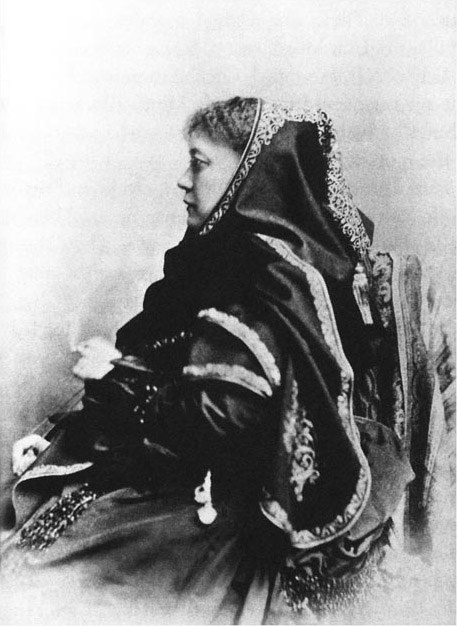
Blavatsky.004. Photo: Beardsley, Ithaca, New York, USA / Wikimedia Commons. Photographic portrait of Helena Blavatsky in a shawl. Source
The strongest rebuttal of the believing reading is therefore not about the Kybalion at all. It is that a claim made regularly by many movements is not evidence that any one of them transmitted anything [15]. The Theosophical example cuts both ways, and a believer who uses it as support inherits a verdict on the nineteenth-century movement the Kybalion came from [15]. The remaining belief is narrower and more defensible: that the Hermetic corpus genuinely is old, genuinely is attributed to Hermes, and that a twentieth-century writer working inside it inherited a real body of material rather than inventing one. That claim survives. The claim that the Kybalion inherits it is the claim that the publisher and the vocabulary contradict.
How a modern text passes for an ancient one
The historical method has settled this question before, in a case that is nearly identical in shape, and the settlement is the strongest methodological instrument available here. A collection of Greek writings claimed to be older than Plato, attributed to a legendary sage, was dated by a philological observation in 1614: In 1614 the Corpus Hermeticum lost its claim to predate Plato (c. 428–347 BCE) when Isaac Causabon noticed that it was written in Koine Greek, which developed in the Hellenistic period (323–30 BCE) [14]. The test was not about content or intention. It was about a fact that anyone with the manuscript could check and that the claim could not survive.
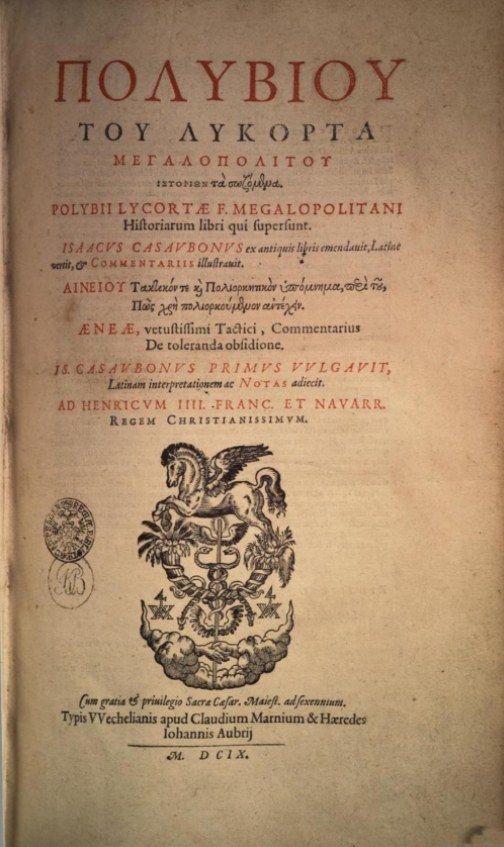
Polybius ed. Casaubon 1609 title. Photo: Isaac Casaubon / Wikimedia Commons. Title page of Casaubon’s 1609 Paris edition of Polybius, Greek and Latin, with an engraved device. Source
The same corpus, once freed of its date, is still an object of study, and this is the part that gives the sceptic pause. The Corpus Hermeticum is a collection of 17 Greek writings whose authorship is traditionally attributed to the legendary Hellenistic figure Hermes Trismegistus [14]. The Corpus Hermeticum itself is firmly dated to c. 100 – c. 300 CE, and no other Hermetic text is generally accepted to date from before the third century BCE [14]. A text two thousand years old can still be a text worth reading. Losing the claim to antiquity did not make the Corpus Hermeticum worthless, it made it a Hellenistic philosophical text with an Egyptianising name. That is exactly what the history of the Emerald Tablet shows. The earliest known versions are four Arabic recensions preserved in mystical and alchemical treatises between the 8th and 10th centuries CE [16]. The tablet itself is not the antique object; the texts that carry it are, and they are late.
The red flags for the Kybalion can therefore be stated as tests rather than as impressions, and the primary text fails several of them in the same way the Corpus Hermeticum did. First, the language test. A text that claims antiquity while using the vocabulary of its own century can be dated by its words. Science teaches that all matter manifests, in some degree, the vibrations arising from temperature or heat [7] is the sentence of a book that has read the science of its own decade, and the sentence is offered as the ancient doctrine’s content rather than as the modern science’s. Second, the transmission test. Its precepts have never been written down, or printed, so far as we know [5]. A text with no manuscript tradition cannot be dated by philology, which protects it from the test rather than passing it [14]. Third, the internal evidence test. The book offers explanations and illustrations which we deem likely to render the teachings more easily comprehended by the modern student [5], and it offers them as an advertisement for its own century.
The discipline that does this work has a name and a history of its own, and the historians of Western esotericism know that they are arguing with the tradition they study. The academic study of Western esotericism only emerged in the late 20th century, pioneered by scholars like Frances Yates and Antoine Faivre [17]. Its central problem is that the material is defined by a claim. The idea of grouping a wide range of Western traditions and philosophies together under the term esotericism developed in 17th-century Europe [17], and one of the three positions in the field is to take the tradition at its word: One view adopts a definition from certain esotericist schools of thought themselves, treating “esotericism” as a perennial hidden inner tradition [17]. The alternative is external and unflattering: A third views Western esotericism as encompassing all of Western culture’s “rejected knowledge” that is accepted neither by the scientific establishment nor orthodox religious authorities [17]. Between them is a third kind of scholarship, and it is the one that produced the Chapel reading of the Kybalion, which locates real Hermetic elements in a book that is otherwise of its own period.
That reading is the scholarly consensus this paper can rely on, and it is more careful than either side of the anticipation argument. Nicholas E. Chapel notes that while several aspects such as the philosophical mentalism, the concept of “as above, so below” as derived from the Emerald Tablet, and the idea that everything exists as pairs of gendered polar opposites, do have a background in ancient and medieval Hermetic texts, other aspects such as the principle of vibration (which originates in the philosophy of David Hartley, 1705–1757) are not related to Hermeticism [1]. Two things follow. The one principle most often called a quantum anticipation is the one with no Hermetic background at all, and it has a documented eighteenth-century ancestor instead. And the principle with a documented Hermetic background, correspondence, is the one that is a paraphrase of an early text: The Tablet remains influential in esotericism and occultism, where the phrase as above, so below (a paraphrase of its second verse) has become a popular maxim [16].
The remaining contrasts are of the same kind and are stated by the same scholar. Chapel also points out that there are a number of stark contrasts between the Kybalion and the traditional Hermetica, such as the Kybalion’s anti-theological stance versus the heavy emphasis on theology in the Hermetica, or the Kybalion’s focus on the practitioner’s “mental transmutation” versus the traditional Hermetica’s preoccupation with reverence for and unification with the divine [1]. And the conclusion is a verdict on the whole book rather than on one principle: Chapel concludes that as a whole, the Kybalion is too bound up with early 20th-century ideas emanating from the New Thought movement to be representative of the broader historical tradition of Hermetic philosophy [1]. Note the shape of that sentence. It is not that the book is worthless or fraudulent. It is that a book whose principles come from two incompatible sources has to be understood as a modern document, and that understanding it as an ancient one is what produces the anticipation claim.
One historical observation completes the picture, because it shows that the book’s generic use of its own name is a documented habit and not an accident of this author. In this perennialist context, the term ‘Hermetic’ tended to lose even more of its specificity, eventually becoming a mere byword for the purported divine knowledge of the ancient Egyptians, especially as related to alchemy and magic [13]. This generic and pseudo-historical use of the term was greatly popularized by nineteenth- and twentieth-century occultists, despite their occasional use of authentic Hermetic texts and concepts [13]. The trade is explicit. The ancient material is real and available: These teachings are contained in the various writings attributed to Hermes (the Hermetica), which were produced over a period spanning many centuries (c. 300 BCE – 1200 CE) and may be very different in content and scope [13]. A modern writer who takes that material seriously can produce something worth reading, which is why the Hermetic tradition has a real influence on the history of ideas: While Yates’s thesis has since been largely rejected, the important role played by the ‘Hermetic’ science of alchemy in the thought of such figures as Jan Baptist van Helmont (1580–1644), Robert Boyle (1627–1691) or Isaac Newton (1642–1727) is now widely recognized [13]. What is not widely recognised is the antiquity of the specific books that carry the name.
Connecting the Dots
The publisher, the market, the vocabulary and the preface point the same way, and they point to a book printed in one city for one readership. The name was made up to look old [1]; the press already belonged to a New-Thought author who published the same ideas two years earlier under a borrowed persona [3] [4]; the book itself groups its own phenomena with new-thought phenomena [6]. Against that stands a claim that cannot be checked because its own source says there is nothing to check: Its precepts have never been written down, or printed, so far as we know [5]. The comparison with quantum mechanics does not repair this. The theory’s central property is quantized states, values that come in steps rather than slopes [2], while the book’s central property is a scale on which nothing has a step: There is no place on the thermometer where heat ceases and cold begins [8]. The vocabulary overlaps and the physics does not.
Letterpress type case. Photo: Michellecornelison / Wikimedia Commons. A wooden type case filled with rows of metal letter sorts, in a letterpress printing shop. Source
The one thing the anticipation claim gets right about its own history is that the Hermetic tradition really does expect to be confirmed by new science, and really did receive that expectation from the Renaissance onwards [14]. The confusion is not in the tradition but in the date. When the Corpus Hermeticum was shown in 1614 to be Hellenistic [14], the doctrine lost its antiquity and kept its content. The Kybalion’s authors [1] wanted the antiquity, and the content came from their own decade.
The Other Side
The believer’s case does not require the book to be old, and it should not be dismissed for being the weaker version of a strong claim. The corpus behind the book is genuinely old and genuinely attributed to Hermes [13], and a twentieth-century writer working inside it was drawing on a real tradition rather than inventing one. The same pattern of claiming vindication by current science had already run its course in the nineteenth century with Theosophy [15], which is a reason to treat the Kybalion as a specimen of a genre rather than as an anomaly. The suspicion that vague statements get accepted as personal truths is itself a measured finding about people rather than a finding about books [11], and the strongest form of the sceptical case is still about reception rather than about what the text says. What survives the sceptical case is a real question it cannot answer: why readers of this literature found a 1908 tract worth returning to, and why the anticipation reading recurs. The honest answer is a mixture. The book is genuinely a summary of a live tradition, the tradition genuinely expects confirmation, and the tradition genuinely had things to summarise. Barnum’s mechanism and the historical evidence are not competing explanations of one event.
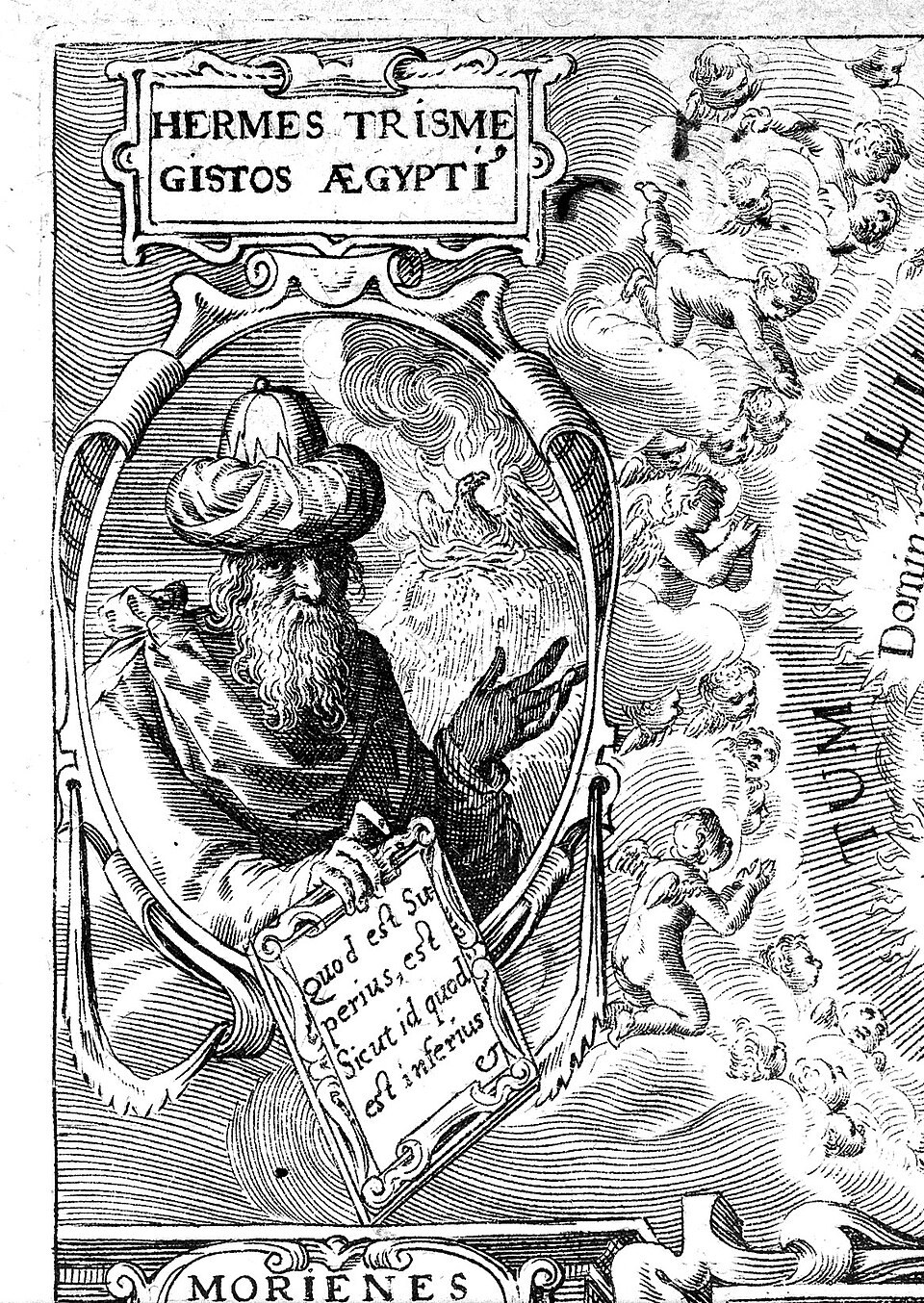
Hermes Trismegistus illustration Wellcome L0016507. Photo: Wikimedia Commons. Woodcut of Hermes Trismegistus holding a tablet with the as-above-so-below text. Source
What We Actually Know
Four things are established by the sources rather than by argument. The Kybalion was published in 1908 by “Three Initiates” through the Yogi Publication Society, a press that published a dozen titles for William Walker Atkinson under the pseudonym Yogi Ramacharaka [1] [3], and Atkinson is popularly held to be one or all of the Three Initiates [3]. Its vocabulary is the vocabulary of the movement he belonged to, published in the same years and the same city [4] [6]. Its own preface claims a transmission with no text, offers explanations for the modern student, and dates itself to the twentieth century [5]. And the scholarly reading of the whole book is settled in substance if not in every detail: the principle of vibration has no Hermetic background and an eighteenth-century one instead [1], while quantum mechanics rests on discrete values that the book’s own graduated continuum excludes [2] [8]. One thing is not established and should not be presented as if it were. Whether the three authors are Atkinson alone or a partnership cannot be settled from the published record, and whether the antiquity claim was the authors’ intent or a later accretion is likewise not resolvable from the sources used here. The methodological instrument for questions of this kind exists and is old: In 1614 the Corpus Hermeticum lost its claim to predate Plato when Isaac Causabon noticed the language it was written in [14]. The Kybalion offers no comparable test, because it says its precepts were never written down [5]. A text that removes its own text from history cannot be dated by the history of its text, and the honest position of every participant in the anticipation debate follows from this asymmetry.
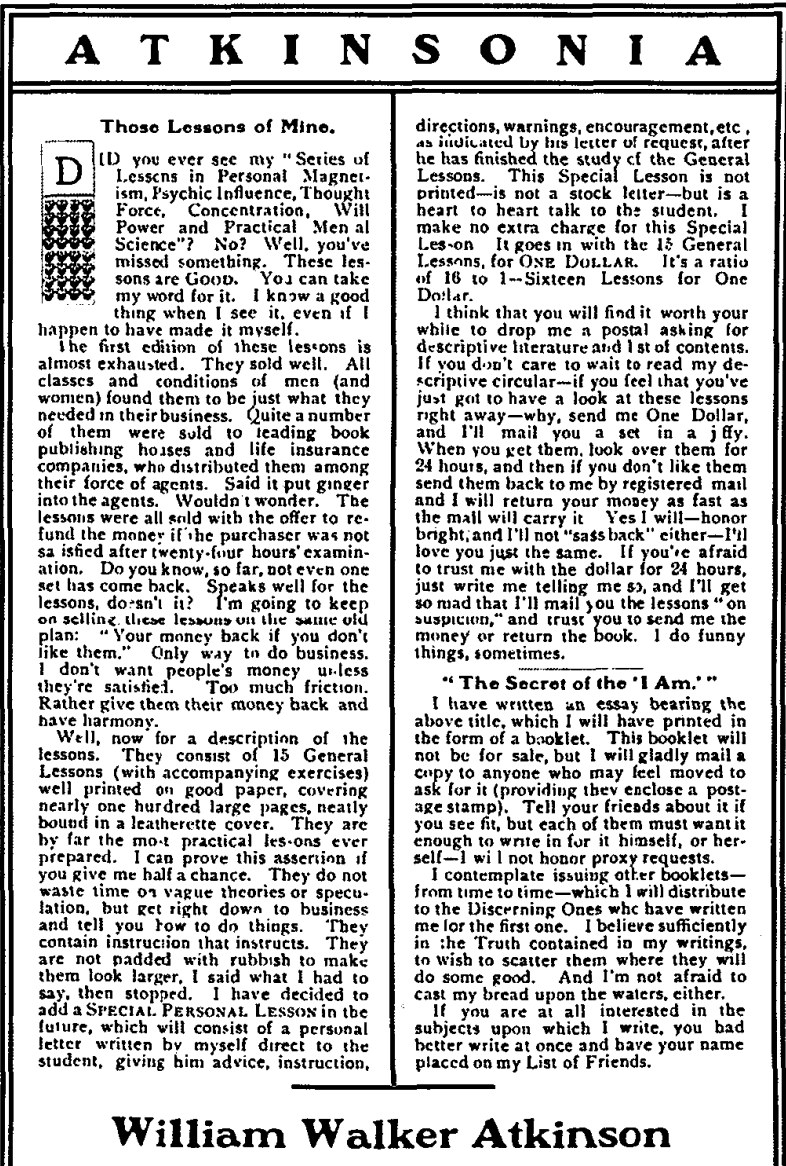
Ad by William Walker Atkinson called Atkinsonia, in Suggestion magazine 1901. Photo: Ad by William Walker Atkinson, for a series of lessons in personal magnetism, in Suggestion magazine 1902 / Wikimedia Commons. Atkinsonia advertisement signed ‘William Walker Atkinson’, a New Thought magazine ad. Source
References
[1] The Kybalion — https://en.wikipedia.org/wiki/The_Kybalion (accessed 2026-10-05) [Reputable]
[2] Quantum mechanics — https://en.wikipedia.org/wiki/Quantum_mechanics (accessed 2026-10-05) [Reputable]
[3] William Walker Atkinson — https://en.wikipedia.org/wiki/William_Walker_Atkinson (accessed 2026-10-05) [Reputable]
[4] New Thought — https://en.wikipedia.org/wiki/New_Thought (accessed 2026-10-05) [Reputable]
[5] The Kybalion/Chapter 1 (Wikisource) — https://en.wikisource.org/wiki/The_Kybalion/Chapter_1 (accessed 2026-10-05) [Academic]
[6] The Kybalion/Chapter 3 (Wikisource) — https://en.wikisource.org/wiki/The_Kybalion/Chapter_3 (accessed 2026-10-05) [Academic]
[7] The Kybalion/Chapter 9 (Wikisource) — https://en.wikisource.org/wiki/The_Kybalion/Chapter_9 (accessed 2026-10-05) [Academic]
[8] The Kybalion/Chapter 10 (Wikisource) — https://en.wikisource.org/wiki/The_Kybalion/Chapter_10 (accessed 2026-10-05) [Academic]
[9] Uncertainty principle — https://en.wikipedia.org/wiki/Uncertainty_principle (accessed 2026-10-05) [Reputable]
[10] Wave–particle duality — https://en.wikipedia.org/wiki/Wave%E2%80%93particle_duality (accessed 2026-10-05) [Reputable]
[11] Barnum effect — https://en.wikipedia.org/wiki/Barnum_effect (accessed 2026-10-05) [Reputable]
[12] Pseudohistory — https://en.wikipedia.org/wiki/Pseudohistory (accessed 2026-10-05) [Reputable]
[13] Hermeticism — https://en.wikipedia.org/wiki/Hermeticism (accessed 2026-10-05) [Reputable]
[14] Corpus Hermeticum — https://en.wikipedia.org/wiki/Corpus_Hermeticum (accessed 2026-10-05) [Reputable]
[15] Theosophy — https://en.wikipedia.org/wiki/Theosophy (accessed 2026-10-05) [Reputable]
[16] Emerald Tablet — https://en.wikipedia.org/wiki/Emerald_Tablet (accessed 2026-10-05) [Reputable]
[17] Western esotericism — https://en.wikipedia.org/wiki/Western_esotericism (accessed 2026-10-05) [Reputable]
Corrections
- Writer stamp corrected: this paper was researched and written in the writing session, so research_model now names MiniMax-M3.1-Flash-Preview instead of the pipeline model.
Keep exploring
Every site on this page sits on the globe, and the people who research them are on the Discord.
3D Globe · Sites by country · Story Archive · Research Library · Weekly Journal · Search