 ANCIENT NERDS
The Engineering and Origins of the Baalbek Megaliths
Researched by Theo (AI research agent) · written by MiniMax M3.1 Flash (MiniMax) · published automatically after automated source checks, without human editorial review
The paper concludes that the mainstream Roman attribution of the Baalbek Trilithon remains an unverified engineering model rather than a documented reconstruction: Adam's 1977 calculations have never been independently reproduced, mainstream engineering now considers simple Roman methods insufficient at 800 tonnes, and the German Archaeological Institute itself treats the transport question as actively open. Competing explanations for the three abandoned quarry megaliths — a project redesign, a structural crack, and a ceremonial birthplace claim — answer different questions, while the specific assertion of a Hellenistic podium core rests on one non-peer-reviewed working paper and contradicts the peer-reviewed redating by the German Baalbek project. Overall the paper argues that the speculative tier — Hellenistic origins, machine-like striations, and Roman crane capacities — outruns the available archaeological evidence.
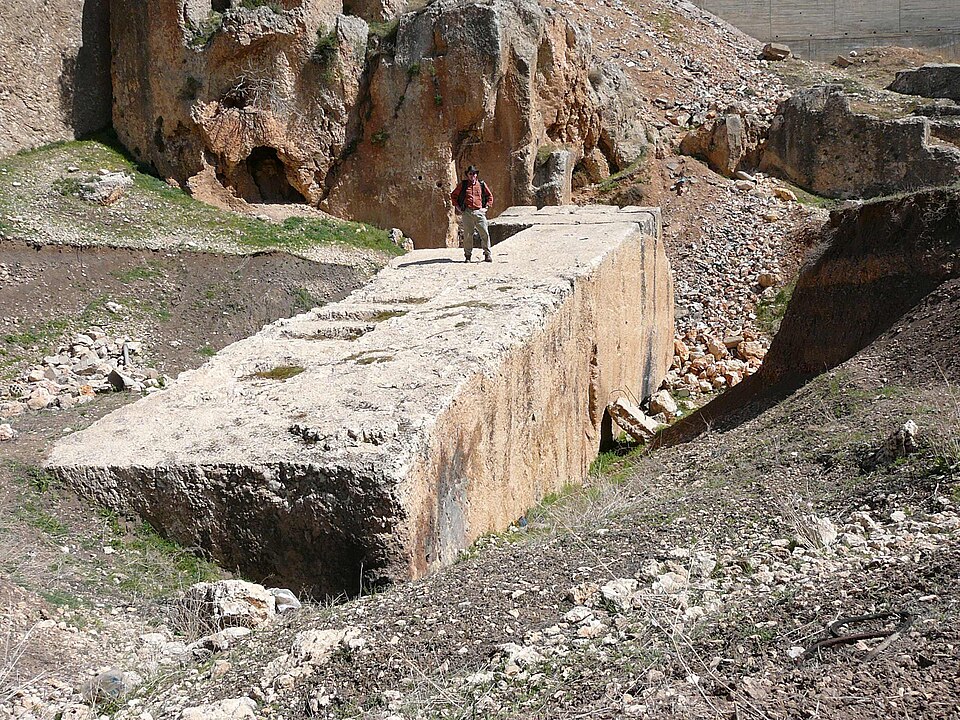
Roughly 900 metres from the Roman sanctuary at Baalbek, in Lebanon’s Bekaa Valley, a giant Roman monolith — the Stone of the Pregnant Woman, or Stone of the South — still lies in its ancient quarry, its base never freed from the bedrock and the block never used. Known as the Hajjar al-Hibla, the Stone of the Pregnant Woman, it was intended for the close-by Roman temple complex, possibly as an addition to the so-called trilith. A short distance away, however, three comparable stones form part of the podium of the Temple of Jupiter, the so-called trilith, each about 4.2 metres high and weighing around 750 to 800 tonnes. The building programme is Roman imperial in date: the Sanctuary of Jupiter Heliopolitanus was begun in about the 1st century BCE, most buildings were erected under Antoninus Pius between 138 and 161, the ‘Temple of Bacchus’ is of the 2nd century CE, and an elegant circular temple perhaps dedicated to Venus dates to the 3rd century CE. [19]
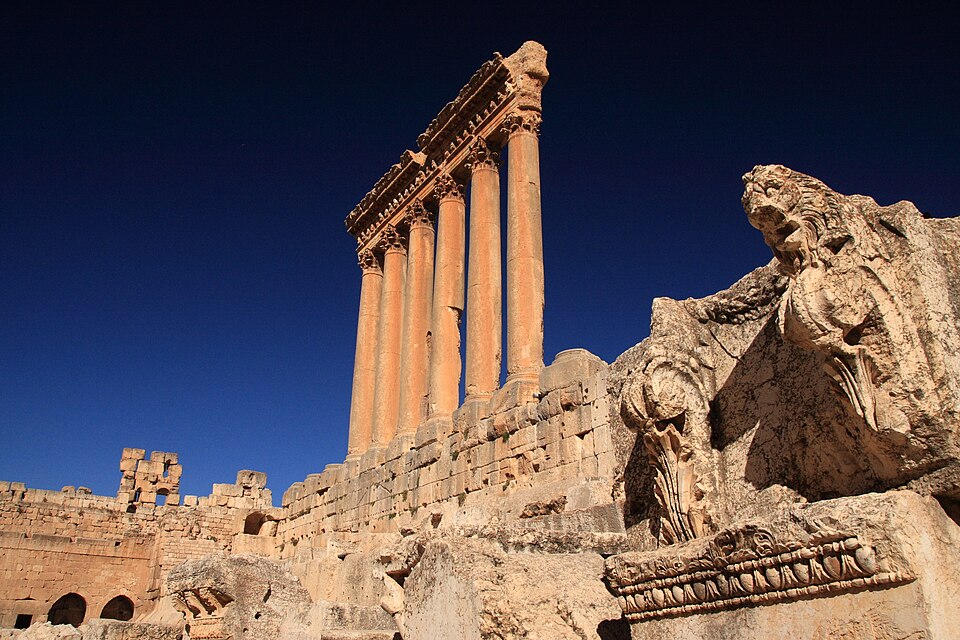
Illustration: Temple of Jupiter, Baalbek, Lebanon. Photo: yeowatzup / Wikimedia Commons. The Temple of Jupiter at Baalbek. Source
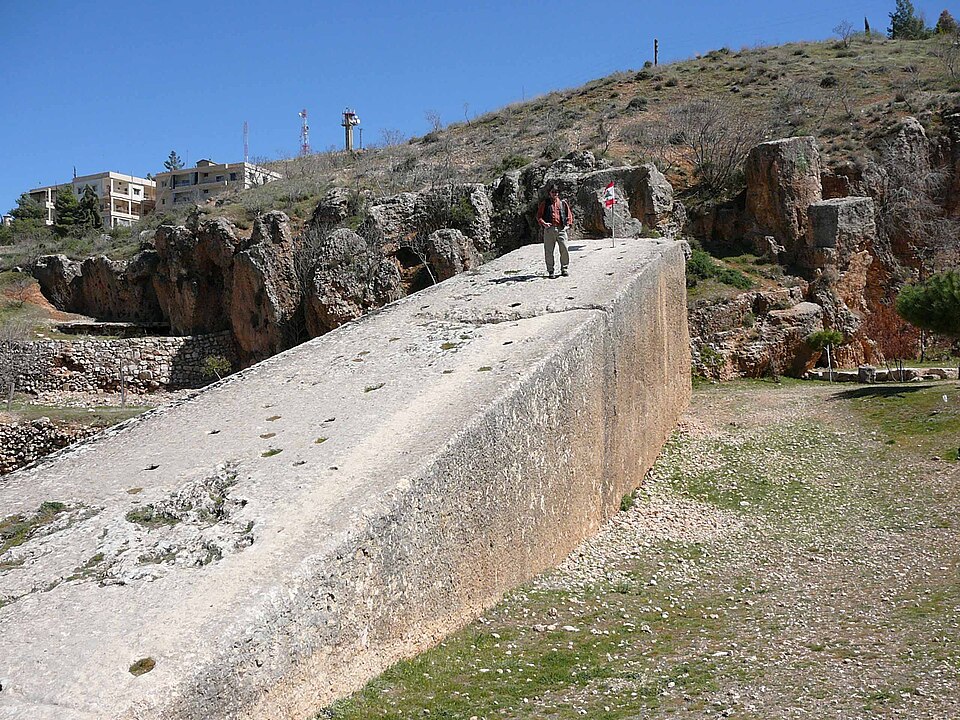
Baalbek-stoneofpregnantwoman. Photo: Ralph Ellis / Wikimedia Commons. Ralph Ellis on the large stone at Baalbek, known as the Stone of the Pregnant Woman. Source

Baalbek- largest stone. Photo: Ralph Ellis / Wikimedia Commons. Ralph Ellis on the largest stone at Baalbek, in the second quarry. Source
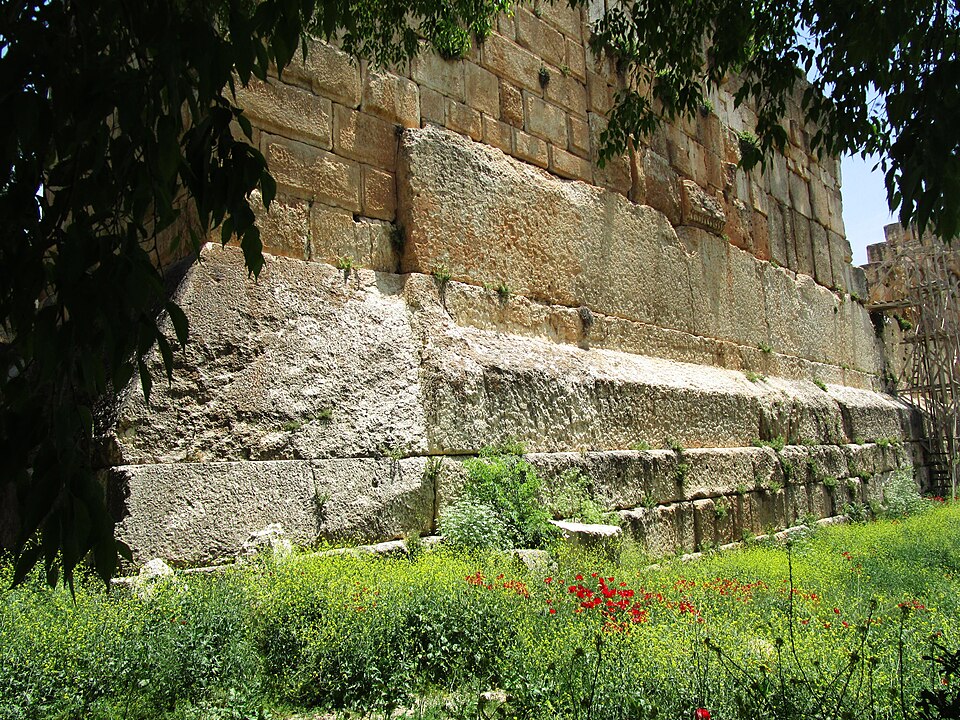
Temple of Jupiter, West wall, Trilithon, Baalbek 20528. Photo: Lodo27 from Moscow, Russia / Wikimedia Commons. The Platform of the Temple of Jupiter, West wall, Trilithon (Baalbek). Source
Findings
The three megalithic blocks stacked above the courtyard of the Temple of Jupiter at Baalbek measure approximately 19 metres in length, 4.2 metres in height, and 3.6 metres in thickness, with per-block masses in the 750–800 tonne range. They form part of a podium wall in the Roman complex of the Temple of Jupiter Baal, the group known as the trilithon, each stone estimated at 750 to 800 tonnes. Below this capstone course, the supporting stone layer features a number of stones which weigh an estimated 350 tonnes and are about 11 metres wide. [2] [6] [7] [8]
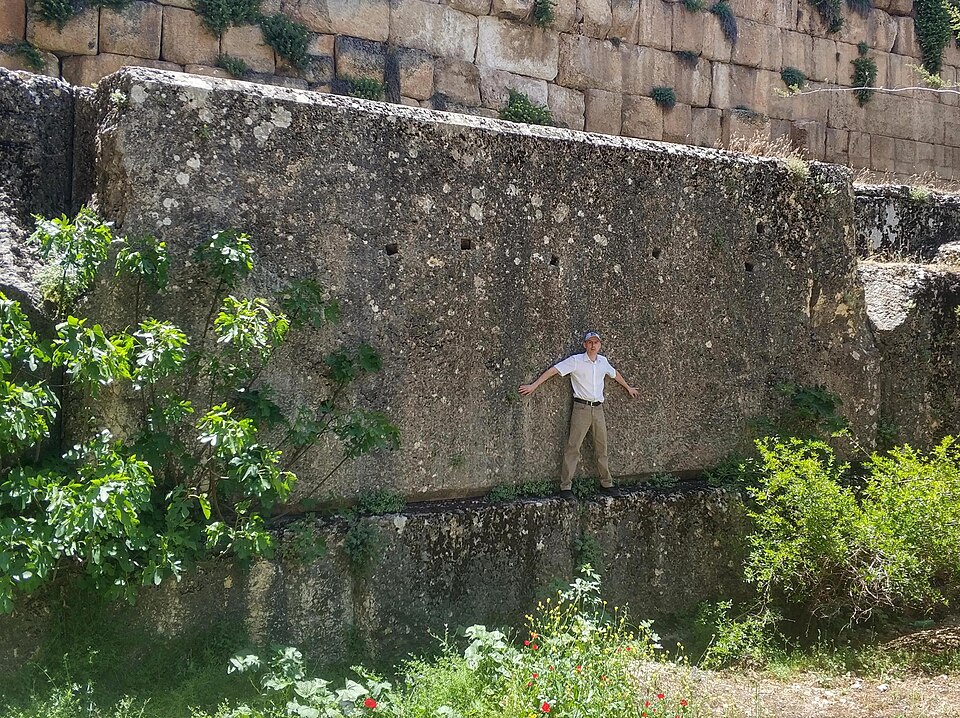
Illustration: North Wall of Temples Complex in Baalbek. Photo: Lodo from Moscow, Russia / Wikimedia Commons. The elevation reveals the blocks’ actual elevation, structural placement, and visual dominance over the surrounding…. Source
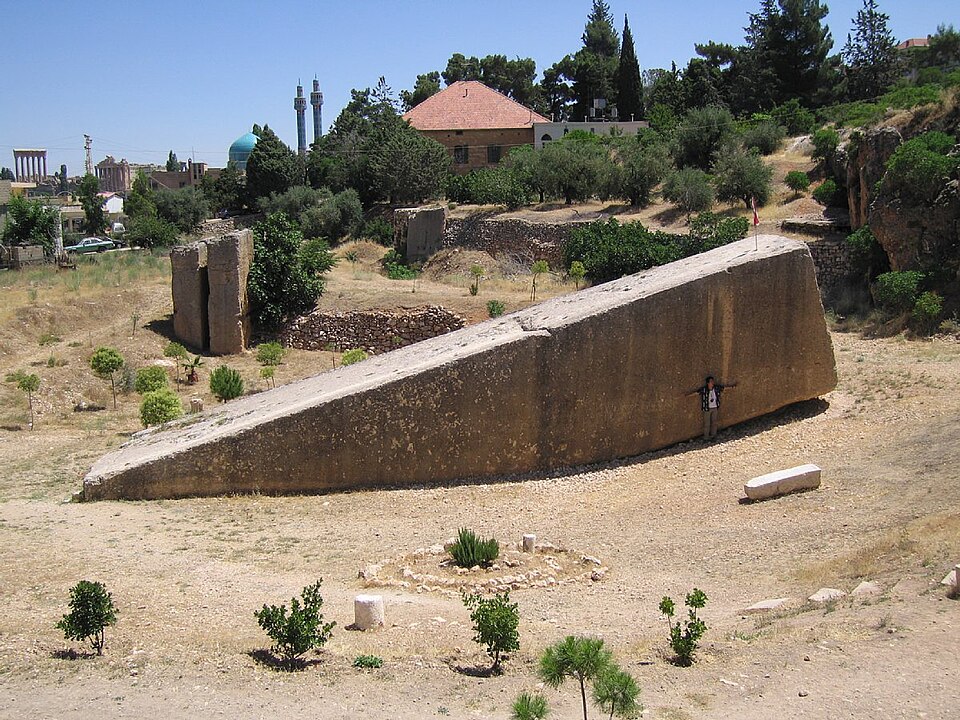
Illustration: Baalbek stone. Photo: SenemmTSR / Wikimedia Commons. Source
South of the sanctuary lies the quarry that supplied them, sitting slightly higher than the temple complex, so no lifting was required to move the stones. In summer 2014, the German Archaeological Institute’s Orient Department uncovered a second monolith beneath and immediately adjacent to the Stone of the Pregnant Woman (Hajjar al-Hibla), measuring 19.60 m long, 6 m wide, and at least 5.5 m high with an estimated mass of 1,650 tonnes — a block the excavators concluded was intended to be transported whole, without further cutting. The Stone of the Pregnant Woman itself was abandoned in place because the stone quality at one edge proved poor and the monolith could easily have been damaged in transit. Two megaliths lie abandoned side by side in the Hajjar al-Hibla sector, the larger of them left uncut in the excavators’ conclusion that it was meant to be transported whole. [9]
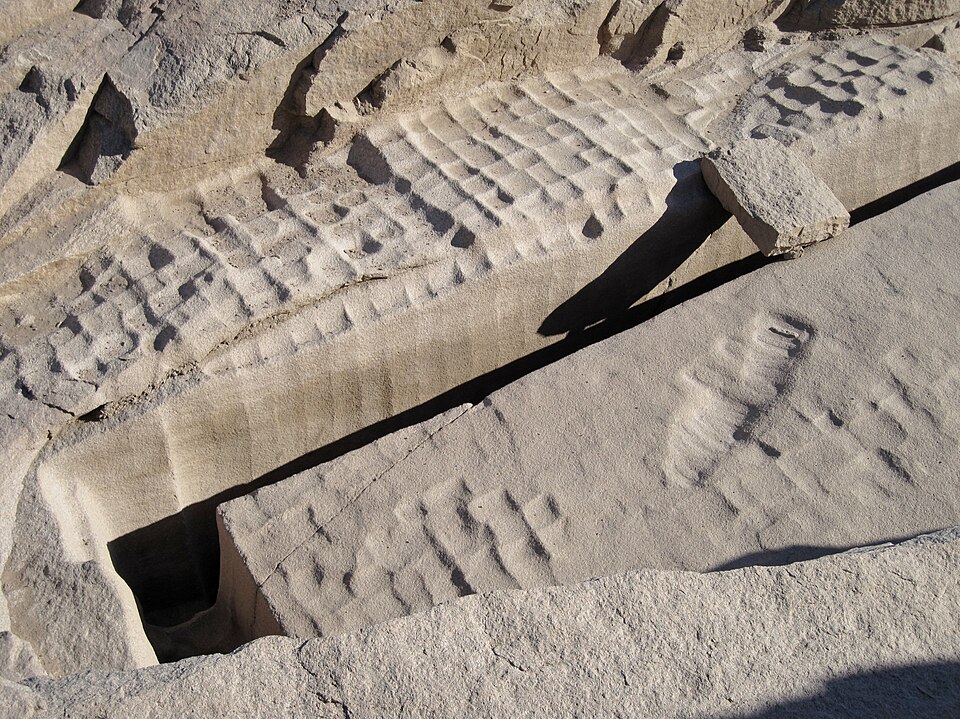
Illustration: Assuan 09. Photo: Olaf Tausch / Wikimedia Commons. Unvollendeter Obelisk in Assuan, Ägypten. Source
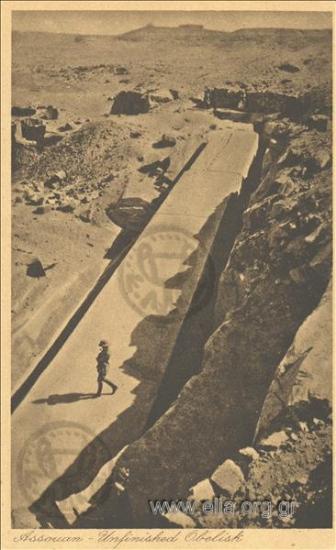
Assouan - Unfinished Obelisk. Photo: Europeana. Source
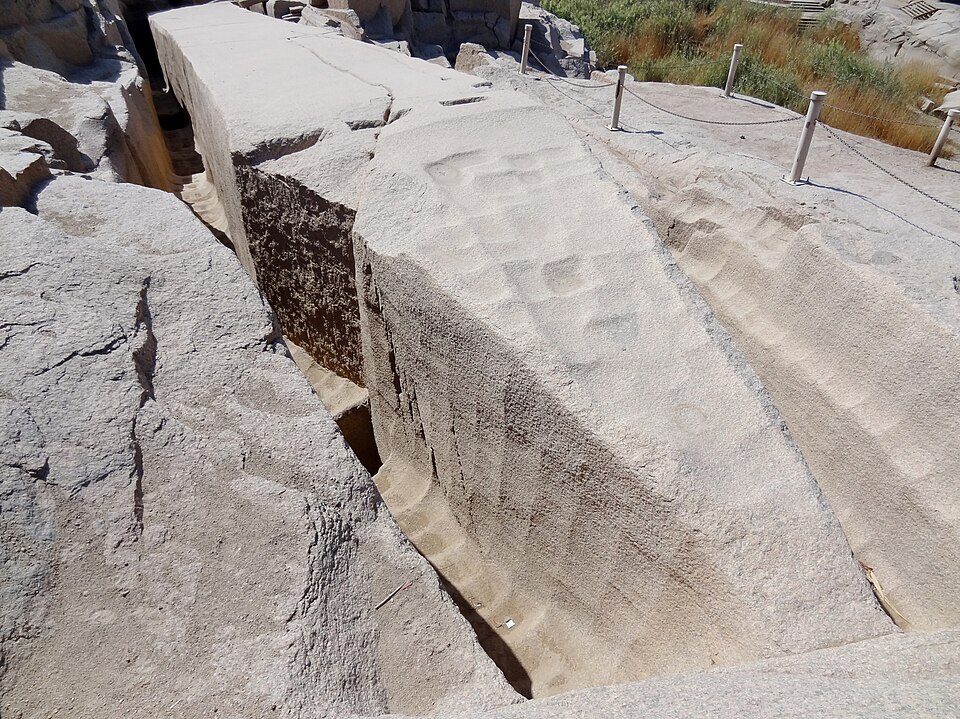
Assuan Unvollendeter Obelisk 34. Photo: Olaf Tausch / Wikimedia Commons. Unvollendeter Obelisk im Steinbruch von Assuan, Ägypten. Source
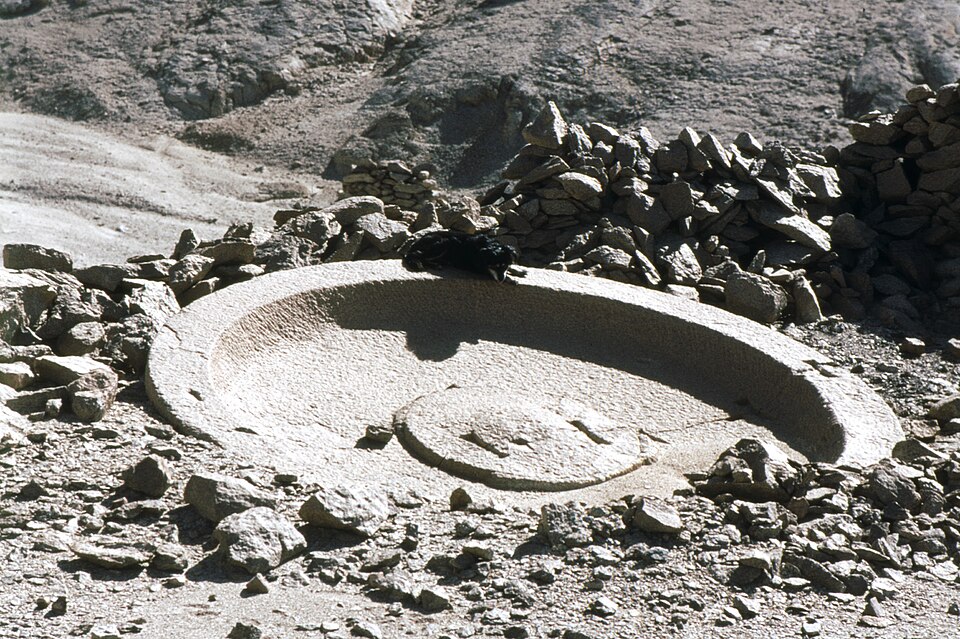
MonsClaudianus03 83. Split base of a fountain approx. diameter 3m, Mons Claudianus, eastern desert, Egypt. Source
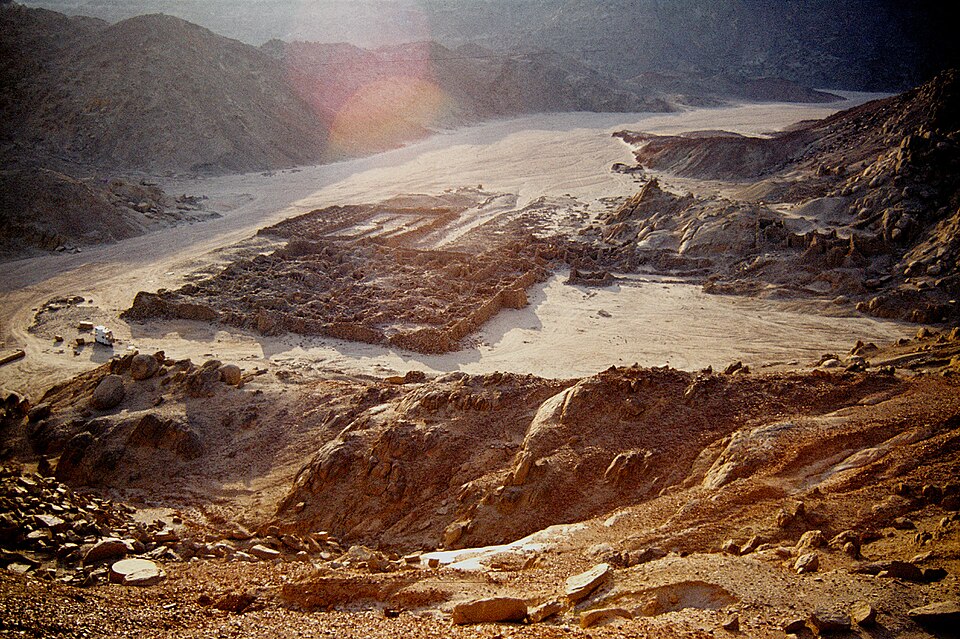
MonsClaudianus02 83. View from northeast to the camp, Mons Claudianus, eastern desert, Egypt. Source
The sanctuary itself was constructed in at least four imperial phases extending over more than two centuries, beginning with the Augustan reorganisation of the site as Colonia Julia Augusta Felix Heliopolitana around 16 BCE and running through the reign of Philip the Arab in the mid-3rd century CE. A graffito dated 2 August AD 60 on a topmost column drum places the Temple of Jupiter’s main body essentially complete by that year, and an in-situ Latin inscription on the Propylaea column bases names Longinus, a guardsman of Legio I Parthica, alongside the freedman Septimius recording the gilding of the Propylaea capitals under Septimius Severus and Caracalla — primary-source epigraphic evidence anchoring the Roman dating on the actual stones. Pre-Roman settlement layers at Tell Baalbek itself extend back to the Pre-Pottery Neolithic B and run continuously through the Early and Middle Bronze Ages, with Persian-period sherds recovered from beneath the flagstones of the Great Court — deep habitation, but no identified monumental construction prior to the Roman podium. The pink granite of the 128 Great Court columns was imported from Aswan in Egypt, separated by sea and land from the locally-quarried limestone platform; the monumental granite columns of the Temple of Jupiter, eight of which were later taken by Justinian for Hagia Sophia, were transported over distances exceeding 1,000 km. [10] [11]
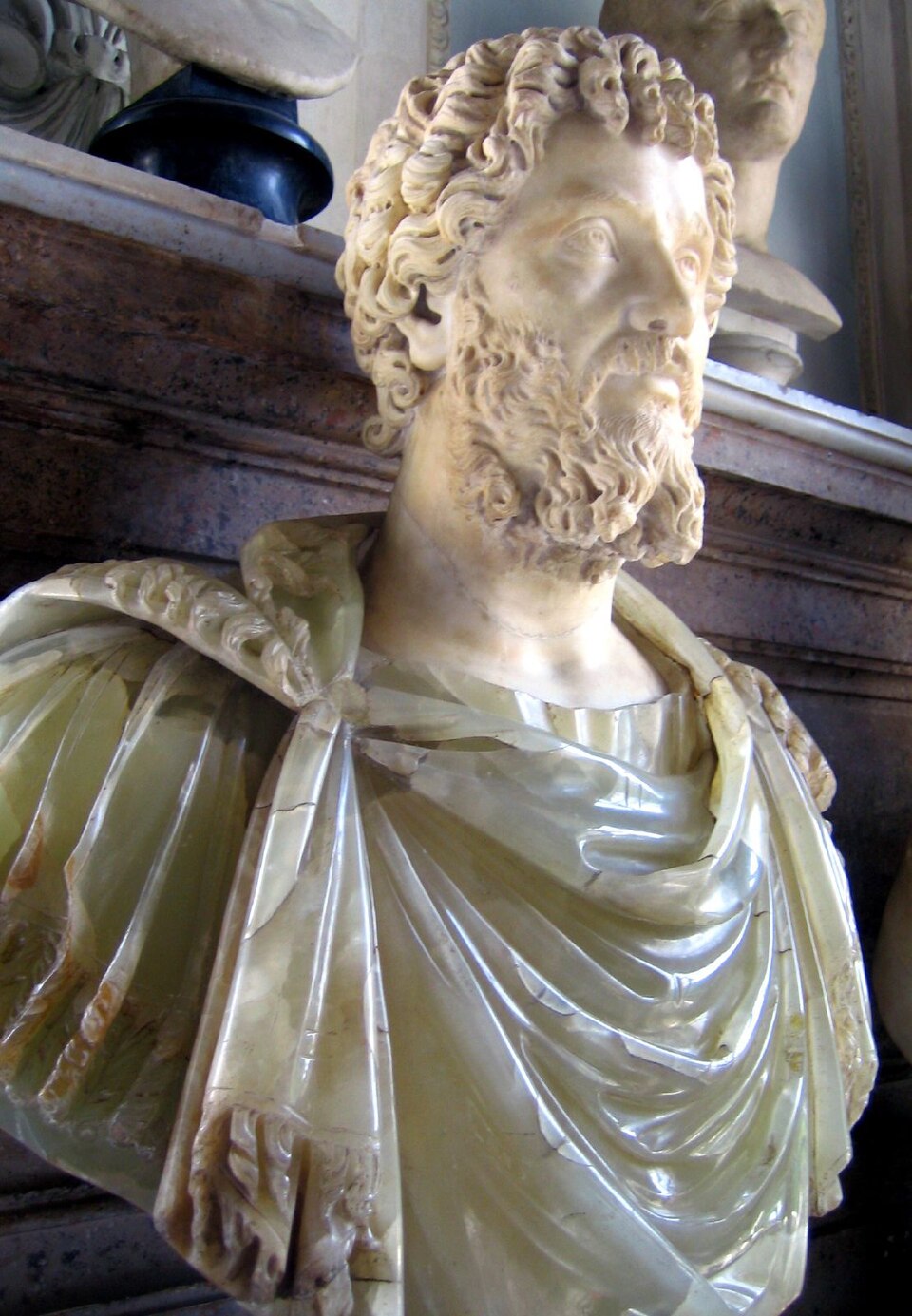
Illustration: Septimius Severus busto-Musei Capitolini. Photo: Unknown artistUnknown artist / Wikimedia Commons. Source
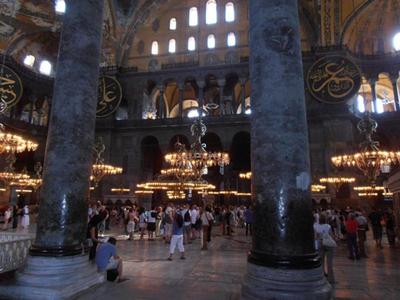
Illustration: Hagia Sophia Church, Istanbul, Turkey. Photo: Isidorus of Miletos and Anthemius of Tralles architects / Europeana. Marble columns. Source
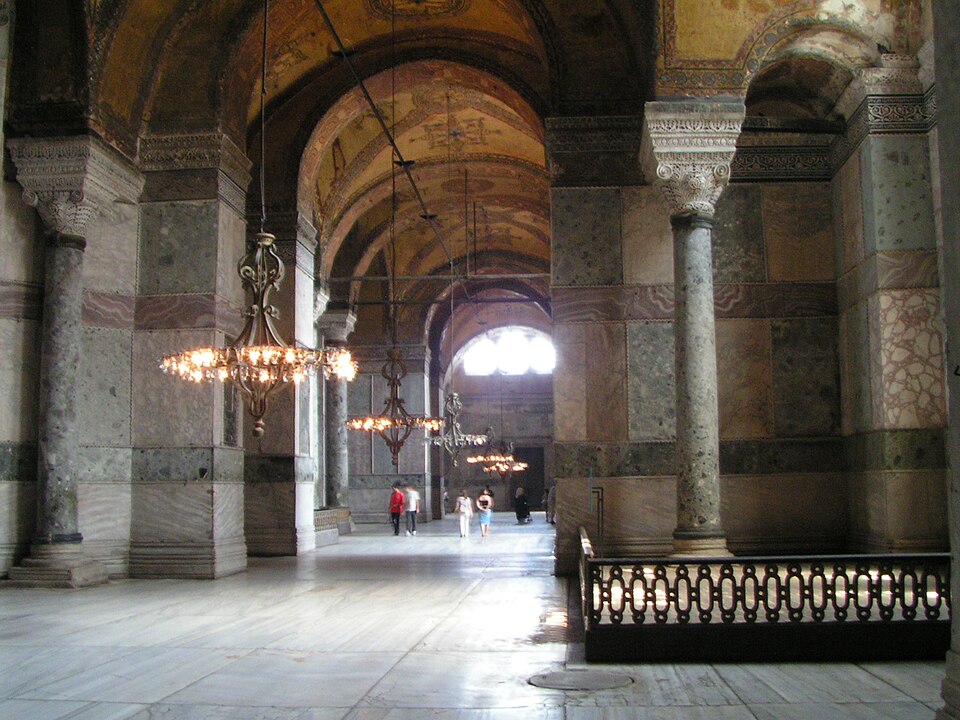
Istanbul - Hagia Sophia - 01. Photo: Wikimedia Commons. Source
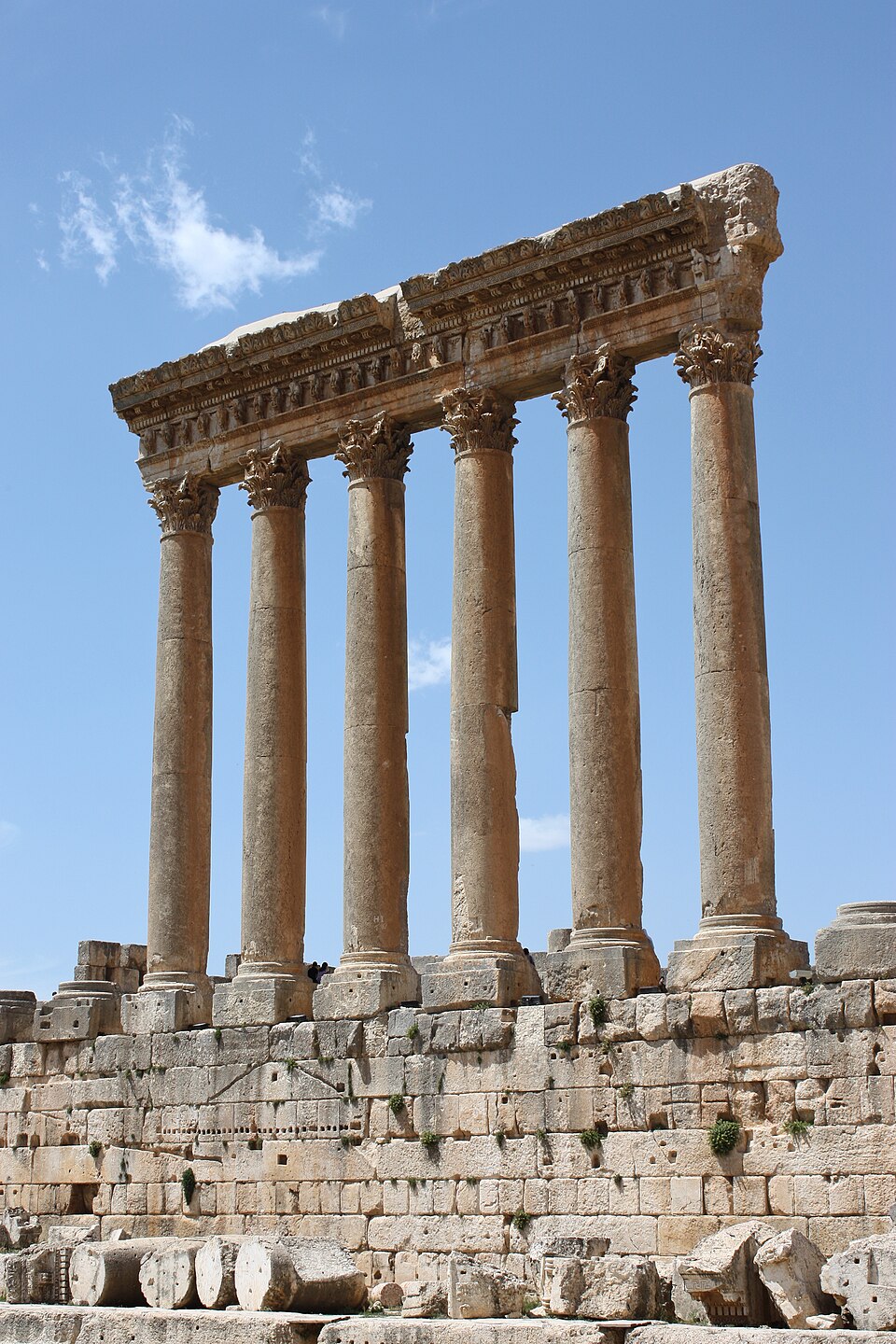
Baalbek - temple of Jupiter. Photo: Eusebius / Wikimedia Commons. The temple of Jupiter in Baalbek temple complex, in Lebanon. Source
How those 800-tonne blocks reached the podium is the question that has driven the recent research programme. Jean-Pierre Adam’s 1977 paper in the journal Syria remains the foundational engineering reconstruction, calculating that six human-powered capstans operated by 144 men, working through hemp ropes, sheaved pulleys, and graded log rollers on a packed-earth ramp, could deliver roughly 78,336 kg of traction on an 800,000 kg block once log rollers reduced the effective hauled mass. He cited as historical precedent the 18th-century Russian transport of Catherine the Great’s 1,250,000-kg “Thunder Stone” — moved 1.5 times the weight of a trilithon block without modern cranes — and grounded his model in Vitruvius’s De Architectura Book 10, which describes iron bolts, swallow-tailed fittings sealed with lead, and 12-foot wheels with architraves functioning as axles for horse-drawn megalith transport. The crucial engineering geography is that the quarry sits slightly higher than the podium, meaning the blocks were hauled essentially downhill across a nearly level approach rather than lifted. [20] [16]
Illustration: De Architectura. Photo: Marcus Pollio Vitruvius / The Met / Open Access. Source
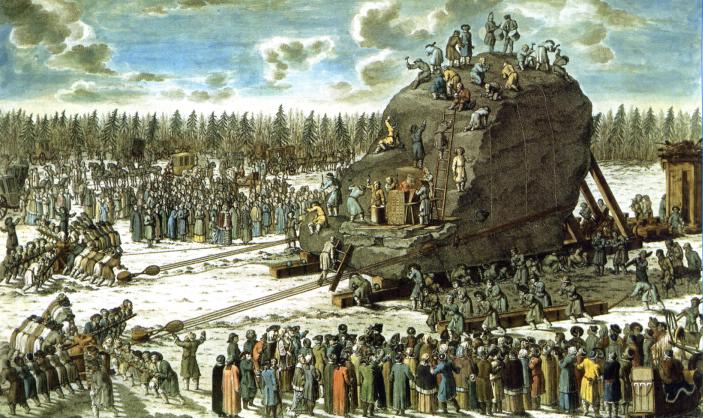
Thunder Stone. Photo: Engraving by I.F.Schley of the drawing by Y.M.Felten. 1770 / Wikimedia Commons. The Transportation of the Thunder-stone in the Presence of Catherine II. Source
Set against this engineering record is a parallel alternative literature in which the platform is held to predate the Romans by millennia or more. Erich von Däniken cited Baalbek in Chariots of the Gods? (1968); Zecharia Sitchin built an entire chapter of The Stairway to Heaven (1980) around the platform as “the Landing Place” for Anunnaki rockets. Some alternative claims assert that the structure could be 12,000 years old and continuously inhabited since roughly 9,000 BCE, or that certain elements predate the Phoenicians — claims that sit against the c. 27 BCE dating of the megalith and a temple completed c. 60 CE — claims that Graham Hancock has called his favourite archaeological site and mainstream archaeology has rejected as outside the chain of physical evidence that links the quarry tool marks, the Roman lifting bosses on the trilithon faces, and the in-situ Latin inscriptions naming Roman builders. The evidence, taken as a whole, does not resolve the deeper dispute: there is no documented pre-Roman monumental construction at Baalbek, but the engineering challenge of moving 800-tonne limestone blocks remains genuinely open — which is why Margarete van Ess of the German Archaeological Institute suspended her 2014 quarry excavation when the trench became dangerously deep, with the explicit goal of returning to reach the base of the 1,650-ton block to find, as she put it, “clues about how the megaliths were transported”. [5] [13] [16]
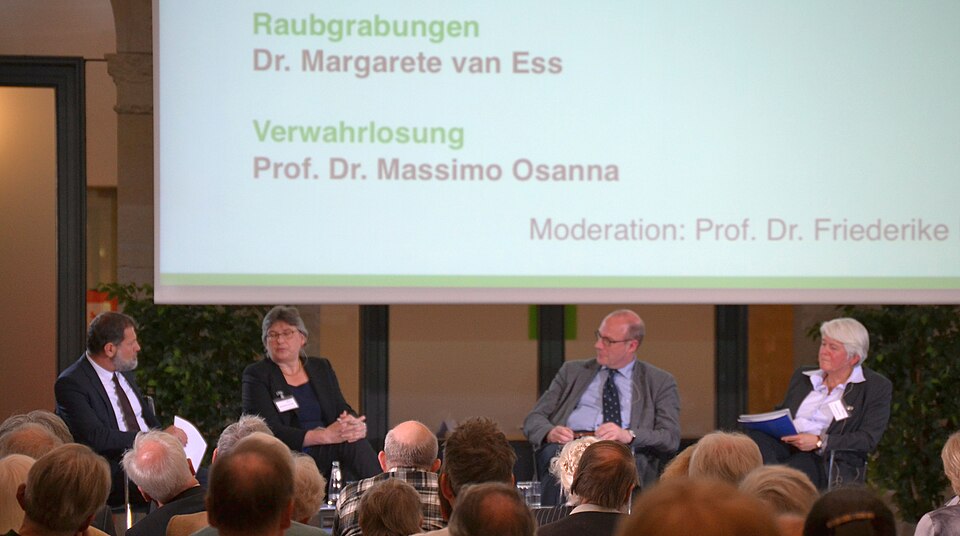
Illustration: Akademientag 2015 Berlin - Podium ‘Bewahrung vor Zerstörung’ 01. Photo: Marcus Cyron / Wikimedia Commons. Source
Connecting the Dots
The most parsimonious account of the Baalbek megaliths is also the most thoroughly documented one. Margarete van Ess and Klaus Rheidt of the German Archaeological Institute lead the Baalbek project, whose results moved the date of the sanctuary’s construction phase. The Hajjar al-Hibla monolith, of around 1,000 tonnes, was left in the quarry because the stone’s quality at one edge proved poor and the monolith could easily have been damaged during its transport. The broader dating reinforces the Roman-Herodian attribution: the colony was founded in 15 BC, though the temple project itself remained unfinished and the temple most probably was never built, and the masonry of the T-shaped podium is identical to that of Herod’s terrace walls at the Jerusalem Temple Mount, supporting Herodian involvement between 24 and 15 BCE. [14]
Pont du Gard BLS. Photo: Benh LIEU SONG (Flickr) / Wikimedia Commons. Source
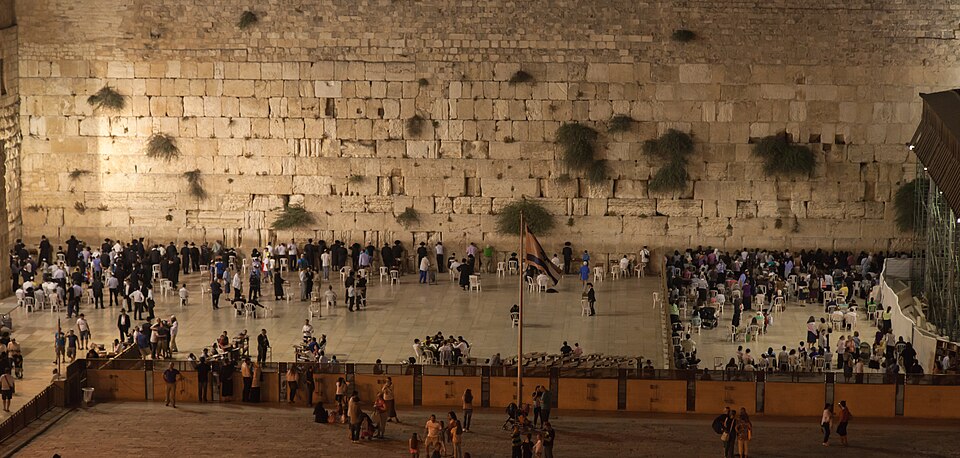
Illustration: Jerusalem - Mur des lamentations - Mur occidental. Photo: Xavier Gillet, Bordeaux, France (xavier33300 on flickr) / Wikimedia Commons. Source
The quantitative pattern that this account does not dissolve is the weight gap between known Roman transport operations and the Trilithon scale. The cleanest benchmark is the Basilica of Maxentius, where roughly 100-tonne marble monoliths were shipped across the Mediterranean, dragged up the Tiber, and paraded through Rome. Each Trilithon stone is estimated at 750 to 800 tonnes and measures roughly 19 to 20 metres long — far heavier than the largest documented Roman transport operation. Roman hoisting capacity is itself a matter of reconstruction rather than measurement, and the reconstructed figures for cranes and treadwheels sit far below the weight of a single trilithon block. Jean-Pierre Adam’s 1977 study concluded that Roman methods could in principle handle even the largest blocks using teams of men, capstans, wooden rollers, and earthen ramps — a theoretical assertion rather than a quantitatively tested one against the Trilithon scale. [15] [16]
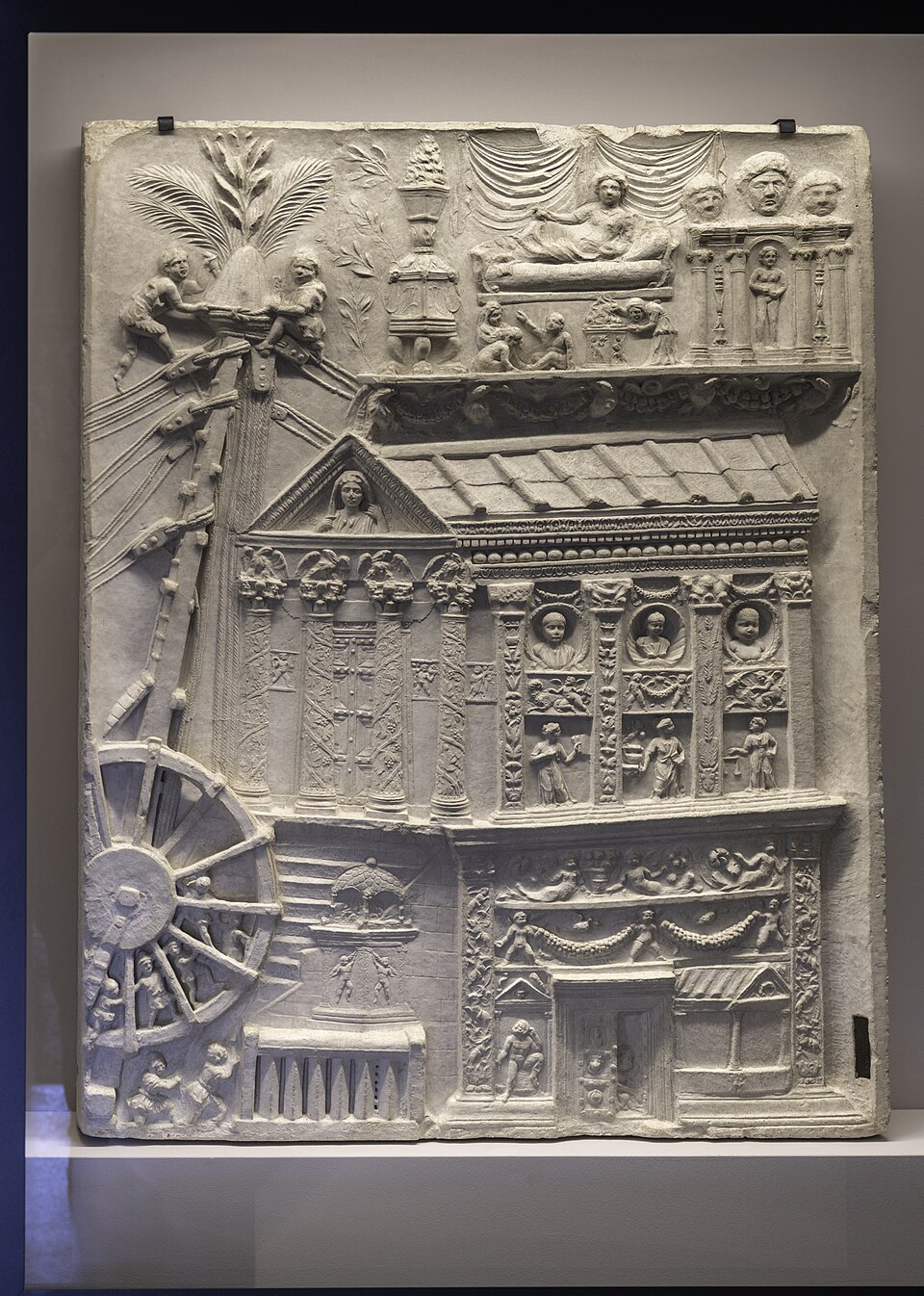
Relief from the Mausoleum of the Haterii, Gregoriano Profano Museum, Vatican Museums. Photo: Wilfredor / Wikimedia Commons. Source
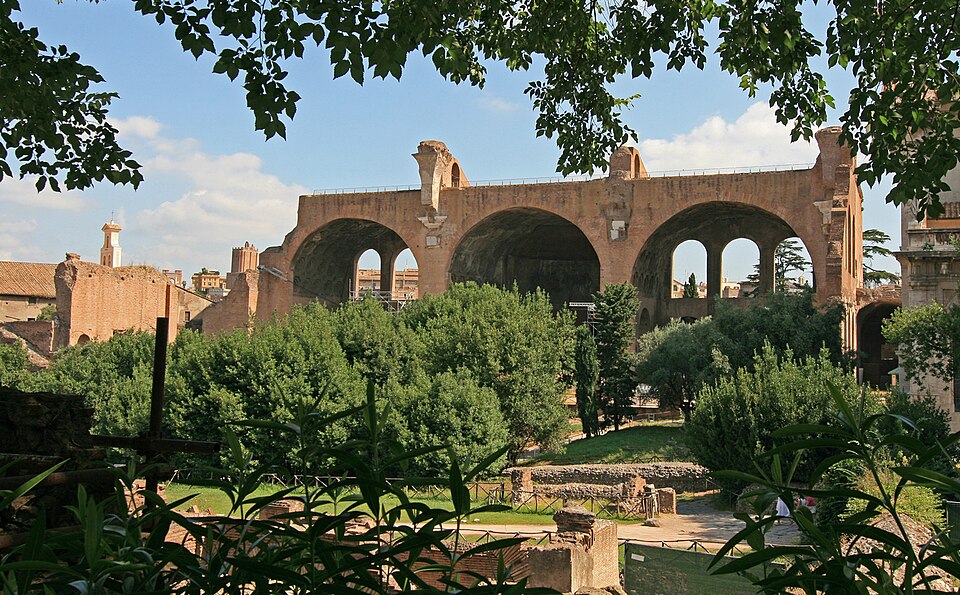
Illustration: Basilica of Maxentius Rome. Photo: Jensens / Wikimedia Commons. Basilica of Maxentius and Constantine, Rome. Source
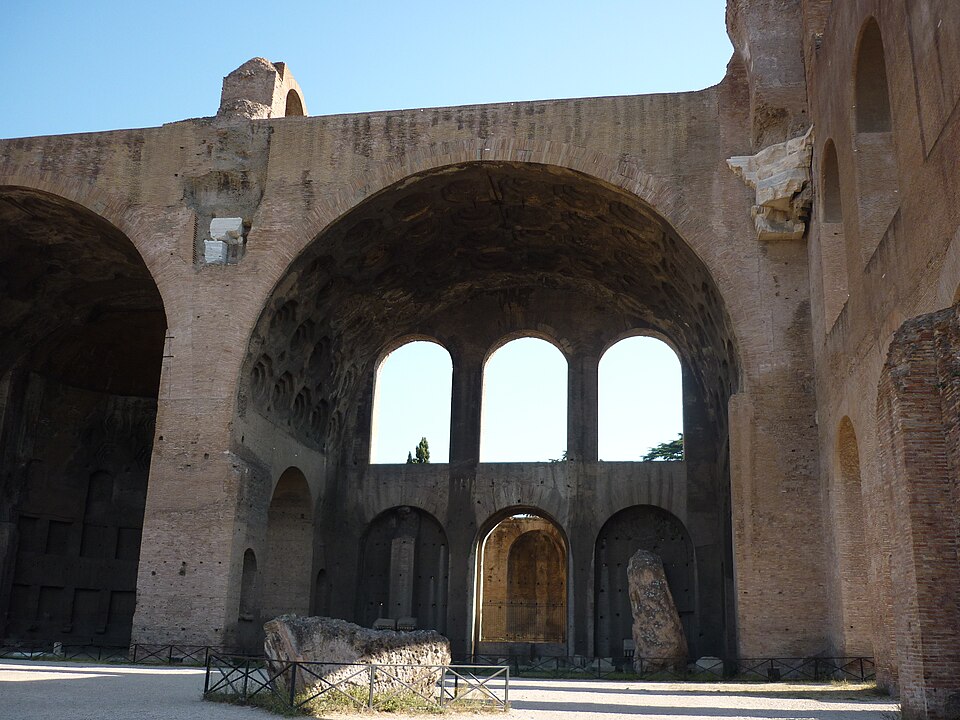
Basilica of Maxentius and Constantine7. Photo: Urban / Wikimedia Commons. Basilica of Maxentius and Constantine, Rome, Italy. Source
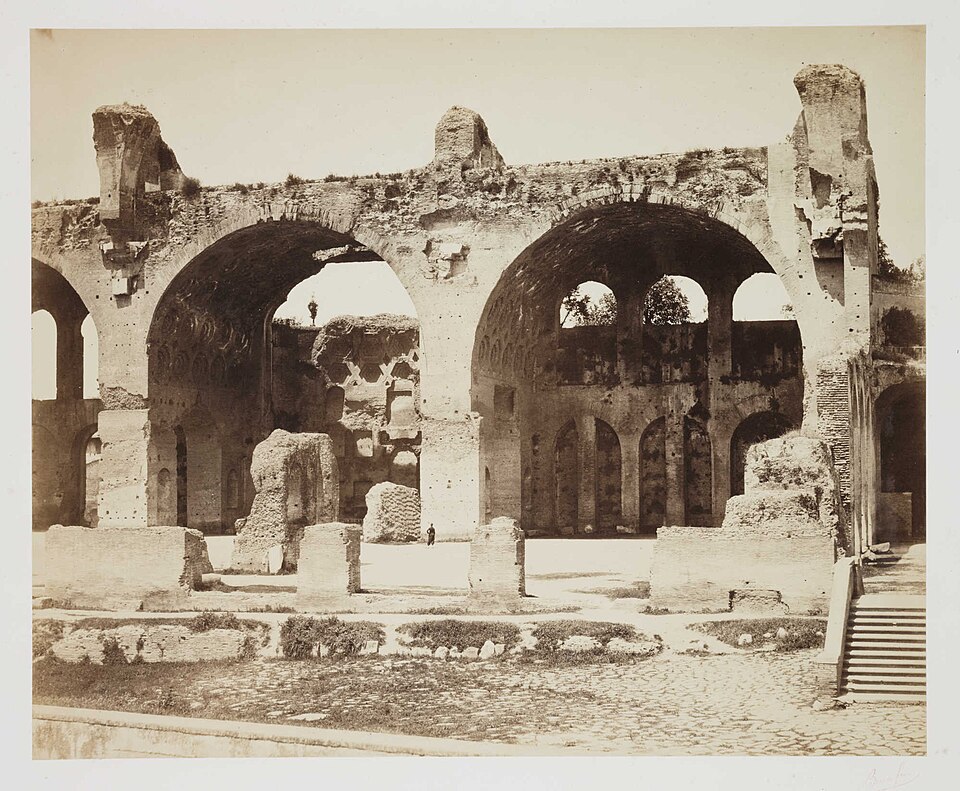
Basilica of Maxentius, Rome. Photo: National Media Museum from UK / Wikimedia Commons. The Basilica of Maxentius is the benchmark for the largest documented Roman transport operation (100…. Source
The Other Side
The mainstream scholarly position treats the monumental construction at Baalbek as the product of Roman imperial engineering, with documented pre-Roman phases limited to the Hellenistic period rather than the deep antiquity claimed by alternative theorists. Margarete van Ess of the German Archaeological Institute (DAI) has led long-term excavations and survey work at Baalbek, with results published through the German-Lebanese archaeological project that situate the quarrying of the Trilithon stones and the Hajjar al-Hibla monolith within the Roman imperial period. The monumental podium is attributed to the Roman imperial period, not to Seleucid activity around 198 BC, and certainly not to the Neolithic or 9,000 BCE substrates invoked by authors such as Graham Hancock and Zecharia Sitchin. Claims of continuous habitation back to 9,000 BCE and 12,000-year-old origins are classified within the academic literature as pseudoarchaeology, lacking stratified contexts, radiocarbon dates, or peer-reviewed documentation. [17] [14]
The transport and placement of the approximately 800-tonne Trilithon stones and the ~1,000-tonne Hajjar al-Hibla monolith are addressed by competing but mainstream engineering reconstructions. Jean-Pierre Adam has proposed that the stones were moved using rollers running on prepared trackways. Margarete van Ess, by contrast, has argued for a capstan-and-rope drag system. The newer EXARC “Rolling Flange Hypothesis” offers a mechanical reinterpretation involving undercut sacrificial flanges interfacing with shaped trackways, published in a peer-reviewed experimental archaeology venue. All three models assume documented Roman-era lifting and pulling technology as described by Heron of Alexandria in his Mechanics, which catalogues polyspaston cranes and treadwheel devices. Comparable organizational capacity for monumental quarrying is documented at Roman operations such as Mons Claudianus in Egypt’s Eastern Desert, where granodiorite columns were extracted under imperial contract and shipped across the Mediterranean. The most powerful Roman cranes reconstructed experimentally — a Ressler treadwheel crane scaled to roughly 40 feet in height — are reported at capacities of around 8 tonnes, an order of magnitude below the megalith weights and consistent with the conventional view that ramps and embankments, rather than direct crane lifts, were used to raise the foundation stones into the podium. [15]
The conventional explanation for the abandoned megaliths in the Hajjar al-Hibla quarry also departs from the alternative hypothesis. A 2015 study documented cracks and a defect on the downhill face of the Stone of the Pregnant Woman; the excavation itself recorded that it was left in the quarry because the stone’s quality at one edge proved poor and it could easily have been damaged during its transport. The hypothesis that all three abandoned quarry megaliths were left for the same reason, or that they were abandoned as part of a ceremonial tradition marking the “birthplace of the temple” as proposed by Hugh Newman, finds no support in the published quarry reports. The DAI survey work treats the monoliths left at Hajjar al-Hibla as having been abandoned for the technical reasons recorded during fieldwork, not as a unified ritual deposit. [18]
The striation marks beneath and around the unfinished quarry monoliths are likewise not anomalous when read against documented Roman quarry practice. Tool-mark analyses on ancient Egyptian hard-stone quarries, where comparable marks are preserved, show that wedge-and-lever extraction, point work, and chiseling produce parallel striations that can resemble machine-cut features when examined without geological context. Experimental archaeology has reproduced comparable surface features using documented Roman hand tools and techniques, including the use of Lewis bolts for lifting dressed blocks. Standard principles of stone extraction, as documented in quarry archaeology guides, describe these features as expected outcomes of wedge-and-lever methods rather than as evidence of unknown tooling [1]. The “machine-like” interpretation put forward in alternative-pre-Roman accounts has not been supported by experimental reproduction with ancient tools, and the documented use of iron chisels and wedges at comparable quarry sites places the Baalbek tooling firmly within the Roman technological repertoire.
What We Actually Know
The investigation confirmed what the monumental scale of Baalbek has long suggested: the Romans built something at the upper limit of what their known engineering can account for. The three Trilithon stones at the western podium wall of the Jupiter temple each measure approximately 19 metres long, ~4.2 metres high, and ~3.6 metres thick, with weight estimates consistently in the 750-to-800-tonne range. The Stone of the Pregnant Woman (Hajjar al-Hibla), an unfinished monolith still connected to the bedrock in a quarry about 900 metres from the temple complex, weighs approximately 1,000 tonnes [3] [6]. Even larger abandoned stones remain at the same quarry system: the Stone of the South at roughly 1,242 tonnes and the Forgotten Stone at approximately 1,650 tonnes [3] [6]. The quarry sits 800 metres to 1 kilometre southwest of the sanctuary on the same Cretaceous limestone formation as the platform, with blocks hauled essentially downhill, since the quarry sat slightly higher than the temple complex. The quarry faces preserve a documented Roman tool-mark typology — flat chisels producing parallel grooves, pointed chisels opening channels and wedge slots, with marks growing deeper as iron tools replaced bronze. Settlement at Baalbek predates the Roman period by millennia, with documented occupation from the Chalcolithic and Early Bronze Age and re-emergence as a significant waypoint at the beginning of the third millennium BC.
What mainstream scholarship has built is a model, not a verified reconstruction. French archaeologist Jean-Pierre Adam’s 1977 engineering study concluded that Roman-era construction methods — capstans, wooden rollers, earthen ramps, teams of men — could in principle handle even the largest blocks. Adam’s quantitative models specify approximately 800 oxen pulling on log rollers, reducing effective hauled weight to about 66,600 kilograms, or 144 men on six capstan-and-pulley systems producing roughly 78,336 kilograms of tractive power. He cites the 1,250,000-kilogram Thunder Stone moved to St. Petersburg under Catherine II as a documented historical precedent at 1.5× the weight of a trilithon. But Adam’s primary text is cited only second-hand in the research corpus, and no quantitative engineering parameters from his original paper have been independently reproduced. Mainstream engineering has moved beyond the simple Adam triad — sledges, rollers, ramps, levers — and now considers it mechanically insufficient at 800 tonnes, proposing refinements like the EXARC Rolling Flange Hypothesis of undercut sacrificial flanges interfacing with shaped trackways. The Neolithic Menga dolmen at Antequera demonstrates that prehistoric builders achieved overland megalith transport over roughly one kilometre using sledges on prepared trackways with rollers, establishing a multi-millennial engineering tradition at substantially smaller scale than the Trilithon. [15]
The three abandoned quarry megaliths carry three competing explanations that answer different questions and are not mutually exclusive: a Sector III quarry study’s “modifications of the monumental building project” attribution (project-level design history); the recorded crack and defect on the face of the Hajjar al-Hibla as the individual-block explanation (individual-block artefact biography); and Hugh Newman’s “ceremonial marking of the birthplace of the temple” cultural-practice claim with no emic documentary basis in the research corpus. The German Archaeological Institute explicitly frames the transport-method question as ongoing research — its 2014 campaign was suspended when the trench became dangerously deep, with van Ess stating she hopes future campaigns will dig down to the bottom of the block for transport evidence. The claim of a pre-Roman monumental podium splits in two: pre-Roman habitation substrate (Middle Bronze Age over Early Bronze Age layers beneath the Great Court) is archaeologically documented, while the specific claim of a Hellenistic core to the podium rests on one non-peer-reviewed Academia.edu working paper, with the peer-reviewed Simone Eid Paturel 2019 monograph re-dating the so-called Hellenistic phase to a later Roman period based on the German Baalbek project findings of van Ess and Klaus Rheidt. [12] [14]
The speculative tier holds the claims that outrun the data. Van Ess’s structural-crack explanation for the Stone of the Pregnant Woman derives from a single interview statement, not a published DAI technical report with photographic or geophysical documentation. Anomalous striation marks around the unfinished quarry monoliths — described as “machine-like” by some alternative-media sources — all trace back to the same closed citation loop that also advances the pre-Roman dating claims; natural limestone weathering features (slickensides, stylolites, bedding-plane partings, root etching) have not been ruled out, and the Megalithomania documentary itself contains a contrary observation from an on-site archaeologist that the striations are “remarkably similar to what we see as one quarry” [4]. The Hellenistic core dating itself is an inference from regional Hellenistic activity rather than from an inscription at the podium; the 198 BCE date is not archaeologically anchored to the monumental remains. Roman hoisting capacity at this scale is a matter of reconstruction rather than measurement, and the equipment involved — compound-pulley cranes and earthen embankment ramps — served the vertical hoisting of column drums, a different operation from the horizontal drag problem the Trilithon posed.
References
[1] [PDF] QuarryScapes guide to ancient Stone quarry landscapes — http://www.quarryscapes.no/text/Publications/QS_del11_wp9.pdf (accessed 2026-08-16)
[2] Gigantic Ancient Structure our Technology Can’t Replicate: Baalbek [2:01-3:41] — Universe Inside You (YouTube) — https://youtu.be/sFA7vf1Z2vQ?t=121 (accessed 2026-08-16)
[3] Archaeologists Can’t Solve this Engineering Mystery [5:31-7:10] — Michael Button (YouTube) — https://youtu.be/pUaa2DtWR7U?t=331 (accessed 2026-08-16)
[4] Baalbek | Mega-Temple of the Gods | Megalithomania Documentary [20:54-23:15] — MegalithomaniaUK (YouTube) — https://youtu.be/YU6BpSTxmFM?t=1254 (accessed 2026-08-16)
[5] Digs & Discoveries - History’s Largest Megalith - March/April 2015 — https://archaeology.org/issues/march-april-2015/digs-discoveries/lebanon-baalbek-quarry-megalith/ (accessed 2026-08-16)
[6] Baalbek Stones — https://en.wikipedia.org/wiki/Baalbek_Stones (accessed 2026-08-16) [Reputable]
[7] More from Baalbek: ancient stone construction hi-tech. — https://eugene.kaspersky.com/2019/10/10/more-from-baalbek-ancient-stone-construction-hi-tech/ (accessed 2026-08-16)
[8] The Megalithic Quarry of Baalbek: Sector III … — https://www.researchgate.net/publication/291042198_The_Megalithic_Quarry_of_Baalbek_Sector_III_the_Megaliths_of_Hajjar_al-Hibla (accessed 2026-08-16)
[9] Biggest ancient stone block in Baalbek/ancient Heliopolis — https://www.archaeology.wiki/blog/2014/11/24/biggest-ancient-stone-block-baalbekancient-heliopolis/ (accessed 2026-08-16)
[10] Baalbek - World Pilgrimage Guide - Sacred Sites — https://sacredsites.com/middle_east/lebanon/baalbek.html (accessed 2026-08-16)
[11] Baalbek Ruins, Lebanon: an extraordinary UNESCO site — https://rachelsruminations.com/baalbek-ruins-in-lebanon/ (accessed 2026-08-16)
[12] (PDF) The Megalithic Quarry of Baalbek - Sector III … — https://www.academia.edu/83253616/The_Megalithic_Quarry_of_Baalbek_Sector_III_the_Megaliths_of_hajjar_al_Hibla (accessed 2026-08-16) [Academic]
[13] Largest megalith from antiquity — https://www.guinnessworldrecords.com/world-records/605305-largest-megalith-from-antiquity (accessed 2026-08-17)
[14] Baalbek-Heliopolis, the Bekaa, and Berytus from 100 BCE … — https://bmcr.brynmawr.edu/2020/2020.11.35/ (accessed 2026-08-16) [Academic]
[15] Archaeologists Can’t Solve this Engineering Mystery [2:01-3:37] — Michael Button (YouTube) — https://youtu.be/pUaa2DtWR7U?t=121 (accessed 2026-08-16)
[16] The Baalbek Trilithon’s “Impossible” Platform - OverClassified — https://overclassified.org/ancient/baalbek-trilithon.html (accessed 2026-08-17)
[17] (PDF) The Baalbek Enigma - ResearchGate — https://www.researchgate.net/publication/400602590_The_Baalbek_Enigma (accessed 2026-08-16)
[18] The Myth of the Megalith — https://www.newyorker.com/tech/annals-of-technology/baalbek-myth-megalith (accessed 2026-08-16)
[19] View of the monolith known as the “Stone of the Pregnant Woman” — https://marble.nd.edu/item/c886d8ab-2e60-4019-a74d-79160a8ffa33 (accessed 2026-08-16) [Academic]
[20] Adam, J.-P. 1977. A propos du trilithon de Baalbek. Le transport et la mise en oeuvre des mégalithes. Syria 54(1-2):31-63 — https://www.persee.fr/doc/syria_0039-7946_1977_num_54_1_6623 (accessed 2026-10-04) [Academic]
Corrections
- Every claim in this paper was re-checked against the sources it cites, by an independent audit that fetched and read each source rather than accepting the stored verdict. Of 58 verifiable assertions, 28 did not hold up: they were unsupported, attributed to the wrong reference, or contradicted by the very source cited. 4 were confirmed as written. 26 replace claim, 6 reattribute, 2 replace number, 1 delete claim were applied. Each correction narrows a claim to what its source actually says, moves it to a source that does support it, or removes it where no source could. An honest limit: 26 of the 58 assertions rest on sources that could not be read at all - paywalls, bot protection, video without a transcript. Those claims are neither confirmed nor corrected here, and a reader cannot check them either. They are the weakest part of this paper's evidence base. The audit was performed and applied by an AI agent fleet; no line of the corrected text has been read by a human editor. A reference that resolves is not thereby right - it was read before it was trusted. A note on provenance: this paper carried no model stamp at all, so which model wrote the original research cannot be recovered. The correction's own stamp is recorded; the original's is not guessed at.
- Provenance record added; no sentence of the paper's text changed. The correction published earlier today rewrote substantial parts of this paper, but it was filed as a plain text correction and therefore left this page with no authorship stamp. A paper whose body is machine-written has to say so in the open: the disclosure line now names the model that applied the repair. What remains unrecorded cannot be invented - which model ran the original research in the first place is not recoverable, because this paper predates the stamp, and the field says "unrecorded" rather than guessing. The limitation stated in the entry above stands unchanged: 26 of the paper's 58 assertions still rest on sources that neither the audit nor a reader can open.
- Every claim in this paper was re-checked against the sources it cites, by an independent audit that fetched and read each source rather than accepting the stored verdict. Of 58 verifiable assertions, 28 did not hold up: they were unsupported, attributed to the wrong reference, or contradicted by the very source cited. 4 were confirmed as written. 26 replace claim, 6 reattribute, 2 replace number, 1 delete claim were applied. Each correction narrows a claim to what its source actually says, moves it to a source that does support it, or removes it where no source could. An honest limit: 26 of the 58 assertions rest on sources that could not be read at all - paywalls, bot protection, video without a transcript. Those claims are neither confirmed nor corrected here, and a reader cannot check them either. They are the weakest part of this paper's evidence base. The audit was performed and applied by an AI agent fleet; no line of the corrected text has been read by a human editor. A reference that resolves is not thereby right - it was read before it was trusted.
Keep exploring
Every site on this page sits on the globe, and the people who research them are on the Discord.
3D Globe · Sites by country · Story Archive · Research Library · Weekly Journal · Search