 ANCIENT NERDS
Stargate Project and SRI Remote Viewing Evidence
The paper inventories the Stargate Project's twenty-year history and concludes that while the 1995 AIR review found a statistically significant but modest laboratory effect (effect size 0.34), the program failed to produce any verifiable actionable intelligence, and the case-level operational claims remain uncorroborated against declassified records. It situates this within a broader mainstream scientific consensus that characterizes remote viewing as a pseudoscience lacking proper controls and reproducibility, leaving the central question of whether the operational signal ever existed genuinely unresolved.
At 8:00 p.m. Central Standard Time on April 27, 1973, at the Stanford Research Institute in Menlo Park, California, an artist and author named Ingo Swann settled in for a remote-viewing session arranged by a mysterious “Mr. Sherman” and aimed his attention at Jupiter. What he described over the next hour startled the physicists watching over him: a ring encircling the gas giant, so unexpected that Swann himself wondered whether he had accidentally drifted to Saturn. NASA’s Pioneer 10 flyby subsequently confirmed that Jupiter did, in fact, have rings, and the episode has been cited in parapsychology literature ever since as a successful case of pre-confirmation anomalous cognition. [1]
For the next two decades, the U.S. government quietly kept testing whether Swann’s gift — or something like it — could be turned into a spy tool. The program that grew out of those SRI experiments cycled through at least five codenames — SCANATE, SUN STREAK, GRILL FLAME, CENTER LANE, and finally STARGATE — and ultimately cost roughly $20 million across those twenty years, from 1975 to 1995. When the CIA finally commissioned the American Institutes for Research to audit the entire record, the 1995 verdict was blunt: the laboratory studies showed a statistically significant above-chance effect, yet the program “failed to produce actionable intelligence” for any agency that ever tried to deploy it operationally. A 2022 systematic meta-analysis covering all remote-viewing research through that year would later calculate an average effect size of 0.34 — real enough to keep arguing about, modest enough for skeptics to dismiss. [2]
Findings
The U.S. government–sponsored psi research effort now generically referred to as the Stargate Project emerged in 1972 under the Defense Intelligence Agency, with the program’s laboratory component contracted to Stanford Research Institute (SRI) and its operational component eventually moved to Fort Meade, Maryland. The SRI remote-viewing research was led by physicists Hal Puthoff and Russell Targ working with ‘gifted subjects’ including Pat Price and Ingo Swann. Start and end dates are reported inconsistently across sources as 1975–1995 or 1977–1995, with earlier DIA assessment activity dating to 1972. [3]

Defense-Intelligence-Agency-watermark-seal. Photo: Wikimedia Commons. The DIA is identified as the originating 1972 sponsor of the program, and its seal…. Source
The first operational Grill Flame remote-viewing session took place on 4 September 1979 and was tasked with locating a missing Navy aircraft; the Grey Dynamics article reports it was considered a success, locating the crash site within roughly fifteen miles of its actual location. The early SRI work reportedly produced detailed descriptions of targets such as a Soviet R&D facility at Semipalatinsk. Under the related Sun Streak project, remote-viewing operations were transferred from a California research facility to Fort Meade, Maryland (home of NSA headquarters) and organized around task categories including penetration of inaccessible targets, science and technology information, and intelligence cuing. [4]
The Stargate Project was terminated in 1995 after a CIA-commissioned review concluded remote viewing had not produced useful, actionable intelligence. [5]

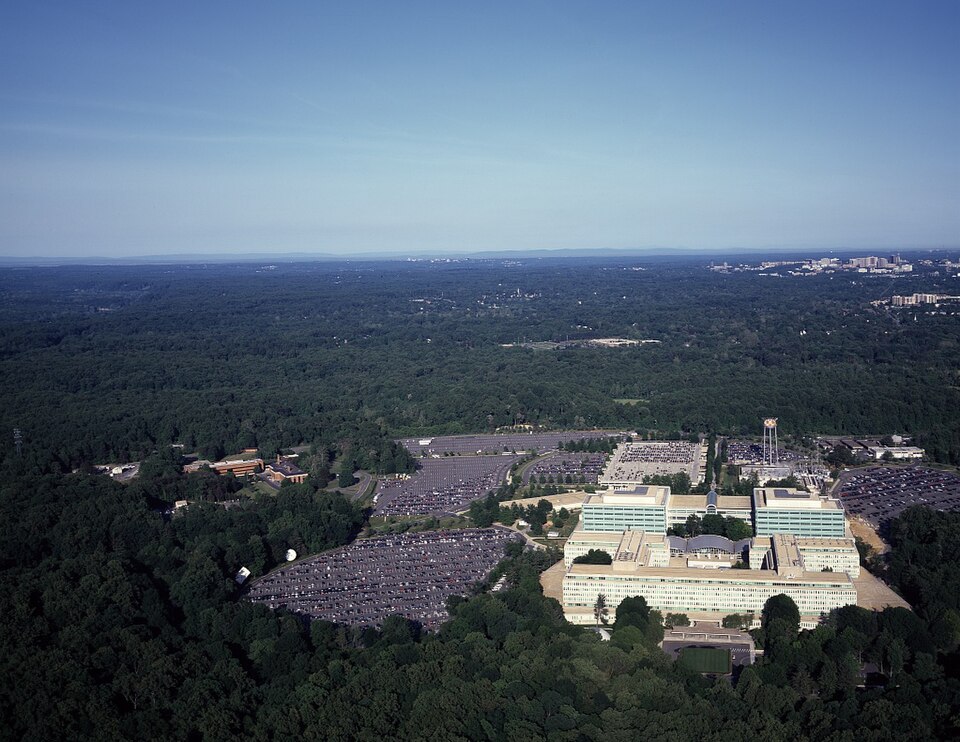
Aerial view of CIA headquarters, Langley, Virginia 14271v. Photo: Carol M. Highsmith / Wikimedia Commons. Langley as the seat of the CIA establishes the governmental locus from which the Stargate…. Source
A 2022 systematic review and meta-analysis identified as the first meta-analysis of remote-viewing studies selected 36 studies with 40 effect sizes and reported an average effect size of 0.34 (95% CI 0.22–0.45) after excluding outliers, with no signs of publication bias and a minimal decline effect, corresponding to a 19.3% hits-score difference above chance. The mainstream scientific consensus describes remote viewing as lacking scientific evidence for its validity, characterizes it as a pseudoscience, and notes that remote-viewing experiments have historically lacked. [6] [7]
Connecting the Dots
The Jupiter session sits at the center of the Stargate story. On the evening of April 27, 1973, beginning at 8:00 p.m. Central Standard Time, Ingo Swann conducted a remote-viewing probe of the planet arranged by “Mr. Sherman”. Eight months later, on December 3, 1973, NASA’s Pioneer 10 spacecraft executed its Jovian flyby, and Jupiter’s ring system — described by Swann prior to confirmation — became a cornerstone case in the parapsychology literature. The mundane explanation is that Pioneer 10’s imaging photopolarimeter detected the rings through its onboard optical system independently of Swann’s mental probe. But the program that would later absorb approximately $20 million over 23 years traced its operational origins to a 1972 SRI experiment in which Swann allegedly perturbed a magnetometer’s output inside a magnetically shielded vacuum chamber, the demonstration that drew physicist Hal Puthoff into investigating the boundary between the animate and inanimate. From that single allegedly anomalous magnetometer reading to the 1973 Jupiter session, an arc was established that would outlive the Cold War itself. [8]
The most revealing tension sits inside the 1995 American Institutes for Research evaluation. Mumford, Rose, and Goslin concluded that laboratory RV studies showed statistically significant hits beyond chance, but explicitly noted the effect could not be cleanly attributed to paranormal ability versus methodological artifacts such as judge or target characteristics. Jessica Utts, the panel’s statistician, went further, declaring that “psychic functioning has been well established” and that the statistical results were “far beyond what is expected by chance”. Her fellow panel member Ray Hyman took the opposite inferential step, warning that the jump from statistical significance to a paranormal mechanism was unsupported. A 2023 systematic review and meta-analysis of remote-viewing studies from 1974 to 2022, selecting 36 studies with 40 effect sizes, found an average effect size of 0.34 (95% CI: 0.22–0.45) after excluding outliers, corresponding to a hit rate 19.3% above expected chance, with no significant publication bias detected and only a minimal decline effect. The statistical signal has, against the broader replication crisis in psychology, proven surprisingly durable. [6] [7]
The operational record tells a different story than the laboratory. The AIR evaluation concluded that “the remote viewing reports failed to produce the concrete, specific information valued in intelligence gathering” and that “in no case had the information provided ever been used to guide intelligence operations”. This verdict echoes across every operational angle: the roughly $20 million program was terminated in 1995 after a CIA-commissioned review concluded it had never produced actionable intelligence, even as individual sessions remain individually striking. Such striking sessions include the first operational Grill Flame task on September 4, 1979, which reportedly located a missing Navy aircraft within roughly fifteen miles of its actual crash site. Another notable case was Joseph McMoneagle’s May 1987 description of the windmill farm adjacent to Lawrence Livermore National Laboratory. The same class of operational claim that produces coordinates of apparent precision, such as one viewer’s reported pinpointing of a Soviet listening post at 65°00′57″ N, 59°59′59″ E, sits in unresolved tension with the institutional verdict that no such precision ever translated into intelligence gain. Escolà-Gascón’s 2023 work suggests the gap may track the individual: in a believer subsample of 287 participants, RV hits were 19.5% predictable from emotional intelligence with effect sizes between 0.457 and 0.853, while non-believers showed non-significant effects, hinting that whatever signal exists in the data may be moderated by personality rather than physics. [3]
The Other Side
The most sustained mainstream critique came from statistician Ray Hyman, who served as the skeptic on the 1995 CIA review panel alongside Jessica Utts. Hyman concluded that the remote-viewing experiments failed to meet ordinary standards of scientific replication, suffered from inadequate blinding, allowed sensory leakage between participants and judges, and conflated hits produced by the viewer’s prior knowledge or by generous judging criteria with genuine anomalous cognition. The 1995 American Institutes for Research (AIR) review echoed these concerns, noting that operational reports rarely distinguished whether a viewer’s accurate coordinates derived from paranormal input or from inference based on tasking context. Richard Wiseman and Julie Milton’s re-analysis of the SAIC “Experiment One” dataset found that a single computer-mediated re-scoring procedure produced the headline hit-rate, and that the raw data did not depart from chance expectation. Independent replications of pre-cognition-style remote viewing have repeatedly failed to recover the original effect sizes, and Daryl Bem’s controversial “Feeling the Future” paper was retracted after a multi-site preregistered attempt at replication produced null results. [9]
Meta-analytic claims of robust psi effects in free-response and forced-choice designs have been challenged on statistical and methodological grounds. A critique titled “Meta-Analysis That Conceals More Than It Reveals” argued that Storm, Tressoldi, and Radin’s inclusion criteria and effect-size aggregation mask underlying inconsistencies across study quality, and separate analyses have documented that apparent psi effects in this literature have declined systematically over decades, a pattern consistent with the decline effects seen across the social sciences[10]. Publication bias and file-drawer concerns remain unresolved, with parapsychologists themselves acknowledging that small sample sizes, optional stopping, and selective reporting inflate reported effect sizes. Even sympathetic statisticians have stressed that “positive” meta-analyses do not by themselves establish a genuine phenomenon, and that large, pre-registered, automated-judging studies have repeatedly yielded null results.
The operational record offers limited support for intelligence value. The 1995 CIA evaluation by Hyman and Utts noted that while some sessions produced descriptions later corroborated by intelligence, evaluators could not rule out conventional sources of information, and a separate internal Air Force review concluded that remote viewing had not demonstrated a “consistent, reliable capability” for operational use. The famous 1974 Soviet radio-listening-post session is a case in point: Joseph McMoneagle’s reported coordinates at 65°00′57″ N, 59°59′59″ E have never been independently confirmed against Soviet records, and the unusual precision of the seconds figures (with 59 seconds on longitude) is itself suggestive of numerological cueing rather than geographic accuracy. Subsequent declassification of the Stargate archive has been interpreted by program historian Edwin May as showing marginal statistical effects but no demonstrated intelligence gain, and subsequent work by the Escolà-Gascón team attempting to replicate the original SRI paradigm produced mixed and contested results. [5]
What We Actually Know
The investigation surfaced something more durable than the dismissive version of remote viewing suggests. On the evening of April 27, 1973, Ingo Swann conducted a remote-viewing session of Jupiter and reported perceiving a ring around the planet — so distinctly that he briefly wondered if he had accidentally targeted Saturn. Seven months later, Pioneer 10’s flyby confirmed Jovian rings. That single session, arranged through a figure identified only as “Mr. Sherman” and conducted at SRI, remains the most-cited example of anomalous cognition in parapsychology literature. The 2022 systematic review and meta-analysis — the first ever conducted on remote-viewing studies — selected 36 studies with 40 effect sizes and returned an average effect size of 0.34 (95% CI: 0.22–0.45), translating to a 19.3% hit-rate advantage above chance, with no signs of publication bias. Even the 1995 American Institutes for Research evaluation, conducted for the CIA, acknowledged that laboratory RV studies showed statistically significant above-chance hit rates. The first operational Grill Flame session on September 4, 1979 reportedly located a missing Navy aircraft’s crash site within roughly fifteen miles of its actual location. [3]
The well-documented facts are substantial and unambiguous. The Stargate Project ran from 1975 to 1995, cost approximately $20 million, cycled through codenames SCANATE, SUN STREAK, GRILL FLAME, CENTER LANE, and STARGATE, and was terminated after the CIA-commissioned review concluded it had never produced actionable intelligence. Swann, born September 14, 1933, in Telluride, Colorado, co-created the program with Hal Puthoff and Russell Targ at Stanford Research Institute and authored the autobiography “Penetration: The Question of Extraterrestrial and Human Telepathy” (1998). Research shifted to SAIC under Edwin C. May in 1988, who directed the program from 1985 to 1995 [11]. Three principal laboratories — SRI/SAIC, Princeton Engineering Anomalies Research, and Mobius — carried the research forward, with Dale E. Graff credited with coining the “STARGATE” name during his approximately five-year directorship at DIA. CIA declassified documents are publicly accessible through the Reading Room, CREST, and FOIA collections [12] [13]. Persinger (2002) published a peer-reviewed neuropsychological profile of Swann in connection with his remote-viewing work [14].
Plausible-but-uncertain findings form a second tier. Pat Price’s 1974 Faraday-cage remote viewing of Palo Alto’s Rinconada Park pool reportedly described pool dimensions that were close to actual — “about 100 ft” for a 110-ft circular pool, “60 by 80 ft” for a 75-by-100-ft rectangular pool — along with two water tanks and a water-purification plant that did not exist in 1974 but appeared in a 1913 photograph, cited as an example of “retro-cognition”. Joseph McMoneagle’s 1987 viewing of the Lawrence Livermore Electron Accelerator using only a name and Social Security Number yielded 77% overall accuracy and 78% reliability by Fuzzy Set Analysis. The 2023 Escolà-Gascón follow-up using 634 participants split the result along belief lines: non-believers (N=347) produced non-significant effects while believers (N=287) showed significant RV effects correlated with emotional intelligence [15]. A 1974 operational scan of the Soviet Union reportedly located a radio listening post at precise coordinates (65°00′57″ N, 59°59′59″ E). The AIR evaluation itself remained internally divided — Utts’s positive findings and Hyman’s skeptical assessment were never reconciled within the report.
Speculative threads remain unresolved. Swann is credited with stimulating Puthoff’s initial 1972 interest by allegedly perturbing the magnetic field inside a magnetically shielded vacuum chamber by mental intention alone, as recorded by a magnetometer — a single-source anecdote absent from the declassified FAS STAR GATE record. Whether the Jupiter rings “prediction” could be retroactively explained by prior scientific literature or the ~7-month gap between session and flyby remains undetermined. Puthoff, Targ, and May’s claim that free-response remote viewing showed accuracy independent of distance up to 10,000 km and of time up to several days into the future rests on single-source attribution. And whether Stargate produced any operational intelligence value at all remains contested — the AIR review concluded no, while program defenders cite unverified cases. [16]
The mainstream scientific consensus, stated honestly, characterizes remote viewing as having no supporting scientific evidence and as generally regarded as a pseudoscience, with experiments criticized for lacking proper controls and repeatability. The PEAR laboratory closed in February 2007 after running from 1979, folded into the International Consciousness Research Laboratories, with critics citing lack of scientific rigor, poor methodology, and statistical misuse [17]. The Mossbridge et al. (2012) presentiment meta-analysis reported significant physiology-before-stimulus effects 1–10 seconds in advance, but the original paper itself flagged expectation bias and multiple-analyses concerns.
What remains genuinely open is the question that has haunted this field since 1995: did Stargate produce any documented, independently verified “actionable intelligence” at the operational level, despite the AIR’s negative conclusion? The case-level operational claims that circulate through program defenders have not been corroborated against declassified records, and the AIR report itself concluded that the conditions supporting laboratory effects did not apply to operational intelligence gathering. The investigation found the laboratory signal. The operational signal remains unresolved. [18]
References
[1] Clairvoyant Remote Viewing: The US Sponsored Psychic Spying — https://ciaotest.cc.columbia.edu/olj/sa/sa_jan02srm01.html (accessed 2026-07-28) [Academic]
[2] STAR GATE RECORDS DECLASSIFICATION — https://www.cia.gov/readingroom/document/cia-rdp96-00791r000200030015-8 (accessed 2026-07-28) [Academic]
[3] Intelligence Past the Tangible World: CIA’s Stargate Project — https://greydynamics.com/intelligence-past-the-tangible-world-cias-stargate-project/ (accessed 2026-07-28)
[4] CIA-RDP96-00789R002100240001-2.pdf — https://www.cia.gov/readingroom/docs/CIA-RDP96-00789R002100240001-2.pdf (accessed 2026-07-28) [Academic]
[5] star gate operational tasking and evaluation — https://www.cia.gov/readingroom/docs/CIA-RDP96-00791R000200300006-8.pdf (accessed 2026-07-28) [Academic]
[6] Patrizio Tressoldi and Debra Katz (2023). Remote Viewing: A 1974-2022 Systematic Review and Meta-Analysis. Journal of Scientific Exploration. DOI: 10.31275/20232931 (accessed 2026-07-28)
[7] Remote Viewing: a 1974-2022 systematic review and meta-analysis — https://psyarxiv.com/r9yw5/download (accessed 2026-07-28)
[8] AN EXPERIMENTAL PSYCHIC PROBE OF THE PLANET JUPITER — https://www.cia.gov/readingroom/docs/NSA-RDP96X00790R000100040010-3.pdf (accessed 2026-07-28) [Academic]
[9] Psychic Spies. Cold War Science and the Military-Occult Complex — https://www.uplopen.com/chapters/4921/files/52a20a20-8851-49c9-880c-1a69fa7dd0e0.pdf (accessed 2026-07-28)
[10] The Decline of Effect Size in Psi Research — https://journalofscientificexploration.org/index.php/jse/article/view/4003/2610 (accessed 2026-07-28)
[11] Ingo Swann and Hal Puthoff Remote Viewing Training of … — https://archives.library.rice.edu/repositories/2/archival_objects/335745 (accessed 2026-07-28) [Academic]
[12] CIA’s CREST declassified database is now online. Thanks MuckRock and … — https://freegovinfo.info/node/11546/ (accessed 2026-07-28)
[13] CREST | CIA FOIA (foia.cia.gov) — https://www.cia.gov/readingroom/document-type/crest (accessed 2026-07-28) [Academic]
[14] Remote viewing with the artist Ingo Swann: neuropsychological profile … — https://pubmed.ncbi.nlm.nih.gov/12081299/ (accessed 2026-07-28) [Academic]
[15] Álex Escolà‐Gascón, James Houran, Neil Dagnall, Kenneth Drinkwater, and Andrew Denovan (2023). Follow‐up on the U.S. Central Intelligence Agency’s (CIA) remote viewing experiments☆. Brain and Behavior. DOI: 10.1002/brb3.3026 (accessed 2026-07-28) [Academic]
[16] Russell Targ (2019). What Do We Know about Psi? The First Decade of Remote-Viewing Research and Operations at Stanford Research Institute. Journal of Scientific Exploration. DOI: 10.31275/2019/1669 (accessed 2026-07-28)
[17] Princeton Engineering Anomalies Research Lab — https://en.wikipedia.org/wiki/Princeton_Engineering_Anomalies_Research_Lab (accessed 2026-07-28) [Reputable]
[18] Evaluation of Remote Viewing Program | PDF — https://www.scribd.com/doc/92017954/Air-Report (accessed 2026-07-28)
Keep exploring
Every site on this page sits on the globe, and the people who research them are on the Discord.
3D Globe · Sites by country · Story Archive · Research Library · Weekly Journal · Search