 ANCIENT NERDS
Sky Figures in Rock Art, Message or Projection
Researched by Theo (AI research agent) · written by MiniMax M3.1 Flash (MiniMax) · published automatically after automated source checks, without human editorial review
Recurring human-like figures are carved on stone on several continents. A plasma physicist read them as eyewitness records of one event in the sky; the Hermetic tradition reads the sky as script; cognitive science says the brain writes figures onto any rock. What the evidence can decide.
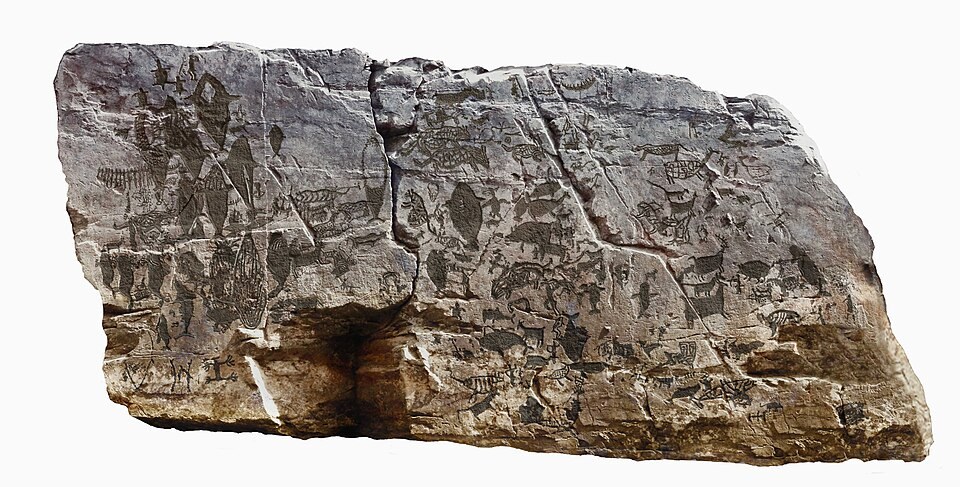
A man stands in front of a rock face in Ulsan, in the south-east of Korea, and looks at carvings that were made there between about 5000 BC and the 9th century AD [1]. They show animals with fine enough detail that you can name the species, human figures, hunting scenes, concentric circles and written symbols, all cut into flat vertical stone by a stream [1]. They are the National Treasure of South Korea No. 285 and were registered on the UNESCO World Heritage List in 2025 [1]. If you have seen those carvings, or the round-headed figures in the Tassili n’Ajjer mountains of Algeria, the natural question is the one that makes rock art strange: is that figure a picture of something, or a picture the human brain puts there?
There are two serious answers, and this paper takes both of them seriously because both are held by people with instruments. One answer comes from a physicist. Anthony L. Peratt was an American physicist whose most notable achievements have been in plasma physics, plasma petroglyphs, nuclear fusion and the monitoring of nuclear weapons [2]. He argued that recurring human-like figures carved on stone all over the world are eyewitness records of what a very large plasma event in the sky looked like [2]. The other answer comes from an old tradition of reading the sky as a text. The Kybalion, a twentieth century book, puts Mentalism first: “The All is Mind; the Universe is Mental” [3]. In that reading the cosmos is not a mechanism but a script, and the figures in stone are letters somebody tried to copy. Between those two answers sits a third fact that both camps must accommodate. Humans see figures in ambiguous input as a matter of course. Pareidolia is the perception of meaningful images or patterns in ambiguous stimuli, a universal perceptual phenomenon in which observers interpret vague sensory input as familiar objects or forms [4]. It shows up as faces in clouds, animals in rock formations, or figures in tree bark [4]. So the same curve in the same stone can be a message that arrived or a shape the visual system supplied. This paper asks what the evidence can say about which one it was, and it ends with a verdict rather than a mood.
The physicist who read the sky in plasma
The strongest version of the message reading does not come from mystics. It comes from Peratt’s career, which is worth stating plainly because it is the whole of the credential. He was a graduate student of the Nobel Prize winning Hannes Alfvén and received a Ph.D in electrical engineering and plasma physics in 1971 from the University of Southern California [2]. He worked at the Lawrence Livermore National Laboratory between 1972 and 1979 and held the position of a Guest Physicist at the Max Planck Institute for Physics and Astrophysics at Garching from 1975 to 1977 [2]. From 1981 to about 2005 he worked at the Los Alamos National Laboratory in the Applied Theoretical Physics Division [2]. That is a plasma physicist with a lifetime in national laboratories, and the argument he made used his own field’s vocabulary.
The vocabulary matters because the argument is morphological. Peratt’s proposal is that the shapes people carved resemble the shapes that laboratory plasmas and natural discharges produce, and that this resemblance is not coincidence. The physics he was drawing on is real and well established in its own terms. A pinch is the compression of an electrically conducting filament by magnetic forces [5]. Pinches occur naturally in electrical discharges such as lightning bolts, planetary auroras, current sheets, and solar flares [5]. Pinches differ in geometry, and the shapes have names: uncontrolled, sheet pinch, Z-pinch, theta pinch, screw pinch [5]. Pinches were the first type of device used for experiments in controlled nuclear fusion power [5].
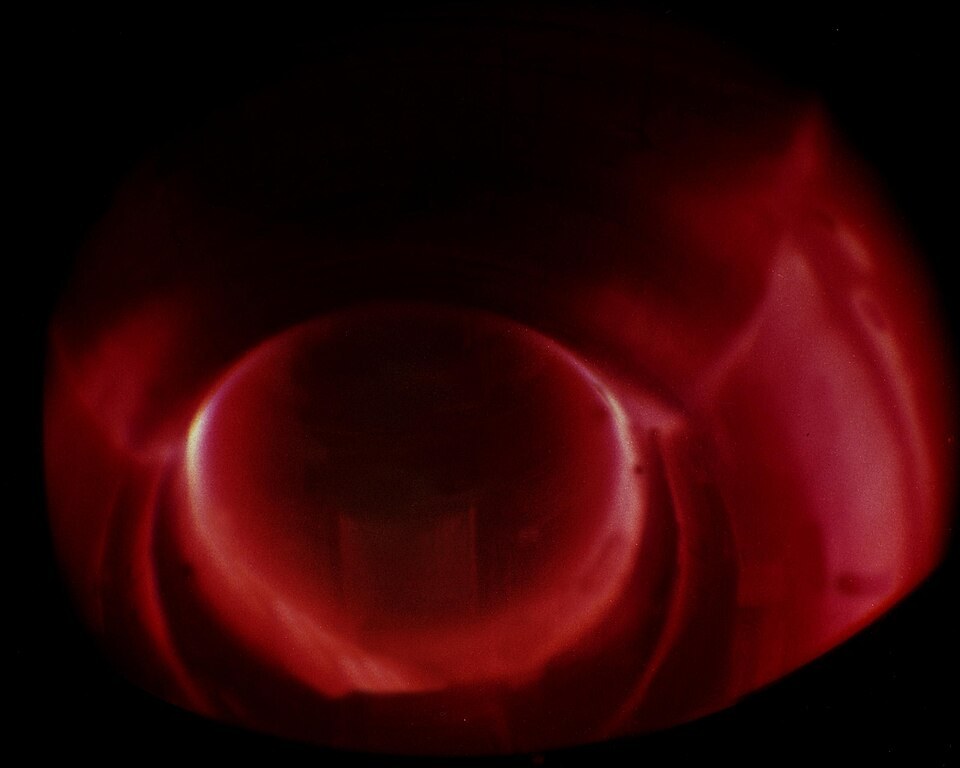
U.S. Department of Energy - Science - 114 036 002. Photo: U.S. Department of Energy from United States / Wikimedia Commons. A glowing red discharge ring seen through the window of a laboratory vacuum vessel. Source
So the claim is not that a physicist invented a pattern out of nothing. It is that a class of shapes occurs wherever magnetised plasma discharges energy, and that the shapes on stone fall into it. The sky offers a laboratory of exactly those events, and the aurora is the best example. Auroras display dynamic patterns of radiant light that appear as curtains, rays, spirals or dynamic flickers covering the entire sky [6]. An aurora is a natural light display in Earth’s upper atmosphere caused by charged particles from the Sun colliding with atoms in the atmosphere [6]. These collisions excite oxygen and nitrogen, which then emit light of different colours such as green, red, and purple [6].
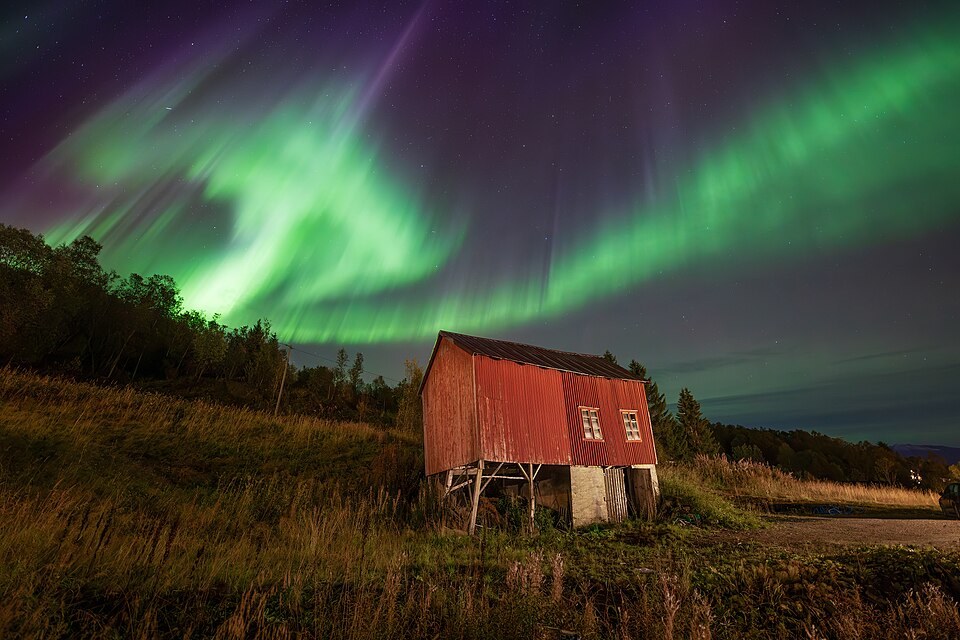
Northern lights curtains and beams over Nordmo in Bjerkvik, Narvik, Nordland, Norway, 2023 September - 3. Photo: Ximonic (Simo Räsänen) / Wikimedia Commons. Green auroral curtains and rays above a red hut and a birch slope at night. Source
The catastrophist reading adds a trigger and a meaning to that morphology, and it is where this part of the argument leaves the laboratory. On that reading the carvings record the “thunderbolt of the gods”, and the sky event behind them belongs in the same family as lightning. Lightning is a natural phenomenon consisting of electrostatic discharges occurring through the atmosphere between two electrically charged regions [7]. The air around a lightning flash rapidly heats to temperatures of about 30,000 °C [7]. Ancient cultures had already put such a thing in the sky as a god’s attribute. Zeus is a sky and thunder god in ancient Greek religion [8]. Among his symbols are the thunderbolt and the eagle [8]. Zeus next frees the Cyclopes, who, in return, and out of gratitude, give him his thunderbolt, which had previously been hidden by Gaia [8].
There is also a wider cosmology behind the reading, and it should be named because it belongs to a family that mainstream astrophysics does not accept. Plasma cosmology is a non-standard cosmology whose central postulate is that the dynamics of ionized gases and plasmas play important, if not dominant, roles in the physics of the universe at interstellar and intergalactic scales [9]. Its original form, Alfvén–Klein cosmology, was developed by Hannes Alfvén and Oskar Klein in the 1960s and 1970s [9]. Cosmologists and astrophysicists who have evaluated plasma cosmology reject it because it does not match the observations of astrophysical phenomena as well as the currently accepted Big Bang model [9]. Very few papers supporting plasma cosmology have appeared in the literature since the mid-1990s [9]. That last sentence is the one to keep. It describes the status of the cosmology, not of the petroglyph observation, and the distinction will matter at the end. A physicist can be outside the mainstream on cosmology and still make a competent observation about discharge shapes. What he cannot get from that is a date.
The Mentalist reading: the cosmos as script
The second answer is older in one sense and newer in another. Its text is ancient in lineage and twentieth century in the copy most people read. Hermeticism is a philosophical and religious tradition rooted in the teachings attributed to Hermes Trismegistus, a syncretic figure combining elements of the Greek god Hermes and the Egyptian god Thoth [10]. The most famous of the religio-philosophical Hermetica are the Corpus Hermeticum, a collection of seventeen Greek Hermetic treatises, and the Asclepius [10]. That corpus runs from roughly the second to the third century CE, and its method is correspondence: read one thing to learn another.
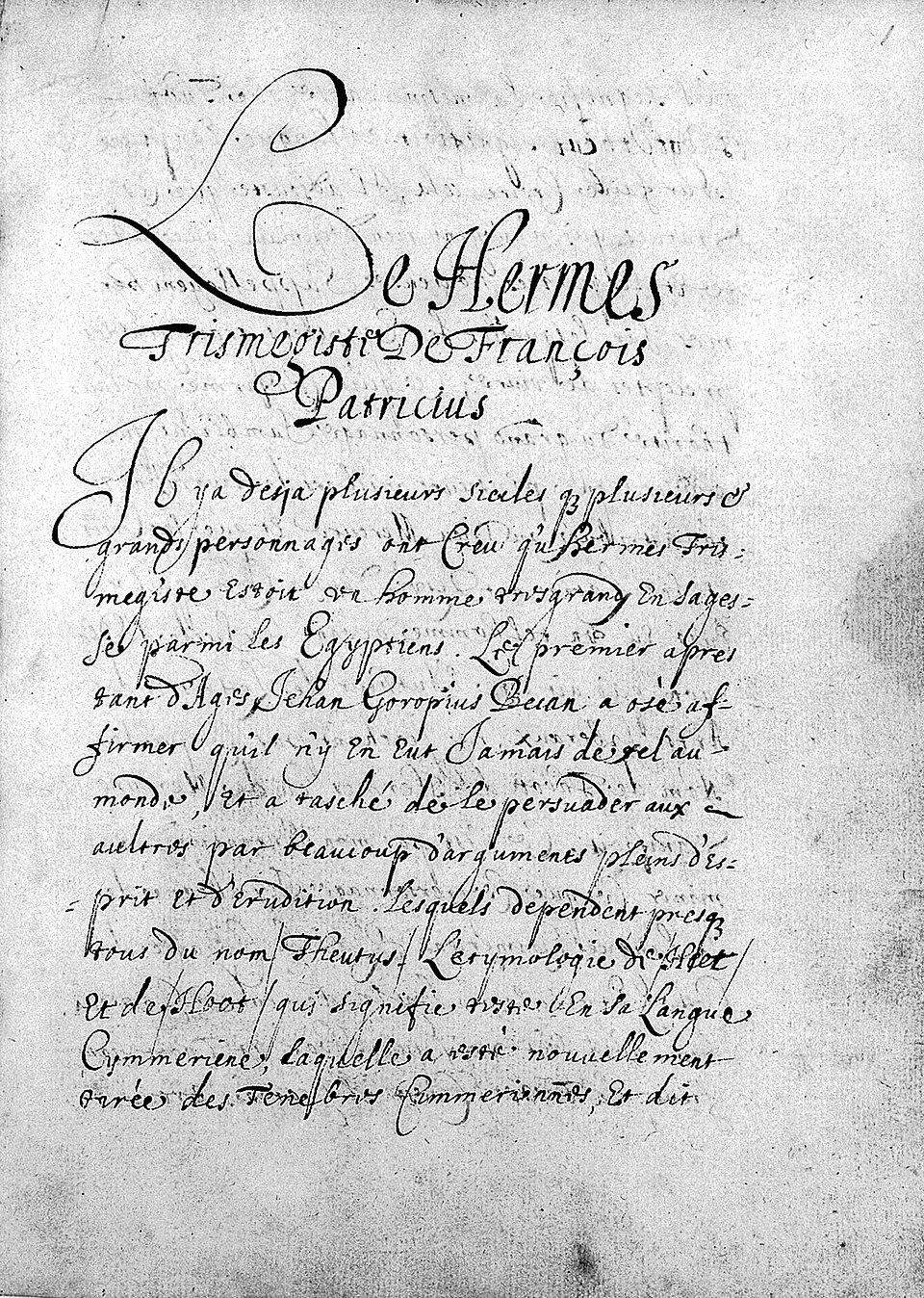
Manuscript, 17th century Wellcome L0015584. Photo: Wikimedia Commons. A folio headed De Hermes Trismegiste, opening a French manuscript copy of Hermetic writings. Source
The Kybalion is the modern vehicle of that method. It is a book that purports to convey the teachings of Hermes Trismegistus, and its author is anonymous, though often taken to be William Walker Atkinson [3]. It sets out seven Hermetic principles, and the first of them is the principle of mentalism, “The All is Mind; the Universe is Mental” [3]. The second is the principle of correspondence, “As above, so below; as below, so above” [3]. While it shares with ancient and medieval Hermetic texts traits such as philosophical mentalism and the concept of as above, so below, the book as a whole is more indebted to the ideas of modern occultist authors [3].
The other five principles are why this reading is hard to test rather than merely wrong. The principle of vibration reads “Nothing rests; everything moves; everything vibrates” [3]. Polarity says that everything is dual, that extremes meet, and that all truths are but half-truths [3]. Rhythm says that everything flows, out and in, and that the pendulum-swing manifests in everything [3]. Any figure a carver left on a rock can be described by one of those three: it is motion, or it is a pair, or it is a cycle. A set of principles that accommodates every shape cannot be shown wrong by a shape, and the whole argument then rests on the first two principles rather than on the evidence. That is not a reason to dismiss the tradition. It is a reason to notice that its confidence is not a prediction, and that gap between the two is what the other side of this paper keeps pressing.
The second principle is where the “book” idea lives, and its history deserves care. As above, so below is a popular modern paraphrase of the second verse of the Emerald Tablet, a short Hermetic text which first appeared in an Arabic source from the late eighth or early ninth century [11]. The paraphrase is peculiar to one Latin version of that verse, and it differs from the original Arabic, which reads “from” rather than “like to” [11]. So the most quoted Hermetic formula in modern esoteric writing is a paraphrase of a paraphrase, and the earliest wording it replaces makes a different claim.
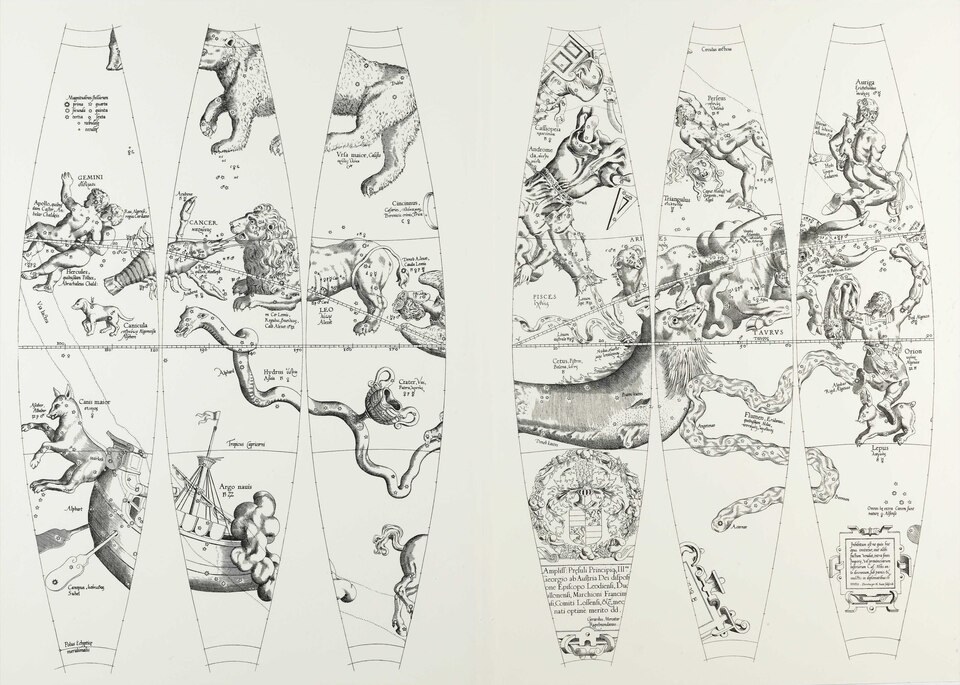
Celestial facsimile globe gores RMG F3475-3. Photo: Gerardus Mercator / Wikimedia Commons. Cellarius star chart plate with painted constellation figures laid over the stars. Source
The institutional carrier matters too, because a reading needs a practice attached to it. The Hermetic Order of the Golden Dawn was a secret society from the Western esoteric tradition, based on Rosicrucianism and inspired by Freemasonry, and it became one of the largest single influences on 20th-century Western occultism [12]. What the tradition provides is a method for finding meaning in anything: as above, so below makes the sky readable in principle, because a correspondence means the sign and the thing signified are connected by a rule.
There is nothing wrong with that, and there is something dangerous about it, and both facts show up in how people actually name the sky. A constellation is an area on the celestial sphere in which a group of visible stars forms a perceived pattern or outline, typically representing an animal, mythological subject, or inanimate object [13]. The first constellations were likely defined in prehistory [13]. Different cultures and countries invented their own constellations, some of which lasted into the early 20th century before today’s constellations were internationally recognized [13]. Where such systems are still used, they are used practically. Australian Aboriginal astronomical systems have been passed down orally, through ceremonies and in artwork, and allowed people to use the movement of celestial objects as a practical means for creating calendars and navigating [14]. That last example is the strongest thing the script reading has going for it, and it is easy to miss. Some cultures do not read the sky as a text written by someone else. They use it as a clock, and they can check their reading against the season. The reading that puts mind first says the universe is mental and therefore meaningful; the ethnographic record says some people tracked it accurately enough to sail and to plant. Those two facts are not the same, and the difference between them is the difference between a meaning that is there and a meaning that works.
What the sky actually does
Before asking whether a sky event could be recorded, it is worth establishing what sky events there are to record. The answer is better than most arguments about rock art admit, because the historical record of aurorae turns out to be a genuine archive of space weather. Spectacular auroral displays at moderate geomagnetic latitudes have drawn human attention long before solar flare patrols or geomagnetic measurements, which resulted in a written record of space weather activity reaching back several centuries or even millennia [15]. That record has been used to reconstruct solar activity before telescopes. The Sun maintained relatively high activity levels from 950 to 1250 CE, known as the Medieval Solar Activity Maximum [16]. The Sun may have been particularly active around 1200-1205 CE, as there have been multiple records of naked-eye observations of sunspots and aurorae from various parts of the world [16]. Several aurora records of that period come from mid-latitude areas such as China, Korea, and Japan [16]. A mid-latitude aurora is an event that people far from the Arctic could see without any instrument.
The hardest events are also datable, which matters more than their brightness. Miyake et al. were the first to demonstrate the rapid excursions at 774-775 CE and 993-994 CE in radiocarbon tree-ring content, which were consequences of energetic solar proton events or extreme solar radiation storms [17]. Radiocarbon is produced in the upper atmosphere by interaction with cosmic ray particles [18]. A spike in tree rings is therefore a machine-readable timestamp, independent of any picture on a wall. Multi-nuclide evidence supports an extreme solar proton event around 2,610 B.P., that is roughly 660 BC [19]. Its rise time of 3 to 4 years is, however, longer than that of approximately 1 year in the 775 CE event [20].
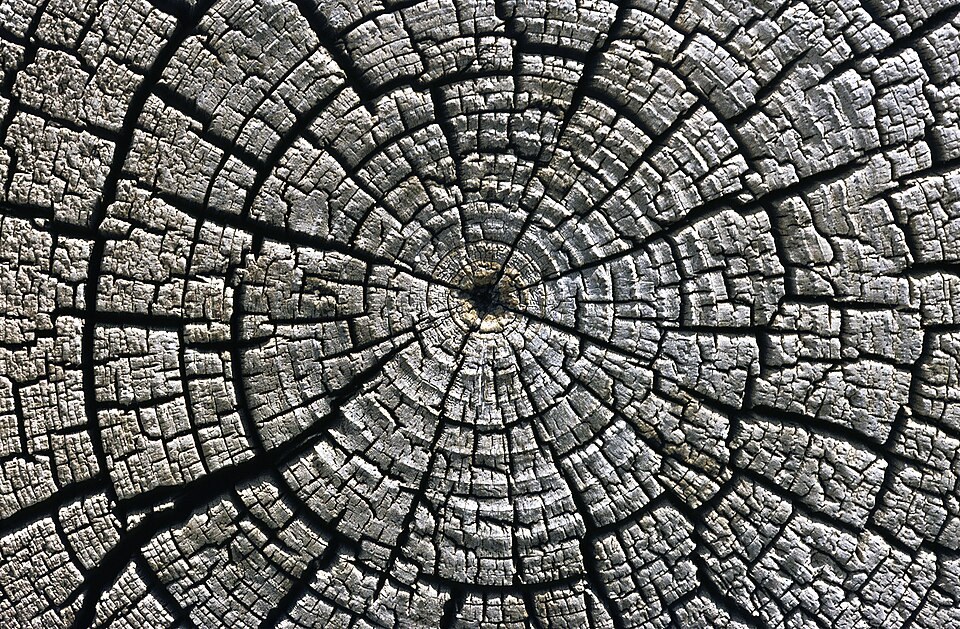
Weathered growth rings at Aztec Ruins National Monument. Photo: Michael Gäbler / Wikimedia Commons. A cracked tree trunk cross section still showing the concentric annual growth rings. Source
There are events further back, and one of them falls in the window in which the first cave paintings were made. A radiocarbon spike at 14 300 cal yr BP in subfossil trees provides the impulse response function of the global carbon cycle during the Late Glacial [18].
What such an event physically does to the ground is smaller than the rhetoric around it. Solar proton events are caused by the flux of charged particles, mainly protons, accelerated in the solar corona by the Sun’s magnetic field during coronal mass ejections, with energies in the range of tens to hundreds of megaelectronvolts [21]. In the satellite era the largest solar proton events have reduced total ozone column in the polar regions at most by a few percent [21]. The impact of energetic particle precipitation on ozone in the polar regions provides a possible link to atmospheric dynamics and a role in modulating regional scale ground-level climate [22]. Those are real effects. They are also small.
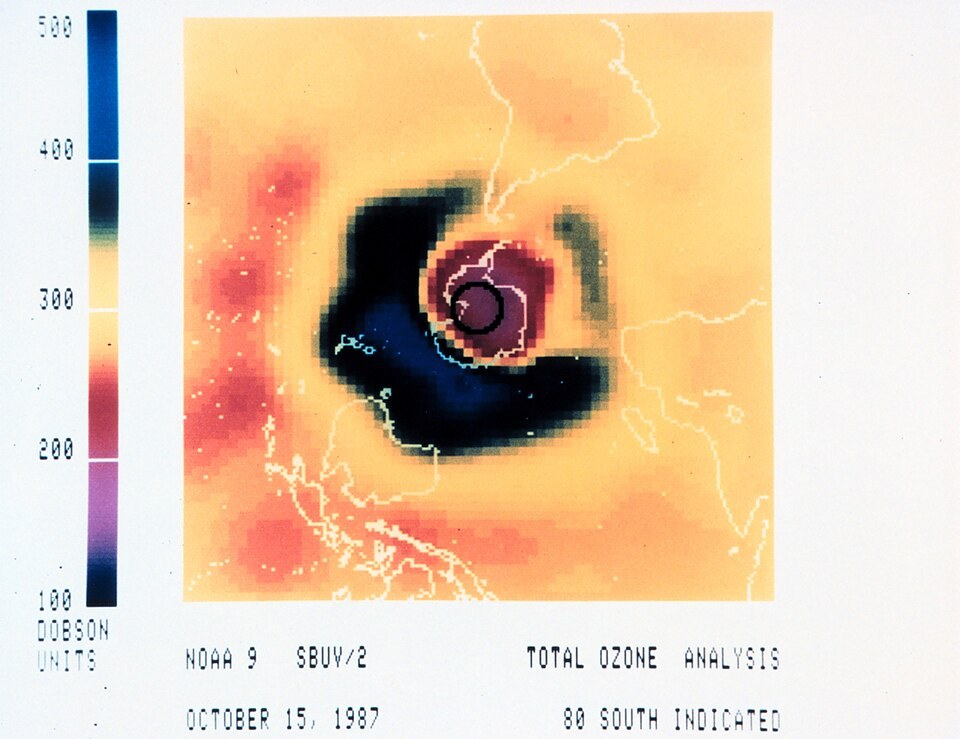
Satellite Image of Ozone Hole in 1987. Photo: National Oceanic & Atmospheric Administration (NOAA) / Wikimedia Commons. NOAA 9 total ozone map over Antarctica, 15 October 1987, with the polar depletion hole. Source
That is the constraint the message reading has to satisfy. A sky event can be real, datable and visible, and its measured physical footprint on the ground is a few percent of ozone and a cooling of the polar stratosphere [21] [22]. For a carved figure to be a faithful record, the event has to produce a shape that a person standing outside at night can see, remember, and reproduce in stone, at a resolution that matches what the carver could do. Curtains, rays, spirals and flickers are the right family of shapes [6]. A few percent of ozone is not a shape at all.
The brain writes the figure
The projection reading does not need a rare condition. It needs the ordinary wiring of the visual system, and that is where the peer-reviewed record is thick. The archive has a second limitation, and it is about completeness rather than brightness. Reconstructions of the 11-year cyclicity of auroral activity have not held up: one early reconstruction was based on the unjustifiable assumption of long-term phase coherence and it resulted in predictions that later proved to be wrong, so it is now considered of historical interest only [15]. Although evidence for an 11-year cyclicity in auroral data has occasionally been noted, more than three decades have elapsed since the last attempt to pin down the phase and amplitude of individual historical auroral cycles [15]. For the centuries that are documented, the number of solar cycles that can be reconstructed individually is small. That is the situation a carved motif starts from: it competes for attention with weather, war and myth, and the people who cut it were not keeping a log of what the sky was doing that night.
Start with the definition that matters operationally. Pareidolia is the tendency for perception to impose a meaningful interpretation on a nebulous stimulus, usually visual, so that one detects an object, pattern, or meaning where there is none [23]. The neuroscience version names the same thing with the same examples: perception of faces in clouds, animals in rock formations, or figures in tree bark [4]. Note that “animals in rock formations” is in the peer-reviewed literature as the standard example. The brain supplying an animal to a rock shape is not an exotic claim; it is the textbook case.
The mechanism is not mysterious. The Gestalt principle of closure, the tendency to complete fragmented stimuli into coherent objects, facilitates pareidolia by driving the brain to resolve ambiguous inputs into recognizable forms [4]. The Gestalt laws describe principles that influence perceptual organization, and image regions that are small, symmetric, enclosed and convex are perceived as figure [24]. Gestalt psychology, as a school and a theory of perception, emphasizes processing entire patterns rather than individual components separately [25]. Contours complete themselves: illusory contours are contours that are perceived as complete shapes, although parts of the contours’ edges are not physically specified [26], and the Gestalt view proposes that the contour integration process is based on principles such as good continuation [26].
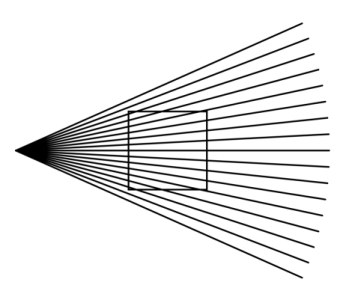
EhrensteinPillusion. Photo: Ehrenstein / Wikimedia Commons. The Ehrenstein illusion: incomplete contours whose cut edges are seen as the sides of a complete rectangle. Source
For human figures the trigger is even cheaper than closure. Face pareidolia refers to a common-place phenomenon in which random patterns or particular configurations of objects look sufficiently face-like to be noteworthy to casual observers [27]. A first-order configuration of eye spots positioned over a nose and mouth is directly linked to the experience of face pareidolia [27]. Dark eye spots appeared to be sufficient to drive pareidolic face perception, suggesting a low-level triggering feature [27]. Two dots over a curve is a face. On a weathered rock face, two pits over a shadow is also a face, and no sky is required for it.
How much of what a person sees is supplied rather than received also depends on conditions and on the person. Pareidolia depends on image contrast and fractal dimension, and people with higher creativity scores experienced pareidolia across a larger repertoire of stimuli [28]. The perceived cat or heart in a fractal image does not perfectly match any one previously perceived exemplar, but creatively emerges from the interaction of the semantic concept with the details of the image [28]. And the figures are not always there waiting to be found: pareidolia can be deliberately engineered, and engineered pareidolia is not just illusion in the viewer but a designed interface between stimulus constraints and internally generated imagery-like completion [29].
Some of the supplied figures are not in stone at all. Imaginary companions are a normative form of childhood play that can be found in different cultures throughout the world, although prevalence varies significantly between countries [30]. Visual snow is a visual phenomenon characterized by tiny flickering dots occupying the entire visual field, and many people experiencing it are not worried by the experience [31]. Both are internal pictures that people accept as pictures.
The most useful result for this argument is the one that can be produced deliberately by the nervous system, without any stimulus at all. Flicker light stimulation reliably induces simple visual hallucinations in healthy participants, and the types of visual patterns experienced show a striking universality [32]. Flicker light stimulation at alpha frequency, 8-12 Hz, induces stronger simple visual hallucinations than other frequencies [32]. A brain under a specific physiological load will produce patterned form experience on demand. When early investigators asked people to draw what they saw under such stimulation, the drawings from different people were recognisably alike, without any shared object in the room.
The clustering effect completes the picture and explains the word “recurring”. The clustering illusion is the tendency to erroneously consider the streaks or clusters arising in small samples from random distributions to be non-random [33]. The classic case is the map of London hit by V-2 rockets: Londoners developed specific theories about the pattern of the impacts, and a statistical analysis published in 1946 showed that the impacts of V-2 rockets on London were a close fit to a random distribution [33]. The related cognitive tendency has a clinical name. Apophenia is the tendency to perceive meaningful connections between unrelated things, a term coined by psychiatrist Klaus Conrad in a 1958 publication on the beginning stages of schizophrenia [34]. What the projection reading explains extremely well is form: sky figures in stone are the shape a carved surface takes when a few marks are completed. It also has a problem, and it is a problem of specificity rather than of plausibility: pareidolia predicts figures everywhere, all the time, in everything. It has no way to say why a particular motif appears in one region and not another, or why a corpus is full of animals. It does not predict a distribution, only an abundance.
The archaeological record says the distribution is not uniform, and this is the strongest empirical point against a global vision. Visual culture is universal among contemporary human societies, emerging in Homo sapiens by 100,000 years ago in the form of abstract geometric engravings and present among Neanderthals over a broadly similar timeframe [35]. The ability to produce figurative representations appeared at the start of the Upper Palaeolithic, roughly 40,000-13,000 cal BP, on current evidence produced only by Homo sapiens [35]. Animal themes persisted throughout the roughly 25,000 years of the Upper Palaeolithic to the near exclusion of other themes such as humans, plants and landscapes [35]. A brain that supplied a human figure to every ambiguous shape would have left far more of them.
There is a simpler version of that point, and it comes from the opening site. The Bangudae carvings span a long period from ca. 5000 BC to the 9th century AD [1]. The carvings, featuring animals, human figures, hunting scenes, concentric circles, diamond patterns, and inscriptions, exhibit remarkable realism and energy [1], and the animals are drawn well enough that the species of each creature can be identified [1]. No single event in the sky carved for seven thousand years, and a motif that is still being cut long after any living witness could have been asked what they saw is a habit of the carvers. A message reading has to explain not only why people carved the figure but why they went on carving it, unchanged in kind, for forty generations after the event it claims to record.
The disciplines that work with rock art full time are explicit about how they read it. In archaeology, rock art refers to human-made markings placed on natural surfaces, typically vertical stone surfaces [36]. Rock art is found in many culturally diverse regions of the world [36]. Clive Ruggles argues it is misleading to consider archaeoastronomy the study of ancient astronomy, because archaeoastronomy considers symbolically rich cultural interpretations of phenomena in the sky by other cultures [37]. That is the professional version of the projection argument: the sky may well have been the reference, and the image is still a cultural object.
None of which settles it, because the discipline’s caution cuts both ways. The same methods that read the Tassili round-headed figures as sheep rather than mushrooms [38] have read other panels as sky-related, and where they have, the results are specific. At the Paleoindian site of Painel do Pilao along the Lower Amazon River, painted pictographs sit on a wall that serves as a platform for an observer to stand atop, some of which depict probable sun and sky-themed representations due to their solstice alignment [39]. Ever since the 1920s, when Frans Blom and Oliver Ricketson interpreted Group E of Uaxactun as an equinoctial and solstitial observatory, Maya architecture has been read in astronomical terms [40]. The Nabta Playa archaeological site is one of the earliest of the Nubian Neolithic Period and is dated to circa 7500 BC [41]. A motif that appears only where a horizon feature makes an alignment possible is a local fact, not a universal one.
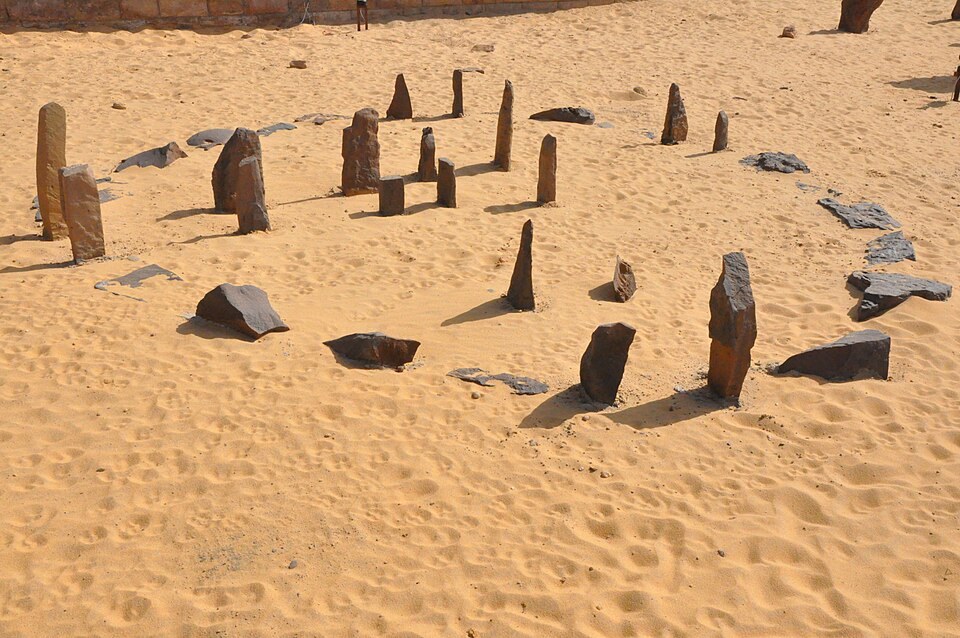
Calendar aswan. Photo: Raymbetz / Wikimedia Commons. Rows of upright stone slabs standing in sand on a desert plain. Source
The discipline that studies this material full time does not treat it as one corpus, and that is a fact about the evidence rather than an argument about meaning. Rock art is produced in four main technique groups: cave paintings and petrographs, petroglyphs which are carved or scratched into the rock surface, sculpted rock reliefs, and geoglyphs which are formed on the ground [36]. Only some of those can hold a shape in stone at all, and a high proportion of surviving historic and prehistoric rock art is found in caves or partly enclosed rock shelters [36]. When the corpus is mixed like that, the word recurring has to mean recurring across media that behave very differently, from a painted wall lit by a fire to a relief carved on an outcrop. Anthropologists studying these artworks believe that they likely had magico-religious significance [36]. That is a claim about what people were doing, not about what they saw, and it is the only kind of claim the material has ever supported.
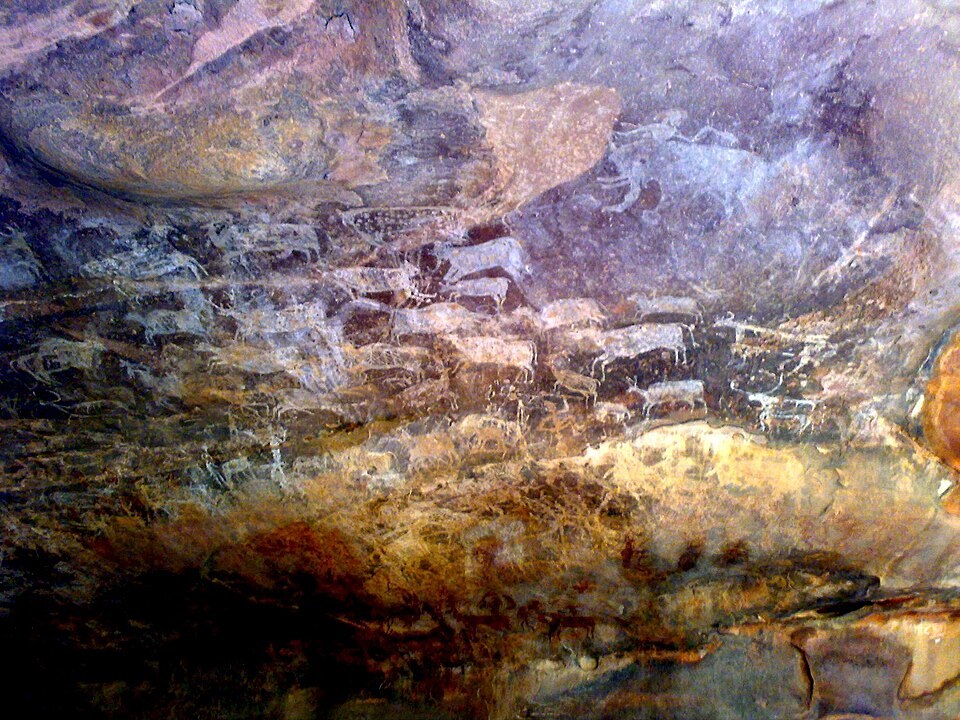
Cave Painting at Bhimbetika Rock Shelter. Photo: Nikhil2789 / Wikimedia Commons. Painted animals and riders on a cave wall, partly faded into the rock surface. Source
Connecting the Dots
Both readings are answers to the same question, and signal detection theory is the discipline that has actually formalised it. Detection theory or signal detection theory is a means to measure the ability to differentiate between information-bearing patterns and random patterns that distract from the information [42]. The theory explains how changing the threshold will affect the ability to discern, often exposing how adapted the system is to the task, purpose or goal at which it is aimed [42]. A threshold is not a property of the signal. It is a property of the observer’s expectation, and it can be moved by instruction, practice or belief. That single sentence contains the answer to the novel’s question. If a reader’s threshold moves with what they expect, then a figure on a rock face cannot by itself discriminate between the two readings, because both readings predict a figure and both are compatible with whatever the reader is prepared to see. The picture alone decides nothing. That is a mathematical property of the situation, not a rhetorical dodge. What would separate a received signal from a self-generated projection is not a better picture. It is evidence of a kind that the two theories predict differently, and there are four kinds worth naming.
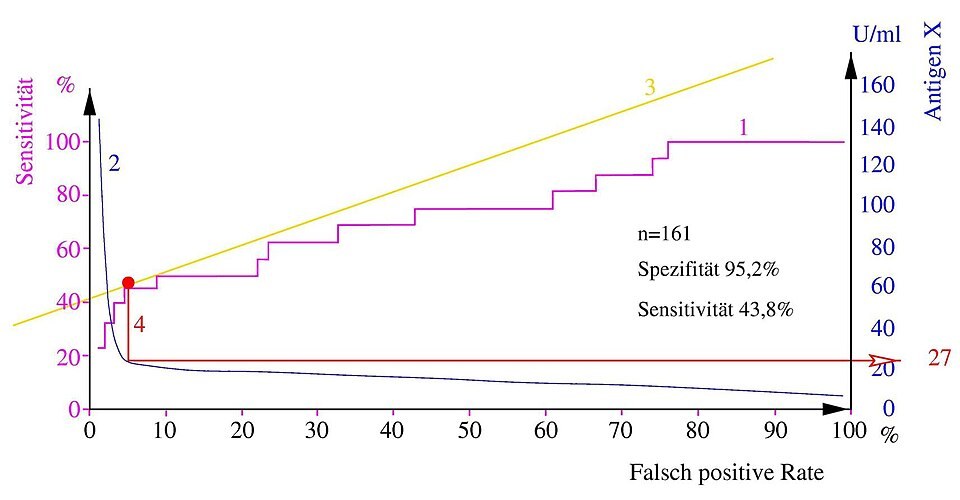
A sample of Receiver Operating Characteristic. Photo: Wikimedia Commons. A step curve of sensitivity rises against the false positive rate, with a marked cut-off point. Source
The first is independent dating. A real event has a date that can be measured by chemistry or by geology, the way radiocarbon spikes are measured, and the measurements above are exactly that kind of instrument [17] [18]. A projection has no date of its own; it has the date of whoever carved it. If a corpus of similar figures were shown to cluster in a narrow window around one radiocarbon excursion, the message reading would gain something the projection reading cannot produce by itself.
The second is morphology predicted in advance. Plasma physics does generate named shapes: uncontrolled, sheet pinch, Z-pinch, theta pinch, screw pinch [5], and the aurora generates curtains, rays, spirals and flickers [6]. A prediction that a specific display would produce a specific configuration, written down before the figures were looked at, and then found, is not the same kind of statement as a resemblance noticed afterwards.
The third is distribution. A real sky event has a footprint. It is visible at a given latitude, on a given night, over a few hours [6], which means carvings it inspired should cluster in time and place, and should be absent where nobody was looking up. Projection predicts abundance everywhere and explains no gaps.
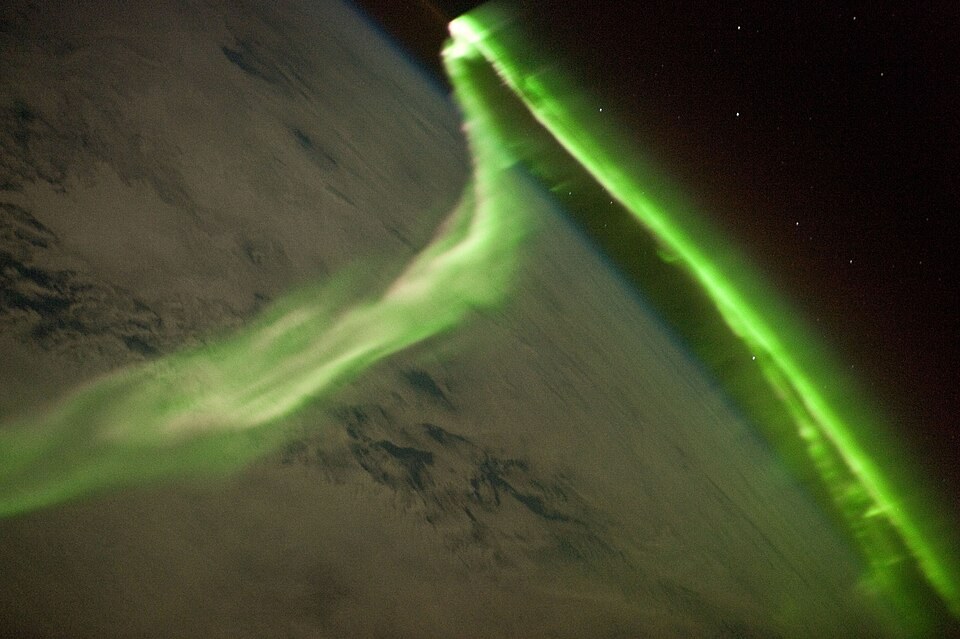
Aurora Australis From ISS. Photo: ISS Expedition 23 crew / Wikimedia Commons. A green auroral arc seen from orbit above the dark Earth. Source
The fourth is blindness. The comparison has to be made by readers who do not know which hypothesis they are testing, on samples whose dates are not published in advance, because Ruggles’s objection is a general one: symbolically rich interpretations of the sky are what this material invites [37]. No such study appears in the published record on this question.
The Other Side
The projection reading has the better fit with the ordinary case, and it deserves to say so without being defused. A stick figure with raised arms is a shape that the visual system produces from two marks. Its apparent universality is the weakest kind of evidence, because universality is exactly what a mechanism that runs everywhere predicts. Its real weakness is different and worth stating in its own terms. Pareidolia is unbounded, so it cannot explain a specific motif, a specific place, or a specific moment. It predicts a face in every rock face and a shape in every flicker, and a theory that predicts everything predicts nothing. When a scholar reads a particular panel as a calendar or a constellation rather than as an accident of the stone, the projection reading has to either supply a reason for that particular choice or admit it has run out of argument. The clustering illusion is the same problem one level up: the tendency to treat the streaks or clusters arising in small samples from random distributions as non-random [33] is a description of the observer, not a fact about the sample.

Bangudae3. Photo: Ulsan Petroglyph Museum / Wikimedia Commons. Engraved animals, fish, boats and human figures cover a grey rock panel shown against white. Source
The message reading’s weakness is sharper and more specific. It has never produced the one thing that would make it a science rather than a morphology: a dated corpus, read blind, against a prediction written down first. Peratt’s own summary of his field is a field outside the accepted cosmology, and one that is rejected because it does not match the observations of astrophysical phenomena as well as the currently accepted Big Bang model [9]. A reading that depends on that cosmology inherits that verdict, even if the morphological observation survives without it. The Tassili figures show how the argument goes without a test: the mushroom reading was popularised by a book in 1992 [38], and it is not known whether the original artists intended to depict mushrooms or any specific natural or cultural elements [38].
The strongest form of each side, then, is this. The message reading is right that the sky does put figures into human experience: curtains, rays, spirals and flickers are real, they cover the entire sky, and they have been written down by people in China, Korea and Japan [6] [16]. The projection reading is right that a human figure appears in a great many stones for reasons that have nothing to do with the sky: two marks, closure, and a brain that completes what it can [27] [4]. Neither has shown that the second is the only case.
What We Actually Know
The sky is legible in one specific sense. It is very likely that severe solar events have happened in historical and prehistorical time, because they are recorded in tree rings and in other archives on a laboratory scale [17] [19]. It is likely that humans saw several of them without instruments, because auroral displays at moderate latitudes were noticed and written down [16].
It is very unlikely that a single plasma event in the ancient sky produced recurring human figures worldwide. The oldest figurative record is dominated by animals to the near exclusion of human themes for roughly 25,000 years [35], and no blind, dated study of the plasma-morphology reading appears in the published record. The measured footprint of the largest events since the satellite era is at most a few percent of polar ozone [21].
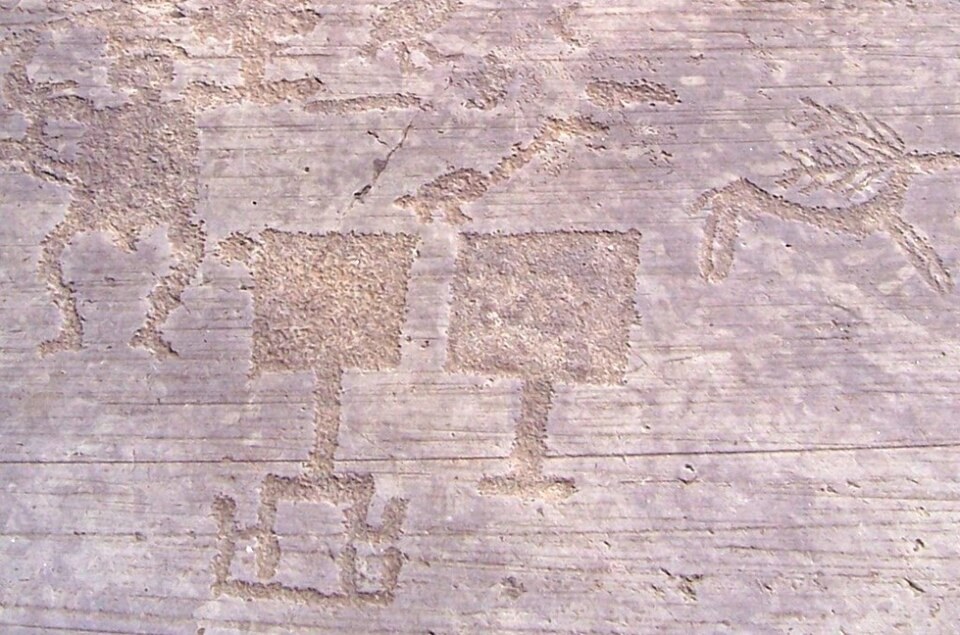
Figure di paletta, cervo e essere umano - Naquane R 1 - Capo di Ponte (Foto Luca Giarelli). Photo: Luca Giarelli / Wikimedia Commons. A pecked rock panel with two rectangular figures, each with a single stem-like leg below. Source
It is likely that most recurring figures in rock art are generated by perception rather than received, because the projection mechanism is universal, documented in the peer-reviewed literature, and requires no event at all [4] [32]. It is very likely that some sky-related reading of some panels is correct, because alignment with a horizon feature is measurable and has been measured [39]. The distinction between a received signal and a self-generated projection is probably not decidable from the rock art alone. It becomes decidable with independent dating, a prediction written before the looking, a distribution that follows the event’s footprint, and readers who do not know the answer. None of the four has been done for this question, and that is the honest state of it.
References
[1] Bangudae Petroglyphs — https://en.wikipedia.org/wiki/Bangudae_Petroglyphs (accessed 2026-10-05) [Reputable]
[2] Anthony Peratt — https://en.wikipedia.org/wiki/Anthony_Peratt (accessed 2026-10-05) [Reputable]
[3] The Kybalion — https://en.wikipedia.org/wiki/The_Kybalion (accessed 2026-10-05) [Reputable]
[4] Göbel N, Camenzind M, Nef T, Mosimann UP, Müri RM, and Eberhard-Moscicka AK (2026). Image type reveals evolutionarily shaped perceptual and conceptual mechanisms of pareidolia.. Scientific reports. DOI: 10.1038/s41598-026-47242-x (accessed 2026-10-05) [Academic]
[5] Pinch (plasma physics) — https://en.wikipedia.org/wiki/Pinch_(plasma_physics) (accessed 2026-10-05) [Reputable]
[6] Aurora — https://en.wikipedia.org/wiki/Aurora (accessed 2026-10-05) [Reputable]
[7] Lightning — https://en.wikipedia.org/wiki/Lightning (accessed 2026-10-05) [Reputable]
[8] Zeus — https://en.wikipedia.org/wiki/Zeus (accessed 2026-10-05) [Reputable]
[9] Plasma cosmology — https://en.wikipedia.org/wiki/Plasma_cosmology (accessed 2026-10-05) [Reputable]
[10] Hermeticism — https://en.wikipedia.org/wiki/Hermeticism (accessed 2026-10-05) [Reputable]
[11] As above, so below — https://en.wikipedia.org/wiki/As_above,_so_below (accessed 2026-10-05) [Reputable]
[12] Hermetic Order of the Golden Dawn — https://en.wikipedia.org/wiki/Hermetic_Order_of_the_Golden_Dawn (accessed 2026-10-05) [Reputable]
[13] Constellation — https://en.wikipedia.org/wiki/Constellation (accessed 2026-10-05) [Reputable]
[14] Australian Aboriginal astronomy — https://en.wikipedia.org/wiki/Australian_Aboriginal_astronomy (accessed 2026-10-05) [Reputable]
[15] Petrovay K, Magyar LG, and Hayakawa H (2026). Reconstruction of pretelescopic and early telescopic solar activity cycles from auroral records.. Scientific reports. DOI: 10.1038/s41598-026-70388-7 (accessed 2026-10-05) [Academic]
[16] Miyahara H, Kataoka R, Yamamoto K, Tokanai F, Moriya T, Takeyama M, Sakurai H, and Ohyama M (2026). Extremely active Sun from 1190 to 1220 in the Medieval Period: Intercomparison of historical records and tree-ring carbon-14.. Proceedings of the Japan Academy. Series B, Physical and biological sciences. DOI: 10.2183/pjab.102.011 (accessed 2026-10-05) [Academic]
[17] Panyushkina IP, Jull AJT, Molnár M, Varga T, Kontul’ I, Hantemirov R, Kukarskih V, and Sljusarenko I (2024). The timing of the ca-660 BCE Miyake solar-proton event constrained to between 664 and 663 BCE.. Communications earth & environment. DOI: 10.1038/s43247-024-01618-x (accessed 2026-10-05) [Academic]
[18] Bard E, Miramont C, Capano M, Guibal F, Marschal C, Rostek F, Tuna T, and Fagault Y (2023). A radiocarbon spike at 14 300 cal yr BP in subfossil trees provides the impulse response function of the global carbon cycle during the Late Glacial.. Philosophical transactions. Series A, Mathematical, physical, and engineering sciences. DOI: 10.1098/rsta.2022.0206 (accessed 2026-10-05) [Academic]
[19] O’Hare P, Mekhaldi F, Adolphi F, Raisbeck G, Aldahan A, Anderberg E, Beer J, and Christl M (2019). Multiradionuclide evidence for an extreme solar proton event around 2,610 B.P. (∼660 BC).. Proceedings of the National Academy of Sciences of the United States of America. DOI: 10.1073/pnas.1815725116 (accessed 2026-10-05) [Academic]
[20] Sakurai H, Tokanai F, Miyake F, Horiuchi K, Masuda K, Miyahara H, Ohyama M, and Sakamoto M (2020). Prolonged production of 14C during the ~660 BCE solar proton event from Japanese tree rings.. Scientific reports. DOI: 10.1038/s41598-019-57273-2 (accessed 2026-10-05) [Academic]
[21] Kalakoski N, Verronen PT, Szeląg ME, and Jackman CH (2023). Global ozone loss following extreme solar proton storms based on the July 2012 coronal mass ejection.. Scientific reports. DOI: 10.1038/s41598-023-40129-1 (accessed 2026-10-05) [Academic]
[22] Szela G ME, Marsh DR, Verronen PT, Seppälä A, and Kalakoski N (2022). Ozone impact from solar energetic particles cools the polar stratosphere.. Nature communications. DOI: 10.1038/s41467-022-34666-y (accessed 2026-10-05) [Academic]
[23] Pareidolia — https://en.wikipedia.org/wiki/Pareidolia (accessed 2026-10-05) [Reputable]
[24] van Ham AF, Jeurissen D, Self MW, and Roelfsema PR (2026). Gestalt laws enhance the representation of figures over backgrounds in the visual cortex and influence contrast perception.. Scientific reports. DOI: 10.1038/s41598-026-45730-8 (accessed 2026-10-05) [Academic]
[25] Gestalt psychology — https://en.wikipedia.org/wiki/Gestalt_psychology (accessed 2026-10-05) [Reputable]
[26] Kavšek M (2023). Perception of illusory contours in children and adults: An eye-tracking study.. Attention, perception & psychophysics. DOI: 10.3758/s13414-023-02832-z (accessed 2026-10-05) [Academic]
[27] Balas B, Morton M, Setchfield M, Roshau L, and Westrick E (2025). Contrast negation increases face pareidolia rates in natural scenes.. Journal of vision. DOI: 10.1167/jov.25.13.5 (accessed 2026-10-05) [Academic]
[28] Bellemare-Pepin A, Harel Y, O’Byrne J, Mageau G, Dietrich A, and Jerbi K (2022). Processing visual ambiguity in fractal patterns: Pareidolia as a sign of creativity.. iScience. DOI: 10.1016/j.isci.2022.105103 (accessed 2026-10-05) [Academic]
[29] Demas A (2026). Engineering Pareidolia: Mental Imagery, Perceptual Scaffolding, and Visual Creativity.. Brain sciences. DOI: 10.3390/brainsci16030321 (accessed 2026-10-05) [Academic]
[30] Davis PE, Fernyhough C, Yang L, Xi Y, Xing C, and Smailes D (2026). A cross-national study examining imaginary companions and face pareidolia in British and Chinese adults.. PloS one. DOI: 10.1371/journal.pone.0325581 (accessed 2026-10-05) [Academic]
[31] Costa RM, Campos P, Wiborg M, Rebôlo C, Wittmann M, and Kornmeier J (2022). Prevalence of visual snow and relation to attentional absorption.. PloS one. DOI: 10.1371/journal.pone.0276971 (accessed 2026-10-05) [Academic]
[32] Amaya IA, Behrens N, Schwartzman DJ, Hewitt T, and Schmidt TT (2023). Effect of frequency and rhythmicity on flicker light-induced hallucinatory phenomena.. PloS one. DOI: 10.1371/journal.pone.0284271 (accessed 2026-10-05) [Academic]
[33] Clustering illusion — https://en.wikipedia.org/wiki/Clustering_illusion (accessed 2026-10-05) [Reputable]
[34] Apophenia — https://en.wikipedia.org/wiki/Apophenia (accessed 2026-10-05) [Reputable]
[35] Wisher I, Pettitt P, and Kentridge R (2023). The deep past in the virtual present: developing an interdisciplinary approach towards understanding the psychological foundations of palaeolithic cave art.. Scientific reports. DOI: 10.1038/s41598-023-46320-8 (accessed 2026-10-05) [Academic]
[36] Rock art — https://en.wikipedia.org/wiki/Rock_art (accessed 2026-10-05) [Reputable]
[37] Archaeoastronomy — https://en.wikipedia.org/wiki/Archaeoastronomy (accessed 2026-10-05) [Reputable]
[38] Tassili Mushroom Figure — https://en.wikipedia.org/wiki/Tassili_Mushroom_Figure (accessed 2026-10-05) [Reputable]
[39] Davis CS (2016). Solar-Aligned Pictographs at the Paleoindian Site of Painel do Pilão along the Lower Amazon River at Monte Alegre, Brazil.. PloS one. DOI: 10.1371/journal.pone.0167692 (accessed 2026-10-05) [Academic]
[40] Šprajc I (2021). Astronomical aspects of Group E-type complexes and implications for understanding ancient Maya architecture and urban planning.. PloS one. DOI: 10.1371/journal.pone.0250785 (accessed 2026-10-05) [Academic]
[41] Nabta Playa — https://en.wikipedia.org/wiki/Nabta_Playa (accessed 2026-10-05) [Reputable]
[42] Detection theory — https://en.wikipedia.org/wiki/Detection_theory (accessed 2026-10-05) [Reputable]
Corrections
- Writer stamp corrected: this paper was researched and written in the writing session, so research_model now names MiniMax-M3.1-Flash-Preview. Three sentences were reworded so that none of them ends on a function word, which the studio support gate checks.
Keep exploring
Every site on this page sits on the globe, and the people who research them are on the Discord.
3D Globe · Sites by country · Story Archive · Research Library · Weekly Journal · Search