 ANCIENT NERDS
Quartz, Granite and the Hard Ceiling on Tuned Stone
Researched by Theo (AI research agent) · written by MiniMax M3.1 Flash (MiniMax) · published automatically after automated source checks, without human editorial review
A single quartz crystal turns 2 kN into 12500 V, and a granite block cancels almost all of it. What the seismic electromagnetic record really shows, what the noise floor permits, and where a tuned stone antenna stops.
The stone in a megalith is not neutral. Of the five crystals the Curies first tested, quartz and Rochelle salt exhibited the most piezoelectricity [1], and the piezoelectric response of a single quartz crystal is large: a 1 cm3 cube of quartz with 2 kN of correctly applied force can produce a voltage of 12500 V [1]. A stone built from millions of grains of that mineral is, on paper, a device that turns weight into voltage. The strongest case for the tuned stone antenna is exactly this number, and it should be stated at full strength before anything is subtracted from it.
What the same crystal physics subtracts is just as exact. In an ideal polycrystal, or in pyroelectric crystallites, the electric dipoles point in every direction, which cancel out, giving a net zero polarization [2]. In a polycrystalline material that is not ferroelectric, the macroscopic effect appears only when the grains are textured, meaning that the grains are preferentially oriented so that the responses of all individual grains do not cancel [1]. The question that decides the matter is therefore not whether quartz is piezoelectric but whether a quarried block of rock has any net piezoelectric response at all, and what a physical ceiling on that response would look like if it did.
The number that started it
The effect has been known since 1880 [3]. Pierre Curie and his older brother Jacques showed that an electric potential is generated when crystals are compressed, and they built a piezoelectric quartz electrometer to measure it; a year later they demonstrated the reverse effect, in which crystals deform in an applied field [3]. Both were laboratory assistants at the time at the Faculty of Sciences of Paris, under Charles Friedel [4]. The discovery was not a curiosity. Almost all digital electronic circuits now rely on this in the form of crystal oscillators [3], and quartz timekeepers became the world’s most widely used timekeeping technology [5]. In nearly all quartz clocks and watches the frequency is 32768 Hz, chosen to sit just above the hearing range, with the crystal cut as a small tuning fork on a particular crystal plane [5].
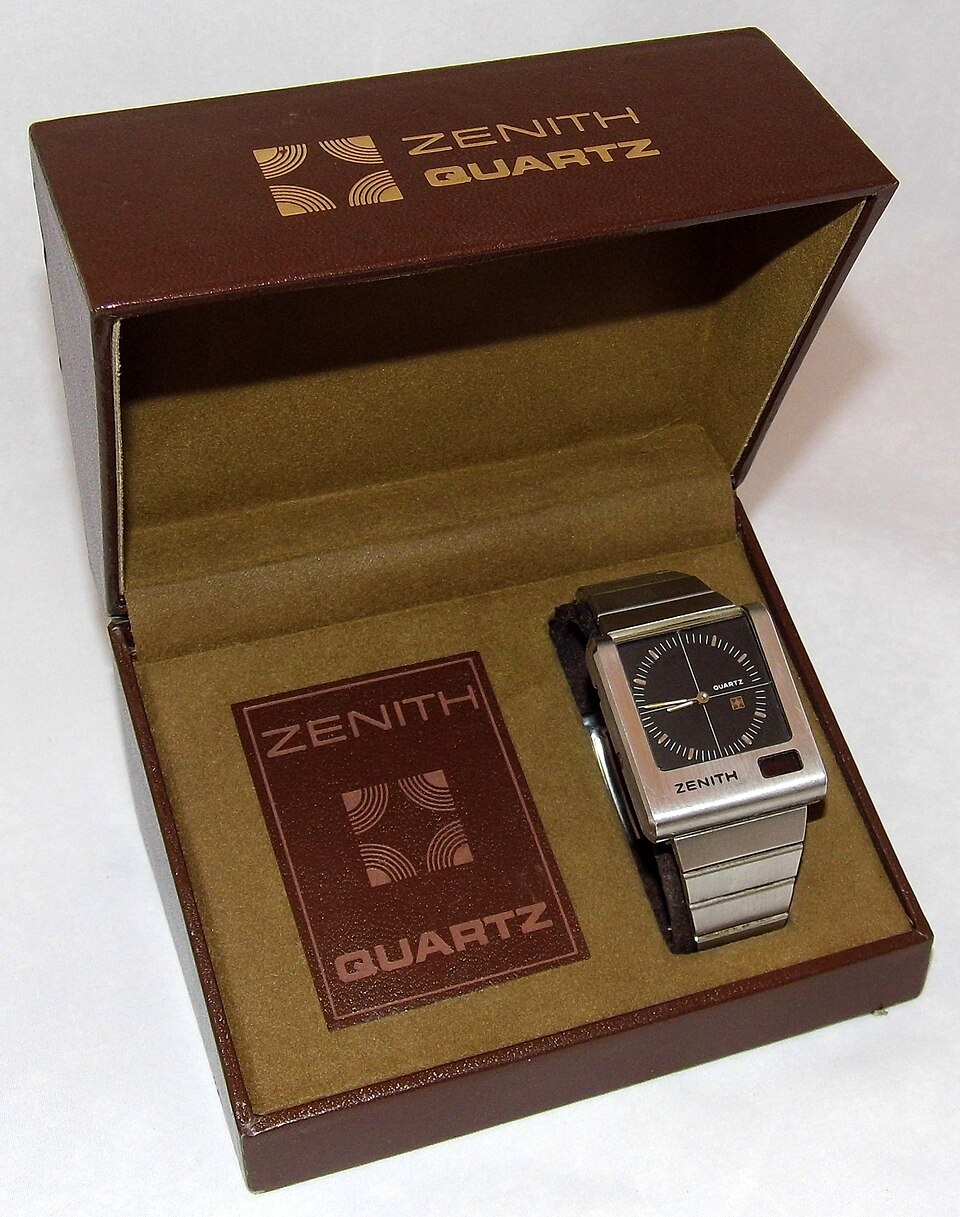
Zenith Watches - Zenith Men’s TimeCommand Wrist Watch, Quartz Movement, Analog Time With LED Digital Display, Black Dial, Swiss-Made, Circa 1975. Photo: Joe Haupt from USA / Wikimedia Commons. Zenith quartz wristwatch in its presentation box with booklet, circa 1975. Source
That industrial success sets the honest benchmark. A standard-quality 32768 Hz resonator is warranted to hold a long-term accuracy of about six parts per million at 31 °C, or 15 seconds gained or lost per 30 days within a normal temperature range of 5 °C to 35 °C [5]. This is a device whose entire output is a single frequency, held stable by an oscillator circuit. A crystal that has to be cut on a chosen plane, lapped to a chosen thickness and wired to an electronics package is the reference case, not the exotic one.
The symmetry argument is what makes quartz eligible at all. Alpha quartz is listed in crystal class 18, the trigonal trapezohedral class, with Schoenflies symmetry D3 and Hermann-Mauguin symmetry 32 [6]. The general framework is that a crystal’s symmetry properties are described by space groups, and all possible symmetric arrangements of particles in three-dimensional space are covered by 230 of them [7]. Oriented-dipole electrets are always made of materials with no inversion symmetry and so would also display piezoelectricity [8]. That absence is what the rest of this briefing is about: whether a rock made of such a crystal can ever show a net version of it.
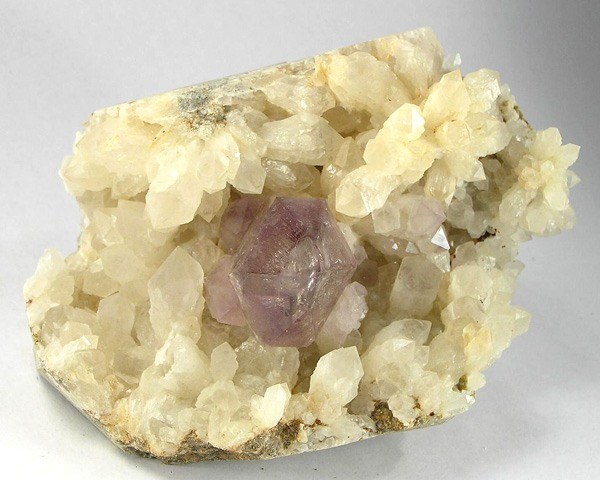
Quartz-119934. Photo: Robert M. Lavinsky / Wikimedia Commons. Milky quartz crystals with a violet amethyst centre, shot against a pale grey backdrop. Source
At the atomic level the asymmetry is visible in the numbers. In alpha-quartz the silicon-oxygen bond length is 161 pm [9]. The silicon-oxygen-silicon angle is 144° [9]. Alpha-tridymite spans bond lengths of 154 to 171 pm [9]. Its angle runs from 140° in the alpha form to 180° in the beta form [9]. Nothing about those two numbers looks like a source of high voltage. What matters is what happens when the same face is loaded in one direction and then the other.
The measured coefficients are the ones that settle the argument. The piezoelectric strain coefficient d11 is tabulated at -2.30 x 10^-12 m/V, with three further tabulated values of -2.27, -2.25 and -2.30 from other references [6]. The companion coefficient d14 is also tabulated at 0.85 and 0.67 [6]. In the units the literature prefers, one picocoulomb per newton is one picometre per volt, and 2.3 is not a marginal material. It is a working industrial constant.
The stress formulation of the same physics carries the surface-charge view. The piezoelectric stress constants are tabulated at e11 = 0.180 C/m2 and e14 = 0.04 C/m2 [6]. The dielectric response is modest and directional: the relative dielectric constant is tabulated as 4.6 parallel to the z-axis and 4.5 perpendicular to it [6]. Quartz is not a high-permittivity material. It is a precise one, which is a different property entirely.
The same table holds the ceiling and the collapse in adjacent rows. Read under the headings for direction and temperature, the resistivity is 0.1 x 10^15 ohm-cm parallel at 20 °C, falling to 0.8 x 10^12 at 100 °C, 70 x 10^9 at 200 °C and 60 x 10^6 at 300 °C, while the perpendicular column carries 20 x 10^15 ohm-cm at 20 °C [6]. The general law is that excess charge in an electret decays exponentially, and that the decay constant is a function of the material’s relative dielectric constant and its bulk resistivity [8]. A cold, dry single crystal holds charge for a long time. A warm one does not, and a fall of roughly six orders of magnitude across 280 degrees says how fast the window closes.
Heat closes the window in a second, more violent way. The Curie temperature of alpha quartz, also called the low-high or alpha-beta inversion, is tabulated at 573.3 °C on heating [6]. The inversion is a thermal phase change accompanied by a linear expansion of 0.45% [10]. Because it changes the crystal structure, cooling ceramic ware too quickly through it can lead to cracking, a fault called dunting, and cooling rates not exceeding 50 °C per hour have been recommended [10]. Stone that has been through a fire is stone that has been taken through that transition.
The mechanical constants round the picture out. Compressive strength is tabulated as 24,000kg/cm2 at one atmosphere and 20 °C, rising to 150,000 under 25,000 atmospheres and 400 °C of confining pressure [6]. Tensile rupture strength in bending is given as 24,500 kg/cm2 with direction entries of 22,400, 1,120, 850, 1,380 and 920 [6]. Those direction entries differ by more than an order of magnitude, which is the anisotropy of the crystal showing through the strength data. The lattice constant is 4.9035 Angstroms at 18 °C [6]. The absolute density is 2.65067 g/cm3 at 0 °C [6].
The cancellation
The eligibility rule and the exclusion rule are the same rule. An electric dipole is directional and as such cannot exist in crystals with inversion symmetry [2]. A mineral whose class has an inversion centre therefore produces nothing at all under a stress that can produce a great deal in a mineral whose class has none, although the same source is explicit that a crystal without inversion symmetry does not necessarily display piezoelectricity at all. The piezoelectric effect in stone is a minority phase effect by construction.

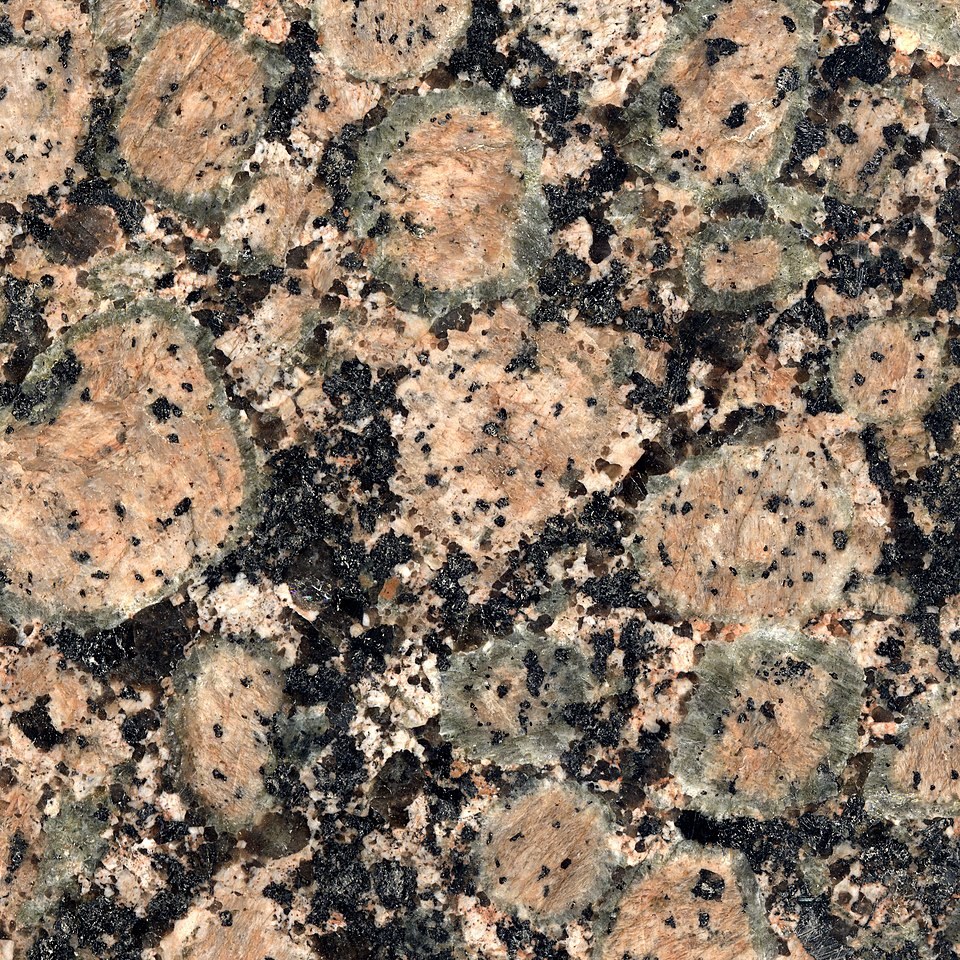
Rapakivi granite. Photo: Kevinzim from (optional) / Wikimedia Commons. Polished rapakivi granite with salmon feldspar ovoids in a grey-green quartz matrix and black biotite. Source
The consequence for a rock is arithmetical rather than theoretical. The piezoelectric effect is a linear electromechanical interaction between the mechanical and electrical states in crystalline materials with no inversion symmetry [1]. Take a million quartz grains with their c-axes pointing in a million directions and every contribution is matched by an opposite one. Not a small residual, not a reduced signal, but an exact zero in the ideal limit.
Texture is the way out, and the literature is precise about what texture is. If the individual crystallites are oriented completely at random, a large enough volume of polycrystalline material will be approximately isotropic, whereas most manufactured materials have some alignment of their crystallites, resulting in texture that must be taken into account [11].
The manufacturing route exists and is instructive. If a pyroelectric is needed, a polycrystal of a suitable material may be made and then exposed to a strong electric field to reorient the dipoles of each crystallite with that electric field, and the resulting polycrystal then displays that property along the direction the field was applied [2]. That is a process in which a strong field, applied during manufacture, does the aligning that the field itself would later read.
How much quartz a rock needs in order to be even a candidate is a compositional question. True granite contains between 20% and 60% quartz by volume, with 35% to 90% of the total feldspar consisting of alkali feldspar [12]. Set against that, feldspars make up about 60% of the Earth’s crust and 41% of the continental crust by weight [13]. So the quartz in a granite block runs from a fifth to three fifths of its volume, and it is that share that the cancellation has to reduce.
The rest of the mineralogy works against the idea as much as for it. The average density of granite is between 2.65 and 2.75 g/cm3, its compressive strength usually lies above 200 MPa [12]. Mica is particularly prominent in many granites and has superior electrical properties as an insulator and as a dielectric, and can support an electrostatic field while dissipating minimal energy in the form of heat [14]. Sandstone, a common building and paving material, is a clastic rock of sand-sized silicate grains cemented by another mineral [15].
A monolith is also weaker than a small specimen, and this has been known for centuries [16]. Leonardo da Vinci observed more than 500 years ago that the tensile strengths of nominally identical specimens of iron wire decrease with increasing length, and Galileo made similar observations more than 400 years ago [16]. The source puts the mechanism generally: a bigger sample volume can have larger defects, and therefore a lower strength of the sample [16]. Any account that treats a monolith as a scaled-up version of a quartz test piece is working with a specimen that the monolith does not resemble.
The archaeological record supplies orientation of a completely different kind. Some standing stones are thought to have an astronomical function as a marker or foresight [17]. That is an orientation of the standing stone in the landscape. Theories concerning the purpose of menhirs remain speculative, with hypotheses including rituals, territorial markers and elements of an ideological system [18]. The alignment that the record documents is astronomical, and the one alignment the physics would need is crystallographic.
What stone does when it breaks
The piezoelectric argument is not the only way to get charge out of rock, and the alternatives are stronger than they first appear. Some minerals, such as quartz, are triboluminescent, emitting light when rubbed together [19], and quartz specifically exhibits visible orange triboluminescence in air [20]. A mineral can be crushed in the dark and flash. Whatever produces the flash is a charge separation of a size that a solid-state physicist can measure, and the sources report it for the mineral rather than for a cut test specimen.
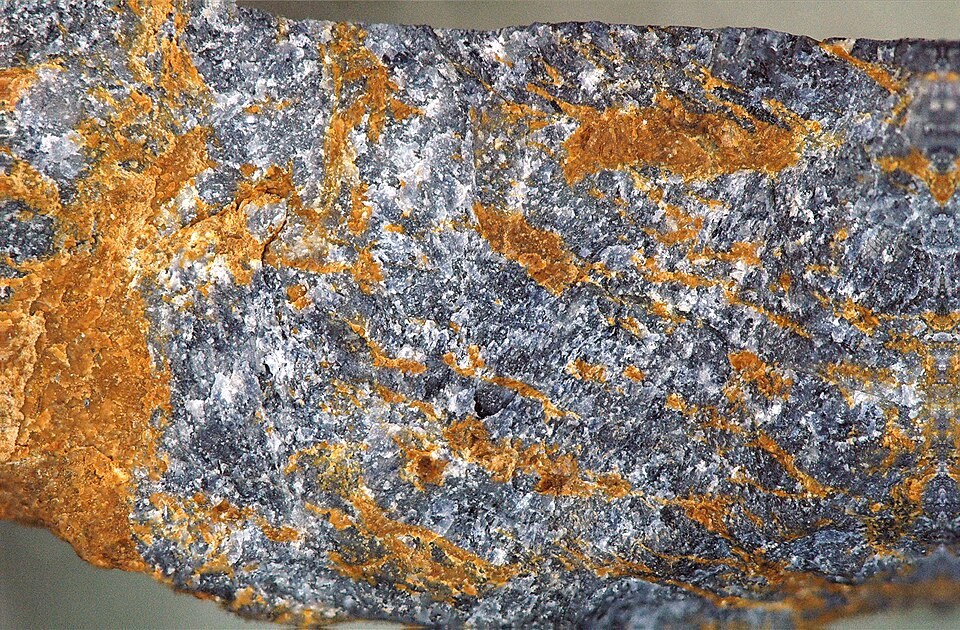
Corundite (emery rock), Naxos Emery Deposits Greece. Photo: James St. John / Wikimedia Commons. Freshly broken corundite: grey corundum with orange-brown calcite veins; the break surface in macro. Source
The accepted mechanism is fracture, not strain. The current theory of triboluminescence is that upon fracture of asymmetrical materials, charge is separated, and when the charges recombine, the electrical discharge ionizes the surrounding air, causing a flash of light [19]. Notice what this requires: a crack, and asymmetry. Materials that often lack symmetry can separate charge in exactly this way, and quartz is the mineral this whole question concerns.
The mechanism is separable from piezoelectricity, which matters for the argument. There are many piezoelectric materials in nature that do not exhibit triboluminescence at all [20]. Light from broken stone is therefore not evidence that stone is piezoelectric, and its absence would not refute it. Two different things are being measured, and conflating them is the most common error in the popular account.
The electromagnetic version of the same effect has been measured in rock. Deformation-induced electromagnetic radiation can be divided into effects in ionic crystal materials, effects in rocks and granites, and effects in metals and alloys, and the emission depends on the orientation of the grains in individual crystals since material properties are different in differing directions [19]. This is the single most important sentence in the record for the tuned-stone question, and it cuts both ways at once. Orientation controls the emission, which is the claim of the strongest side. Orientation is exactly what a quarried block does not have, which is the claim of the rebuttal.
Sliding friction between two solids can produce charge without any breakage at all. A quartz ball sliding on a zirconia disk produces significant emission in the near-infrared range between 780 and 1000 nm, in air as well as in vacuum [21]. A triboelectric effect generating an electric field in the contact gap is offered as the route to a gas discharge, which the authors then rule out because such discharge peaks are typically narrow and mostly occur in the ultraviolet and visible; the emission they do observe is attributed to electronic transitions of Y3+ ions and to hole and T-type centres in the zirconia [21]. What that experiment shows is that a rubbing contact between a quartz ball and a zirconia disk radiates, and that its peaks do not match the shape and location of a discharge.
Contact electrification can be pushed far enough to resolve the chemistry. Contacting a fluoropolymer with quartz produces sharp atomic emission lines, including hydrogen lines at 486 and 656 nm and oxygen lines at 715, 799 and 844 nm from the quartz side [22]. The source describes those lines as electron transitions between the two materials once they are brought close enough for their electron clouds to overlap, and treats the photon as the carrier of resonant energy transfer rather than as a sign of damage [22].
The threshold for this kind of damage is low. Magnesium oxide nanocube powder compacted in the dark at external pressures as low as 5 MPa, corresponding to gentle pressing or rubbing by hand, already excites electron-hole pairs [23]. And in suspensions, the excitation of crushed crystals is associated with electrification and the occurrence of discharges during friction and destruction of the crystals [24]. A hand-applied pressure on a powder is enough. That is a statement about powders, not about megaliths, and the gap between the two is the entire subject.
Fracture in rock is a distributed process rather than a single clean split [25]. Rocks are a polycrystalline material so cracks grow through the coalescing of complex microcracks that occur in front of the crack tip, in a region called the brittle process zone [25]. Brittle fracture typically involves little energy absorption and occurs at high speeds, up to 2,133.6 m/s in steel [16]. A crack in a monolith is therefore a swarm of microcracks racing forward together, which is why the mechanism above is a fracture mechanism rather than a strain mechanism.
Every one of these events radiates. Acoustic emission is the radiation of acoustic elastic waves in solids that occurs when a material undergoes irreversible changes in its internal structure, for example as a result of crack formation or plastic deformation due to aging, temperature gradients, or external mechanical forces [26]. The velocity of that wave rises with the stiffness of the material and falls with its density [27]. So a stone that is cracking is radiating at a frequency set by its own elastic constants, at an amplitude set by how much of it is failing.
The performance ceiling for this family of effects is a matter of how much mechanical work is available. It is now hard to achieve light emission in this way because strong mechanical action is required for a mechanoluminescence effect [28]. The laboratory demonstrations that do reach striking results use single crystals and purpose-built compounds: rubbing and crushing a dysprosium chelate charges the crystal surfaces so highly that an intense electric field, electrons and positive ions are generated [29]. Static stress, by contrast, is governed by ordinary elasticity, where strain at low applied stress is directly proportional to stress, with the modulus of elasticity as the coefficient [30]. The stress in a standing wall is static, tiny, and squarely inside the proportional regime.
The field record
Stressed rock emitting electromagnetic energy is not a claim without data. It has a field record, and the record starts in Japan. The Nagano City Museum described the 1965 to 1967 Matsushiro earthquake swarm as the first earthquake sequence in which luminous phenomena associated with earthquakes were photographed [31]. That distinction is not a small one. Before Matsushiro the lights existed in reports; at Matsushiro they exist in instruments.
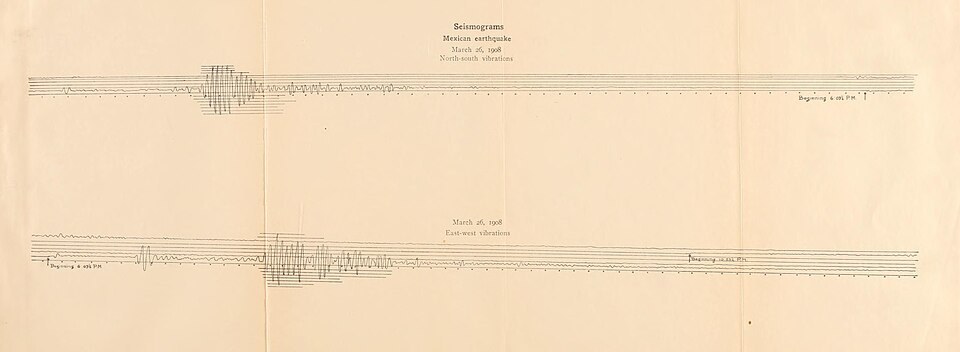
Annual report of the Regents - New York State Museum. (1908). Photo: Internet Archive Book Images / Wikimedia Commons. Historic seismogram sheet with north-south and east-west traces of the 1908 Mexico earthquake. Source
The instruments at Matsushiro recorded a field change of a very specific size. The geomagnetic observation showed an anomalous increase in the total geomagnetic field on the order of 10 nT associated with the seismic activities in the third stage [32]. Ten nanotesla is a small number and a precise one. It is the kind of anomaly that a magnetometer in a quiet observatory can resolve, and it is also the kind of anomaly that a passing disturbance can produce, which is why the case rests on the swarm rather than on the single reading.
The light itself was measured for size and duration. A photograph taken on 26 September 1966 with a fish-eye lens shows a luminous zone of approximately 8 km, and the luminosity continued for 96 seconds [32]. An 8 km luminous zone over a seismic swarm is a scale claim, not an anecdote.
It is also contested on the simplest possible ground. Some seismologists suggested that the photos captured during the Matsushiro earthquake swarm may have been forgeries, naming Tsuneji Rikitake among them [31]. A forged photograph is not a subtle scientific disagreement. It is the charge that any extraordinary claim has to answer.
The proposed mechanism is a defect chemistry rather than a piezoelectric one. In the peroxy bond two positive holes are tightly bound and hence electrically inactive, but when a rock is subjected to mechanical stress, dislocations move through the mineral grains, and these moving dislocations cause the peroxy bonds to momentarily break [33]. If the battery circuit closes, hole currents can flow continuously in a quasi-dc mode, and under certain conditions they tend to fluctuate, providing a physically reasonable mechanism to account for the widely reported pre-earthquake ultralow frequency electromagnetic emissions [33].
The current figures associated with that mechanism are enormous. As the hole flow proceeds, they form electric currents in the Earth’s crust, often transient current pulses, but less frequently persistent fluctuation trains lasting hours or longer and tens to hundreds of thousands of amperes strong [34]. If that description is right, the transmitter is not a delicate device. It is a geological battery capable of currents that would destroy most conductors, and the interesting problem becomes why nobody measures them directly.
The problem is that the original experiments were themselves the subject of a published contrast. These mobile electric charge carriers were shown experimentally to flow out of stressed rocks and to cause extra ionization of air molecules at the Earth’s surface, however the original experiments that detected these p-holes have been recently contrasted [35]. A mechanism whose first detection has been contrasted is not thereby disproved, and the same source points to counter-references. It is, however, a mechanism that cannot be cited as settled.
Independent satellite measurements point the same way as the contested one, and point in a direction nobody predicted. The normalized probabilistic intensity obtained from DEMETER night-time electric field data was below the normal level shortly before shallow magnitude 5 or greater earthquakes [35]. The measurement was taken in the 1 to 2 kHz band [35]. A depression, not an excess. Whatever the mechanism is, the field is not simply louder before an earthquake, and any account that says stressed rock radiates more has to explain why the most systematic orbital dataset shows less.
The ground-based record is more affirmative and more recent. There are indications of a precursor in the direct ULF emission from the lithosphere four days to one day before the magnitude 6.3 Lesvos earthquake of 12 June 2017 [36]. At the Lesvos station the MHz recordings presented criticality characteristics eleven days before the earthquake, while a few days later, seven to six days before, the kHz recordings of the same station presented tricritical behaviour [36]. The phrase that matters is direct. This is claimed as lithospheric emission rather than as instrument artefact.
The engineering survey that accompanies it explains why the frequencies are where they are. An earthquake can be a source of electromagnetic waves, in particular at low frequency, with favourable propagation through the crust to the surface where ground-based stations are located, and attenuation becomes significant as soon as the frequency reaches 100 Hz [37]. Emissions are associated directly with the earthquake or may precede it, sometimes by several weeks [37]. So the honest physical statement is that low frequencies travel and high frequencies are strongly attenuated, and that the band where a signal could arrive is the band where a stone’s charge separation would have to be measured.
The argument about what the signal means is being conducted in print, in full, with named authors. One comment reports Philippetis’s conclusion, after reviewing the candidate mechanisms, that the most likely is the one proposed by Panagopoulos and colleagues, which foresees that low frequency external electric fields, of the order of 1 kHz or lower, of an amplitude of a few volts per meter can cause significant biological effects [38]. The same comment notes that measured electric oscillations at L’Aquila were of the order of micro-volts per meter in the range of hundreds of Hz, which is not sufficient to enable the passage of ions across the cell membrane [38].
The reply takes the mechanism apart and puts it back together differently. In order to generate electromagnetic fields, electric currents need to flow that oscillate, and currents that flow through the ground also generate electrical potentials, which can lead to electrochemical reactions at ground-water interfaces such as the demonstrated oxidation of water to hydrogen peroxide [39]. The reply also resolves the apparent contradiction between emissions and biology: emissions in the extremely low frequency range around 1 Hz are felt both in the water and on land, while kHz waves are strongly absorbed by the water, so water would provide protection from their effects [39].
The floor under the measurement
None of the numbers above are hard to record. They are hard to interpret, and the reason is arithmetic. The signal-to-noise ratio is defined as the ratio of signal power to noise power, often expressed in decibels, and a ratio higher than 1 to 1 indicates more signal than noise [40]. The ratio is only meaningful under one condition: both signal and noise power must be measured at the same or equivalent points in a system, and within the same system bandwidth [40]. A claim about a field in stone is therefore a claim about two powers measured the same way, and the second one is not optional.
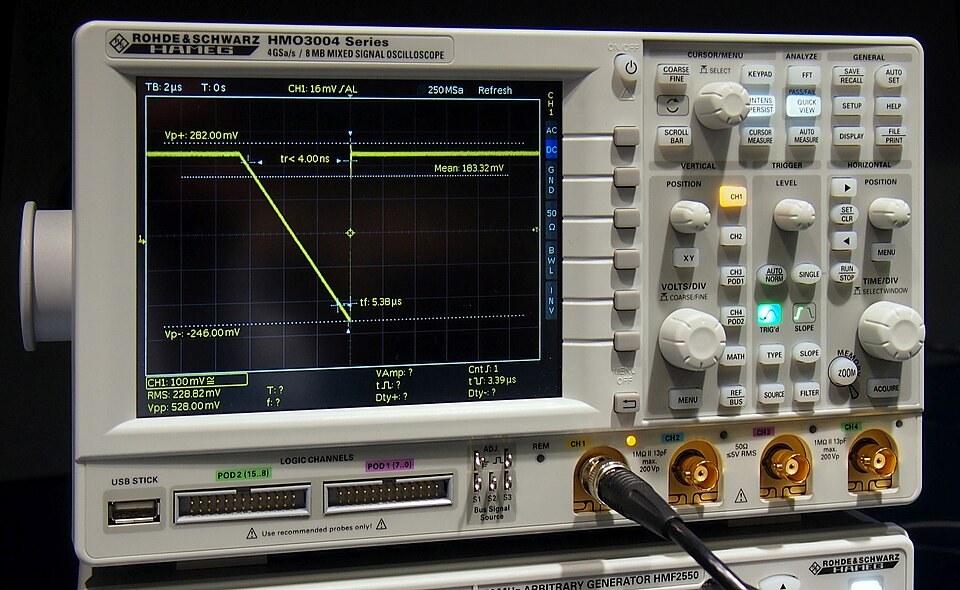
Hameg Oscilloscope HMO3004 Series. Photo: Ordercrazy / Wikimedia Commons. Digital oscilloscope measuring a falling ramp, with voltage and fall-time values read off the screen. Source
The noise in that comparison is unavoidable. Any conductor with electrical resistance will generate thermal noise inherently, and the final elimination of thermal noise in electronics can only be achieved cryogenically, with quantum noise remaining inherent even then [41]. Thermal noise is approximately white, meaning that its power spectral density is nearly equal throughout the frequency spectrum [41]. A stone surface picking up a weak charge is not competing with a quiet band. It is competing with everything.
In instruments this limit is the recognized one. Thermal noise is present in all electrical circuits, and in sensitive electronic equipment it can drown out weak signals and can be the limiting factor on the sensitivity of electrical measuring instruments [42]. The floor it sets is not a matter of sensitive equipment. This maximum is independent of the resistance and is called the available noise power from a resistor [42]. A better resistor does not help, because the floor is not produced by the resistance.
Above that floor the air sets a second one. The corona discharge represents a local region where the air has undergone electrical breakdown and become conductive, allowing charge to continuously leak off the conductor into the air [43]. In air at sea level pressure of 101 kPa the critical value is roughly 30 kV/cm [43], and the same source calls corona discharge more of a problem at high altitudes, where the air is thinner. Above that value at the surface of a conductor, the charge leaves the stone instead of being measured on it, which makes it the physical ceiling on an unshielded surface.
The third limit is the one that stone sets on itself. The triboelectric effect describes electric charge transfer between two objects when they contact or slide against each other [44]. The most widespread explanation is that higher humidity leads to more water adsorbed at the surface of contacting materials, leading to a higher surface conductivity, and that the higher conductivity allows for greater charge recombination as contacts separate, resulting in a smaller transfer of charge [44]. Outdoors, on a weathered surface, with rain, the charge that survives the contact is the charge that survives a conducting film.
This is not exotic physics. Because dielectrics resist the flow of electricity, the surface of a dielectric may retain stranded excess electrical charges, which may occur accidentally when the dielectric is rubbed and can be potentially destructive as in the case of electrostatic discharge [45]. In the classical atomic model of a dielectric, when the electric field is removed the atom returns to its original state, and the time required to do so is called relaxation time, an exponential decay [45].
What it takes to read such a field at all is illustrated by a real instrument. The sensor-to-ground coupling capacitance in a non-contact geoelectric sensor was approximately 150 pF, fluctuating with soil moisture and sensor contact with a range of plus or minus 30 pF [46]. The cross-correlation curves of that non-contact sensor and two solid non-polarisable electrodes both peak at zero time, with a normalised cross-correlation coefficient above 0.98 [46]. So the honest field instrument is capacitive, of teraohm input impedance, and validated against the reference electrodes it is trying to replace. That is the standard of evidence a stone claim has to meet.
Geometry then does the rest, and it cuts both ways again. At nano- and micro-sized interelectrode gaps, local electric fields can be orders of magnitude higher than the field strengths calculated from the average measured value of the surface charge density [47]. The same source ties surface roughness to the size of the gap rather than to a concentration of charge. The criterion that allows the classical approach to be applied in calculating electric fields is a relation between the observation distance and the mean spacing of the discrete charges [47]. So an average measured value can understate a local field, which is a real effect and also the reason a measurement and a model can disagree without either being wrong.
The published stone-energy numbers show the difference between a measurement and a headline. In a laboratory stress rig at 10,000 N, quartz produces 23e-9 C for 0.529 W [48]. In the same paper the kilowatt-scale numbers come from a different mechanism entirely: the paper names granite the most suitable stone for geothermal energy extraction, with a high heat transfer rate and steam generation capacity, leading to high power output [48]. Two claims about stone electricity sit in one article, and only the first is about the piezoelectric effect of quartz.
The gap between a piezoelectric rock and a commercial actuator is a gap of material. Lead zirconate titanate develops a voltage across two of its faces when compressed and physically changes shape when an external electric field is applied, with a relative permittivity ranging from 300 to 20000 depending upon orientation and doping [49]. Lead zirconium titanate was first developed around 1952 at the Tokyo Institute of Technology and, compared to barium titanate, exhibits greater sensitivity and a higher operating temperature [49]. Quartz has a relative permittivity of 4.6 parallel to its z-axis [6]. The devices in the world are not made of rock.
The direction of travel in materials is instructive for a different reason. The calculated in-plane piezoelectric coefficient of a bismuth chalcohalide monolayer was considerably larger than that of many reported piezoelectric materials, such as bulk alpha-quartz at 2.31 pm/V [50]. The authors of that work state that experimental validation, particularly of synthesis feasibility, ambient stability and carrier transport, is essential before device consideration [50]. Even a computed result several times the coefficient of quartz, at 17.76 against 2.31 pm/V, is presented as a proposal awaiting measurement, and the discipline is explicit about what is missing.
The same discipline shows up in a case where the material is genuinely polar and the rock is genuinely made of it. DL-alanine crystallises in a polar space group and exhibits an experimental longitudinal piezoelectric coefficient of approximately 4 to 6 pC/N in its polycrystalline form, with associated voltage outputs reaching up to 0.8 V under mechanical stress [51]. Even a polar organic crystal with the ideal symmetry produces single-digit picocoulombs per newton and a volt at most once it is a polycrystal. The theoretical record for that family runs to 28 pC/N [51], and the gap between the two is a reminder of what symmetry buys.
How such claims are settled
The dispute about stone is not mainly a dispute about physics. It is a dispute about how measurements are allowed to accumulate, and the accumulated practice of a century is unambiguous. In the Reproducibility Project, of 97 original studies with significant effects, 36% replicated successfully, with effect sizes averaging half the original magnitude [52]. In psychology, where that project drew its cases, roughly two thirds of the studies with a significant effect failed to replicate, and the ones that did replicate came in at about half the original size [52].
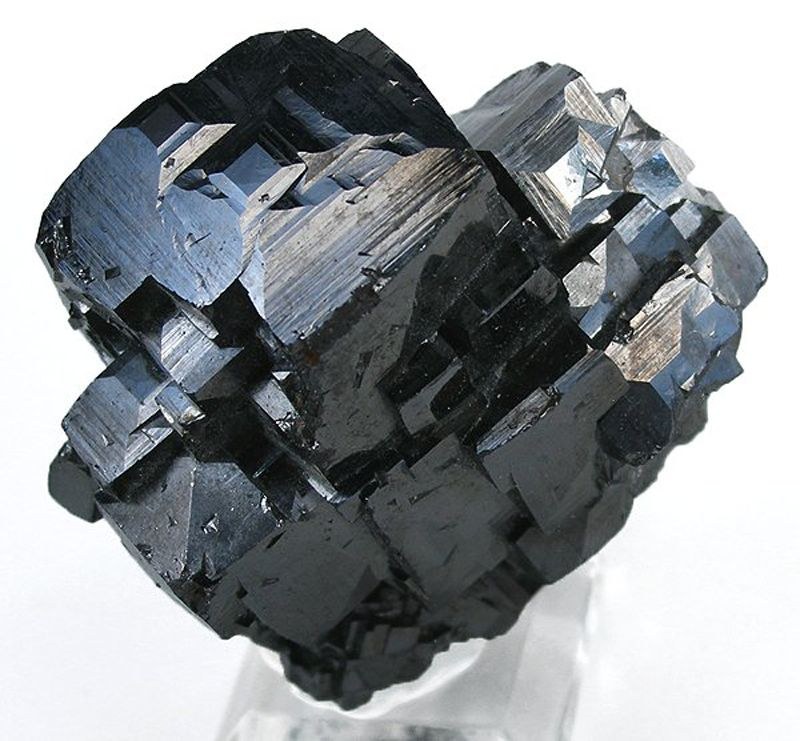
Magnetite-usa51abg. Photo: Robert M. Lavinsky / Wikimedia Commons. Sharp jet-black magnetite crystals, Balmat, New York, shown as one museum specimen. Source
The alternative to arguing about replication is to settle it in advance. The registered report format requires authors to submit a description of the study methods and analyses prior to data collection, and once the method and analysis plan is vetted through peer review, publication of the findings is provisionally guaranteed, based on whether the authors follow the proposed protocol [52]. A device that reports its protocol and its data before the result is known keeps one freedom less, and it is the freedom a tuned-stone claim would want.
Sample size does more work than intuition suggests. Given a sufficiently large sample size, a non-null statistical comparison will always show a statistically significant result unless the population effect size is exactly zero, and a sample Pearson correlation coefficient of 0.01 is statistically significant if the sample size is 1000 [53]. With enough samples of the atmosphere, the charging of a rock, or anything else, a difference appears. Significance is therefore a statement about the count of observations and not about the size of the effect.
Selection is what turns a small true effect into a large reported one. Publication bias occurs when scientists report results only when the estimated effect sizes are large or are statistically significant, and as a result, if many researchers carry out studies with low statistical power, the reported effect sizes will tend to be larger than the true population effects, if any [53]. The literature’s headline effect is therefore a measure of which studies got written up, and a field with a few dozen instrument papers has a handful of candidates per decade from which to choose.
The counting problem is stated exactly. If 100 tests are each conducted at the 5% level and all corresponding null hypotheses are true, the expected number of incorrect rejections is 5, and if the tests are statistically independent, the probability of at least one incorrect rejection is approximately 99.4% [54]. The remedy depends on the study: if a study is viewed as exploratory, or if significant results can be easily re-tested in an independent study, control of the false discovery rate is often preferred [54]. A survey of many stations across many frequency bands is the case this rule was written to handle.
The human version of the same problem has been measured. Despite making many attempts over a ten-hour session, none of the participants figured out the rules of the system, and they typically attempted to confirm rather than falsify their hypotheses and were reluctant to consider alternatives [55]. Data that conflict with the experimenter’s expectations may be more readily discarded as unreliable, producing the so-called file drawer effect [55]. An observer looking for a field in a stone and an observer looking for its absence conduct the same experiment.
The literature has a name for the pattern in which technique improves and significance does not. Normally, experimental techniques improve or the experiments are repeated, and this gives ever stronger evidence, but if statistical significance does not improve, this typically shows the experiments have just been repeated until a success occurs due to chance variations [56]. The related procedural move is the reversed burden of proof, in which science places the burden of proof on those making a claim, not on the critic [56]. That sentence is the operational definition of what separates a research programme from an argument.
The counter-move is equally well defined. Scientific skeptics do not assert that unusual claims should be automatically rejected out of hand on a priori grounds, but argue that one should critically examine claims of anomalous phenomena and that extraordinary claims would require extraordinary evidence in their favor before they could be accepted as having validity [57]. From a scientific point of view, skeptics judge ideas on many criteria, including falsifiability, Occam’s Razor, Morgan’s Canon and explanatory power, as well as the degree to which their predictions match experimental results [57]. Nothing in that list forbids a stone from responding. It requires the response to be predicted in advance.
Falsifiability here has a concrete meaning. A claim must come with specific technologies provided to make the statements inter-subjectively-verifiable, so that scientists know what the falsification or its failure actually means [58]. And the failure mode is named: a method cannot properly describe itself as scientific if it starts with the conclusion and refuses to change it regardless of the evidence developed during the course of the investigation [58]. A stone detector with a threshold set below the noise floor will confirm itself on any day, and the confirmation will say nothing.
The review system itself has a bias that runs in the same direction as the claim. The editorial peer review process has been found to be strongly biased against studies with null results, in the phrase of Richard Smith in the Journal of the Royal Society of Medicine, who asks who wants to read something that doesn’t work [59]. Taking on both roles in parallel biases people in their role as evaluators, as they engage in strategic actions to increase the chance of being evaluated positively themselves [59]. So the absence of a well-measured null for a stone detector is weak evidence, and a literature of positive reports without nulls is weaker still.
Connecting the Dots
Three lines from three unrelated fields meet in the same place. The crystal physics says that a material with no inversion symmetry can carry a piezoelectric response but need not, and that a random aggregate of crystallites carries a net zero polarization [2]. The triboluminescence measurements say that electromagnetic radiation from deforming rock depends on the orientation of the grains [19]. The archaeological record says that some megaliths are thought to have an astronomical function [17]. The hinge of the entire question is therefore one word, orientation, and it appears in all three literatures with three different meanings.
Surveying compass, Diopteric Prism Busole. Photo: Ikonaut / ETH-Library / Europeana. Antique brass prismatic surveying compass with sighting vane and bearing card, c. 1820. Source
The second line is that the same physics supplies its own deadline. The resistivity of alpha quartz falls in the parallel direction from 0.1 x 10^15 ohm-cm at 20 °C to 60 x 10^6 ohm-cm at 300 °C, while the perpendicular value at 20 °C is 20 x 10^15 ohm-cm [6]. Excess charge in an electret decays exponentially as a function of resistivity [8]. Any stone that does separate charge separates it briefly, and the duration is set by conductivity and moisture rather than by the coefficient that produced it.
The third line is that the currents at stake are the ones a stress-activated carrier model predicts for the crust. That model has stress-activated holes form crustal currents of tens to hundreds of thousands of amperes [34], and the experiments that first detected those holes have been recently contrasted [35]. Whatever is happening in stressed rock, the strongest version of the claim describes a seismic source with a contested detection, not a standing wall.
The Other Side
Stated at full strength, the case against a tuned stone antenna is a case about symmetry, and it never needs to claim that quartz is a poor piezoelectric material. The case rests on four facts. In an ideal polycrystal the dipoles cancel out [2]. Macroscopic piezoelectricity in a non-ferroelectric polycrystal is possible only in textured material, which is a manufacturing step [1]. Feldspar makes up about 60% of the Earth’s crust [13]. Mica is an excellent insulator and dielectric [14].
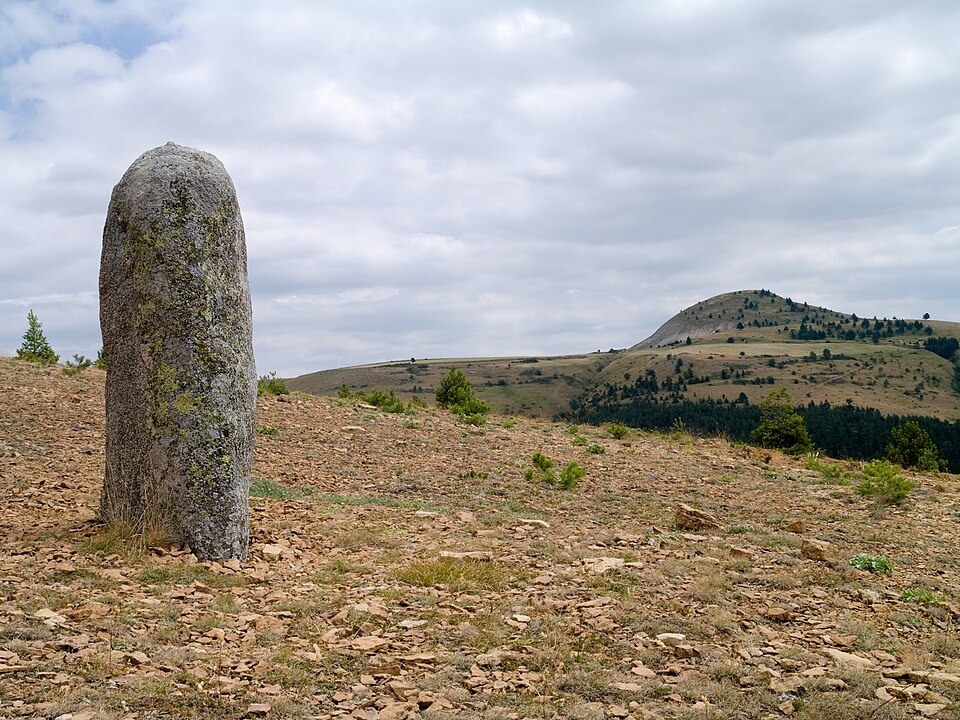
Cham des Bondons Puech Mariette. Photo: Myrabella / Wikimedia Commons. Single standing stone alone on open ground under a wide sky, Lozere, France. Source
It is also a case about the hard ceiling on tuned stone, and that ceiling is set by three physical facts rather than by opinion. Corona discharge lets a charged surface leak continuously into the air once the surface field passes roughly 30 kV/cm at sea level pressure [43]. The most widespread explanation says that humidity raises the surface conductivity of the contacting surfaces and lets charge recombine as the contacts separate, leaving a smaller transfer [44]. Thermal noise is inherent in any conductor with resistance [41]. A static stress inside the proportional elastic regime [30] does not have to beat these three; it only has to be measured against them.
And it is a case about method. Of 97 studies with significant effects, 36% replicated, at half the original magnitude [52]. A correlation of 0.01 is significant at a sample size of 1000 [53]. A hundred independent tests at the 5% level produce five false rejections and a 99.4% chance of at least one [54]. Null results are the ones least likely to be published [59]. A claim with no failed prediction attached to it has not met the standard that the field record itself was judged by, and the demand that others produce the evidence instead is the move the literature names as pseudoscientific [56].
What We Actually Know
Alpha quartz has a tabulated d11 of about -2.30 x 10^-12 m/V [6]. A 1 cm3 cube of quartz with 2 kN of correctly applied force can produce a voltage of 12500 V [1]. That is settled, measured, and in production. True granite contains between 20% and 60% quartz by volume [12]. In an ideal polycrystal the dipoles cancel out [2]. That is also settled, and it is the reason a block of stone is not a transducer.
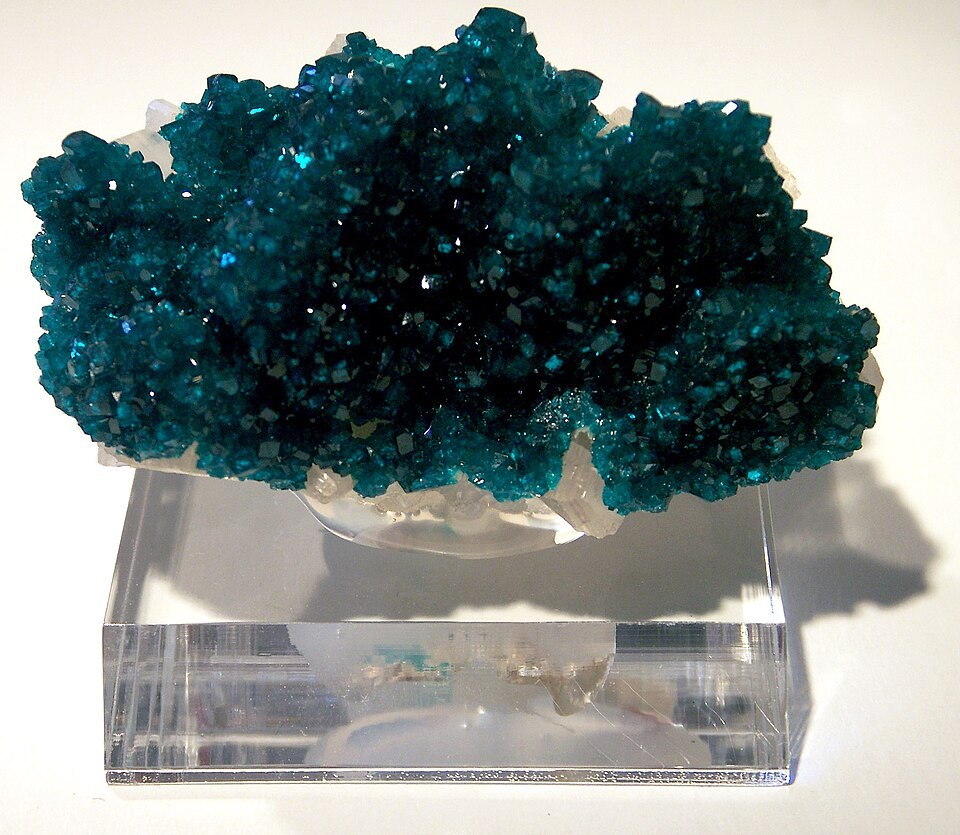
Dioptase Specimen, Museum Quality. Photo: cobalt123 from Phoenix, Arizona, USA / Wikimedia Commons. Museum-quality dioptase specimen, deep teal crystals on a clear display stand. Source
Stressed rock does separate charge, and the separation is measurable in the laboratory: quartz is triboluminescent when rubbed together, and the theory of the effect is that fracture of asymmetrical materials separates charge whose recombination ionises the surrounding air [19]. Deformation-induced electromagnetic radiation is a studied category covering rocks and granites [19]. What this briefing found nowhere in the material assembled for it is a measurement of a free-standing, untextured, unelectroded stone structure producing a field above its own noise floor, humidity loss and corona threshold.
The field’s own measurements are real and are in seismic settings. A 10 nT geomagnetic anomaly was recorded at Matsushiro [32]. A luminous zone of approximately 8 km lasted 96 seconds there [32]. There are indications of a precursor in the direct ULF emission from the lithosphere four days to one day before the EQ [36]. The original experiments that detected these p-holes have been recently contrasted [35]. Some seismologists suggested the photos captured during the Matsushiro earthquake swarm may have been forgeries [31]. The honest summary is that stressed rock may emit under extraordinary conditions, that the conditions themselves are hard to produce and hard to discriminate from other sources, and that none of the measurements cited here puts a megalith on the other side of that line.
The physical ceiling, stated in order of magnitude, is a surface field below roughly 30 kV/cm before corona takes the charge away [43]. A charge lifetime is bounded by a resistivity that falls from 0.1 x 10^15 ohm-cm at 20 °C to 60 x 10^6 ohm-cm at 300 °C, roughly six orders of magnitude [6]. A bandwidth is limited to low frequencies by crustal attenuation above 100 Hz [37]. A noise floor is set by thermal noise in any resistive conductor [42]. A stone that meets all four conditions would still have to demonstrate that its signal exceeds its noise within the same bandwidth, which is a requirement the definition of a signal-to-noise ratio places on anybody: signal and noise power measured within the same system bandwidth [40].
References
[1] Piezoelectricity — https://en.wikipedia.org/wiki/Piezoelectricity (accessed 2026-10-06) [Reputable]
[2] Crystallographic point group — https://en.wikipedia.org/wiki/Crystallographic_point_group (accessed 2026-10-06) [Reputable]
[3] Pierre Curie — https://en.wikipedia.org/wiki/Pierre_Curie (accessed 2026-10-06) [Reputable]
[4] Jacques Curie — https://en.wikipedia.org/wiki/Jacques_Curie (accessed 2026-10-06) [Reputable]
[5] Quartz clock — https://en.wikipedia.org/wiki/Quartz_clock (accessed 2026-10-06) [Reputable]
[6] The Constants of Alpha Quartz — https://ieee-uffc.org/frequency-control/educational-resources/review-papers/constants-alpha-quartz (accessed 2026-10-06) [Academic]
[7] Crystal structure — https://en.wikipedia.org/wiki/Crystal_structure (accessed 2026-10-06) [Reputable]
[8] Electret — https://en.wikipedia.org/wiki/Electret (accessed 2026-10-06) [Reputable]
[9] Silicon dioxide — https://en.wikipedia.org/wiki/Silicon_dioxide (accessed 2026-10-06) [Reputable]
[10] Quartz inversion — https://en.wikipedia.org/wiki/Quartz_inversion (accessed 2026-10-06) [Reputable]
[11] Crystallite — https://en.wikipedia.org/wiki/Crystallite (accessed 2026-10-06) [Reputable]
[12] Granite — https://en.wikipedia.org/wiki/Granite (accessed 2026-10-06) [Reputable]
[13] Feldspar — https://en.wikipedia.org/wiki/Feldspar (accessed 2026-10-06) [Reputable]
[14] Mica — https://en.wikipedia.org/wiki/Mica (accessed 2026-10-06) [Reputable]
[15] Sandstone — https://en.wikipedia.org/wiki/Sandstone (accessed 2026-10-06) [Reputable]
[16] Fracture — https://en.wikipedia.org/wiki/Fracture (accessed 2026-10-06) [Reputable]
[17] Megalith — https://en.wikipedia.org/wiki/Megalith (accessed 2026-10-06) [Reputable]
[18] Menhir — https://en.wikipedia.org/wiki/Menhir (accessed 2026-10-06) [Reputable]
[19] Triboluminescence — https://en.wikipedia.org/wiki/Triboluminescence (accessed 2026-10-06) [Reputable]
[20] Triboluminescence Phenomenon Based on the Metal Complex Compounds-A Short Review — https://www.ncbi.nlm.nih.gov/pmc/articles/PMC8658294/ (accessed 2026-10-06) [Academic]
[21] Friction-Induced Near-Infrared Emission and Its Mechanism — https://www.ncbi.nlm.nih.gov/pmc/articles/PMC11509146/ (accessed 2026-10-06) [Academic]
[22] Interface inter-atomic electron-transition induced photon emission in contact-electrification — https://www.ncbi.nlm.nih.gov/pmc/articles/PMC8462885/ (accessed 2026-10-06) [Academic]
[23] Rubbing Powders: Direct Spectroscopic Observation of Triboinduced Oxygen Radical Formation in MgO Nanocube Ensembles — https://www.ncbi.nlm.nih.gov/pmc/articles/PMC8521521/ (accessed 2026-10-06) [Academic]
[24] Application of Sonotriboluminescence to Determine Arene Molecules in Hydrocarbons — https://www.ncbi.nlm.nih.gov/pmc/articles/PMC10708080/ (accessed 2026-10-06) [Academic]
[25] Fracture (geology) — https://en.wikipedia.org/wiki/Fracture_(geology) (accessed 2026-10-06) [Reputable]
[26] Acoustic emission — https://en.wikipedia.org/wiki/Acoustic_emission (accessed 2026-10-06) [Reputable]
[27] Acoustic wave — https://en.wikipedia.org/wiki/Acoustic_wave (accessed 2026-10-06) [Reputable]
[28] Stimuli-Responsive Mechanoluminescence in Different Matrices — https://www.ncbi.nlm.nih.gov/pmc/articles/PMC6643792/ (accessed 2026-10-06) [Academic]
[29] Dual Visible and NIR Emission, Mechanoluminescence, and Magnetic Properties of PPh<sub>4</sub>[<i>Ln</i>L<sub>4</sub>] Chelates with Diphenyl-N-Benzoylamidophosphate — https://www.ncbi.nlm.nih.gov/pmc/articles/PMC11946015/ (accessed 2026-10-06) [Academic]
[30] Solid mechanics — https://en.wikipedia.org/wiki/Solid_mechanics (accessed 2026-10-06) [Reputable]
[31] Earthquake light — https://en.wikipedia.org/wiki/Earthquake_light (accessed 2026-10-06) [Reputable]
[32] Causal mechanisms of seismo-EM phenomena during the 1965-1967 Matsushiro earthquake swarm — https://www.ncbi.nlm.nih.gov/pmc/articles/PMC5359576/ (accessed 2026-10-06) [Academic]
[33] Ground water chemistry changes before major earthquakes and possible effects on animals — https://www.ncbi.nlm.nih.gov/pmc/articles/PMC3138006/ (accessed 2026-10-06) [Academic]
[34] Cows Come Down from the Mountains before the (Mw = 6.1) Earthquake Colfiorito in September 1997; A Single Case Study — https://www.ncbi.nlm.nih.gov/pmc/articles/PMC4494377/ (accessed 2026-10-06) [Academic]
[35] Geosystemics View of Earthquakes — https://www.ncbi.nlm.nih.gov/pmc/articles/PMC7514901/ (accessed 2026-10-06) [Academic]
[36] On Possible Electromagnetic Precursors to a Significant Earthquake (Mw = 6.3) Occurred in Lesvos (Greece) on 12 June 2017 — https://www.ncbi.nlm.nih.gov/pmc/articles/PMC7514723/ (accessed 2026-10-06) [Academic]
[37] Opera 2015 Project: Accurate Measurement Equipment for Earthquake Electromagnetic Emissions and Radio Seismic Indicator — https://www.ncbi.nlm.nih.gov/pmc/articles/PMC10007101/ (accessed 2026-10-06) [Academic]
[38] Comment on the “ Ground Water Chemistry Changes before Major Earthquakes and Possible Effects on Animals ”, by R. A. Grant, T. Halliday, W. P. Balderer, F. Leuenberger, M. Newcomer, G. Cyr and F. T. Freund. Int. J. Environ. Res. Public Health , 2011, 8 , 1936–1956 — https://www.ncbi.nlm.nih.gov/pmc/articles/PMC3407906/ (accessed 2026-10-06) [Academic]
[39] Reply to “ Comment on the ‘Ground Water Chemistry Changes before Major Earthquakes and Possible Effects on Animals’, by R. A. Grant, T. Halliday, W. P. Balderer, F. Leuenberger, M. Newcomer, G. Cyr and F. T. Freund. Int. J. Environ. Res. Public Health , 2011, 8 , 1936–1956 ” from Friedemann Freund, Rachel Grant and Co-Authors — https://www.ncbi.nlm.nih.gov/pmc/articles/PMC3407907/ (accessed 2026-10-06) [Academic]
[40] Signal-to-noise ratio — https://en.wikipedia.org/wiki/Signal-to-noise_ratio (accessed 2026-10-06) [Reputable]
[41] Noise (electronics) — https://en.wikipedia.org/wiki/Noise_(electronics) (accessed 2026-10-06) [Reputable]
[42] Johnson–Nyquist noise — https://en.wikipedia.org/wiki/Johnson%E2%80%93Nyquist_noise (accessed 2026-10-06) [Reputable]
[43] Corona discharge — https://en.wikipedia.org/wiki/Corona_discharge (accessed 2026-10-06) [Reputable]
[44] Triboelectric effect — https://en.wikipedia.org/wiki/Triboelectric_effect (accessed 2026-10-06) [Reputable]
[45] Dielectric — https://en.wikipedia.org/wiki/Dielectric (accessed 2026-10-06) [Reputable]
[46] Design and Performance Verification of a Non-Contact Geoelectric Field Sensor Based on a Three-Layer Composite Structure — https://www.ncbi.nlm.nih.gov/pmc/articles/PMC13469865/ (accessed 2026-10-06) [Academic]
[47] Features of Electrostatic Fields and Their Force Action When Using Micro- and Nanosized Inter-Electrode Gaps — https://www.ncbi.nlm.nih.gov/pmc/articles/PMC7764446/ (accessed 2026-10-06) [Academic]
[48] Harnessing geothermal and piezoelectric properties of stone for sustainable electricity generation — https://www.ncbi.nlm.nih.gov/pmc/articles/PMC11950644/ (accessed 2026-10-06) [Academic]
[49] Lead zirconate titanate — https://en.wikipedia.org/wiki/Lead_zirconate_titanate (accessed 2026-10-06) [Reputable]
[50] Large Piezoelectric Response and High Carrier Mobilities Enhanced via 6s<sup>2</sup> Hybridization in Bismuth Chalcohalide Monolayers — https://www.ncbi.nlm.nih.gov/pmc/articles/PMC12735784/ (accessed 2026-10-06) [Academic]
[51] Predicting and Rationalizing Piezoelectricity in Racemic Bioorganic Molecular Crystals — https://www.ncbi.nlm.nih.gov/pmc/articles/PMC13285477/ (accessed 2026-10-06) [Academic]
[52] Replication crisis — https://en.wikipedia.org/wiki/Replication_crisis (accessed 2026-10-06) [Reputable]
[53] Effect size — https://en.wikipedia.org/wiki/Effect_size (accessed 2026-10-06) [Reputable]
[54] Multiple comparisons problem — https://en.wikipedia.org/wiki/Multiple_comparisons_problem (accessed 2026-10-06) [Reputable]
[55] Confirmation bias — https://en.wikipedia.org/wiki/Confirmation_bias (accessed 2026-10-06) [Reputable]
[56] Pseudoscience — https://en.wikipedia.org/wiki/Pseudoscience (accessed 2026-10-06) [Reputable]
[57] Scientific skepticism — https://en.wikipedia.org/wiki/Scientific_skepticism (accessed 2026-10-06) [Reputable]
[58] Falsifiability — https://en.wikipedia.org/wiki/Falsifiability (accessed 2026-10-06) [Reputable]
[59] Peer review — https://en.wikipedia.org/wiki/Peer_review (accessed 2026-10-06) [Reputable]
Corrections
- Writer stamp corrected: the research and the text of this paper were produced in the writing session on MiniMax-M3.1-Flash-Preview, not on the pipeline's MiniMax-M3.
- Writer stamp corrected: the research and the text of this paper were produced in the writing session on MiniMax-M3.1-Flash-Preview, not on the pipeline's MiniMax-M3. The first correction of 07 October republished the workspace's previous bundle, which predated that research record.
Keep exploring
Every site on this page sits on the globe, and the people who research them are on the Discord.
3D Globe · Sites by country · Story Archive · Research Library · Weekly Journal · Search