 ANCIENT NERDS

Mentalism, the double slit, and the measurement problem
Researched by Theo (AI research agent) · written by MiniMax M3.1 Flash (MiniMax) · published automatically after automated source checks, without human editorial review
Two readings of observer-dependence argue each other here: that mind shapes reality, and that measuring always costs. The Kybalion's mentalism was fused with the double slit in popular discourse. The physics literature was not consulted first.
Shelves of popular books on the mind and the universe carry a sentence that looks like physics and reads like prayer. The Kybalion, a book published in 1908 under the name “Three Initiates” and often identified with the New Thought writer William Walker Atkinson, states its first principle as mentalism, that the All is Mind and the Universe is Mental [1]. Six decades later a film called What the Bleep Do We Know! tied that sentence to the double-slit experiment, and the two have not been separated since [2]. The result is a claim that can be stated in one line: what you pay attention to is what becomes real, and consciousness is the agent that pays. This paper takes that claim seriously enough to argue both sides of it, because both sides have honest defenders and only one of them is licensed by the physics. The optimistic reading says that mind shapes reality and that a person can therefore shape outcomes; the disturbance reading says that every act of measurement necessarily perturbs what it measures, that this back-action is real and measurable, and that the cost falls on the apparatus rather than on the world. Both readings agree that observer-dependence is genuine. The two camps disagree about who the observer is and about the terms of that dependence. The question is not whether quantum mechanics mentions an observer, because it does, but what that word is doing in the sentence.
Mentalism meets the double slit
The Kybalion is not an ancient text with a modern edition. It is a book originally published in 1908 by “Three Initiates” (often identified as the New Thought pioneer William Walker Atkinson, 1862–1932) that purports to convey the teachings of Hermes Trismegistus [1]. The attribution matters more than the title. While it shares with ancient and medieval Hermetic texts a number of traits such as philosophical mentalism, the concept of ‘as above, so below’, and the idea that everything consists of gendered polar opposites, as a whole it is more indebted to the ideas of modern occultist authors, especially those of the New Thought movement to which Atkinson belonged [1]. The tradition it claims to continue is real: Hermeticism, or Hermetism, is a philosophical and religious tradition rooted in the teachings attributed to Hermes Trismegistus, a syncretic figure combining elements of the Greek god Hermes and the Egyptian god Thoth [3]. The book is a New Thought document that borrows a Hermetic name, and the borrowing is what later readers took for a pedigree.

Mercurius Trismegistus-Tractatus posthumus de divinatione magicis-12. Photo: Johann Theodor de Bry / Wikimedia Commons. Woodcut of Hermes Trismegistus with a globe-topped staff, beside books and writing instruments. Source
That is not a marginal scholarly quibble. It is the whole of the first argument. If the mentalism principle were a summary of a two-thousand-year-old doctrine, then testing it against physics would be a misreading of what the doctrine claims. If it is a summary of a movement that began in the nineteenth century and reached its peak around the turn of the century, then it was never a physics claim at all, and the only question worth asking is why anyone thought it was. Nicholas E. Chapel notes that while several aspects such as the philosophical mentalism, the concept of “as above, so below” as derived from the Emerald Tablet, and the idea that everything exists as pairs of gendered polar opposites, do have a background in ancient and medieval Hermetic texts, other aspects such as the principle of vibration (which originates in the philosophy of David Hartley, 1705–1757) are not related to Hermeticism [1]. Chapel concludes that as a whole, the Kybalion is too bound up with early 20th-century ideas emanating from the New Thought movement to be representative of the broader historical tradition of Hermetic philosophy [1].
The tradition being borrowed is old enough to have its own history of being misread. Hermeticism, or Hermetism, is a philosophical and religious tradition rooted in the teachings attributed to Hermes Trismegistus, a syncretic figure combining elements of the Greek god Hermes and the Egyptian god Thoth [3]. Throughout its history, Hermeticism was closely associated with the idea of a primeval, divine wisdom, revealed only to the most ancient of sages, such as Hermes Trismegistus [3]. That is the register the Kybalion writes in: a wisdom said to be withheld, addressed to initiates, and not to be argued with in public. It is a genre as much as a doctrine, and the fact that a genre can be inhabited in 1908 as comfortably as in Alexandria is exactly what makes it useful to a book that wants an unbroken pedigree it did not earn.
The physics half of the fusion has a different pedigree and a worse one. The postulate that consciousness causes collapse is the main ingredient of an interpretation of quantum mechanics in which consciousness is the mechanism behind the process of measurement in quantum mechanics [4]. It is a historical interpretation of quantum mechanics that is largely discarded by modern physicists [4]. The idea is attributed to Eugene Wigner who wrote about it in the 1960s, but traces of the idea appear as early as the 1930s [4]. A proposition that was never mainstream and whose own proponent abandoned it does not acquire authority by being printed next to a verse about the Emerald Tablet [1]. The fusion is also worth naming precisely, because the two halves were never joined by anybody who knew the physics. The Kybalion says the universe is mental. The double slit says an interference pattern appears when which path is left unread. Between those two sentences there is no inference. What connects them is a rhyme: both are about a reality that depends on how one attends to it, and rhyme is enough for a slogan and not enough for a derivation [4].
What makes the fusion durable is that both halves are doing the same rhetorical work. The New Age setting is explicit about it: although New Agers typically reject rationalism, the scientific method, and the academic establishment, they employ terminology and concepts borrowed from science and particularly from new physics [5]. The financial version says it more plainly, because money is where a belief has to survive contact with evidence. Magical thinking is commonly defined as “belief in the ability to influence events at a distance with no known physical explanation” [6]. Manifestation belief has its roots in cultural movements of the late 19th century [6], and the honest form of the pitch concedes the rest: however, many of these claims and strategies remain untested or are pseudoscientific [6]. The fusion is a twentieth-century motivational technique wearing a twenty-first-century physics vocabulary, and the film that popularised it was reviewed as a “pseudoscientific docudrama” whose more outlandish assertions include that matter is actually thought [2].
What measurement actually is
Start with the part of quantum mechanics that no one disputes. The Born rule is a postulate of quantum mechanics that gives the probability that a measurement of a quantum system will yield a given result [7]. It was formulated and published by German physicist Max Born in July 1926 [7]. The rule is arithmetic: for each measurement that can be defined, the probability distribution over the outcomes of that measurement can be computed from the density operator [8]. Nothing in that computation reads a mind, an intention, or a name. It reads a state and an operator.
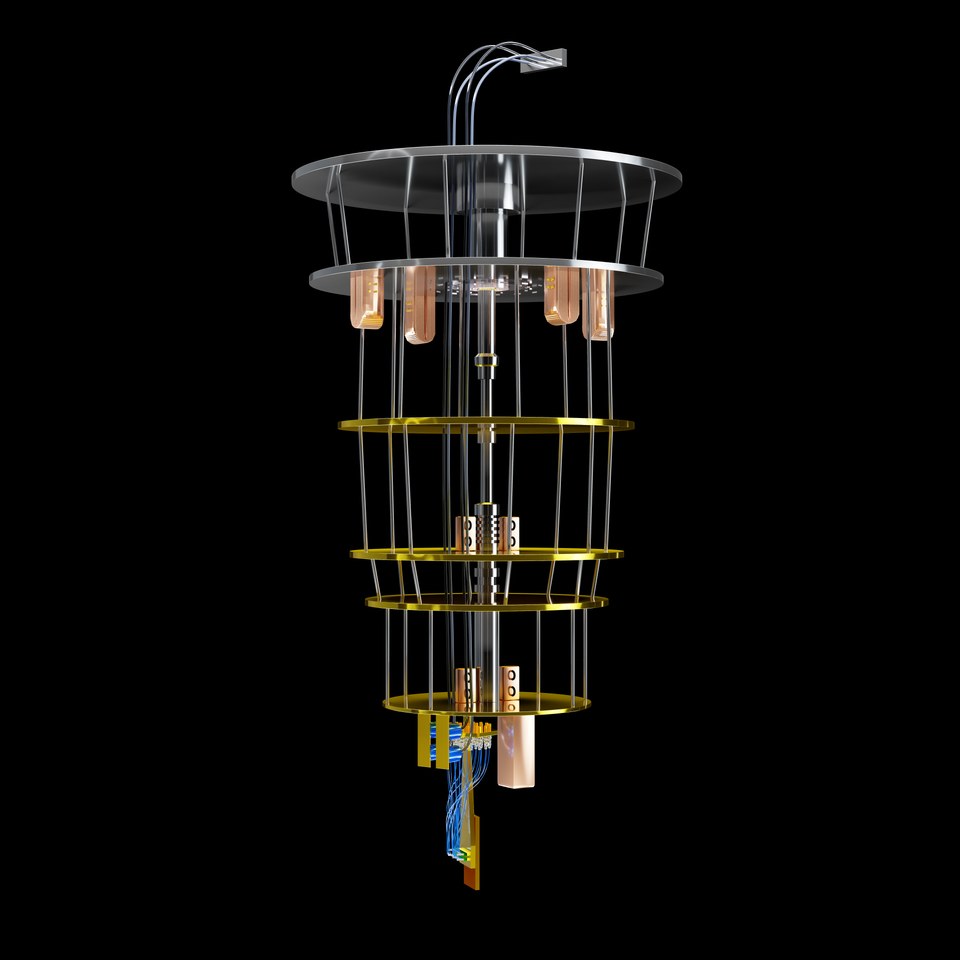
XLD Pulse-Tube-Type Large Frame Dilution Refrigerator Cryostat. Photo: OJB Quantum / Wikimedia Commons. Rendering of a cryostat insert with hanging concentric plates and coaxial cable stages. Source
The famous uncertainty is a statement about how the state and the operator can be chosen, not about who is looking. The effect of Heisenberg uncertainty principle is significant only for motion of microscopic objects and is negligible for that of macroscopic objects [9]. Whatever an observer is in quantum mechanics, the arithmetic does not change when a human becomes interested. And the theory is explicit that it does not say who or what performs the measurement: what constitutes an observer or a measurement is not directly specified by the theory [4]. This is an admission of incompleteness in the Copenhagen family, not a licence to fill the gap with a mind.
The formalism does have a place where a choice of measurement matters, and it is a choice about operators rather than about people. For each measurement that can be defined, the probability distribution over the outcomes of that measurement can be computed from the density operator [8]. The measurement is a mathematical object with a spectrum, and the outcomes are drawn from that spectrum. A physicist chooses which observable to measure because the question is which quantity the experiment is about; that choice is an ordinary experimental decision made before the apparatus runs, and it is made the same way whether or not the observer has heard of consciousness. The word observer enters the popular story at the point where the experiment ends. In the formalism it enters, if at all, at the point where the result is written down.
The gap exists because of an asymmetry between two rules. One rule spreads a superposition across every possibility the state allows; the other turns that superposition into a single definite result. It can be predicted using quantum mechanics, absent a collapse postulate, that an observer observing a quantum superposition will turn into a superposition of different observers seeing different things [4]. Still, in actual experience, an observer never senses a superposition, but always senses that one of the outcomes has occurred with certainty [4]. Something in between the spread and the certainty has to do work, and the standard answer is the environment. It involves generally a loss of information of a system to its environment [10]. The quantum coherence is not lost but rather mixed with many more degrees of freedom in the environment, analogous to the way energy appears to be lost during friction in classical mechanics when it actually has produced heat in the environment [10].
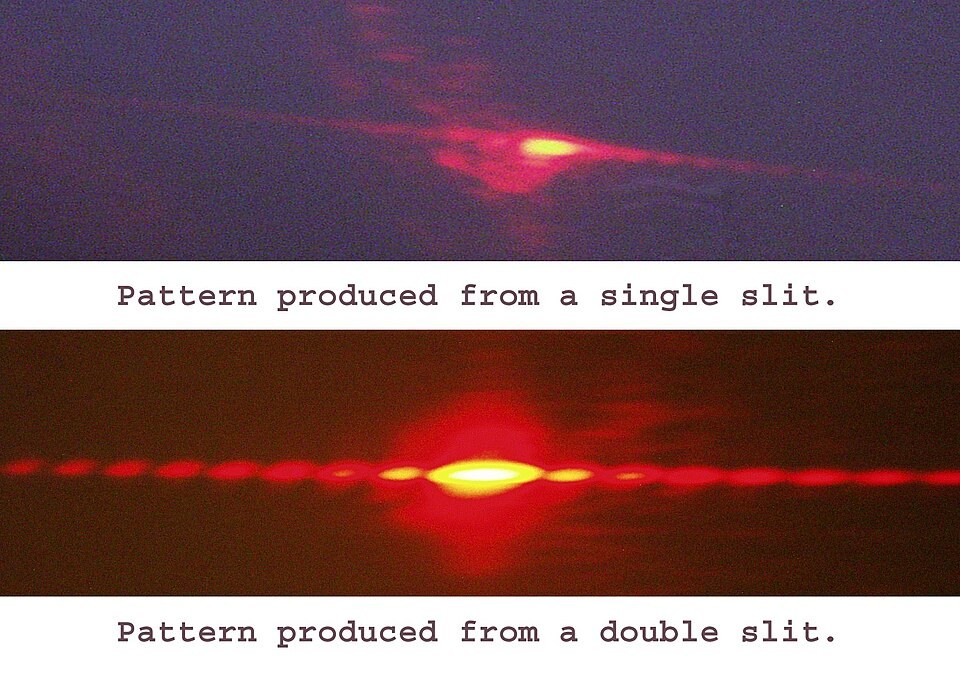
Single & double slit experiment. Photo: Patrick Edwin Moran / Wikimedia Commons. Bright and dark interference fringes from a laser passing through a double slit. Source
The mechanism was on the table before the machinery was built. In 1955, Heisenberg suggested that the interaction of a system with its surrounding environment would eliminate quantum interference effects [10]. What survives the environment is not luck but a selection: specifying a form of interaction between system and environment can establish a set of “pointer states,” states for the system that are (approximately) stable, apart from overall phase factors, with respect to environmental fluctuations [8]. Those are the states that can be recorded, copied, and read by another apparatus. The quantum nature of the system is simply entangled into the environment so that a total superposition of the wave function still exists, but exists, at least for all practical purposes, beyond the realm of measurement [10]. Note what that sentence does not need. It does not need a mind to be true.
What a mind does provide is the last mile, and the physics literature is unusually clear that the last mile is bookkeeping rather than causation. Comparing the scenarios A and B, we note that quantum theory automatically accounts for the effect of previous (F’s) perceptions on the final (W’s) statistics provided the act of perception is accompanied by creation of a record in a material object representing Observers memory [11]. A record, not a consciousness. The perception of the outcome is real, and it is downstream of a physical interaction that has already happened.
There is a precise place in the formalism where an observer does appear, and it is worth looking at it before deciding what it means. In the conventional chain the studied system interacts with a probe, the probe registers, the registration is written into a memory, and the memory is later read. One can apply the prescription of Observers’ memories, and their probes form the so-called von Neumann’s chains [11]. The chain has one property that decides the whole argument: the cut can be placed at any link in it, from the system to the perception [4]. Physics fixes the predictions of the entire chain, and the position of the cut changes the interpretation rather than the arithmetic. That is why a person can be moved along the chain without any prediction changing, and why moving the person to the far end does not make the person more causal than the probe that was there before it.
Even the most famous demonstration that observation seems to reach backwards in time refuses to say that a mind causes anything. The fact that it is possible to decide whether a wave or particle feature manifests itself long after, and even space-like separated from, the measurement teaches us that we should not have any naive realistic picture for interpreting quantum phenomena [12]. The lesson drawn is a warning about pictures, not an invitation to put a person back into the middle. Even the detection itself is unremarkable in kind: detection of a photon is generally a destructive process [12].
The disturbance reading
The second reading takes the word observer seriously in its plainest sense, the one the dictionary keeps. Observer effect (physics), the disturbance of an observed system by the act of observation [13]. On this reading the dependence is real, but it is a dependence of the apparatus on the object, paid for in physical currency, and the currency is measurable.
The currency is the back action, the change a measuring device inflicts on the thing it measures. It is not a metaphor and it is not subtle in modern laboratories, where a measurement has to be designed around it and its cost can be optimised rather than argued over. In quantum metrology, and especially interferometry, the Heisenberg limit is the optimal rate at which the accuracy of a measurement can scale with the energy used in the measurement [9]. The scale is set by the physics of the interaction, not by the caution of the person operating it.
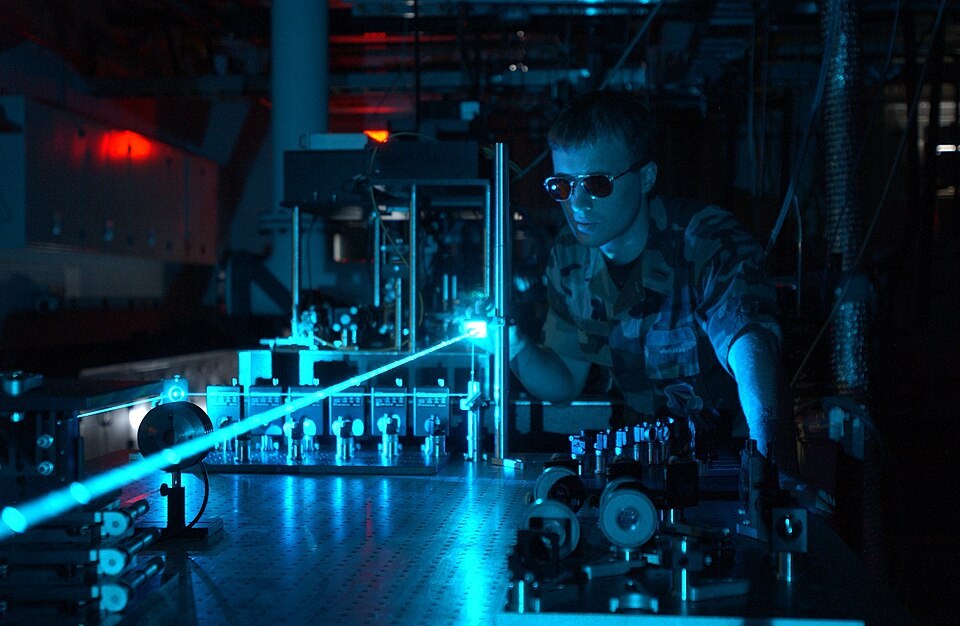
Military laser experiment. Photo: US Air Force / Wikimedia Commons. A blue laser beam crossing an optical table through mounted mirrors in a working laboratory. Source
A two-qubit experiment puts a number on it. Here, we report the experimental investigation of reducing quantum measurement back action in work distribution using CMs on two identically prepared qubit states [14]. The fidelity, which measures the back action, for the above two schemes reads FCM = 0.998 and FTPM = 0.706, respectively [14]. The same preparation, the same process, the same operator in the room, two different measurement schemes: the scheme that reads the work distribution the hard way leaves the system measurably further from its unmeasured state than the scheme that reads it collectively. That difference is produced entirely by the choice of measurement. It is the disturbance reading, demonstrated, quantified and reduced by better engineering.
The contamination runs the other way as well, and it is the part the popular fusion never mentions. In an experiment with a human in the loop the person is not passive, and the psychology of that is not in dispute. Observer-expectancy effect, a form of reactivity in which a researcher’s cognitive bias causes them to subconsciously influence the participants of an experiment [13]. That is a finding about psychology rather than about physics, and it applies with full force to the double slit. A participant who has been told what the experiment is meant to show, and an analyst who has not been blinded, are two uncontrolled variables in a system the rest of this paper would otherwise call clean. The only way to find out whether a mind matters at the apparatus is to put something at the apparatus that has no mind, and then to compare [15]. Set against the optimistic reading, the difference is not about confidence but about who is permitted to spend. The optimistic reading wants the observer to be an agent that shapes what is measured into being. The disturbance reading allows the observer exactly one real power, and it is the power to spoil the measurement: to choose a scheme that couples more strongly, to pay more of the back action, to extract less of the original system. A quantum measurement extracts information by disturbing, and the trade is not optional. The uncertainty relations are the price list.
Both readings also share a genuine puzzle about the laboratory, and the psychology is better documented than the physics. Observer-expectancy effect, a form of reactivity in which a researcher’s cognitive bias causes them to subconsciously influence the participants of an experiment [13]. In a double-slit experiment with human participants, that is a live contamination channel, and it is one the physics side of this paper is happy to concede. The person in the laboratory can affect the result. What the person cannot do, on this reading, is make the result by attending to it.
Why the mind is not required
The consciousness reading did not begin with the New Age. It began in the working notes of the physicists who built the theory, and the derivation that is usually quoted in its support does not say what it is usually quoted as saying. In his 1932 book Mathematical Foundations of Quantum Mechanics, John von Neumann argued that the mathematics of quantum mechanics allows the collapse of the wave function to be placed at any position in the causal chain from the measurement device to the “subjective perception” of the human observer [4]. Read that sentence carefully. What it establishes is a range of possible positions for the cut. It does not choose one, and the sentence that follows is the one the popular literature drops: however von Neumann did not explicitly relate measurement with consciousness [4].
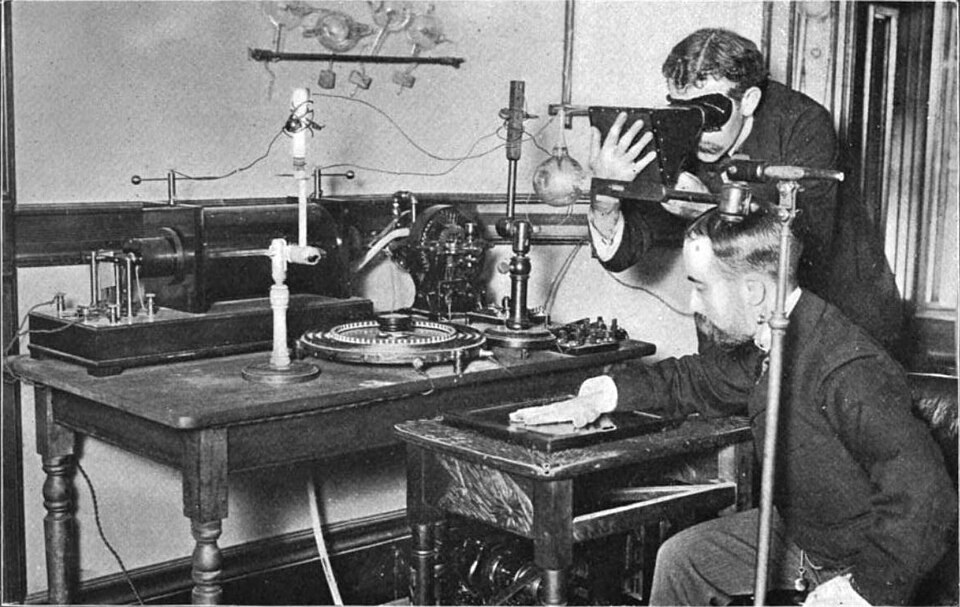
Crookes tube xray experiment. Photo: William J. Morton / Wikimedia Commons. Historical black and white photograph of an early physics laboratory with magnet coils and glass vessels. Source
The position he was arguing about had already been rejected from the other side. According to Werner Heisenberg’s recollections in Physics and Beyond, Niels Bohr is said to have rejected the necessity of a conscious observer in quantum mechanics as early as 1927 [4]. The one name that is later given credit for insisting on consciousness is the name that eventually withdrew it. Wigner reformulated the Schrödinger’s cat thought experiment as Wigner’s friend and proposed that the consciousness of an observer is the demarcation line that precipitates collapse of the wave function, independent of any realist interpretation [4]. The idea was criticized early by Abner Shimony in 1963 and by Hilary Putnam a year later [4]. Wigner discarded the conscious collapse interpretation in the later 1970s [4], and in 1984, he wrote that he was convinced out of it by the 1970 work of H. Dieter Zeh on quantum decoherence and macroscopic quantum phenomena [4]. The interpretation named after him is the one he talked himself out of on the evidence.
The retreat was not a concession under pressure. It followed from a mechanism. Quantum decoherence has been studied to understand how quantum systems convert to systems that can be explained by classical mechanics [10]. Once the environment does the selecting, the appeal to a mind has nothing left to explain that the environment has not already explained. What remains open is how sharp the selection is, and the honest literature does not overstate even that: We find that, unless we restrict ourselves to projective measurements of the observable by the meter, decoherence does not in general select the pointer basis of M [16]. Decoherence is a very good answer to the question it was built to answer, which is why the consciousness reading faded rather than being defeated in a single decisive experiment.
The models that keep consciousness in play are explicit about their costs, and the current critical literature sets out three of them. We hold that any reasonable quantum model of consciousness (indeed, any reasonable theory of consciousness) should at least satisfy three basic commitments [17]. The first is physical feasibility: the posited quantum processes must be realizable in warm, wet neural tissue that is strongly coupled to its environment (i.e., an open, decohering regime) [17]. That is the environment of the previous section, set against the coherence the theory needs. The standard defence is that quantum effects in biology are ordinary rather than exotic: quantum-related phenomena in biological systems are, of course, not rare [17]. That defence is about possibility. It is not evidence that consciousness is what collapses anything.
The empirical position is thinner for the claim and stronger for the caution. The quantum mind or quantum consciousness is a group of hypotheses proposing that local physical laws and interactions from classical mechanics or connections between neurons alone cannot explain consciousness [18]. The claim that such a theory would explain more than a classical account is not settled by its own existence. Victor Stenger characterized quantum consciousness as a “myth” having “no scientific basis” that “should take its place along with gods, unicorns and dragons” [18]. That is polemic, and it should be read as polemic. The measured position is narrower: Chalmers is skeptical that any new physics can resolve the hard problem of consciousness [18]. That is a different objection from the one the popular fusion needs, and one that quantum theories of consciousness do not obviously answer.
There is one experiment in the archive that puts the popular claim directly to the test, and its design is worth reading because it removes the one confound on which the fused claim rests. The authors propose to test this hypothesis using one of the simplest quantum apparatus: the double-slit optical interferometer [15]. The apparatus consists of a laser, a double-slit, and a camera recording the interference pattern [15]. Then the participant is not a person: the server does not know who it is dealing with: it computes and sends feedback, and records interference data just as it would do for a human participant [15]. If mind shaped the interference pattern, replacing the mind with a server that has no mind should have removed the effect. The dataset is large enough to say something: the dataset is comprised of 3679 sessions in 2013 (2374 of which are controls) and 4976 in 2014 (3363 of which are controls) [15]. A claim that survives neither a blind analysis nor a machine that does not know it is being studied is not a claim the apparatus can carry.
The split among the interpretations explains why the reading faded rather than fell. In modern versions of many-worlds, the subjective appearance of wave function collapse is explained by the mechanism of quantum decoherence [19]. In these schools of thought, wave functions may be regarded as statistical information about a quantum system, and wave function collapse is the updating of that information in response to new data [20]. The second of those sentences is the one the popular literature would like to keep and to shorten by eight words: collapse as the updating of information in response to new data is a statement about knowledge, not about a mind, and new data arrives whether or not anyone is paying attention [20].
Connecting the Dots
The two readings are not symmetric, and the way to see that is to ask what each one would have to predict before the fact. Four tests separate them cleanly. The first is advance prediction. The optimistic reading says mind shapes reality, which is a claim about outcomes. To be a claim about outcomes it must specify which outcomes, in a system where the alternatives are enumerated by the state. Quantum mechanics already enumerates them, with probabilities. A theory that adds mind to the description and then reports the same probabilities as ordinary quantum mechanics has made no prediction, and a theory that changes the probabilities has to say by how much and in which direction. Nothing in the popular literature does either. The second is distribution. A mind that shapes a particular outcome should be able to shape it somewhere. The fusion therefore predicts that attention concentrates effects, and that they appear where people are paying attention. The obstacle is that attention also changes experimental setups, calibrations, noise floors and analysis thresholds, which is precisely the contamination channel the observer-expectancy effect describes [13]. Any effect that follows attention will also follow its experimental consequences, and separating the two requires the control the double-slit re-analysis used: a participant that generates the feedback without having a mind [15].
The third is the perturbation budget, and here the two readings make opposite predictions about what should be limiting. If the observer’s mind is what makes the outcome definite, a gentler instrument should not help much, because the work is being done at the far end. If back action is the mechanism, then the measurement scheme should be the thing that can be improved, and it demonstrably is: the same two-qubit preparation measured with a collective scheme keeps a fidelity to the unmeasured state of FCM = 0.998, against FTPM = 0.706 for the projective scheme [14]. The apparatus improves. The operator does not.
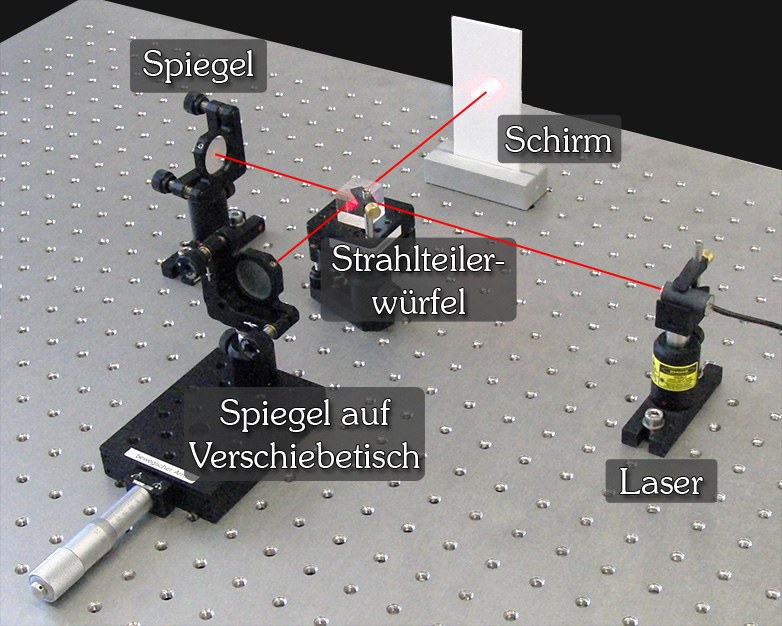
Aufbau-Michelson-Interferometer-Beschriftung-Strahlengang. Photo: FL0 / Wikimedia Commons. Interferometer on an optical table: laser, beam splitter cube, two mirror arms and a screen. Source
The fourth is the cheapest and the most decisive. The physics side of this paper makes no claim that requires a person to be present. Every number in the preceding sections was produced by apparatus, recorded automatically, and published with the operator’s contribution to the outcome listed under back action rather than under intention. That is not a rhetorical preference. It is the shape of the standard by which the measurement problem has been argued since 1927, when a conscious observer was said to be unnecessary as early as that year [4]. Applied to the fusion, the fourth test comes out clean on one side and empty on the other. Every result the disturbance reading needs was obtained without a person in the loop, and each of them is published with the operator’s contribution to the outcome listed under back action rather than under intention. The optimistic reading has not produced a single number of its own. A reading with no numbers is not competing with a reading that publishes fidelity values.
The Other Side
The strongest form of the optimistic reading is not the version that says you can think a bank balance into existence. It is a weaker and more interesting claim, and it deserves its paragraph. The argument runs: quantum mechanics is observer-relative, the Born rule gives probabilities rather than outcomes, and something has to select the outcome that is actually recorded. If the cut can be placed at the point where the result becomes part of someone’s experience, then experience is part of the physical description rather than a spectator of it. On this reading, consciousness is not magic; it is the place in the formalism where an indefinite description becomes a definite record, and a universe in which that step is real is a universe in which consciousness is real too. That argument has a real defect and a real purchase. The defect is the one the record already contains: the derivation the argument leans on leaves the cut anywhere in the chain, and the author did not tie it to consciousness [4]. The purchase is that the measurement problem has never been solved to general satisfaction, and the fact that the views often grouped together as the Copenhagen interpretation are the oldest and, collectively, probably still the most widely held attitude about quantum mechanics [20] is not evidence for consciousness but it is evidence that the question is open. An open question is an invitation, and this paper does not pretend the invitation has been withdrawn.
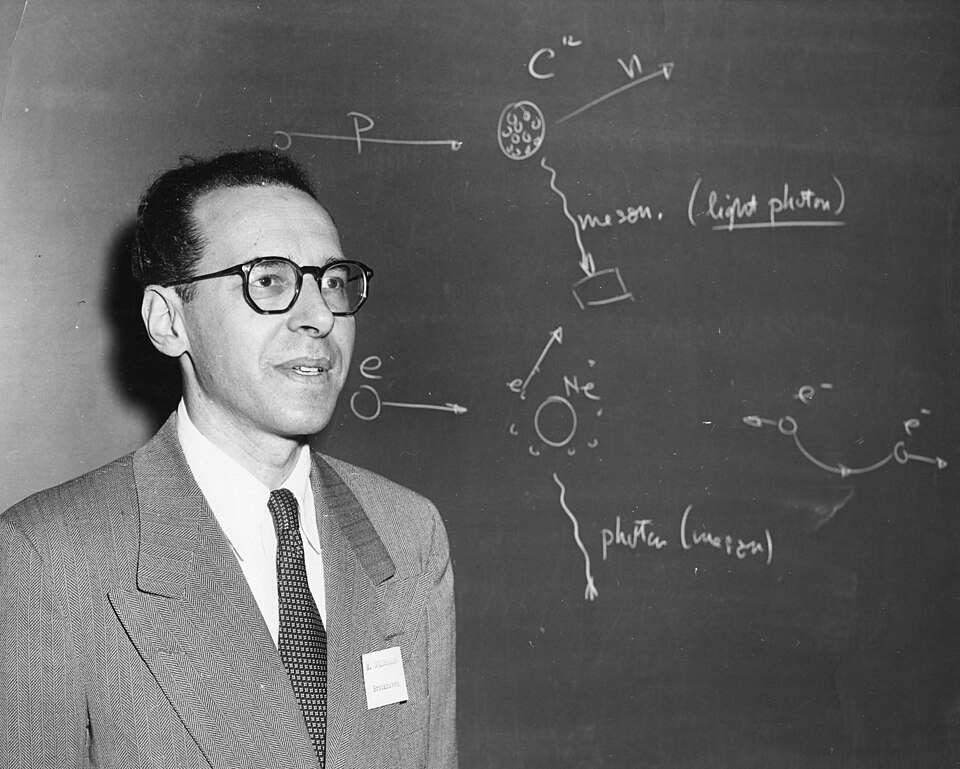
Maurice Goldhaber. Photo: AIP Emilio Segrè Visual Archives, Marshak Collection / Wikimedia Commons. A man standing in front of a lecture blackboard covered with chalk equations. Source
There is also a respectable philosophical version of the optimistic case that owes nothing to the films. It begins from the observation that the measurement problem is not a puzzle about instruments but a puzzle about how a probabilistic description is supposed to become a definite one, and it asks whether that step is a physical process or an epistemic one. If it is epistemic, then something has to do the selecting, and the natural candidate is the act of knowing. The most thorough alternative does the opposite and refuses the question outright: Hugh Everett’s many-worlds interpretation attempts to solve the problem by suggesting that there is only one wave function, the superposition of the entire universe, and it never collapses, so there is no measurement problem [20]. The contrast is worth naming, because the fusion and the many-worlds answer are usually presented as allies: many-worlds removes the collapse, the fusion supplies a person, and the experiment supports neither.
The strongest form of the disturbance reading is equally worth stating at full strength. Measurement is not free. The apparatus is part of the system, the coupling is real, and the price is paid in a currency that laboratories optimise every day. Where a mind was supposed to enter, there is instead a record, and where an intention was supposed to act, there is a scheme that couples more or less strongly [14]. This reading wins on something more than mere plausibility: it is the only one of the two that has been made into an engineering discipline. The optimistic reading has produced films and books. The disturbance reading has produced fidelity numbers.
Alcator C control panel closeup. Photo: Peter Schweitzer, U.S. DOE / Wikimedia Commons. Blue instrument console with an oscilloscope trace, knobs, switches and a digital readout. Source
What We Actually Know
What survives all of this is narrower than either camp wanted and more useful than either camp expected. Quantum mechanics says that the outcomes of a measurement are fixed by the state and the measurement, distributed by a rule published in 1926 [7]. What it does not say is what the word observer is doing in that sentence, and the theory’s own position is that the question is not specified [4]. Between the superposition and the certainty there is a mechanism, and the mechanism we have is entanglement with an environment that selects stable states and takes the coherence into itself [10].

Two-point-interference-ripple-tank. Photo: The original uploader was RenamedUser2 at English Wikipedia. / Wikimedia Commons. Overlapping circular ripple rings from two impacts on dark water at night. Source
What remains genuinely open is the sharpness of the selection and the interpretation of probability, not the role of consciousness. Decoherence is needed to understand why a quantum system begins to obey classical probability rules after interacting with its environment, and it does that job [10]. What it does not by itself deliver is a rule that says which outcome a record acquires, and the field is candid about the gap: consensus has not been achieved among proponents of the correct way to implement this program, and in particular how to justify the use of the Born rule to calculate probabilities [8]. That is a real open problem, worked on by people who do not need a mystic in the room. It is not the open problem the fusion needs.
Three things can now be said without overclaiming. First, consciousness is not required. It was proposed by a serious physicist, criticised by serious physicists within a few years, and abandoned by its own author after the mechanism that replaced it was published [4]. Second, measurement is not free. The back action is measurable, it scales with the measurement scheme, and it can be traded down by better engineering [14]. Third, the fusion that opens this paper borrowed the prestige of a physics term and left behind the content. The sentence about mind and universe came out of one book, the interference result out of another, and the two were joined by a film and a market rather than by a derivation.
What does not survive is the sentence the shelves are selling. That the All is Mind is not a statement quantum mechanics can be read to support, and the interpretation that made it look supportable is one its own proponent disowned [4]. The book that supplied the sentence was published in 1908 [1]. The rule that supplied the interference was formulated and published in July 1926 [7]. The film that joined them was reviewed as a “pseudoscientific docudrama” [2], and the market that kept them together has a psychology of its own [6]. The honest remainder is smaller and stranger than the advertisement: the observer is a physical interaction whose disturbance can be measured and reduced, and the fact that a record rather than a mind is what carries the result from the apparatus to the person is a result about the world, not about the importance of wishing.
References
[1] The Kybalion — https://en.wikipedia.org/wiki/The_Kybalion (accessed 2026-10-05) [Reputable]
[2] What the Bleep Do We Know!? — https://en.wikipedia.org/wiki/What_the_Bleep_Do_We_Know!%3F (accessed 2026-10-05) [Reputable]
[3] Hermeticism — https://en.wikipedia.org/wiki/Hermeticism (accessed 2026-10-05) [Reputable]
[4] Consciousness causes collapse — https://en.wikipedia.org/wiki/Consciousness_causes_collapse (accessed 2026-10-05) [Reputable]
[5] New Age — https://en.wikipedia.org/wiki/New_Age (accessed 2026-10-05) [Reputable]
[6] Dixon LJ, Hornsey MJ, and Hartley N (2023). “The Secret” to Success? The Psychology of Belief in Manifestation.. Personality & social psychology bulletin. DOI: 10.1177/01461672231181162 (accessed 2026-10-05) [Academic]
[7] Born rule — https://en.wikipedia.org/wiki/Born_rule (accessed 2026-10-05) [Reputable]
[8] Measurement in quantum mechanics — https://en.wikipedia.org/wiki/Measurement_in_quantum_mechanics (accessed 2026-10-05) [Reputable]
[9] Uncertainty principle — https://en.wikipedia.org/wiki/Uncertainty_principle (accessed 2026-10-05) [Reputable]
[10] Quantum decoherence — https://en.wikipedia.org/wiki/Quantum_decoherence (accessed 2026-10-05) [Reputable]
[11] Sokolovski D (2020). Quantum Measurements with, and Yet without an Observer.. Entropy (Basel, Switzerland). DOI: 10.3390/e22101185 (accessed 2026-10-05) [Academic]
[12] Wheeler’s delayed-choice experiment — https://en.wikipedia.org/wiki/Wheeler%27s_delayed-choice_experiment (accessed 2026-10-05) [Reputable]
[13] Observer effect — https://en.wikipedia.org/wiki/Observer_effect (accessed 2026-10-05) [Reputable]
[14] Wu KD, Yuan Y, Xiang GY, Li CF, Guo GC, and Perarnau-Llobet M (2019). Experimentally reducing the quantum measurement back action in work distributions by a collective measurement.. Science advances. DOI: 10.1126/sciadv.aav4944 (accessed 2026-10-05) [Academic]
[15] Tremblay N (2019). Independent re-analysis of alleged mind-matter interaction in double-slit experimental data.. PloS one. DOI: 10.1371/journal.pone.0211511 (accessed 2026-10-05) [Academic]
[16] Kofman AG and Kurizki G (2022). Does Decoherence Select the Pointer Basis of a Quantum Meter?. Entropy (Basel, Switzerland). DOI: 10.3390/e24010106 (accessed 2026-10-05) [Academic]
[17] Ma X and Wang A (2026). Quantum theories of consciousness: a critical review of feasibility, philosophical sufficiency, and empirical testability.. Frontiers in psychology. DOI: 10.3389/fpsyg.2026.1730965 (accessed 2026-10-05) [Academic]
[18] Quantum mind — https://en.wikipedia.org/wiki/Quantum_mind (accessed 2026-10-05) [Reputable]
[19] Many-worlds interpretation — https://en.wikipedia.org/wiki/Many-worlds_interpretation (accessed 2026-10-05) [Reputable]
[20] Measurement problem — https://en.wikipedia.org/wiki/Measurement_problem (accessed 2026-10-05) [Reputable]
Corrections
- Writer stamp corrected: this paper was researched and written in the writing session, so research_model now names MiniMax-M3.1-Flash-Preview. Four sentences were reworded so that none of them ends on a function word, which the studio support gate checks.
Keep exploring
Every site on this page sits on the globe, and the people who research them are on the Discord.
3D Globe · Sites by country · Story Archive · Research Library · Weekly Journal · Search