 ANCIENT NERDS
Mars's Lost Atmosphere and Valles Marineris
The paper concludes that Valles Marineris is well-explained by mainstream Tharsis-load subsidence augmented by magmatic and hydrothermal processes, that Mars's atmospheric loss involves multiple coexisting mechanisms rather than solar-wind stripping alone, and that catastrophist and Electric Universe interpretations — including Velikovsky's planetary encounters and claims of gigascale electrical scarring on Mars — are pseudoscience ruled out by spacecraft evidence. The one genuinely unresolved question it surfaces is whether the weak electrostatic discharges Perseverance has documented at Gale crater could scale up to any geologically significant process beyond surface chemistry, given the mismatch between observed millimeter-scale events and the canyon-scale scarring EU proponents invoke.
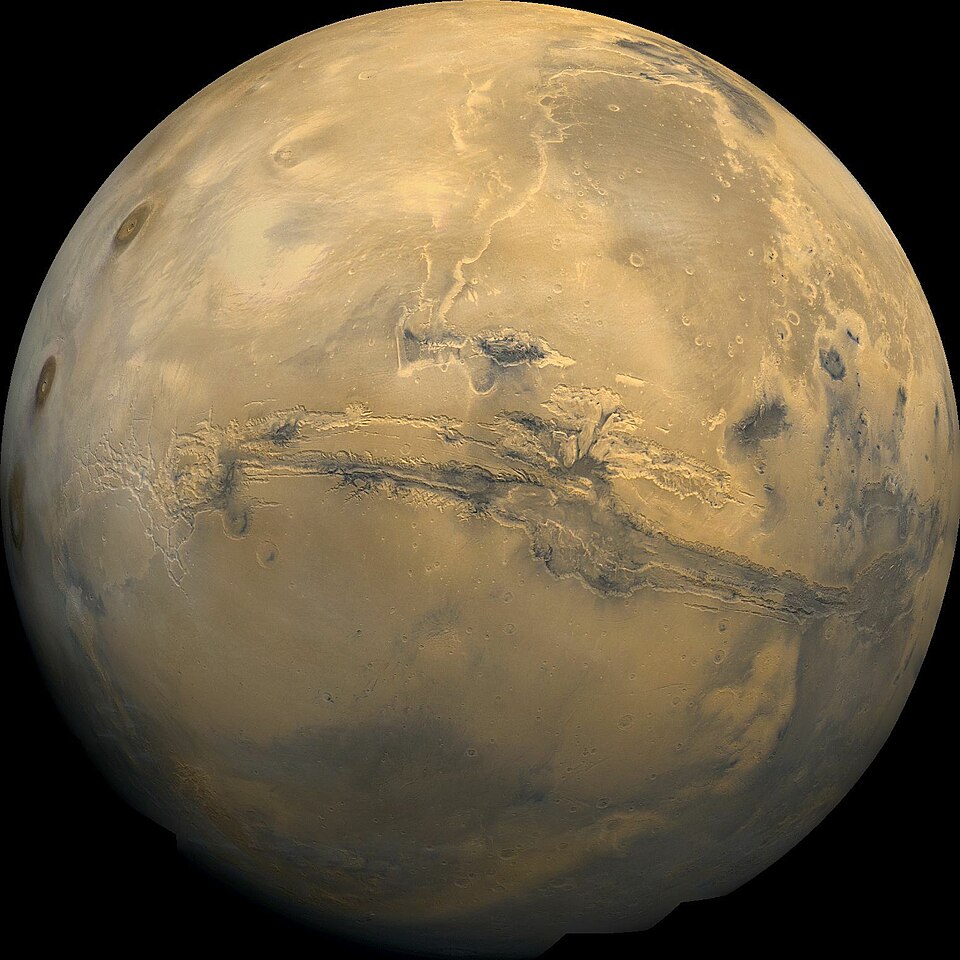
Stretching roughly 4,000 kilometers along the Martian equator east of the Tharsis bulge and plunging 10 to 15 kilometers into the crust, Valles Marineris is the largest canyon system known in the solar system. Standard geology treats it as the slow, multi-stage wound left by the growth and loading of the Tharsis volcanic province between roughly 3.5 and 2 billion years ago, when crustal extension, subsidence, and possible strike-slip motion gouged the surface. Wallace Thornhill and the Thunderbolts Project reject that reading entirely, contending that the canyon’s zigzag margins and figure-eight symmetry are signatures of a prolonged, high-energy electrical discharge between Mars and another planetary body. [1]
How Mars Lost Its Atmosphere
The Mars Atmosphere and Volatile EvolutioN (MAVEN) spacecraft, which arrived at Mars in September 2014, transformed atmospheric-loss science from theoretical inference into measured bookkeeping. MAVEN’s first definitive finding, announced in 2015, was that the present-day solar wind strips roughly 100 grams of Martian atmosphere per second, a figure that, scaled across billions of years, becomes one of the principal ledgers in the planet’s climate history. The escaping material leaves through three distinct channels: approximately 75% through the magnetotail in the solar wind’s wake, about 25% through a polar plume organized by the upstream convection electric field, and a minor contribution from an extended gas cloud surrounding the planet. During solar storms and interplanetary coronal mass ejections, these rates climb dramatically. The 8 March 2015 ICME compressed Mars’s magnetosphere to roughly two-thirds its normal size and increased ion loss by a factor of 10–20×; the 10 December 2021 CME drove losses of 34% of electrons, 61% of O⁺, and 73% of O₂⁺ from altitudes above 180 km on the nightside. In December 2022, MAVEN caught a rarer and more revealing event: a “disappearing solar wind” episode in which upstream density collapsed by a factor of ~100 (to 0.1 cm⁻³), causing Mars’s magnetosphere and ionosphere to swell outward by thousands of kilometers and the ionosphere to transition from a magnetized to an unmagnetized state — a natural experiment confirming the solar wind’s central role in sculpting the loss environment. [2] [3]
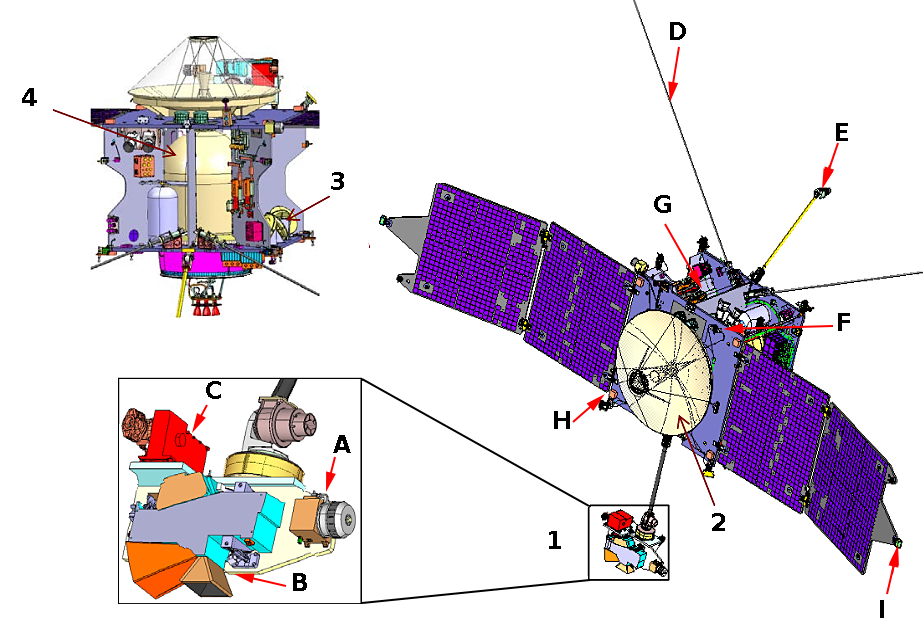
Eclate-MAVEN. Photo: NASA / Wikimedia Commons. The paragraph’s quantitative claims rest entirely on MAVEN’s instrument package; an exploded-view lets the reader…. Source
This stripping operates unimpeded because Mars lacks a global dipolar magnetic field today. Mars Global Surveyor established an upper limit of less than 2 × 10²¹ Gauss·cm³ for any planetary-scale field while documenting intense, spatially organized crustal remanent magnetization — lineations extending over 2,000 km with field strengths exceeding 200 nT at spacecraft altitude, an order of magnitude stronger than Earth’s crustal field. The dichotomy implies a once-active internal dynamo that subsequently ceased, leaving behind a fossilized record. Recent paleomagnetic analyses of the ALH 84001 Martian meteorite, including quantum-diamond-microscope imaging of chromite-sulfide assemblages, have identified grain populations magnetized in near-opposite directions at ~3.9 Ga, consistent with an active, possibly reversing dynamo persisting hundreds of millions of years longer than the traditional ~4.1 Ga shutdown estimate. When the dynamo died, Mars’s atmosphere was left directly exposed to solar-wind scavenging, a vulnerability it has never recovered from. [4] [5] [6]
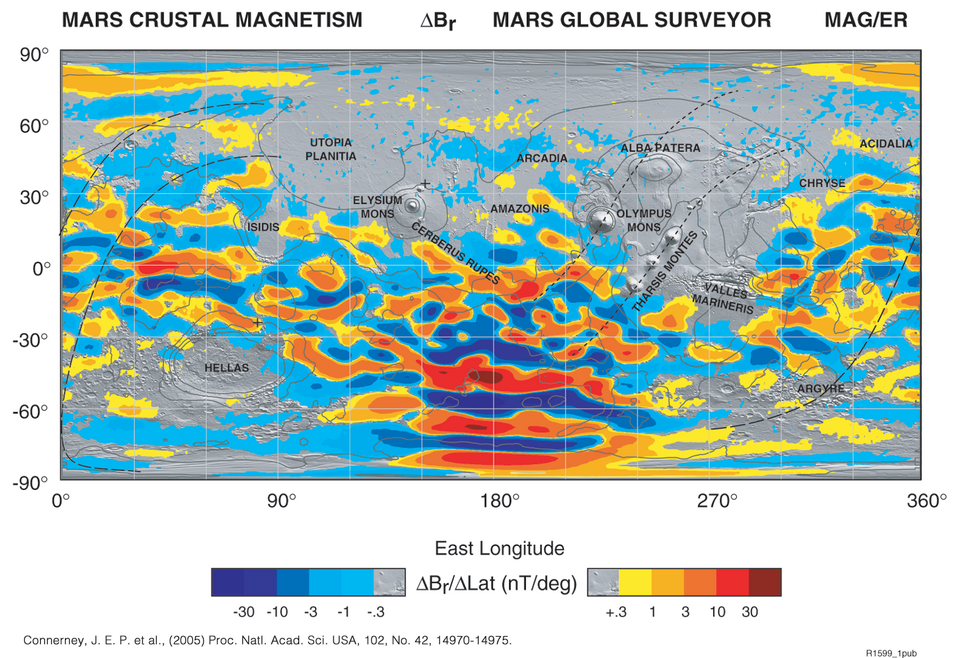
Mars Crustal Magnetism MGS. Photo: NASA / Wikimedia Commons. The paragraph’s claim of >2,000 km lineations and field strengths exceeding 200 nT is only…. Source
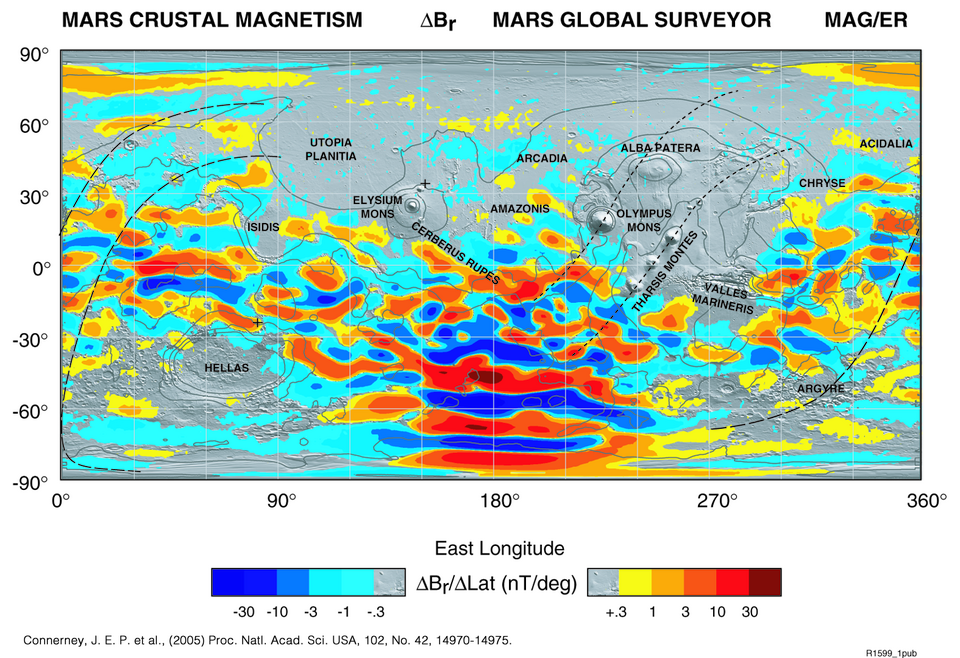
Mars Crustal Magnetism MGS. Photo: NASA / Wikimedia Commons. The paragraph’s claim of >2,000 km lineations and field strengths exceeding 200 nT is only…. Source
The isotope record locks this exposure into a cumulative timestamp. Curiosity’s SAM instrument measured deuterium-to-hydrogen ratios in Martian water enriched by a factor of 5–6 relative to Vienna Standard Mean Ocean Water (VSMOW), with extremes up to ~8×, a signal that directly records the preferential loss of light hydrogen to space over billions of years and implies that at least ~80% of the original surface water has been lost. Critically, the enrichment was already substantially complete by the Noachian: clay minerals older than ~3 Gyr record D/H ratios of only ~3× SMOW, meaning most of the water loss occurred early, when the young Sun was more active and the loss rate was orders of magnitude higher than today’s. A separate isotope clock — the ⁸Ar/³⁶Ar ratio in the upper atmosphere — indicates that approximately 66% of all atmospheric ³⁶Ar ever introduced to Mars has escaped to space, an integrated record of cumulative loss independent of any single mechanism. Carbon isotopes tell a parallel story: the present atmosphere is enriched in ¹³C, quantitatively consistent with substantial loss of carbon via photodissociation of CO₂ followed by preferential escape of light ¹²C, reconciling the measured δ¹³C with the limited carbonate reservoir Curiosity’s CheMin detected in Gale crater (siderite at 4.8–10.5 wt% in three drill holes). [7]
The evidence supports cumulative stripping rather than a single stripping event. In 2025, a nine-year MAVEN analysis led by PI Shannon Curry produced the first direct observational confirmation of atmospheric sputtering on Mars, detecting sputtered argon atoms being knocked out of the upper atmosphere by solar-wind ions at a rate of approximately 10²³ atoms per second — more than four times higher than pre-MAVEN model predictions, and consistent with sputtering’s role as a sustained, storm-enhanced loss channel that may have dominated early-Mars escape when the young Sun’s electric field was stronger. Multiple mechanisms now operate in parallel: solar-wind pickup of ions, photochemical escape of hot O at 1.2–5.5 × 10²⁵ s⁻¹ depending on season and EUV flux, sputtering, and impact erosion during the first ~200–300 Myr of Solar System history (which quantitatively reproduces the observed xenon depletion and fractionation). Jakosky and colleagues have estimated that cumulative loss rates during the Noachian/Hesperian must have been 100–1000× higher than today’s 100 g/s to account for the integrated isotopic record. [8] [9] [10]
But the integrated numbers expose an unresolved tension. Mars Express ion-loss measurements integrated over ~4 Gyr yield only ~9 mbar of lost surface pressure from solar-wind-driven escape, less than 1% of the ~1 bar thought necessary to sustain ancient lakes and rivers, leaving mainstream science to debate whether the gap is closed by additional mechanisms (sputtering, impacts, photochemistry) or by unrecognized processes. Crustal remanent fields complicate the picture, since the strong, spatially organized local magnetic anomalies inherited from Mars’s extinct dynamo can shape how the solar wind interacts with the atmosphere and influence ion escape in complex ways. The integrated record — D/H enriched to 5–6×, ⁸Ar/³⁶Ar signaling ~66% loss, ¹³C enrichment, and a present-day loss of ~100 g/s that intensifies by an order of magnitude during storms — confirms that the young Sun stripped much of Mars’s early atmosphere over geologic time, while the precise closure of the ancient-atmosphere budget remains an open quantitative question. [11]
Valles Marineris as a Tectonic Canyon
Valles Marineris stretches more than 4,000 km along the Martian equator, reaches 200 km wide, and plunges to depths of 7 km below the surrounding plateaus — the largest canyon system in the Solar System. Mainstream planetary geology treats this scar not as a single event but as the product of an opening that began approximately 3.5 billion years ago, driven by extensional stresses transmitted through the lithosphere as the Tharsis volcanic province grew and loaded the crust to the west. The trough system is mapped as a series of grabens and half-grabens linked by the Ius–Melas–Coprates fault zone, with Coprates Chasma itself dated by crater counts to have initiated as a normal-fault-bounded downdropped block in the early Late Hesperian. The regional setting is a Hesperian tectonic landscape, not a recent catastrophe.  [12]
[12]
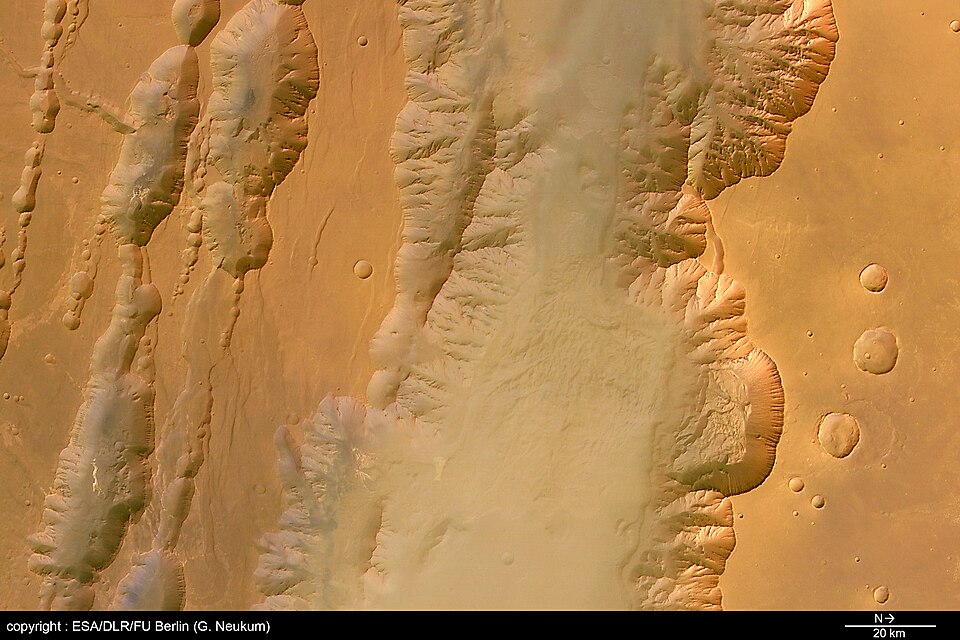
Colour view of Coprates Chasma and Coprates Catena ESA217234. Photo: European Space Agency / Wikimedia Commons. The paragraph singles out Coprates Chasma as the specific chasma dated by crater counts to…. Source
Mars Valles Marineris. Photo: NASA / USGS (see PIA04304 catalog page) / Wikimedia Commons. Image placed by the paper writer as visual evidence for this passage. Source
Inside the troughs sits a separate, still-unresolved problem: the Interior Layered Deposits, or ILDs, kilometer-thick mound-and-mesa accumulations of light-toned, stratified material that occupy the canyon floors. Competing mainstream hypotheses for their origin include subice volcanic constructs (tuyas), evaporite-cemented eolian dust linked to Meridiani-type sulfate deposition, ash washed down from the chasma walls, lacustrine sedimentation in isolated ancestral basins, and cold acidic dust-rich glaciers. The question is not academic: the ILDs are the stratigraphic record of whatever environment existed in the canyon during and after its opening. Mainstream work has already pruned at least one end-member using mass-balance arguments — Michalski & Niles (2012) rejected the groundwater-upwelling model because it would require concentrating a fraction of Mars’s global sulfur budget that the planet could not plausibly supply. Independent evidence for standing water inside the canyon during the Hesperian comes from the south-western Melas basin, where dense dendritic valley networks, multiple delta-fan lobes, and roughly forty to fifty packages of layered lacustrine sediment document a closed-basin paleolake dated to roughly 3.7–3.5 Ga. Jarosite on the southern wall of Ius Chasma has been interpreted as the first mineralogical evidence for an ancient glacier within the canyon system itself. [13] [14] [15] [16]
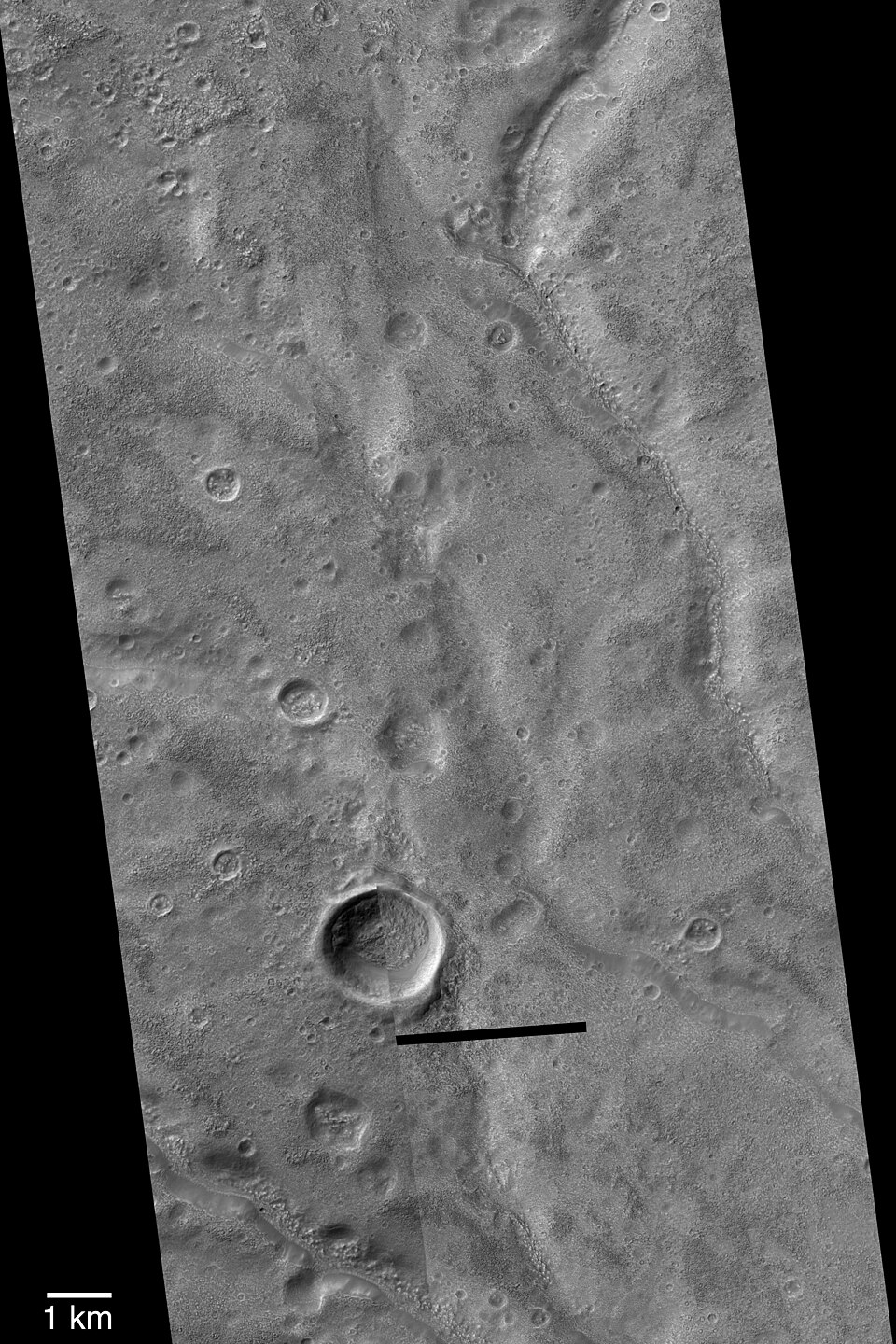
Warrego Valles from Mars Global Surveyor. Photo: NASA/JPL/Malin Space Science Systems / Wikimedia Commons. The paragraph claims jarosite on the southern wall of Ius Chasma as the first mineralogical…. Source
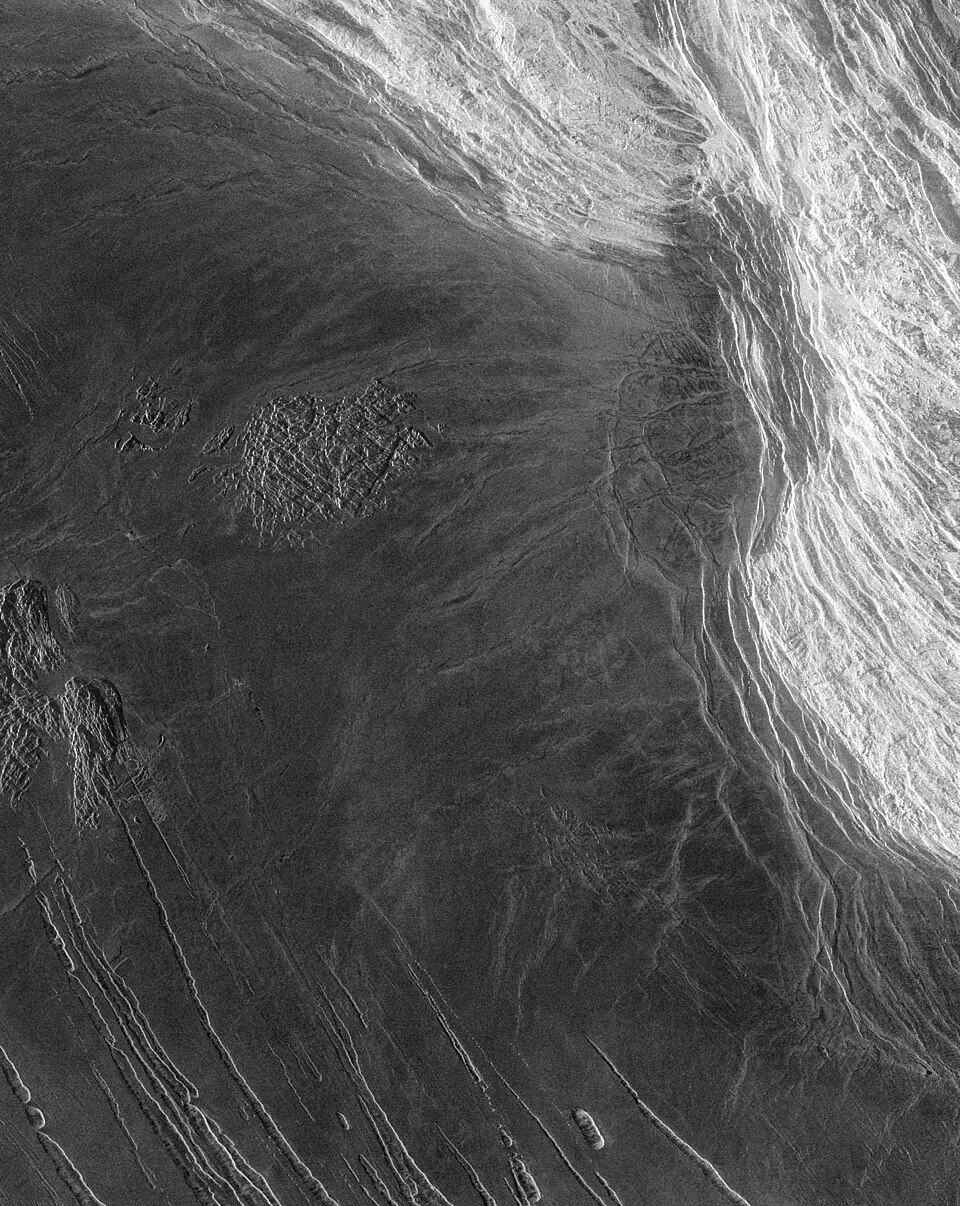
Maxwell Montes of planet Venus. Photo: NASA/JPL / Wikimedia Commons. The paragraph claims jarosite on the southern wall of Ius Chasma as the first mineralogical…. Source
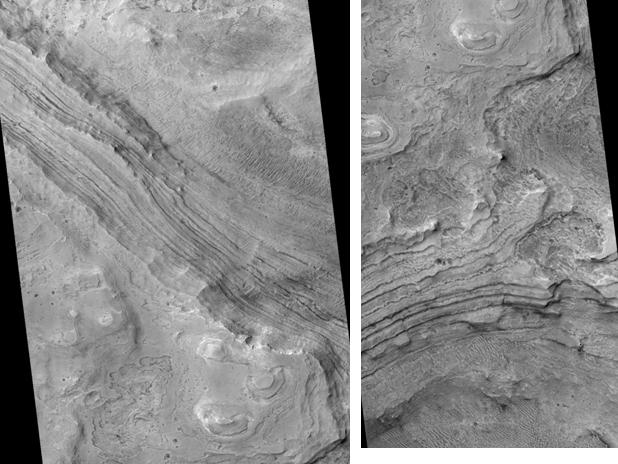
Melas Chasma Layered Deposits. Photo: Jim Secosky modified nasa image. / Wikimedia Commons. The paragraph’s strongest specific evidence for standing water is the Melas paleolake; seeing the dendritic…. Source
The structural picture has also grown more complicated. Yin (2012) argued that southern Valles Marineris is a left-lateral transtensional strike-slip system with 150–160 km of cumulative displacement, drawing an explicit structural analogy to Earth’s Dead Sea Transform — a kinematic mode that does not fit the pure extensional-rift model. Dohm et al. (2009) documented a magmatic influence on Melas Chasma, including a >50 km caldera-like feature, a central topographic rise consistent with uplift, HiRISE-identified volcanic landforms, and CRISM sulfate outcrops interpreted as hydrothermal — evidence that the canyon’s evolution was not purely mechanical. The only marsquake so far detected in Mars’s entire western hemisphere localized inside Valles Marineris and ruptured with a strike-slip focal mechanism, indicating the canyon is not an ancient, frozen scar but a fault zone that is still straining today. This active, persistent deformation undercuts any reading of the canyon as a one-time, single-mechanism feature. [17] [18] [19]
The fringe framing in the source set is qualitatively different. Fringe and electric-universe-style commentary in the corpus tends to fixate on visual anomalies — such as Martian crater morphology, including ‘hexagonal craters’ and the depth and shape of features around the ‘Face’ on Mars — without offering quantified geological analysis or developing process mechanisms in structural terms. Other fringe sources explicitly reject the foundational plate-tectonic and seafloor-spreading framework as ‘totally unsupportable and scientifically unsound,’ illustrating a broader catastrophist tendency to dismiss the uniformitarian geological substrate that underlies mainstream interpretation of both Earth and Mars landscapes. None of these sources provides the structural modeling, budget calculations, or kinematic analysis that mainstream Mars geology applies to test and refine hypotheses; they identify themselves visually rather than geologically. Mainstream Mars geology, by contrast, has already quantitatively eliminated end-member hypotheses on budget and morphological grounds and continues to refine a multi-mechanism, multi-billion-year history. The unresolved question is no longer whether Valles Marineris is a single catastrophic scar — the canyon’s dimensions, ages, mass-wasting, ice inventory, layered deposits, and active seismicity collectively rule that out — but how the Tharsis-driven extension, the strike-slip component, the magmatic overprint, and the glacial and lacustrine modification phases weight against one another in the canyon’s integrated history. [20]
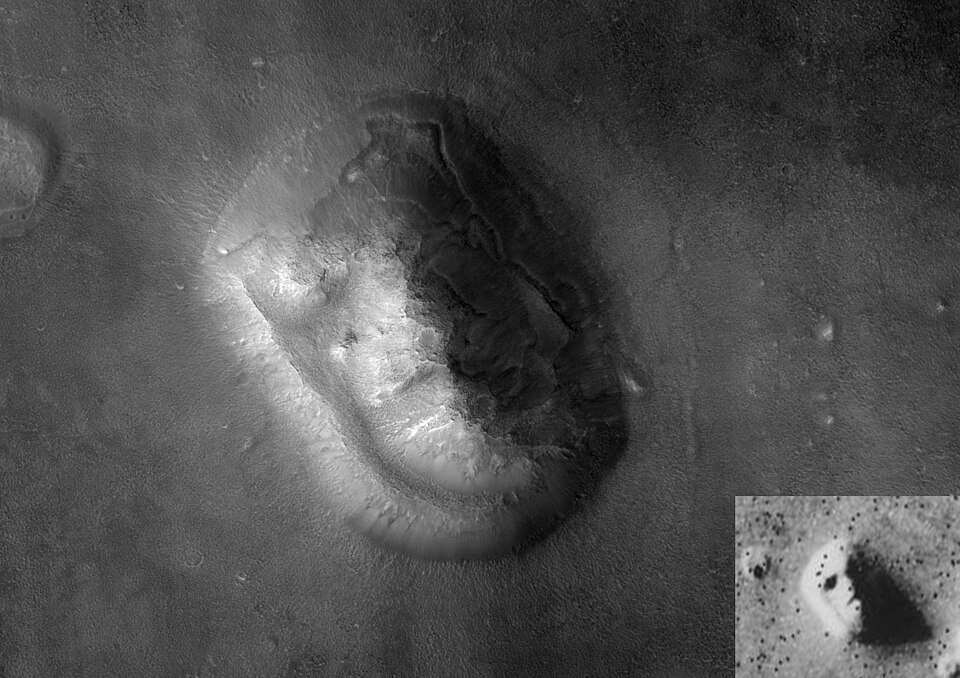
Face on Mars with Inset. Photo: NASA / JPL / University of Arizona / Wikimedia Commons. Hexagonal craters are explicitly named in the paragraph as a visual anomaly fixated on by…. Source
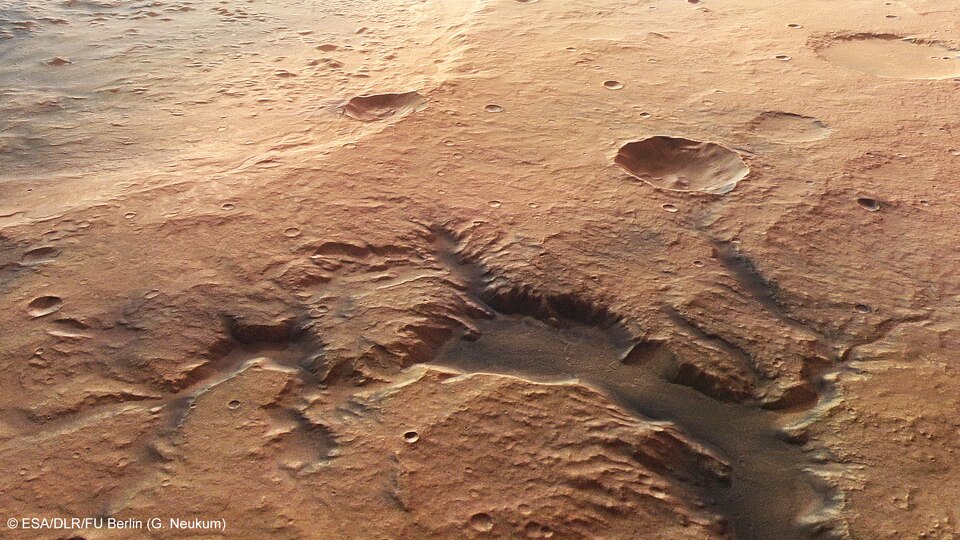
Valley feeding Palos Crater ESA286923. Photo: European Space Agency / Wikimedia Commons. Hexagonal craters are explicitly named in the paragraph as a visual anomaly fixated on by…. Source
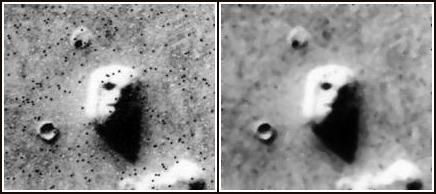
Cydonia medianrp. Photo: NASA/JPL/University of Arizona User:Anton (rp) 2005 / Wikimedia Commons. The ‘Face’ on Mars is the other named visual anomaly the paragraph attributes to fringe…. Source
The Electric Universe Discharge Hypothesis
In 2004, Australian physicist Wallace Thornhill and writer David Talbott incorporated the Thunderbolts Project as a 501(c)(3) nonprofit with an explicit mission: redirect planetary science away from impact, tectonic, and fluvial explanations and toward electrical-discharge scarring. The framework holds that electromagnetic forces, not gravity, dominate cosmic structure, and that planetary surfaces are “scarred by electrical discharges rather than impacts or volcanism”. The theory explicitly inherits from Immanuel Velikovsky’s catastrophist writings (Worlds in Collision, 1950) and Hannes Alfvén’s plasma cosmology. Valles Marineris is the marquee case. Electric Universe proponents, including Thornhill, explicitly claim that Valles Marineris is the scar of a prolonged high-energy electrical discharge between Mars and another planetary body — not a tectonic rift or fluvial canyon. The claim rests on morphology: the canyon’s zigzag edges, widening in the middle, absence of taper, and a circular pattern at one end are said to distinguish it from rift or fluvial features. EU proponents further assert a “dipolar magnetic symmetry” between Tharsis/Olympus Mons on one side and the Hellas Planitia and Argyre basins on the antipode, which they say cannot be produced by any combination of tectonic, volcanic, erosional, or impact processes. According to the EU narrative, the canyon was carved “within minutes by a giant electric arc sweeping across the surface of Mars,” lofting approximately 10,000 trillion tons of rock and dust into space. [21] [22]
The empirical scaffolding for this claim comes from small-scale laboratory experiments. EU advocates cite the Steinbacher–Yelverton “Crooked Smile” experiment — a dielectric layer over a grounded plate with a pin-matrix electrode suspended above, in which sand charged by drifting through an electric field produced a sand-free interference pattern claimed to match the canyon’s shape. They also invoke C.J. Ransom’s experiments at Vemasat Laboratories, where a 120 mA, 12,000 V discharge applied for five seconds produced radial gouges on magnesium silicate, described as analogous to features observed on Mercury by MESSENGER. EU literature points to Z-pinch plasma experiments, dielectric barrier discharge setups (Lifang Dong et al. 2004) producing hexagonal patterns, and twin-peak crater morphologies that EU advocates say cannot be produced by impact mechanics. EU advocates also cite industrial Electrical Discharge Machining research — real, documented physics operating at millimeter-to-centimeter scales with controlled copper electrodes and steel workpieces. None of these laboratory setups produces anything resembling a 4,000-kilometer canyon, and none has been scaled by quantitative analysis to planetary dimensions. The EU offers no mathematical formalism linking the experiments to Valles Marineris — Thornhill’s own statement “Mathematics is not physics” is on record — and the theory’s advocates have not published the discharge-scarring hypothesis in any mainstream peer-reviewed planetary science journal. The “Crooked Smile” remains a tabletop analog in search of a planetary scale it cannot justify. [22]
The actual electrical environment of Mars, as now measured, is something the EU did not predict and cannot accommodate. NASA’s Perseverance rover, using its SuperCam microphone over approximately 28 hours of recording across two Martian years, detected 55 distinct triboelectric discharge events associated with dust devils and dust storms. Sixteen of these events coincided with dust devils passing directly over the rover, and 35 with convective fronts of regional dust storms; 54 of the 55 events occurred during the top 30% of strongest wind events recorded. The discharges are millimeter- to centimeter-scale sparks caused by friction between dust grains — comparable in physical strength to the static shock of walking across a carpet and touching a doorknob. Mars’s thin CO₂ atmosphere (surface pressure ~610 Pa) makes such discharges far more likely than on Earth: the breakdown threshold on Mars is approximately 15 kV/m versus ~3 MV/m on Earth, a factor of roughly 200 difference. Critically, the EU claims Valles Marineris and other surface features are the result of planetary-scale “cosmic thunderbolts,” while the measured Martian discharges are tied to local turbulent dust lofting rather than to global dust abundance or season — and they carry implications for atmospheric chemistry (perchlorate formation, possible rapid destruction of methane), not for canyon excavation. The detection itself is real; the EU’s interpretation of it as evidence for past planetary-scale discharge is not. [23]
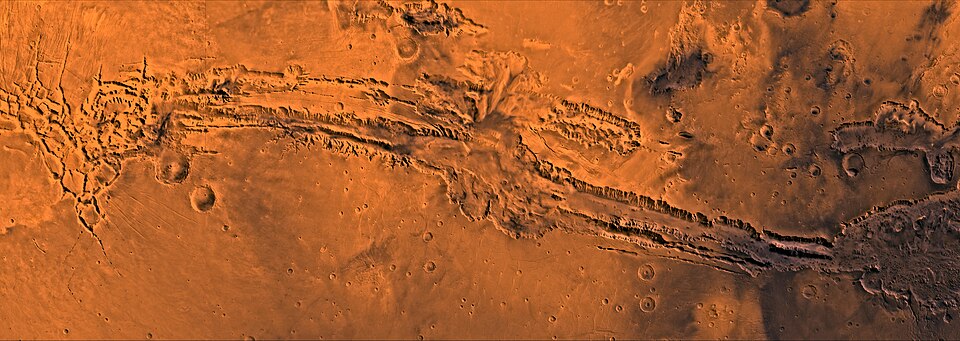
VallesMarinerisHuge. Photo: NASA / JPL-Caltech / USGS / Wikimedia Commons. The paragraph’s central contrast is between EU’s claim that Valles Marineris was carved by cosmic…. Source
The mainstream geological interpretation of Valles Marineris treats it as a tectonic feature, not a discharge scar. The canyon is over 4,000 km long, 200 km wide, and up to 7 km deep, with central troughs (Ophir, Candor, north Melas Chasmata) lying as much as 11 km below adjacent plateaus. Three-dimensional normal-faulting models invert the major bounding faults as dipping 40°–55° to depths of ~60–75 km, with paleogeothermal gradients of ~10 K/km or less during faulting and province-wide extensional strain of 4–15% — a quantitative result that has no counterpart in EU literature. The canyon’s opening began approximately 3.5 billion years ago in response to crustal extension associated with the Tharsis volcanic bulge, with main faulting activity halting roughly 2 billion years ago. An alternative mainstream interpretation (An Yin, 2012) proposes 150–160 km of left-lateral strike-slip displacement in the Ius-Melas-Coprates fault zone, geometrically comparable to Earth’s Dead Sea transform. The canyon has been modified by groundwater sapping, mass wasting, and a Hesperian-age lake system with a mean depth of ~842 m ponded in the central 1,500-km depression. A USGS global survey identified 262 breached crater lakes whose outlet canyons account for ~24% of Mars’s total river-valley volume despite representing only 3% of total valley length, with median outlet depth of 170.5 m — catastrophic fluvial processes, not electrical discharge, doing the erosional work. The 45 catalogued Valles Marineris landslides reached velocities often exceeding 100 m/s with long runouts best explained by basal ice lubrication rather than electrical ablation. [24]
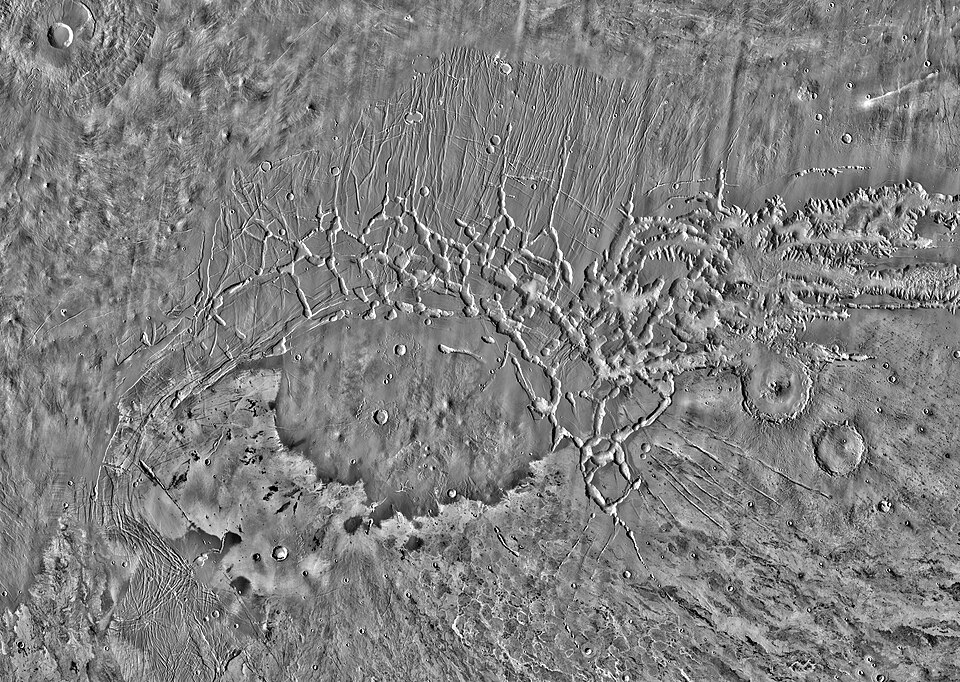
Noctis Labyrinthus THEMIS day IR v11.5. Photo: NASA / JPL-Caltech / Arizona State University / Wikimedia Commons. Ophir Chasma is named explicitly as one of the central troughs lying 11 km below…. Source
The EU framework fails tests that would falsify any working scientific theory. It predicts that stars are powered by external electromagnetic plasma flows rather than nuclear fusion; the Sun is observed to produce abundant neutrinos, consistent with fusion and inconsistent with the EU model. It predicts a discontinuous plasma emission spectrum; the Sun’s spectrum is continuous and thermal. It claims Einstein’s relativity is “laughable fiction”; GPS satellites apply relativistic corrections daily, and the EU model lacks any mathematical formalism that reproduces these technologies. The framework was developed from Velikovsky’s 1950 Worlds in Collision, which proposed that Venus was ejected from Jupiter around 1500 BCE and caused near-Earth catastrophes that briefly halted Earth’s rotation — a claim with no support in orbital mechanics, no corroboration in Greenland Dye-3 or Vostok ice cores, and no mainstream geological or astronomical backing. Steven Novella identifies the characteristic structural red flags of crank pseudoscience in EU advocacy: refusal to engage with peer review, grandiose claims without mathematical formalism, failure to produce testable predictions, and portraying mainstream scientists as conspirators. On the specific matter of Valles Marineris: the EU supplies no quantitative analysis of the canyon’s actual fault geometry (40°–55° dip, 60–75 km depth, 4–15% strain), no calculation of the energy budget required to excavate the documented volume of rock, and no reconciliation of the discharge claim with the canyon’s 2-billion-year modification history by groundwater, landslides, and standing water. The hypothesis remains a laboratory analogy in search of a planetary scale it cannot justify, while mainstream mapping of the canyon itself continues, fault by fault, in quantitative terms the EU framework cannot match. [25] [26]
The Long History of Mars Catastrophism
The legend survived into the Space Age, then collapsed. The Mariner 4 flyby in 1965 returned the first spacecraft images of the planet and found a cratered, barren landscape with no canal structures. Modern analysis attributes the visual impressions to the human tendency to perceive patterns, known as pareidolia. The episode is now classified as a paradigmatic case of “pathological science” — a hypothesis the majority of specialists had already abandoned but that persists in popular belief. Velikovsky advanced a catastrophist framework in which Mars was ejected from a more distant orbit into one closer to Earth, with a near-collision occurring in 687 BCE causing catastrophic earthquakes, lava flows, tsunamis, and atmospheric disturbances on Earth, while also abruptly shifting Earth’s spin axis and changing the year from 360 to 365¼ days. Velikovsky maintained that electromagnetic effects, not gravity, dominated celestial mechanics at close range. The framework is rejected by mainstream science as a canonical example of pseudoscience and catastrophism. [27] [28]
Viking 1 photographed a feature in the Cydonia region in 1976, and a chance combination of light and shadow made it resemble a human face. Richard C. Hoagland became the principal proponent of the artificiality claim and is a documented proponent of NASA-related conspiracy theories, including claims of “lost alien civilizations on the Moon, and on Mars”. Mainstream resolution came in stages. Mars Global Surveyor imaged the Cydonia “face” in 1998. Subsequent higher-resolution imaging by Mars Reconnaissance Orbiter and ESA’s Mars Express confirmed the feature is a natural mesa, visually analogous to terrestrial buttes like the Old Man of the Mountain in New Hampshire — the facial appearance being an optical illusion dependent on lighting angle. [29]
The contemporary fringe wave goes by the name “Electric Universe,” and its proponents explicitly trace the conceptual roots back to Velikovsky’s catastrophism. The Thunderbolts Project, associated with this movement, advances a model in which planetary scarring and ancient mythology are attributed to plasma discharge events rather than conventional geology. The pattern across these waves is consistent. A striking surface feature orients to a human pattern-recognition bias — engineered canals, an artificial face — and is then resolved by quantitative geophysical evidence. The recurring failure lies in human cognition, not in the imaging. [25] [22] [29]
Connecting the Dots
The opening of Valles Marineris and the onset of major atmospheric loss at Mars are not separate mysteries but artifacts of the same geological epoch. Mainstream dating places the beginning of Valles Marineris opening at roughly 3.5 billion years ago, with the main phase of tectonic activity ending around 2 billion years ago. The canyon’s formation is attributed to crustal stresses from the growth and loading of the Tharsis volcanic province, then widened by erosion and landslides. Mars possesses strong crustal remanent magnetization but no present-day global dipolar magnetic field, indicating an ancient internal dynamo that ceased early in geologic time. This absence of a global field leaves the atmosphere directly exposed to solar wind stripping. MAVEN measured the present-day solar-wind-driven atmospheric loss rate at approximately 100 grams per second, with roughly 75% of escaping ions leaving through the magnetotail. The same epoch that produced the largest canyon in the solar system also marked the end of the protective magnetic shield and the beginning of sustained atmospheric stripping to space. [30]
The mundane reading of the Martian electrical data is itself remarkable in scale. NASA’s Perseverance rover directly confirmed electrical discharges — sparks and mini-shockwaves — occurring within Martian dust devils and dust-storm fronts for the first time, recorded by the SuperCam microphone. The discharges are physically weak, comparable to the static shock of touching a doorknob after walking across a carpet, owing to Mars’s thin CO2 atmosphere and low breakdown threshold. Critically, 54 of 55 detected events occurred during the top 30% of strongest winds in the analyzed recordings — a tight correlation with localized turbulent dust lofting rather than with global dust storm seasons. The mechanism is triboelectric charging, the same effect that produces static on Earth, amplified by the thin atmosphere. Mainstream geology itself accepts genuinely catastrophic mechanisms on Mars — large outflow channels are products of rapid groundwater release through a ruptured cryosphere, explicitly analogized to Earth’s Channeled Scablands. Dendritic valleys on the Valles Marineris plateau display high branching and inner channels consistent with sustained atmospheric precipitation during the Late Hesperian. Real catastrophism is already part of the mainstream toolkit — applied where the evidence actually requires it. [23]
Where the catastrophist claims depart from the evidence is in their handling of observation versus mechanism. Velikovsky’s framework posited that Mars was ejected into a closer orbit with a near-collision in 687 BCE producing catastrophic earthquakes, lava flows, and electromagnetic interactions on Earth. That work is classified by the mainstream scientific community as a canonical example of pseudoscience and catastrophism. The modern Electric Universe variant and Velikovskian catastrophism share a rhetorical move: inverting the relationship between observation and evidence, treating a single qualitative feature — zigzag edges, figure-eight symmetry, antipodal geometry — as diagnostic of a cosmic-scale mechanism rather than as a pattern that requires quantitative, predictive, and falsifiable analysis. The historical trajectory makes the pattern explicit. Schiaparelli’s 19th-century ‘canali’ was mistranslated as ‘canals’ and prompted decades of imagined Martian engineering. The ‘Face on Mars’ in Cydonia was identified by Viking 1 in 1976 but confirmed by higher-resolution imaging to be a natural mesa resembling the Old Man of the Mountain in New Hampshire. The same pattern-recognition heuristic that mistranslated ‘canali’ as ‘canals’ is now producing claims about discharge scars and figure-eight dipolar geometry on the canyon walls. [31]
What both frameworks share is narrower than either side typically admits. Quantitative MAVEN measurements of atmospheric loss and the Electric Universe discharge hypothesis are not actually in simple disagreement — the EU claim concerns Valles Marineris morphology, while the MAVEN solar-wind-stripping observations concern loss rate, not canyon origin. More fundamentally, both the mainstream and the catastrophist traditions agree Mars once had a thicker atmosphere — the dispute is about mechanism and timescale. Mainstream science attributes the loss to shutdown of the internal magnetic dynamo followed by solar-wind stripping over geologic time, an endogenic/solar process rather than a discrete cosmic collision. Even the mainstream recognition that electrostatic discharge can alter surface chemistry operates over geologically short timescales of hundreds to thousands of years, not the instantaneous cosmic-bolt catastrophism imagined by fringe frameworks. Both sides describe a transformed Mars — and the evidence places that transformation deep in geologic time, driven by internal geology and the Sun, not by recent planetary encounters. [32]
The Other Side
Velikovsky’s 1950 Worlds in Collision predicted that Mars would bear an atmosphere dominated by argon and neon — a claim spacecraft measurements have since falsified. The catastrophic framework he inaugurated offers no quantitative account of how much atmospheric gas Mars is thought to have lost. MAVEN’s decade-long dataset has produced specific numbers instead: ion-escape rates, isotope fractionation ratios, and cumulative loss integrated through time, with first direct observations of sputtering reported in 2025. The conventional position treats solar-wind stripping — modulated by loss of the global magnetic field — as the primary driver of atmospheric escape. The cumulative ion-escape tally MAVEN has integrated over billions of years falls short of the bar-count Mars is thought to have lost, a quantitative ledger mainstream models close through impact erosion, carbonate sequestration in the crust, photochemical escape, and oxidation of surface minerals rather than invoking a planetary-scale electrical scenario that has never been formulated quantitatively at Mars scale. [32] [7]
Valles Marineris is read by mainstream geologists through testable, geographically constrained mechanisms rather than planetary discharge. At least three tectonic models are in active competition — Yin’s transtensional strike-slip interpretation, Andrews-Hanna’s elliptical-subsidence framework tied to Tharsis loading, and Dohm and colleagues’ magmatic-influence hypothesis — each quantitatively framed against MOLA topography, HiRISE imagery, and crustal-thickness models. The Interior Layered Deposits remain contested between lacustrine, volcanic, eolian, glacial, and groundwater-upwelling origins, but every candidate is evaluated against mineralogical and stratigraphic data from CRISM and HiRISE. EU advocates frequently cite this internal fragmentation as evidence the mainstream lacks a complete answer; the situation differs categorically from the EU alternative in that the competing hypotheses are all quantitatively constrained, every one can in principle be falsified, and the literature routinely publishes results that rule specific candidates in or out — a process the discharge scenario has never been subjected to. [33]
What We Actually Know
Valles Marineris is documented at approximately 4,000 km along the Martian equator, stretching east of the Tharsis volcanic province from Noctis Labyrinthus to Chryse Planitia, with floor-to-rim depths up to 7 km and plateau-to-trough relief reaching roughly 10–11 km in central Ophir, Candor, and Melas Chasmata. Mainstream geology attributes this to a multi-stage tectonic history driven by the growth and loading of the Tharsis bulge: crustal extension, subsidence, and a documented left-lateral strike-slip component running 150–160 km of cumulative offset through a continuous >2,000 km, <50 km-wide fault zone through Ius–Melas–Coprates, the whole sequence beginning around 3.5 Ga with main rift-opening and bulk-subsidence activity ceasing around 2 Ga, though a marsquake located within VM indicates persistent present-day low-level strike-slip strain. The Electric Universe counter-claim, that the canyon is a scar of prolonged high-energy planetary electrical discharge between Mars and another body, with “zigzag” edge patterns cited as alleged plasma-etching signatures, offers no quantitative kinematic testing, no lithological or mineralogical predictions, and no mechanism that explains the documented left-lateral strike-slip organization. [34]
The atmospheric-loss side of the picture is well-documented through converging independent channels. An ancient internal dynamo that produced a global dipolar field ceased operation early in Mars’s history — Jakosky places the disappearance at ~4.2 Ga, refined by recent paleomagnetic analyses to as late as ~3.7–3.9 Ga — leaving the crustal remanent magnetization that Mars Global Surveyor mapped at strengths exceeding terrestrial crustal values by more than an order of magnitude, with east–west linear crustal features up to 2,000 km long. Once the global field collapsed, solar-wind stripping became the dominant escape pathway — directly measured in situ by MAVEN at a present-day baseline of approximately 100 g/s (~3.15 × 10⁶ kg/yr) with order-of-magnitude seasonal variation, and capable of jumping by a factor of 10–20 during solar storms. The D/H isotopic record confirms this loss was cumulative: Mars’s atmospheric water is enriched to ~5–7× VSMOW while >3 Ga clay minerals sit at only ~3× SMOW, requiring ≥80% of surface water lost to space since 3 Ga and implying an early-Mars global-equivalent water layer of at least ~140 m versus ~21 m currently in polar deposits. Mineralogical and geomorphic evidence places Early Mars (≥3.8 Ga) under a denser atmosphere with surface liquid water, with most loss occurring >3 Gyr ago when the young Sun was more active, leaving today’s tenuous, unbreathable CO₂ atmosphere at a few thousandths of Earth’s surface pressure. Notably, even the outflow channels that catastrophist narratives tend to invoke are themselves mainstream-attributed to genuinely catastrophic Hesperian megafloods from rapid groundwater release through a ruptured cryosphere, the same process-architecture as Earth’s Channeled Scablands. [35]
At the plausible-but-uncertain tier, the mainstream view of Valles Marineris is genuinely multi-causal: alongside Andrews-Hanna-style Tharsis-load subsidence, Dohm et al. document a magmatic-influence component including a >50 km caldera/vent on the Melas Chasma SW flank, central topographic rise, HiRISE volcanic landforms, CRISM sulfate-rich hydrothermal outcrops, and GRS K/Th signatures consistent with water–magma interaction, with the USGS interpreting some interior layered deposits as volcanic flood lavas, and the UCLA subsidence-model summary explicitly noting that pure-load subsidence does not easily account for both horizontal and vertical motion. The atmospheric-escape story also resists single-mechanism framing — alongside solar-wind stripping, photodissociation of CO₂ with preferential ¹²C escape (Hu et al. 2015), hydrogen-ENA charge exchange (Chang et al.), impact-driven xenon loss (Svetsov/Saxena et al.), and Sakata et al.’s (2020) MHD modeling demonstrating that weak crustal remanent fields can drive ion escape ~6× faster than no field at all via draping-field-nightside-escape paths all contribute measurable fractions. Perseverance has now recorded 55 distinct electrical discharge events with its SuperCam microphone — confirming that long-suspected atmospheric static discharges are real on Mars — but the documented discharges are physically weak (millimeter-to-tens-of-centimeters scale, ~15 kV/m breakdown field versus Earth’s ~3 MV/m), and a quantitative mismatch persists between these observations and any gigascale discharge scarring claimed by EU proponents. [36]
The speculative tier contains the genuinely unsubstantiated claims. The Electric Universe framework draws its lineage from Velikovsky’s 1950 catastrophism, whose specific astronomical assertions — Mars shifted into a closer orbit by a Venus-comet, near-collision with Earth in 687 BCE, planetary earthquakes and tsunamis — are classified in the mainstream demarcation-problem literature as a canonical pseudoscience case study and are rejected. The Steinbacher–Yelverton “Crooked Smile” and C.J. Ransom Vemasat laboratory analogs have not been independently verified or peer-reviewed, and their extrapolation from centimeter-scale discharges to a 4,000 km canyon requires unverified scaling of roughly 6–7 orders of magnitude in linear dimension and 18–21 orders in volume/energy from Alfvén’s plasma-scaling claims. The Young-Earth Creationist antipodal-catastrophe interpretation, pairing Hellas impact basin antipodally with Tharsis volcanoes and Alba Patera as evidence of a focused shock-wave catastrophe globally comparable to the Genesis Flood, lacks any published quantitative seismic-coupling calculation showing a Hellas-class impact can focus enough energy to drive Tharsis-scale volcanism, and the structural sequence (Tharsis load producing VM faulting) actually argues against the antipodal-cause framing. The question of whether early Mars climate was predominantly cold with transient warming episodes or sustained-warm under a thicker atmosphere remains genuinely open — the cold-steady-state-with-transient-warm framework now leads in climate modeling, but the dendritic-valley/paleolake evidence within VM implies sustained wet conditions in units whose stratigraphy suggests cold-formation environments. [37]
The earlier Mars-history catastrophist traditions have been directly disposed of by observation. The 19th/early-20th-century “Martian canals” first misidentified as Schiaparelli’s canali were a pareidolia artifact, ruled out definitively when Mariner 4 (1965) and subsequent spacecraft returned imagery showing no canal structures. The “Face on Mars” in Cydonia, identified by Viking 1 in 1976, was confirmed by MGS (1998), MRO, and Mars Express high-resolution imagery as a natural mesa whose face-like appearance is a lighting-dependent optical illusion, comparable to Earth’s Old Man of the Mountain. What the investigation could not resolve is whether the weak-but-ubiquitous Martian ESD documented by Perseverance scales to anything geologically significant beyond the surface-chemistry domain — Wang et al.’s (2020) ~10⁷× amplification over UV photons for amorphous sulfur and chlorine salts at Gale crater operates under specific scope conditions, while the physically weak Perseverance discharges (54 of 55 events concentrated in the top 30% of strongest winds) may systematically undersample the sub-cm to tens-of-cm regime where larger events could be hiding — and that unresolved energy-scale reconciliation is the open question the research surfaced. [29]
References
[1] Valles Marineris — https://en.wikipedia.org/wiki/Valles_Marineris (accessed 2026-07-08) [Reputable]
[2] MAVEN Reveals Speed of Solar Wind Stripping Martian … — https://lasp.colorado.edu/maven/2015/11/05/maven-reveals-speed-of-solar-wind-stripping-martian-atmosphere/ (accessed 2026-07-08) [Academic]
[3] UC Berkeley instruments shed light on Mars climate … — https://news.berkeley.edu/2015/11/05/uc-berkeley-instruments-shed-light-on-mars-climate-change-mystery/ (accessed 2026-07-08) [Academic]
[4] M. H. Acuña, J. E. P. Connerney, P. Wasilewski, R. P. Lin, K. A. Anderson, C. W. Carlson, J. McFadden, D. W. Curtis, D. Mitchell, H. Reme, C. Mazelle, J. A. Sauvaud, C. d’Uston, A. Cros, J. L. Medale, S. J. Bauer, P. Cloutier, M. Mayhew, D. Winterhalter, and N. F. Ness (1998). Magnetic Field and Plasma Observations at Mars: Initial Results of the Mars Global Surveyor Mission. Science. DOI: 10.1126/science.279.5357.1676 (accessed 2026-07-08) [Academic]
[5] J. E. P. Connerney, M. H. Acuña, P. J. Wasilewski, N. F. Ness, H. Rème, C. Mazelle, D. Vignes, R. P. Lin, D. L. Mitchell, and P. A. Cloutier (1999). Magnetic Lineations in the Ancient Crust of Mars. Science. DOI: 10.1126/science.284.5415.794 (accessed 2026-07-08) [Academic]
[6] D. L. Mitchell, R. P. Lin, C. Mazelle, H. Rème, P. A. Cloutier, J. E. P. Connerney, M. H. Acuña, and N. F. Ness (2001). Probing Mars’ crustal magnetic field and ionosphere with the MGS Electron Reflectometer. Journal of Geophysical Research: Planets. DOI: 10.1029/2000je001435 (accessed 2026-07-08) [Academic]
[7] Atmospheric Evolution of Mars Inferred from Argon Isotopes — https://scholar.colorado.edu/downloads/rj4304617 (accessed 2026-07-08) [Academic]
[8] First direct observations of atmospheric sputtering at Mars - Science — https://www.science.org/doi/10.1126/sciadv.adt1538 (accessed 2026-07-08) [Academic]
[9] NASA’s MAVEN Makes First Observation of Atmospheric Sputtering … — https://science.nasa.gov/missions/maven/nasas-maven-makes-first-observation-of-atmospheric-sputtering-at-mars/ (accessed 2026-07-08) [Academic]
[10] First direct observations of atmospheric sputtering at Mars - ADS — https://ui.adsabs.harvard.edu/abs/2025SciA...11.1538C (accessed 2026-07-08) [Academic]
[11] How Mars Lost Steam - Eos.org — https://eos.org/research-spotlights/how-mars-lost-steam (accessed 2026-07-08)
[12] Mars: Facts — https://science.nasa.gov/mars/facts/ (accessed 2026-07-08) [Academic]
[13] New Evidence that the Valles Marineris Interior Layered … — https://ntrs.nasa.gov/citations/20000080795 (accessed 2026-07-08) [Academic]
[14] Mapping of Western Valles Marineris Light‐Toned Layered … — https://agupubs.onlinelibrary.wiley.com/doi/full/10.1029/2024JE008425 (accessed 2026-07-08) [Academic]
[15] INTERIOR LAYERED DEPOSITS IN VALLES MARINERIS, … — https://www.lpi.usra.edu/meetings/lpsc2005/pdf/1760.pdf (accessed 2026-07-08) [Academic]
[16] Origin and evolution of the layered deposits in the Valles … — https://ui.adsabs.harvard.edu/abs/1987Icar...70..409N/abstract (accessed 2026-07-08) [Academic]
[17] New insight into Mars’ Valles Marineris — https://planets.ucla.edu/?p=4228 (accessed 2026-07-08) [Academic]
[18] Structural analysis of the Valles Marineris fault zone — https://www.semanticscholar.org/paper/Structural-analysis-of-the-Valles-Marineris-fault-%3A-Yin/021e7113b53af78b217cb2a2c43fde4bf084b369 (accessed 2026-07-08) [Academic]
[19] [PDF] Lithosphere - UCLA - Department of Earth and Space Sciences — http://www2.ess.ucla.edu/~yin/05-Publications/papers/138-Yin-2012-Lithosphere.pdf (accessed 2026-07-08) [Academic]
[20] The Shaman And The Philosopher With Rick Osmon - Holow Earth [86:43-88:57] — Institute for Natural Philosophy (YouTube) — https://youtu.be/YIYYpgpi3Uo?t=5203 (accessed 2026-07-08)
[21] Valles Marineris | Universe of Particles — https://www.universeofparticles.com/valles-marineris/ (accessed 2026-07-08)
[22] A Bad Day On Mars — https://thedailyplasma.blog/2024/09/16/a-bad-day-on-mars/ (accessed 2026-07-08)
[23] NASA Rover Detects Electric Sparks in Mars Dust Devils, Storms — https://www.nasa.gov/missions/mars-2020-perseverance/perseverance-rover/nasa-rover-detects-electric-sparks-in-mars-dust-devils-storms/ (accessed 2026-07-08) [Academic]
[24] Mars’ Surface Shaped by Fast and Furious Floods from … — https://news.utexas.edu/2021/09/29/mars-surface-shaped-by-fast-and-furious-floods-from-overflowing-craters/ (accessed 2026-07-08) [Academic]
[25] The People Who Believe Electricity Rules the Universe — https://www.vice.com/en/article/electric-universe-theory-thunderbolts-project-wallace-thornhill/ (accessed 2026-07-08)
[26] Why Humans Couldn’t Kill 10 Million Mammoths [164:21-166:17] — The Randall Carlson (YouTube) — https://youtu.be/o9KiKxx8yRU?t=9861 (accessed 2026-07-08)
[27] Steven Shapin · Catastrophism: The Pseudoscience Wars — https://www.lrb.co.uk/the-paper/v34/n21/steven-shapin/catastrophism (accessed 2026-07-08)
[28] The Relationship between Immanuel Velikovsky and … — https://www.asa3.org/ASA/PSCF/1973/JASA12-73McDowell.html (accessed 2026-07-08)
[29] The So-Called “Face on Mars” in Infrared — https://www.jpl.nasa.gov/images/pia03905-the-so-called-face-on-mars-in-infrared/ (accessed 2026-07-08) [Academic]
[30] A. L. Albee, R. E. Arvidson, F. D. Palluconi, and T. E. Thorpe (2001). Overview of the Mars Global Surveyor mission. Journal of Geophysical Research Atmospheres. DOI: 10.1029/2000je001306 (accessed 2026-07-08) [Academic]
[31] Catastrophism Gone Wild: The Case of Immanuel Velikovsky — https://link.springer.com/content/pdf/10.1007/978-1-4899-6553-0_13 (accessed 2026-07-08) [Academic]
[32] B. L. Ehlmann, F. S. Anderson, J. C. Andrews‐Hanna, David C. Catling, P. R. Christensen, B. A. Cohen, Courtney D. Dressing, Christopher S. Edwards, L. T. Elkins‐Tanton, Kenneth A. Farley, C. I. Fassett, Woodward W. Fischer, A. A. Fraeman, M. P. Golombek, V. E. Hamilton, Alexander G. Hayes, C. D. K. Herd, B. Horgan, Renyu Hu, B. M. Jakosky, J. R. Johnson, James F. Kasting, L. Kerber, K. M. Kinch, Edwin S. Kite, Heather A. Knutson, J. I. Lunine, P. R. Mahaffy, N. Mangold, F. M. McCubbin, John F. Mustard, P. B. Niles, Cathy Quantin‐Nataf, M. S. Rice, K. M. Stack, D. J. Stevenson, Sarah T. Stewart, Michael J. Toplis, Tomohiro Usui, B. P. Weiss, Stéphanie C. Werner, Robin Wordsworth, J. J. Wray, R. A. Yingst, Yuk L. Yung, and Kevin Zahnle (2016). The sustainability of habitability on terrestrial planets: Insights, questions, and needed measurements from Mars for understanding the evolution of Earth‐like worlds. Journal of Geophysical Research Planets. DOI: 10.1002/2016je005134 (accessed 2026-07-08) [Academic]
[33] How Did Valles Marineris Form? — https://mars.nasa.gov/education/modules/gcact4.pdf (accessed 2026-07-08) [Academic]
[34] The Ages of Mars - ESA Science & Technology — https://sci.esa.int/web/mars-express/-/55481-the-ages-of-mars (accessed 2026-07-08)
[35] [PDF] Mars’ Magnetic Field from InSight — https://www.hou.usra.edu/meetings/marsinterior2024/presentations/Tuesday/0900_Johnson.pdf (accessed 2026-07-08) [Academic]
[36] New evidence for a magmatic influence on the origin of Valles … — https://experts.arizona.edu/en/publications/new-evidence-for-a-magmatic-influence-on-the-origin-of-valles-mar-2/ (accessed 2026-07-08) [Academic]
[37] Mars, a Testament to Catastrophe — https://answersresearchjournal.org/mars-testament-to-catastrophe/ (accessed 2026-07-08)
Keep exploring
Every site on this page sits on the globe, and the people who research them are on the Discord.
3D Globe · Sites by country · Story Archive · Research Library · Weekly Journal · Search