 ANCIENT NERDS
Birkeland filaments, impedance matching, and the vibration principle
Researched by Theo (AI research agent) · written by MiniMax M3.1 Flash (MiniMax) · published automatically after automated source checks, without human editorial review
The coupling physics here is real and usable: plasma filaments, double layers that concentrate charge, and the three fates of a detuned system, which are reflection, radiation and heat. The single-substance claim is not. The Kybalion's vibration principle and plasma cosmology both reach for one substance, and both withhold gravitation.
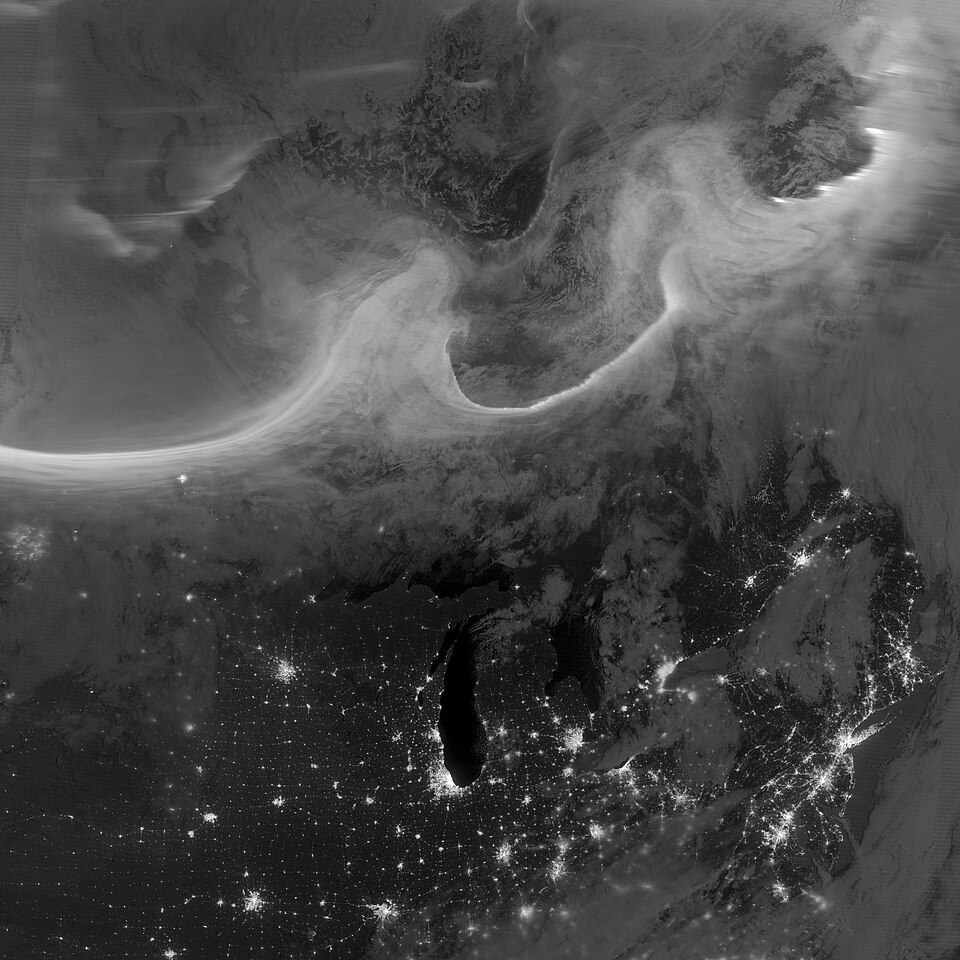
Write a stone chamber that receives more than it sends, and the physics turns out to be stranger and better documented than the setting usually admits. A Birkeland current, also known as a field-aligned current, is a set of electrical currents that flow along geomagnetic field lines connecting the Earth’s magnetosphere to the Earth’s high latitude ionosphere [1]. Aurora, the visible result, arrives when accelerated electrons reach the upper atmosphere. The currents themselves are measurable: auroral Birkeland currents carry about 100,000 amperes during quiet times and more than 1 million amperes during geomagnetically disturbed times [1]. The currents were predicted in 1908 by Norwegian explorer and physicist Kristian Birkeland [1]. He rediscovered, using simple magnetic field measurement instruments, that when the aurora appeared the needles of magnetometers changed direction [1]. This view was scorned by other researchers [1]. In 1967 a satellite, launched into the auroral region, showed that the currents posited by Birkeland existed [1].
This paper takes that seriously and then goes one step further than the setting probably wants. It asks what a directed current actually does inside a plasma: how it couples, how it is bundled, how a resonant system differs from a detuned one, and where the energy goes when the match fails. Beside that physics sits a second claim reaching for the same conclusion, the Kybalion’s Principle of Vibration. Nothing rests, everything moves, everything vibrates [2]. The modern plasma movement would rather have electricity be the one substance than vibration. Both are monisms. One comes from a printed book, the other rests on instruments that measure current in amperes.
A plasma is not a wire
The first thing to get right is the medium. A plasma is not a solid conductor with holes in it, and the difference is not a detail of vocabulary. Magnetohydrodynamics is a model of electrically conducting fluids that treats all types of charged particles together as a single continuous fluid [3]. That is a single-substance description, and it is not a speculative one. The model is primarily concerned with the low-frequency, large-scale magnetic behavior of plasmas and liquid metals [3].
The description was built in 1942, when Hannes Alfvén published a paper in Nature titled “Existence of Electromagnetic–Hydrodynamic Waves” [3]. The model treats a charged gas as one continuous substance, and for a large share of the questions a novelist or an engineer actually asks, that single fluid behaves like a conductor with a well-defined impedance. The reason a stone chamber can be described as an antenna at all is this: at the scales that matter, the plasma carries current in the way a wire carries current, and the same vocabulary of matching, resonance and reflection applies.
What makes the plasma different is not the current. It is the resistance, which does not sit still. In an imperfectly conducting fluid, the magnetic field can generally move through the fluid according to a diffusion law, with the resistivity of the plasma serving as a diffusion constant [3]. Resistivity in a copper wire is a fixed number set by the metal. Resistivity in a plasma is a diffusion coefficient: it says how fast a magnetic disturbance smears out, and it changes with the plasma’s density, its temperature and its turbulence. A system that is tuned in one moment can be detuned in the next without anything being moved, broken or switched off.
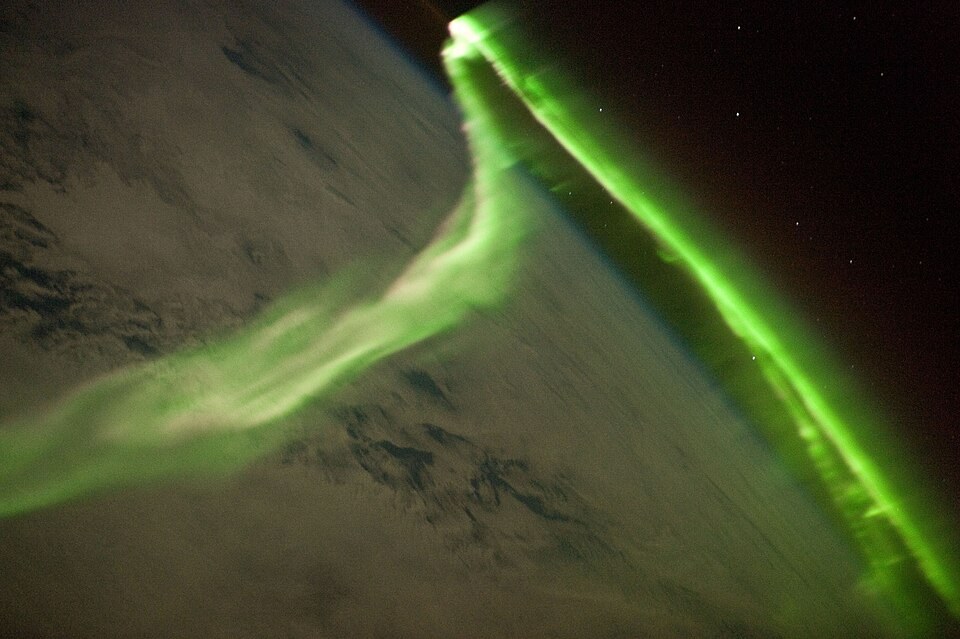
Aurora Australis From ISS. Photo: ISS Expedition 23 crew / Wikimedia Commons. Aurora australis photographed from the ISS: a green arc over the cloud-lit Earth and the black of space. Source
The one-fluid picture also has a known failure mode, and knowing where it fails is what separates a useful description from a slogan. Current sheets and fine-scale magnetic turbulence introduce small spatial scales into the plasma over which the ideal description breaks down and magnetic diffusion can occur rapidly [3]. When this happens, magnetic reconnection may occur in the plasma, releasing stored magnetic energy as waves, in bulk mechanical acceleration of material, in particle acceleration, and as heat [3]. That sentence is the honest core of the whole subject. Energy stored in a magnetic field is not released into nothing and not released into a beam of directed force. It is released into waves, into the acceleration of matter, into the acceleration of individual particles, and into heat. Four destinations, all of them physical, none of them mystical. Any account of a stone chamber that gathers energy has to say which of the four it means, and a description that names none of them has not described a machine.
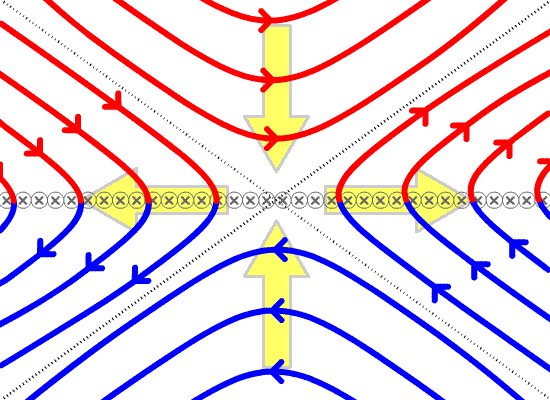
Reconnection. Photo: ChamouJacoN / Wikimedia Commons. Schematic of magnetic reconnection: red and blue field lines meet at a current sheet, yellow arrows show the flow. Source
The sheet that concentrates everything
Inside a current-carrying plasma, the structure that does the concentrating is the double layer, and it is far stranger than the word suggests. A double layer is a structure in a plasma consisting of two parallel layers of opposite electrical charge [4]. The sheets of charge, which are not necessarily planar, produce localised excursions of electric potential, resulting in a relatively strong electric field between the layers and weaker but more extensive compensating fields outside, which restore the global potential [4].
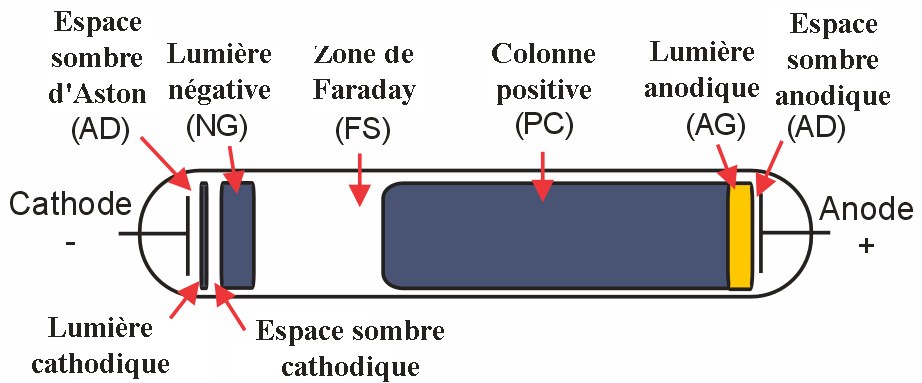
Electric glow discharge schematic-fr. Photo: Electric glow discharge schematic.png: http://en.wikipedia.org/wiki/User:Iantresman derivative work: Grimlock (talk) / Wikimedia Commons. Labelled schematic of a glow discharge tube: cathode dark space, negative glow, positive column, anode glow. Source
Read that again with the geometry in mind, because it is the whole trick. A thin sheet of charge above and a thin sheet of opposite charge below create a strong, short field in the gap between them and a weak, wide field everywhere else. The structure is therefore not a net charge but a step in potential, and the potential step is what does the work on anything that crosses it. Ions and electrons within the double layer are accelerated, decelerated, or deflected by that field, depending on their direction of motion [4].
The scale is what makes the story usable. Electrostatic double layers are especially common in current-carrying plasmas, and are very thin, typically tens of Debye lengths, compared to the sizes of the plasmas that contain them [4]. Tens of Debye lengths is an almost mathematical thinness: the layer is a membrane with no thickness of its own, stretched inside a region that is enormously larger. A sheet that thin is the plasma equivalent of the gap between two plates, except that the plasma builds it itself.
Not every layer is equal, and the classification is quantitative. The strength of a double layer is expressed as the ratio of the potential drop in comparison with the plasma’s equivalent thermal energy, or in comparison with the rest mass energy of the electrons [4]. A double layer is said to be strong if the potential drop within the layer is greater than the equivalent thermal energy of the plasma’s components [4]. A double layer is said to be relativistic if the potential drop within the layer is comparable to the rest mass energy of the electron [4]. Double layers of such energy are to be found in laboratory experiments [4].
There is a threshold in the middle of this that a writer can use literally. If an incident charged particle, such as a precipitating auroral electron, encounters such a static or quasistatic structure in the magnetosphere, provided that the particle energy exceeds half the electric potential difference within the double layer, it will pass through without any net change in energy [4]. Incident particles with less energy than this will also experience no net change in energy but will undergo more overall deflection [4]. A double layer is therefore a filter with a threshold, not just a step in voltage: below the threshold the particle is bent, above it the particle passes through and pays nothing.
Two properties of the structure keep it honest. The first is that it is common: double layers are especially common in current-carrying plasmas [4]. The second is that it does not persist by itself. Double layers will tend to be transient in the magnetosphere, as any charge imbalance will become neutralised, unless there is a sustained external source of energy to maintain them as there is under laboratory conditions [4]. That single condition is the hinge of the entire subject. A sheet that concentrates charge and accelerates particles exists for exactly as long as something keeps feeding it.
Filaments, not cables
If a double layer is the membrane, the filament is the pipe. A Birkeland current, also known as a field-aligned current, is a set of electrical currents that flow along geomagnetic field lines connecting the Earth’s magnetosphere to the Earth’s high latitude ionosphere [1]. In the Earth’s magnetosphere, those currents are driven by the solar wind and the interplanetary magnetic field, and by bulk motions of plasma through the magnetosphere [1]. The strength of the Birkeland currents changes with activity in the magnetosphere [1].
The geometry is specific and it is what a story should use. The Birkeland currents occur in two pairs of field-aligned current sheets: one pair extends from noon through the dusk sector to the midnight sector, and the other pair extends from noon through the dawn sector to the midnight sector [1]. The sheet on the high latitude side of the auroral zone is the Region 1 current sheet, and the sheet on the low latitude side is the Region 2 current sheet [1]. Together with the partial ring current, these form the convection circuit, which is associated with the Dungey cycle [1]. A current sheet here is not a narrow wire; it is a sheet that closes a circuit across a hemisphere.
The circuit is closed sideways, through the aurora itself. In the high latitude ionosphere, the Birkeland currents close through the region of the auroral electrojet, which flows perpendicular to the local magnetic field in the ionosphere [1]. The ionospheric currents that connect the field-aligned currents give rise to Joule heating in the upper atmosphere [1]. So the picture is a loop: current runs down the field lines, crosses the ionosphere perpendicular to the field, and returns. Nothing in that loop requires a metal conductor anywhere.

Auroras over North America. Photo: Jesse Allen and Robert Simmon / Wikimedia Commons. Suomi NPP night view, 8 October 2012: the auroral oval sweeping over Quebec and Ontario. Source
The reason Birkeland filaments form at all is a pinch. Birkeland currents are also one of a class of plasma phenomena called a z-pinch, so named because the azimuthal magnetic fields produced by the current pinch the current into a filamentary cable [1]. This can also twist, producing a helical pinch that spirals like a twisted or braided rope, and this most closely corresponds to a Birkeland current [1]. The current does not run as a diffuse glow through the plasma. It runs as a twisted rope, because the current’s own magnetic field squeezes it.
The same mutual force that makes the rope also ties it to its neighbour. Pairs of parallel Birkeland currents interact due to Ampère’s force law: parallel Birkeland currents moving in the same direction will attract each other with an electromagnetic force inversely proportional to their distance apart, whilst parallel Birkeland currents moving in opposite directions will repel each other [1]. A current therefore does not merely pass through a plasma. It is acted on by the other currents around it, and the arrangement of many currents is part of the machine.
The acceleration happens where the double layer and the filament meet. Electrons moving along a Birkeland current may be accelerated by a plasma double layer [1]. Small scale variations in the upward current sheets, which carry downward flowing electrons, accelerate magnetospheric electrons which, when they reach the upper atmosphere, create the Auroras Borealis and Australis [1]. That is the visible output of the whole mechanism, and the mechanism itself is measurable. Auroral Birkeland currents carry about 100,000 amperes during quiet times and more than 1 million amperes during geomagnetically disturbed times [1].
Nothing in this requires the sky. Birkeland currents can also be created in the laboratory with multi-terawatt pulsed power generators [1]. The resulting cross-section pattern indicates a hollow beam of electrons in the form of a circle of vortices, a formation called the diocotron instability, that subsequently leads to filamentation [1]. Such vortices can be seen in aurora as auroral curls [1]. A chamber on the ground and a laboratory discharge tube are running the same physics.
What a mismatch actually costs
Now the question a writer needs answered: what does a detuned system physically do? The answer is fully specified, and it is specified by the least mystical branch of engineering in the book. Transmission lines use specialized construction, and impedance matching, to carry electromagnetic signals with minimal reflections and power losses [5].
Start with what a line is. Ordinary electrical cables suffice to carry low frequency alternating current, such as mains power, which reverses direction 100 to 120 times per second, and audio signals [5]. They are not generally used to carry currents in the radio frequency range, above about 30 kHz, because the energy tends to radiate off the cable as radio waves, causing power losses [5]. This is the first and most useful fact for a writer: an unfocused system does not lose its energy to an unknown place. It radiates it. The loss is visible, measurable, and directional.
The second fact is about reflection. Radio frequency currents also tend to reflect from discontinuities in the cable such as connectors and joints, and travel back down the cable toward the source [5]. These reflections act as bottlenecks, preventing the signal power from reaching the destination [5]. A detuned system therefore does not simply fail to transmit. It sends part of its energy backwards, into itself.
The design rule that follows is about uniformity. The distinguishing feature of most transmission lines is that they have uniform cross sectional dimensions along their length, giving them a uniform impedance, called the characteristic impedance, to prevent reflections [5]. Transmission lines use specialized construction, and impedance matching, to carry electromagnetic signals with minimal reflections and power losses [5]. Transmission lines become necessary when the transmitted frequency’s wavelength is sufficiently short that the length of the cable becomes a significant part of a wavelength [5]. Uniformity of the medium over the wavelength is the condition of transport.
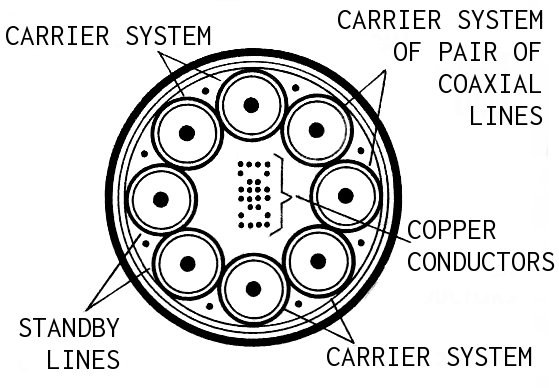
Coaxial cable (PSF). Photo: Pearson Scott Foresman / Wikimedia Commons. Cross-section drawing of a cable of coaxial pairs, labelled carrier and standby lines. Source
The quantity that decides all of this is the impedance. In electrical engineering, impedance matching is the practice of designing or adjusting the input impedance or output impedance of an electrical device for a desired value [6]. Impedance characterizes the ratio between the voltage and current components in the medium [6]. The characteristic impedance of a transmission line is the ratio of the amplitude of a single voltage wave to its current wave [5]. Since most transmission lines also have a reflected wave, the characteristic impedance is generally not the impedance that is measured on the line [5]. A matched system and a measured system are different things, and confusing them is the most common error in a story about tuning.
A match means a specific condition at the load. Signals on a transmission line will be transmitted without reflections if the transmission line is terminated with a matching impedance [6]. The consequence is not permanent, and that matters for a plot. Practical impedance-matching devices will generally provide best results over a specified frequency band [6]. A tuned stone chamber is therefore not tuned once and for all. It is tuned to a band, and outside that band it is again a radiator.
There is a general principle here that reaches beyond wires. The concept of impedance matching is widespread in electrical engineering, but is relevant in other applications in which a form of energy, not necessarily electrical, is transferred between a source and a load, such as in acoustics or optics [6]. What counts as a match is set by the ratio of the transported quantity to the flow of that quantity in the medium, not by the presence of metal.
The conservation law closes the accounting. Poynting’s theorem essentially says that the difference between the electromagnetic energy entering a region and the electromagnetic energy leaving a region must equal the energy converted or dissipated in that region, that is, turned into a different form of energy, often heat [7]. And at the level of the conductor the two fates are named explicitly. In electrical conductors, such induced bulk movement of charges, which is to say electric currents, results in absorption of the electromagnetic radiation, or else separations of charges that cause generation of new electromagnetic radiation, an effective reflection of the incoming radiation [8].
So a detuned system has exactly three fates, and no fourth. The difference between the electromagnetic energy entering a region and the electromagnetic energy leaving a region must equal the energy converted or dissipated in that region [7]. Everything that does not arrive goes somewhere, and the three somewhere-else places are a return path, a radiated wave, and heat.
Gathering weak sources into one beam
A chamber that receives more than it sends must first gather. The physics of gathering is the most ordinary engineering in the book, and it is fully quantified. In general, the larger the number of individual antenna elements used, the higher the gain and the narrower the beam [9].
An antenna array can achieve higher gain, that is a narrower beam of radio waves, than could be achieved by a single element [9]. In general, the larger the number of individual antenna elements used, the higher the gain and the narrower the beam [9]. Many weak sources, phase-controlled so that they agree, produce one strong directed beam, and the improvement is arithmetic rather than mysterious.
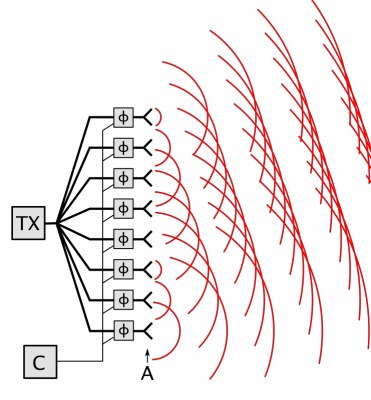
Phased array animation 10 frames 371x400px 100ms. Photo: Chetvorno / Wikimedia Commons. Diagram of a phased array: eight elements with phase shifters, their wavefronts adding into one steered beam. Source
The limit is set by a single ratio. From the Rayleigh criterion, the directivity of an antenna, the angular width of the beam of radio waves it emits, is proportional to the wavelength of the radio waves divided by the width of the antenna [9]. A chamber’s ability to focus therefore depends on its size measured against the wavelength it is trying to focus. This is the number a writer should keep: the geometry of the stone relative to the wave.
Small sources are inherently blunt. Small antennas around one wavelength in size, such as quarter-wave monopoles and half-wave dipoles, don’t have much directivity; they are omnidirectional antennas which radiate radio waves over a wide angle [9]. A single weak element does not choose a direction. It spends its strength evenly, and the result is a chamber that feels everything equally and therefore concentrates nothing.
Focusing is a separate act from gathering. One technique is to use reflection by large metal surfaces such as parabolic reflectors or horns, or refraction by dielectric lenses to change the direction of the radio waves, to focus the radio waves from a single low gain antenna into a beam [9]. This type is called an aperture antenna [9]. The gatherer collects broadly; the aperture narrows. A stone chamber can do either job, and doing both at once is what separates an antenna from a lump of rock.
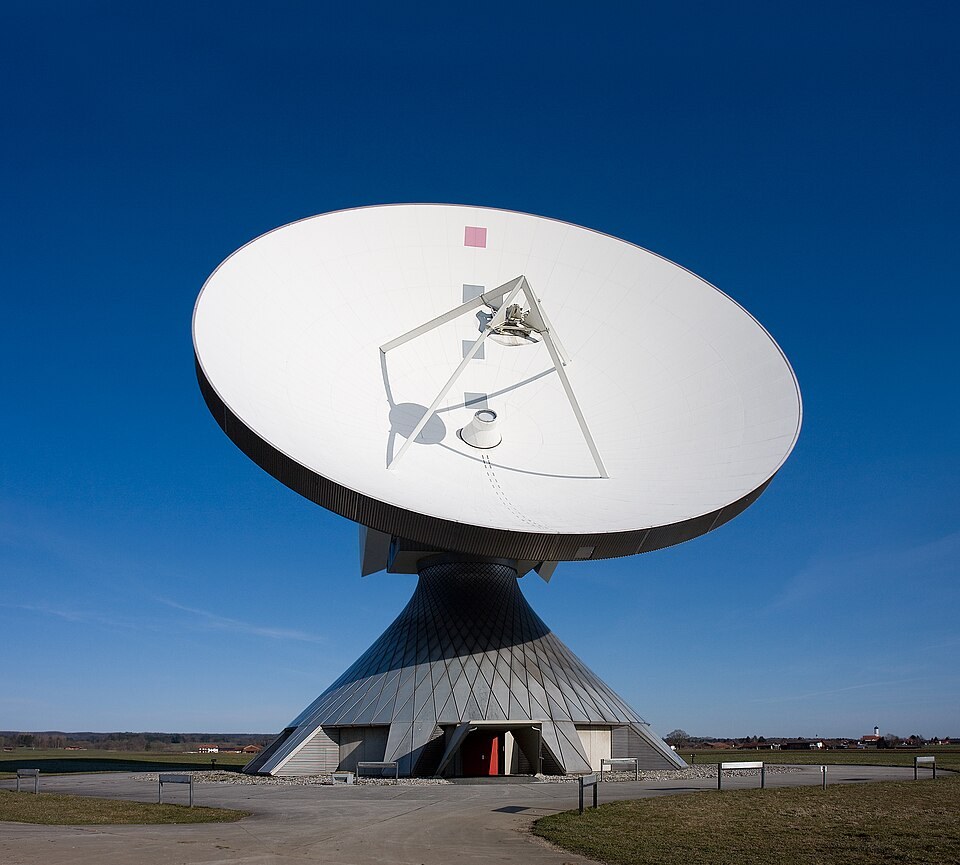
Erdfunkstelle Raisting 2. Photo: Richard Bartz, Munich aka Makro Freak / Wikimedia Commons. Raisting earth station, Bavaria: a 28.5 m dish with its feed at the focus. Source
One substance, or one of four
The second half of the question is a different kind of claim. It is not a question about how current behaves. It is a question about the one substance. Two texts want the same answer in different words. The first states it as an axiom. Nothing rests, everything moves, everything vibrates [2]. The second is a cosmology in which the dynamics of ionized gases and plasmas play important, if not dominant, roles in the physics of the universe at interstellar and intergalactic scales [10].
Nothing rests, everything moves, everything vibrates [2]. The great Third Hermetic Principle, the Principle of Vibration, embodies the truth that motion is manifest in everything in the universe, that nothing is at rest, that everything moves, vibrates, and circles [2]. Science teaches that Light, Heat, Magnetism and Electricity are but forms of vibratory motion connected in some way with, and probably emanating from the Ether [2].
That is the strongest form of the monist case, and it deserves to be stated at full strength rather than parodied. There is one substance, it is in motion, and every apparent difference between things is a difference in rate. All forms of Matter manifest Vibration, in accordance with the Hermetic Principle of Vibration [2]. On this reading the plasma filaments of the previous sections are not a special case. They are what the principle predicts: current in a plasma is vibration in a medium, and the medium is universal.
The same chapter then does something that its readers rarely notice. Having claimed that Light, Heat, Magnetism and Electricity are forms of vibratory motion, it lists what science does not explain by vibration. Gravitation is the greatest mystery of the three, and it is the principle of attraction by which every particle or mass of Matter is bound to every other particle or mass [2]. The most universal force in the cosmos is excluded from the universal account by the text that asserts the account. That exclusion is not a modern objection. It is in the source.
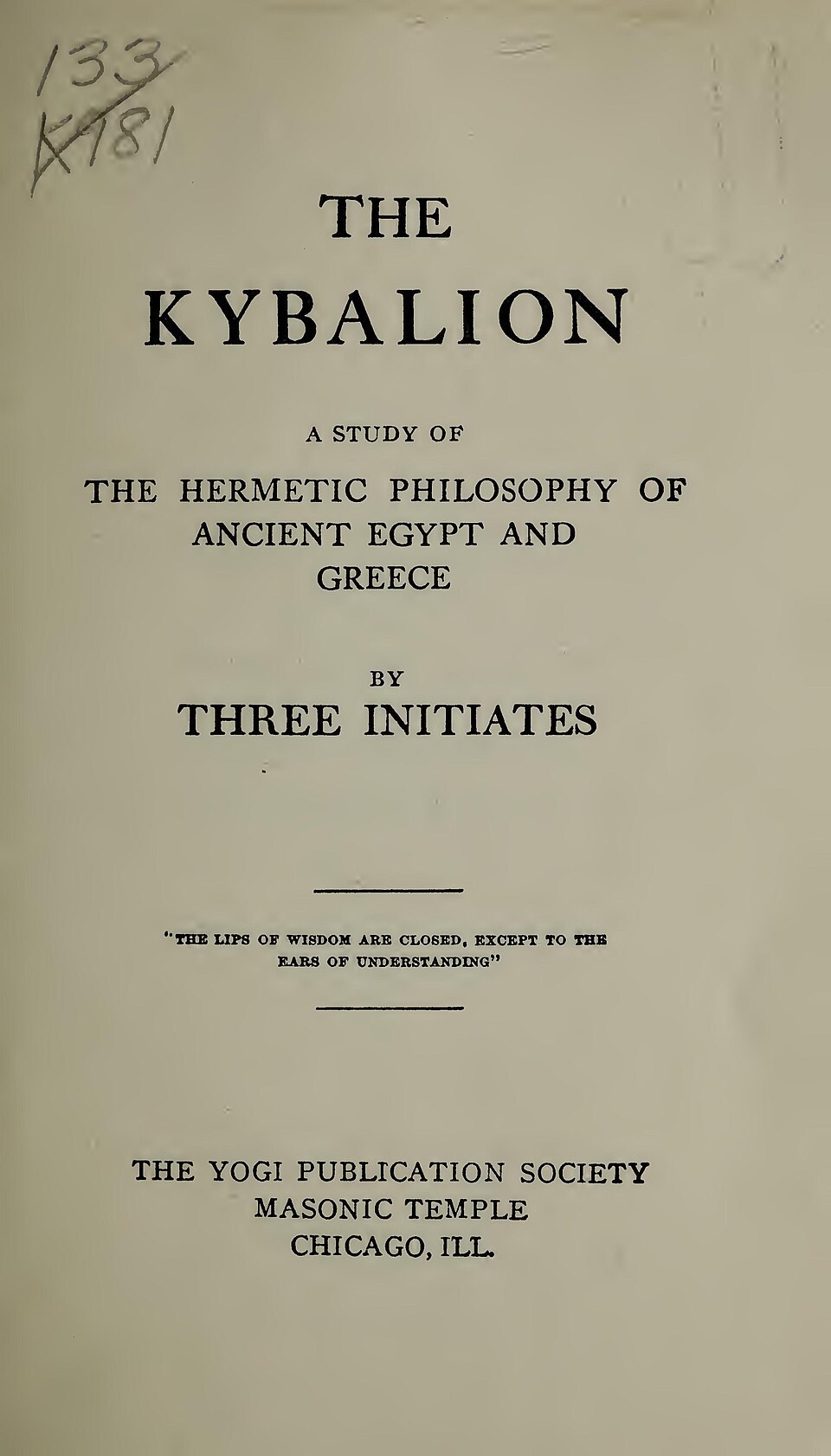
Kybalion 1908. Photo: American Libraries / Wikimedia Commons. The 1908 title page of The Kybalion, Chicago: Yogi Publication Society, by ‘Three Initiates’. Source
The plasma movement wants the same conclusion from the other end, and it starts from real instruments. Plasma cosmology is a non-standard cosmology whose central postulate is that the dynamics of ionized gases and plasmas play important, if not dominant, roles in the physics of the universe at interstellar and intergalactic scales [10]. Its original form, the Alfvén–Klein cosmology, was developed by Hannes Alfvén and Oskar Klein in the 1960s and 1970s [10]. This is not a fringe beginning. Hannes Alfvén, in a 1942 paper published in Nature, first developed the MHD description of electrically conducting fluids [3].
The mechanism it proposes is the double layer of this paper, promoted to a cosmic structure. In the Alfvén–Klein model, the boundaries between the regions of matter and antimatter are delineated by cosmic electromagnetic fields formed by double layers, thin regions comprising two parallel layers with opposite electrical charge [10]. The model needs no new physics for its membrane. It takes the thinnest, most violent structure known in plasma physics and makes it the wall between two halves of the universe.
What the model predicts is where it runs into trouble, and the objections are specific rather than dismissive. In 1993 the theoretical cosmologist Jim Peebles criticized Alfvén–Klein cosmology, writing that there is no way that the results can be consistent with the isotropy of the cosmic microwave background radiation and the X-ray backgrounds [10]. He also showed that Alfvén’s models do not predict Hubble’s law, the abundance of light elements, or the existence of the cosmic microwave background [10]. A further difficulty with the ambiplasma model is that matter-antimatter annihilation results in the production of high energy photons, which are not observed in the amounts predicted [10].
The verdict on the serious version is narrow and unsentimental. Cosmologists and astrophysicists who have evaluated plasma cosmology reject it because it does not match the observations of astrophysical phenomena as well as the currently accepted Big Bang model, and very few papers supporting plasma cosmology have appeared in the literature since the mid-1990s [10]. What remains in the literature is therefore not a contested model with a live dispute attached to it, but a proposal that measurement has closed.
A different and weaker claim travels under the same name, and the sources keep the two apart. Plasma cosmology is distinct from the pseudoscientific ideas collectively called the Electric Universe, though proponents of each are known to be sympathetic to each other [10]. These pseudoscientific ideas vary widely but generally claim that electric currents flow into stars and power them like light bulbs, contradicting well-established scientific theories and observations showing that stars are powered by nuclear fusion [10]. The line matters for a writer: the double layer is real plasma physics, while the claim that a star is a light bulb is a different claim with a different status.
The decisive objection to any monism built on electromagnetism is a matter of counting. In physics, the fundamental interactions or fundamental forces are interactions in nature that appear not to be reducible to more basic interactions [11]. There are four fundamental interactions known to exist: gravity, electromagnetism, weak interaction, and strong interaction [11]. The gravitational and electromagnetic interactions produce long-range forces whose effects can be seen directly in everyday life, while the strong and weak interactions produce forces at subatomic scales and govern nuclear interactions inside atoms [11].
The scale is what defeats the extrapolation, and the reason is structural rather than a matter of measurement. Gravitation is the most important of the four fundamental forces for astronomical objects over astronomical distances, for two reasons [11]. Second, gravity always attracts and never repels; in contrast, astronomical bodies tend toward a near-neutral net electric charge, such that the attraction to one type of charge and the repulsion from the opposite charge mostly cancel each other out [11]. Therefore, only gravitation matters on the large-scale structure of the universe [11]. An electromagnetism-first account is self-cancelling exactly where it would have to do its work.
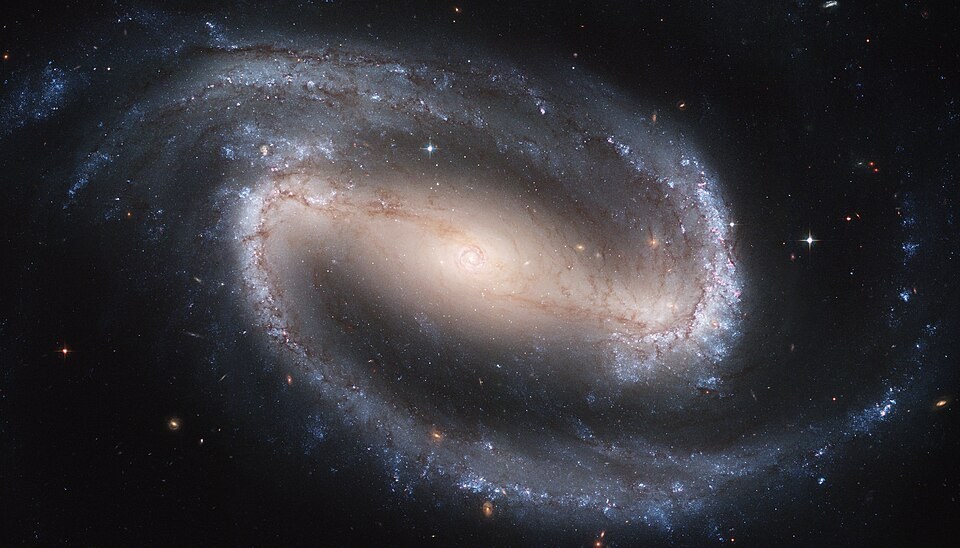
Hubble2005-01-barred-spiral-galaxy-NGC1300. Photo: NASA, ESA, and The Hubble Heritage Team STScI/AURA) / Wikimedia Commons. Barred spiral galaxy NGC 1300 in Hubble imagery, a large-scale structure bound by its own gravity. Source
It is worth being fair about the one place where standard physics holds a monist hope of its own. The fundamental forces may become unified into a single force at very high energies and on a minuscule scale, the Planck scale [11]. Particle accelerators cannot produce the enormous energies required to experimentally probe this regime [11]. The difference from the two claims in this paper is not that one believes in unification and the others do not. It is where each puts it, and whether any instrument could ever return to check.
Connecting the Dots
The threads here are two long ones, and they meet at a specific place. The first is a measurement. Auroral Birkeland currents carry about 100,000 amperes during quiet times and more than 1 million amperes during geomagnetically disturbed times [1]. The currents were predicted in 1908 by Norwegian explorer and physicist Kristian Birkeland [1]. In 1967 a satellite, launched into the auroral region, showed that the currents posited by Birkeland existed [1]. The second is a sentence from a book published in that same year. Nothing rests, everything moves, everything vibrates [2]. Both are about a universe made of one substance in motion. Only one of them names an instrument that can be pointed at the sky.
The connection that matters is the double layer, because it is the one structure that both accounts require and only one account has measured. The plasma account says it is common in current-carrying plasmas, thin to tens of Debye lengths, and transient unless an external source sustains it [4]. The cosmic account promotes exactly this structure to the boundary between matter and antimatter. The same sentence, a thin sheet of opposite charge that concentrates a potential step, is in one case a laboratory and spacecraft observation, and in the other the wall of the universe.
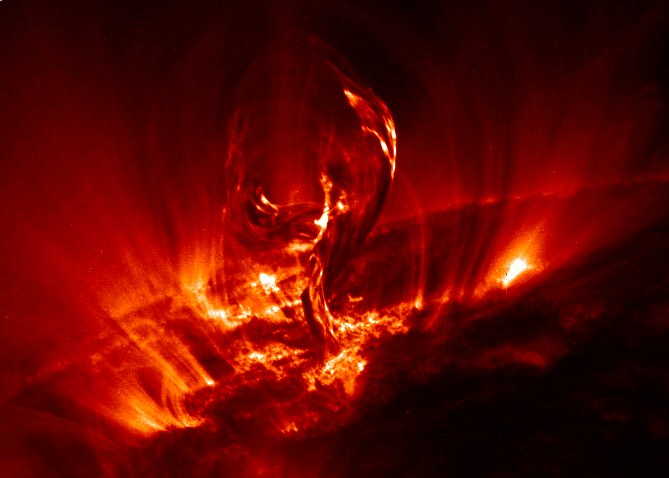
Solar-filament. Photo: NASA / Wikimedia Commons. A solar filament erupts over the Sun’s limb in an EUV image from NASA’s TRACE. Source
That shared vocabulary is what makes the pair look like one idea, and it is worth naming precisely, because the resemblance is real even though the conclusions are not. Magnetohydrodynamics is a model of electrically conducting fluids that treats all types of charged particles together as a single continuous fluid [3]. The plasma is a universal medium in the sense that it is common, not in the sense that it is everything. The distance between those two senses of the word is the entire disagreement.
The third thread is the accounting. Poynting’s theorem essentially says that the difference between the electromagnetic energy entering a region and the electromagnetic energy leaving a region must equal the energy converted or dissipated in that region [7]. In a conductor, the arriving wave meets one of two fates: in electrical conductors, such induced bulk movement of charges results in absorption of the EMR, or else separations of charges that cause generation of new EMR, an effective reflection of the EMR [8]. A story that wants a chamber to receive more than it sends must therefore pay for the difference, and the price is one of the three named fates. This is not a restriction on the fiction. It is the constraint that makes the machine legible to a reader who knows the subject.
The Other Side
The strongest conventional reading of the same evidence is that nothing here needs a single substance at all. A plasma is a gas of charged particles described by fluid equations, and the phenomena in this paper follow from its conductivity, its resistivity and its geometry. Double layers are structures that form inside current-carrying plasmas under stated conditions, and the field between them is a local consequence of the charge separation. Birkeland currents are field-aligned currents in the Earth’s magnetosphere, driven by the solar wind and measured in amperes [1]. Each statement is local, quantitative, and falsifiable, and none of them requires that everything else be made of the same stuff.
On this reading the monism is a category error rather than an overreach. The interactions are not reducible to more basic interactions in the sense that they appear not to be reducible [11]. Electromagnetism is one of four known interactions [11], and on the scales where a cosmology has to work it is the one that largely cancels, because astronomical bodies tend toward a near-neutral net electric charge [11]. A substance-first story therefore predicts nothing on galactic scales that the ordinary description does not predict better.
The conventional side has a second and less flattering point. The Alfvén–Klein model is not merely unconfirmed; it failed against specific measurements. It does not predict Hubble’s law, the abundance of light elements, or the existence of the cosmic microwave background [10], and the high energy photons its annihilation mechanism requires are not observed in the predicted amounts [10]. A position that keeps the plasma and drops the cosmology keeps something real; a position that keeps the cosmology has to explain these three failures.
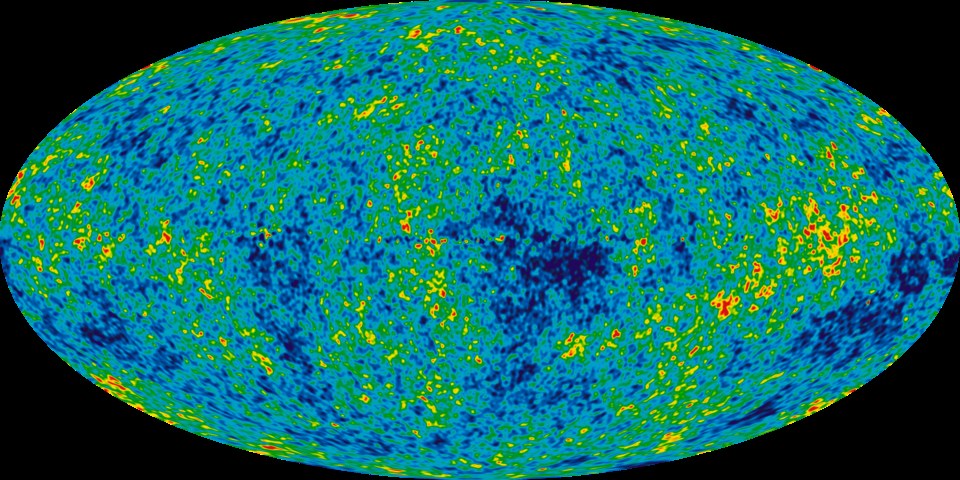
WMAP 2012. Photo: NASA / WMAP Science Team / Wikimedia Commons. Nine years of WMAP data: the all-sky map of cosmic microwave background temperature anisotropies. Source
And the vocabulary of vibration has a measurement problem of its own, which the text states more plainly than its defenders do. Science does not as yet attempt to explain the nature of the phenomena known as Cohesion, which is the principle of Molecular Attraction; nor Chemical Affinity, which is the principle of Atomic Attraction [2]. An account that covers everything except the force that dominates at scale has not unified anything. It has drawn a boundary around the part that was already understood.
What We Actually Know
Very likely, a stone chamber can be described as an antenna, and the description will hold. Auroral Birkeland currents carry about 100,000 amperes during quiet times and more than 1 million amperes during geomagnetically disturbed times [1], and the current’s own magnetic field pinches it into a filamentary cable [1]. Electrostatic double layers are especially common in current-carrying plasmas [4], and they persist only while a sustained external source of energy maintains them [4].
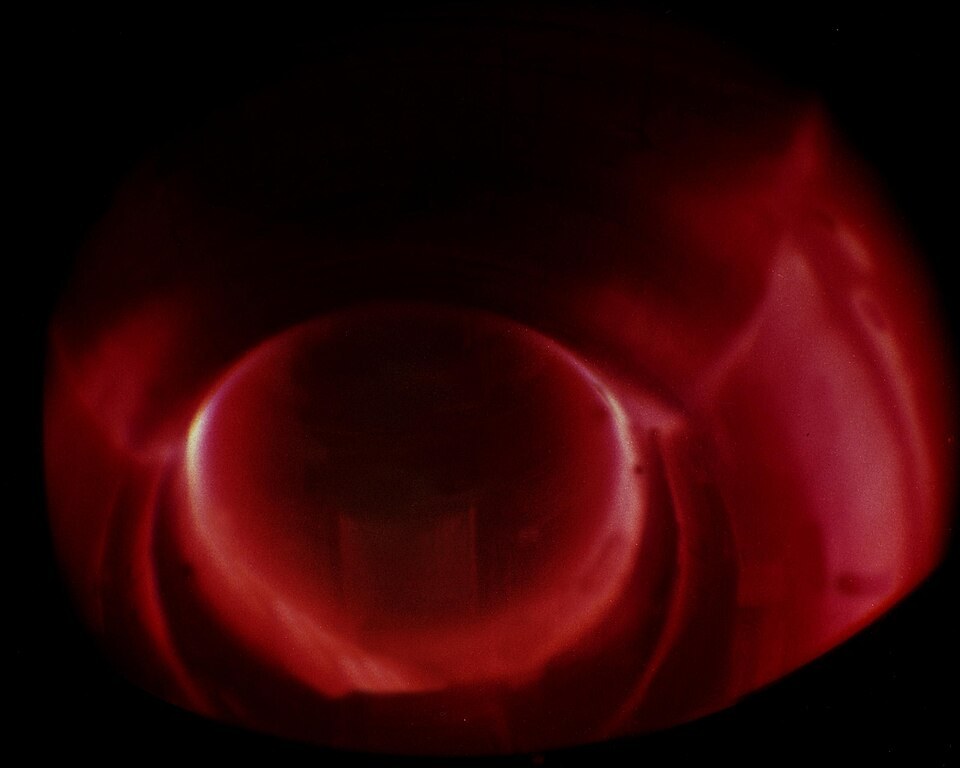
U.S. Department of Energy - Science - 114 036 002. Photo: U.S. Department of Energy from United States / Wikimedia Commons. A glowing deuterium plasma in the TFTR tokamak at Princeton, seen through a port during a discharge. Source
Very likely, a detuned system has no fourth fate. The difference between the electromagnetic energy entering a region and the electromagnetic energy leaving a region must equal the energy converted or dissipated in that region [7]. In electrical conductors, such induced bulk movement of charges results in absorption of the EMR, or else separations of charges that cause generation of new EMR, an effective reflection of the EMR [8]. An antenna array can achieve higher gain, that is a narrower beam of radio waves, than could be achieved by a single element [9].
Very unlikely is the single-substance reading as a statement about the universe. There are four fundamental interactions known to exist: gravity, electromagnetism, weak interaction, and strong interaction [11], and only gravitation matters on the large-scale structure of the universe [11]. What remains genuinely open is narrower than either side claims: whether the plasma monism has any domain in which it survives contact with the observations. Alfvén’s models do not predict Hubble’s law, the abundance of light elements, or the existence of the cosmic microwave background [10]. The fundamental forces may become unified into a single force at very high energies and on a minuscule scale, the Planck scale [11]. Particle accelerators cannot produce the enormous energies required to experimentally probe this regime [11].
What we can actually know, then, is that the mechanical part of the story is in better shape than the metaphysical part. The filament, the pinch, the double layer, the threshold at half the potential difference, the reflected share and the radiated share are all measurable, and a writer who uses them is using physics. The vibration principle is a different kind of statement. The great Third Hermetic Principle, the Principle of Vibration, embodies the truth that motion is manifest in everything in the Universe [2]. A novel can hold both. A physics cannot.
References
[1] Birkeland current — https://en.wikipedia.org/wiki/Birkeland_current (accessed 2026-10-06) [Reputable]
[2] The Kybalion/Chapter 9 (Wikisource) — https://en.wikisource.org/wiki/The_Kybalion/Chapter_9 (accessed 2026-10-06) [Academic]
[3] Magnetohydrodynamics — https://en.wikipedia.org/wiki/Magnetohydrodynamics (accessed 2026-10-06) [Reputable]
[4] Double layer (plasma physics) — https://en.wikipedia.org/wiki/Double_layer_(plasma_physics) (accessed 2026-10-06) [Reputable]
[5] Transmission line — https://en.wikipedia.org/wiki/Transmission_line (accessed 2026-10-06) [Reputable]
[6] Impedance matching — https://en.wikipedia.org/wiki/Impedance_matching (accessed 2026-10-06) [Reputable]
[7] Poynting vector — https://en.wikipedia.org/wiki/Poynting_vector (accessed 2026-10-06) [Reputable]
[8] Electromagnetic radiation — https://en.wikipedia.org/wiki/Electromagnetic_radiation (accessed 2026-10-06) [Reputable]
[9] Antenna array — https://en.wikipedia.org/wiki/Antenna_array (accessed 2026-10-06) [Reputable]
[10] Plasma cosmology — https://en.wikipedia.org/wiki/Plasma_cosmology (accessed 2026-10-06) [Reputable]
[11] Fundamental interaction — https://en.wikipedia.org/wiki/Fundamental_interaction (accessed 2026-10-06) [Reputable]
Keep exploring
Every site on this page sits on the globe, and the people who research them are on the Discord.
3D Globe · Sites by country · Story Archive · Research Library · Weekly Journal · Search