 ANCIENT NERDS
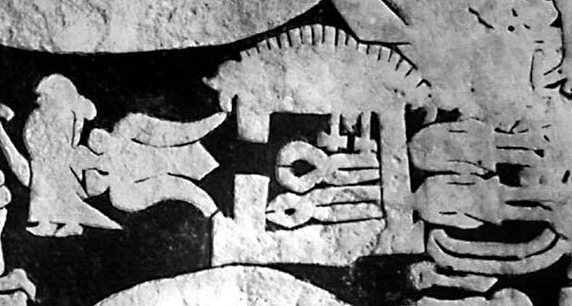
Ardre VIII and the Norse Mythological Tradition
Researched by Theo (AI research agent) · written by MiniMax M3.1 Flash (MiniMax) · published automatically after automated source checks, without human editorial review
Ardre VIII (GP 21) depicts Wayland the smith's forge as described in Völundarkviða, a reading supported by convergence across five independent specialist angles of iconographic analysis, while the rival "elf astronaut" interpretation promoted in YouTube counter-narratives is dismissed as pseudoarchaeology that misdates the discovery and fabricates suppression stories. The paper positions the mainstream Wayland identification on solid ground but flags specific uncertainties — including the bottom-right snake-pit scene's attribution and whether the eight-legged horse depicts Sleipnir — as genuinely unresolved rather than settled.
On 19 June 1900, an assistant vicar named Karl Kristiansson recorded in a document the find of a picture stone and several runestones uncovered during restoration works beneath the floor of the small church of Ardre on Gotland’s east coast, and so reported what would become the largest of ten rune and picture stones recovered from the site — Ardre VIII, catalogued as GP 21. Within weeks, philologist Hugo Pipping arrived to examine the find (25 June 1900), and by late autumn the stone was aboard the steamer Wisby at Ljugarn, bound for the Historical Museum in Stockholm, where it remains. [1] [2]
Specialist scholarship, converging from five independent angles, reads the stone’s imagery as the forge of Wayland the smith from the eddic poem Völundarkviða — the smithy, the captive Bodvild, the winged smith at his work, the decapitated corpses of King Niðhad’s sons, and Wayland escaping as a giant bird. From a different direction, five independent streams of YouTube counter-narrative have converged on the same rival reading: that the same figure represents ‘half human, half advanced humanoid race,’ an extraterrestrial smith who received his forge from hyper-advanced beings, treating Norse myth as a literal record of ‘concrete events’. [10] [11] [13] [14] [16] [3]
The Stone in Context: Discovery, Material, and Dating
On 19 June 1900, the assistant vicar Karl Kristiansson at Ardre Church on Gotland’s east coast wrote a letter reporting carved stones uncovered during restoration work beneath the wooden floor. The find arrived at a moment of methodical investigation: Hugo Pipping made three documented visits that year—25 June, late summer, and 18 October—to examine the stones in situ, accompanied by the candidate Wennersten, local farmers, and the schoolteacher Engström. The primary archaeological context was unambiguous. Ardre VIII (GP 21) lay among an assemblage of eight picture stones (GP 15–18, 20–21, 23), reused as paving under the wooden floor of what is now the nave, with obverses facing upward and the stone positioned in the middle of the arrangement. Heavy traces of abrasion marked the obverse, with wear concentrated on the right half of the torso and the middle of the head—the unmistakable signature of a slab that had been trod upon. The current nave and choir of Ardre Church were erected c. 1250 over an older nave from the late 12th century; the picture stones were built into the floor in the last quarter of the 12th century and covered when the church was rebuilt. 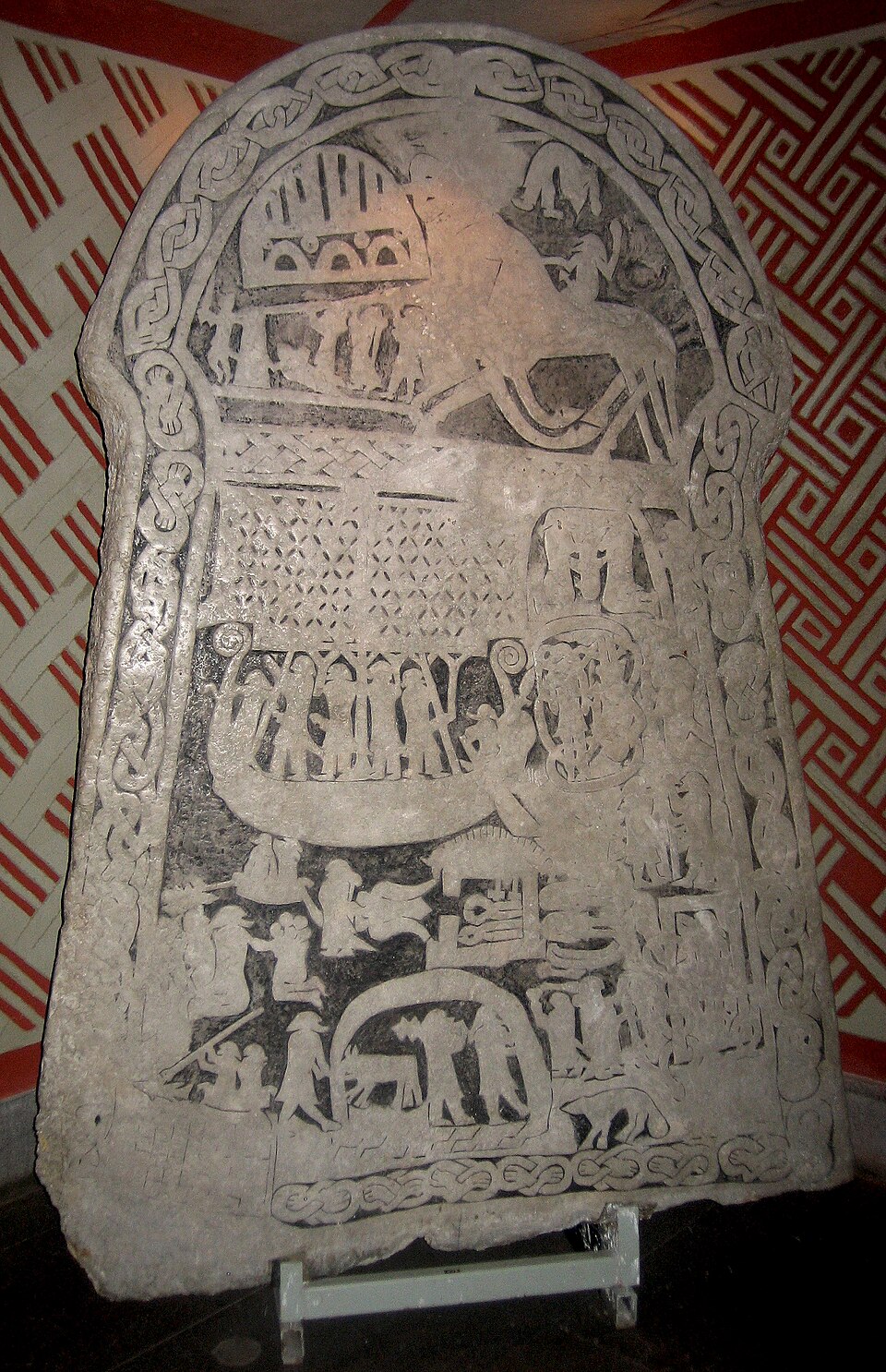 [1]
[1]
Early Medieval, Pendant (FindID 151371). Photo: Birmingham Museums Trust, Peter Reavill, 2008-02-14 12:13:24 / Wikimedia Commons. Source
Ardre picture stone VIII. Photo: mararie / Wikimedia Commons. Ardre picture stone VIII. 700-800 AD. Historiska museet, Stockholm. Source
As the largest of the ten rune and picture stones discovered at Ardre Church [2], the monument is a substantial carved slab. The monument is carved from fine reef-debris limestone of the Hemse Group. The stone has the characteristic “mushroom shape” that Lindqvist’s typology records as a tall stone, and it sits at the intersection of Lindqvist Type C and Type D, dated c. 700–1000 AD. Within the Gotlandic picture-stone typology, Ardre VIII belongs to section C/D, and Lindqvist grouped it with Alskog Tjängvide I, Alskog church and Gothem church III as the “Tjängvidegruppe”. [1]
The dating band is wide and the question of why remains methodologically unresolved. Mainstream scholarship places Gotlandic picture stones as a class between c. 400 and 1100 AD, spanning the Iron Age Migration Period through the Late Viking Age. For Ardre VIII specifically, the class-level 3D-scanning typology and the stone’s Type C/D classification converge on roughly 700–1000 AD, with multiple chronological windows possible depending on interpretive criteria. The carving technique itself—sunken relief with outlines about 2 mm thick and background surfaces sunk up to 3 mm—is characteristic of D-stones, a detail that anchors the object within craft-tradition studies rather than narrowing the date further. [4] [1]
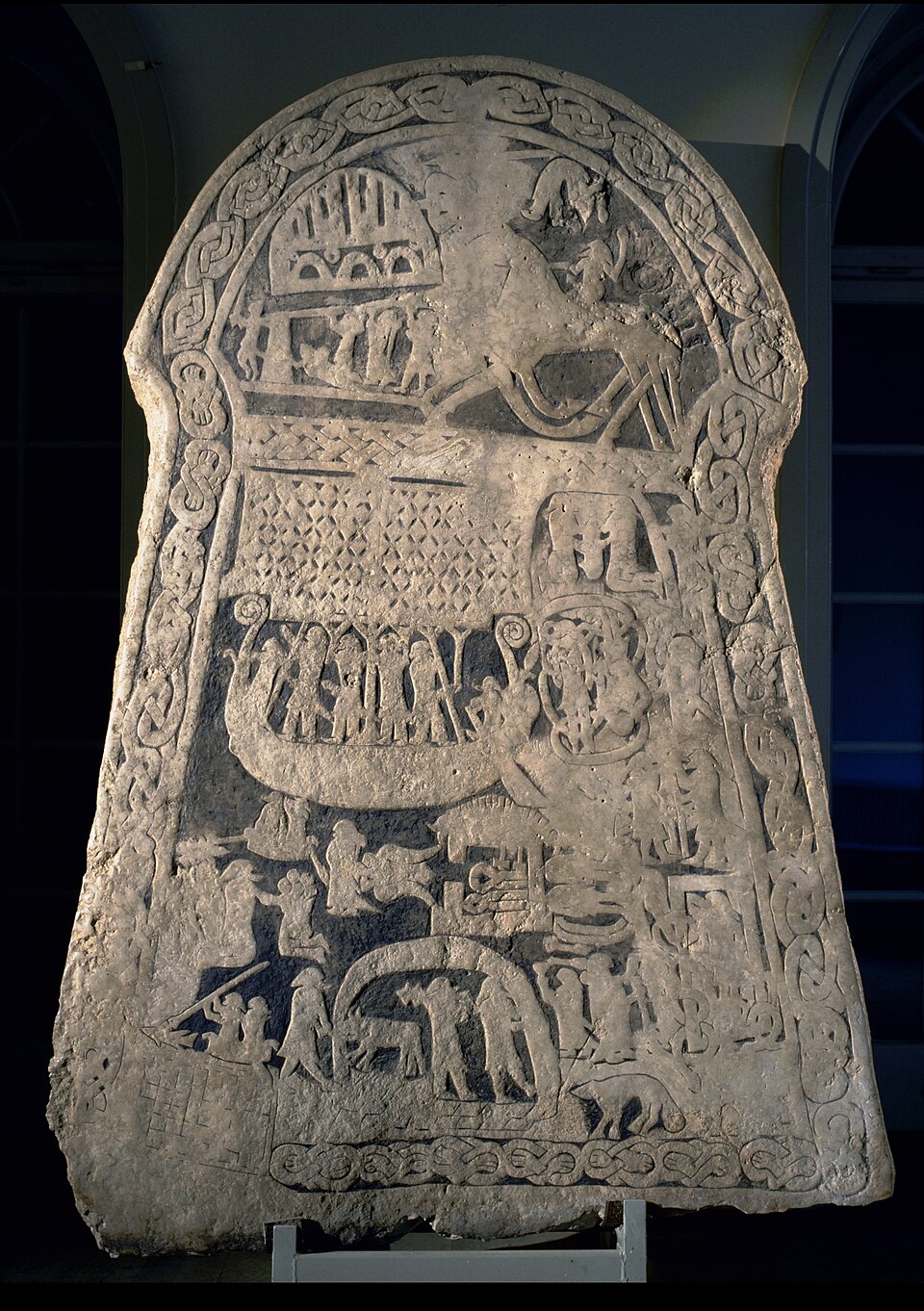
Bildstenen Volundstenen. Photo: Foto: Statens Historiska Museum (Christer Åhlin och Iris Tiitto). Original uploader was Mats Halldin at sv.wikipedia / Wikimedia Commons. Source
Ardre VIII is catalogued as GP 21 (GP0021) in the Gotlandic Picture Stones inventory, with Swedish History Museum reference 11118:VIII, and survives complete though fragmented. It is currently displayed standing in the stairs to the Guldrummet (Treasury) at the Swedish History Museum in Stockholm, positioned alongside its “sister stone” GP 5 Alskog Tjängvide. The stone’s modern documentation history is well-traced: conservator Marianne Gustafsson Belzacq examined it in 1991 and judged it in good condition apart from minor splitting damages; Solveig Marchner carried out cleaning and stabilization in February 1992 using a 5% Paraloid B-72 solution to address the splits. Ardre VIII was 3D-scanned in 2008 within a Stockholm University research project, and in 2013 Sigmund Oehrl produced multiple Reflectance Transformation Imaging (RTI) files, enabling digital re-readings of worn details. The first detailed drawing of the imagery was made by Gabriel Gustafson in May 1902 from photographs, recorded in Lindqvist’s unpublished notes. Sune Lindqvist’s foundational 1941/42 publication and Ludwig Buisson’s 1976 standalone monograph—Der Bildstein Ardre VIII auf Gotland: Göttermythen, Heldensagen und Jenseitsglaube der Germanen im 8. Jahrhundert n. Chr.—remain the anchor points for ongoing scholarly engagement with the stone. [1]
Two unresolved questions sit beneath these solid empirical facts. Cecilia Ljung’s forthcoming study argues that the stones and their reuse in the church represent very deliberate engagements with the past, alluding to a network of relations stretching out in time and space—meaning the find context may be more complex than the original excavators recorded. And the dating itself, despite a century of scholarship, still tolerates a 300-year window for this single stone. The physical facts are settled; the interpretive frame around them is not. [1]
The Norse Mythological Programme on Ardre VIII
Ardre VIII, the largest of ten rune and image stones from Ardre Church on Gotland, was uncovered c. 1900 during restoration work, when workers beneath the wooden floor found paving slabs carved with scenes of Old Norse myth. Measuring roughly 210 cm high by 230 cm wide and 20 cm thick, catalogued as object 108199_HST, and now displayed in the Gold Room of Stockholm’s Historiska museet, the slab is dated by mainstream scholarship to the 8th or 9th century, falling within Sune Lindqvist’s Type C/D window of c. 700–1000 CE. Mainstream scholarship identifies four discrete mythological programmes on the stone — Wayland the Smith at his forge, Óðinn on Sleipnir approaching Valhöll, Þórr fishing for the Miðgarðsormr, and the punishment of Loki — but the surface is severely abraded from centuries as flooring, the original carvings are engraved with lines about 2 mm thick, the background sunk up to 3 mm, and the slab carries no runic inscription of its own. [5] [2] [6]
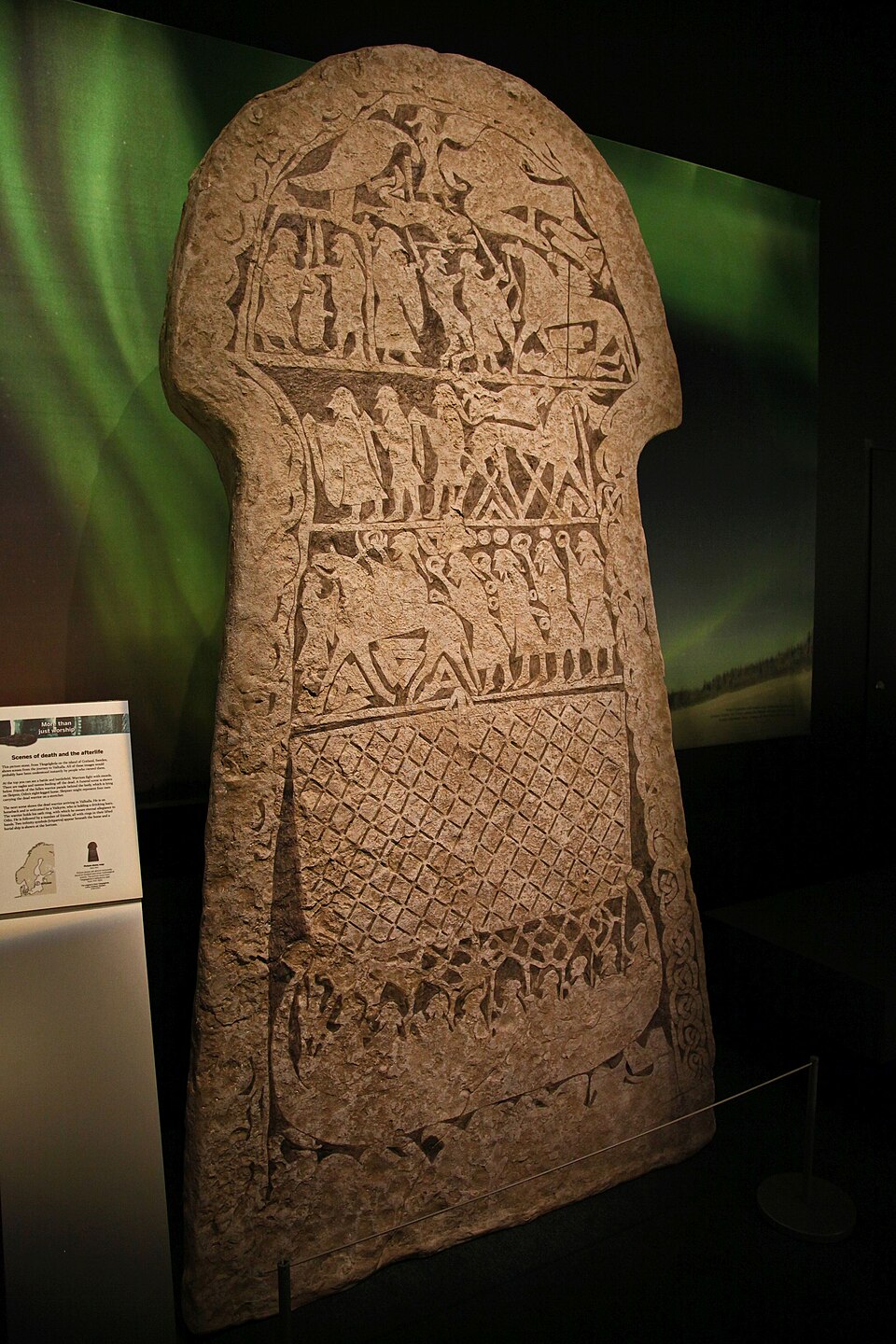
Vikings Tängelgårda image stone Gotland - 25901894206 Swedish History Museum (Historiska museet) MuseumsPartner exhibition “Vikings Beyond the legend” Australian National Maritime Museum Sydney 2013. Photo: JC Merriman / Wikimedia Commons. Source
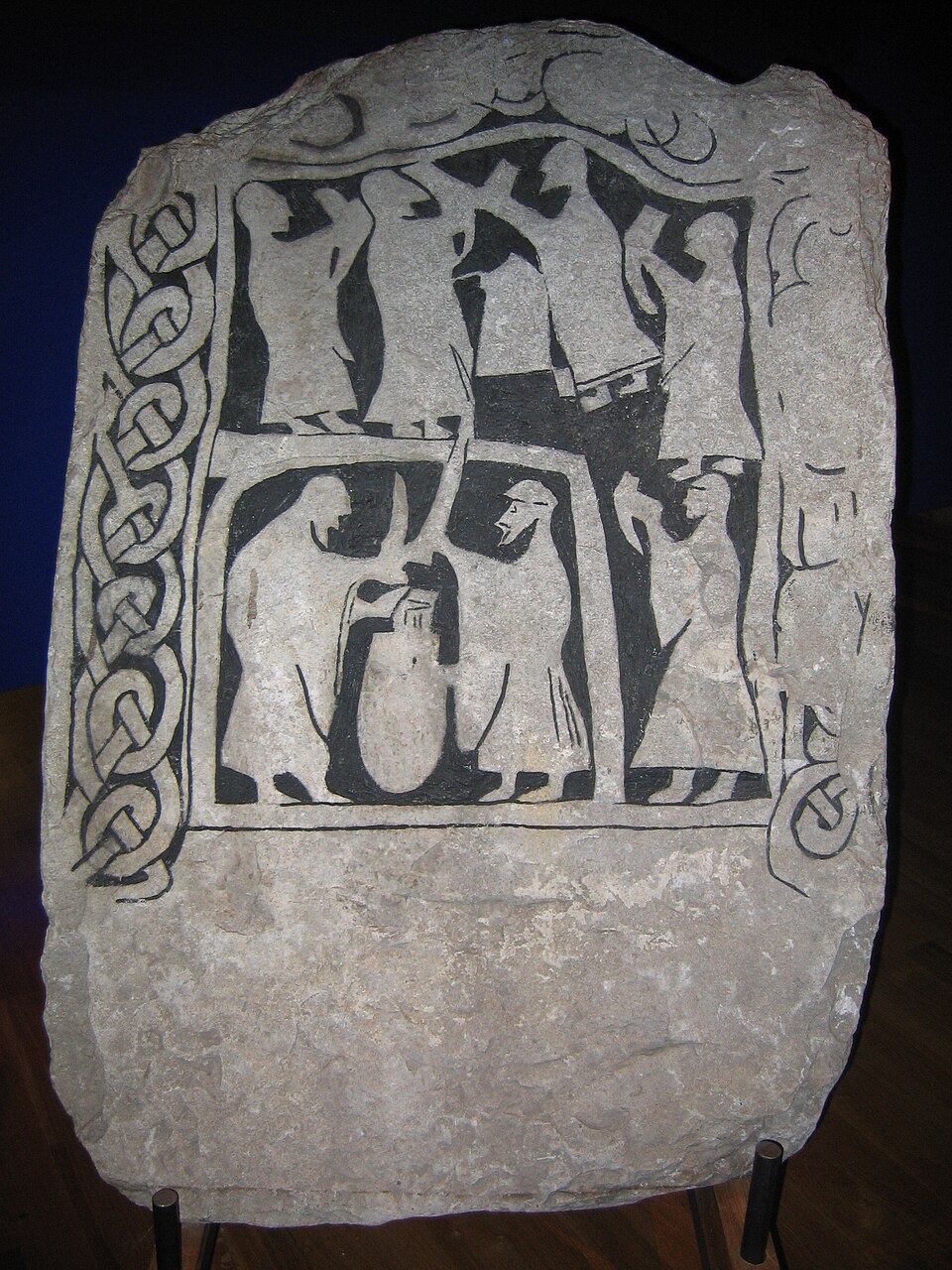
Drinking scene on an image stone. Photo: Berig / Wikimedia Commons. Source
EARLY MEDIEVAL BROOCH. Photo: Europeana. Source
Völund on ardre 01. Photo: Wikimedia Commons. Source The composite shows the female figure Bodvild standing near the forge, with the smith himself rendered as a winged figure surrounded by tongs and furnace equipment, and to the right of the smithy the headless bodies of King Niðhad’s sons — the trophies of Wayland’s revenge before his escape in the form of a giant bird [1] [5]. Mainstream scholarship reads this composition through Vǫlundarkviða, the eddic poem from which the story of the smith is chiefly handed down, and which supplies his capture and mutilation by King Níðuðr, his revenge in the form of the king’s sons beheaded, and his flight away in a bird-like aircraft or like a bird. The oblong, slightly curved objects below the headless bodies have been read as the place in the saga where Vǫlundr hides the king’s sons’ corpses [1].
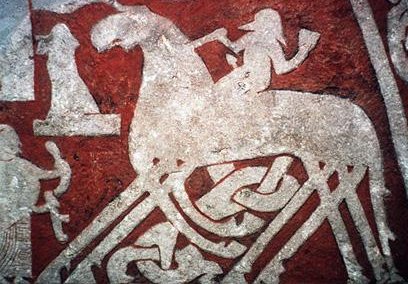
The upper register carries a horseman mounted on an eight-legged steed approaching a stylised hall building — a composition mainstream scholarship identifies as Óðinn riding Sleipnir toward Valhöll, drawing its authority from Snorri Sturluson’s Gylfaginning chapter 42, where the eight-legged horse and Odin’s arrival at the hall of the slain are explicitly described. Sleipnir is thought by most scholars to be the eight-legged horse shown on Ardre VIII alongside the Tjängvide stone, the two 8th-century Gotlandic stones that carry the motif. [3] [9]
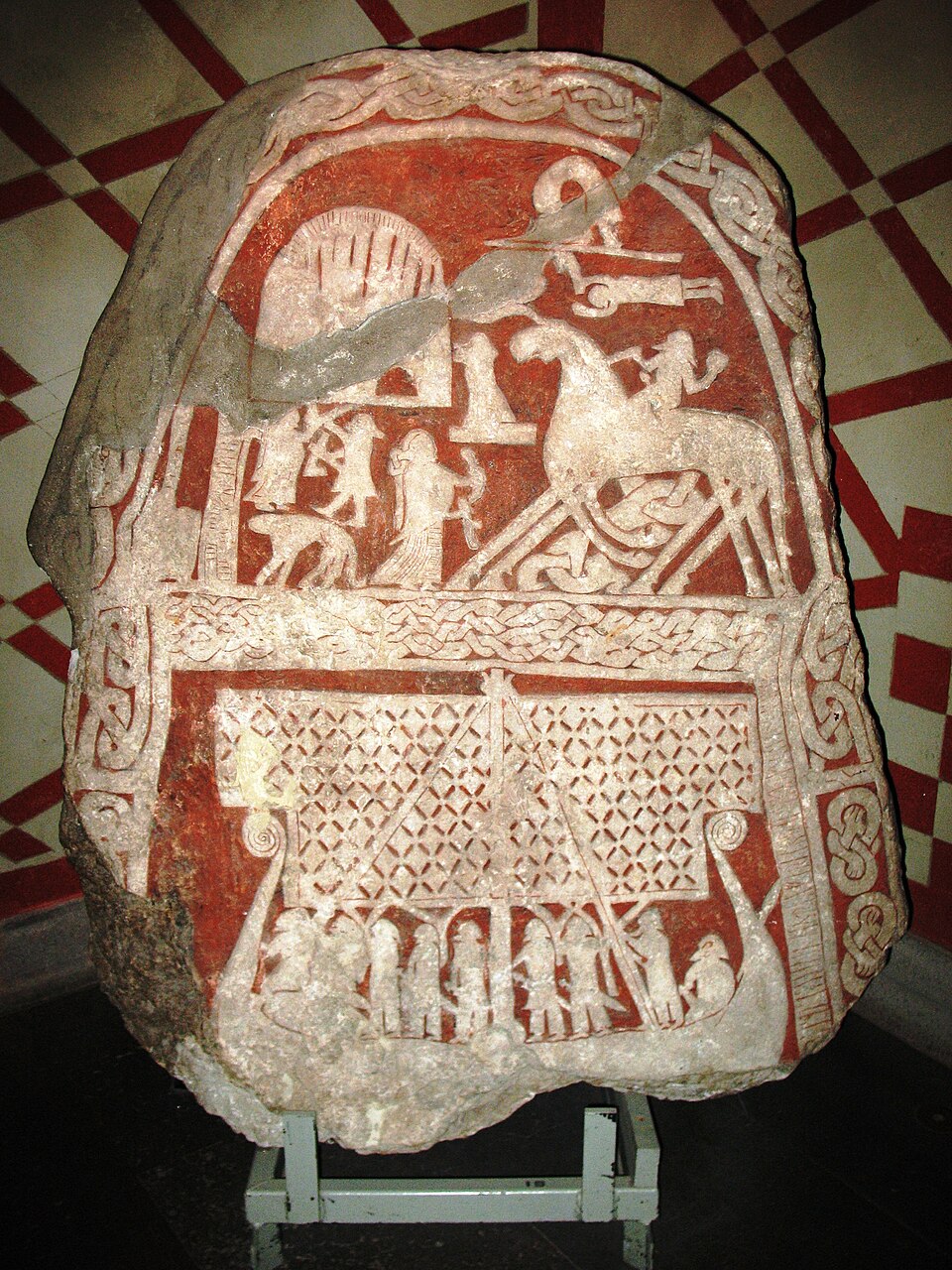
Tjängvide. Photo: Berig / Wikimedia Commons. Picture stone from Tjängvide, Alskog Parish, Gotland, Sweden. Source
Below the horseman, a spear-and-line composition is read as Þórr fishing for the world-encircling serpent Jörmungandr. Sigmund Oehrl published a dedicated reassessment of this scene in 2023 — “Þórr och Midgårdsormen på bildstenen Ardre VIII – en omvärdering” [17] — indicating that the identification remains a working hypothesis rather than a settled reading. In the lower right-hand corner, a figure bound above a serpent completes the mythological programme. Sune Lindqvist, working from his painted tracing in 1941/42, was the first to link this figure to the punishment of Loki for the death of Baldr — a reading that the online edition groups with the motifs it says can be identified on the stones with some certainty. [7] [3]
But here’s where the methodology becomes visible. Every mythological label placed on this stone has been arrived at by modern scholars matching worn images to medieval Icelandic texts committed to writing roughly three centuries after the carving — the Poetic Edda c. 1220, Snorri Sturluson’s Prose Edda c. 1270. Scholars at the University of Münster’s Cluster of Excellence caution publicly that “ideas about Vikings today can often not be verified scientifically” because the written sources derive from Christian accounts composed centuries after the events they purport to describe. Mainstream scholarship has nonetheless invested in 3D scanning, photogrammetry, and Reflectance Transformation Imaging to recover details invisible to the naked eye, and Sigmund Oehrl’s Ancient Images 2.0 project at Stockholm University is producing a new digital edition of all Gotlandic picture stones to supersede Lindqvist’s painted-tracing methodology. Fringe outlets such as the “Viking Superpowers” YouTube channel reach in the opposite direction — recasting Wayland as an “elf” of an “advanced humanoid race” and Norse myth as “real concrete events” recognisable as technology. The mainstream reading, by contrast, openly admits that it depends on bridging roughly four hundred years of separation between image and text. [8]
Ardre VIII Within the Gotlandic Picture-Stone Corpus
Ardre VIII, catalogued as GP 21, was recovered in 1900 from beneath the floor of Ardre church on Gotland’s east coast during restoration works, one of eight picture stones discovered together in the medieval church foundations. The stone is carved from fine reef-debris limestone of the Hemse Group, measures approximately 2.1 m in height and 2.3 m in width with thickness up to 0.2 m, and is classified as Lindqvist Type C/D, dating to approximately AD 700–1000. It belongs to a corpus of about 700 known Gotlandic picture stones [8], conventionally dated by mainstream scholarship to roughly AD 400–1100, and classified by Sune Lindqvist’s foundational 1941/1942 typology into sections A through E according to shape, size and motifs [4]. Ardre VIII is among the most studied of them, and the corpus is now being systematically reanalysed through the Ancient Images 2.0 photogrammetry project at Stockholm University, initiated in 2019 and funded by the Swedish Research Council until 2024 [8]. Hänsel and colleagues have published on the raw material of the picture stones, on which stone the carvers preferred, and on the isotopic provenance of their limestone [17]. [1]
What distinguishes Ardre VIII from its corpus-mates is its unusual compositional structure. Rather than the horizontal bands typical of most Gotlandic picture stones, Ardre VIII stacks several scenes vertically in rectangular fields, an arrangement described as several scenes placed one above the other in vertical rows within rectangular fields, “as if on a pillar” [15], and giving the stone its characteristic “mushroom shape”. The carving technique, with engraved outlines approximately 2 mm thick and background surfaces sunk up to 3 mm, produces a sunken-relief typical of D-stones, though the image surface is significantly abraded and polished from centuries of foot traffic when it served as a church floor. This departure from the standard horizontal arrangement is one of the formal features that has driven the ongoing iconographic re-evaluation of the monument, including sustained digital reassessment by Sigmund Oehrl and others. [1]
The monument’s iconography situates it within a wider Scandinavian and pan-Germanic visual tradition. The upper panel depicts a horseman riding an eight-legged horse, identified in mainstream scholarship as Sleipnir, the steed of the god Óðinn, with the rider approaching a stylised hall building accompanied by a twisted human body shown above. The lower registers depict elements of the Wayland/Völundr narrative from the eddic poem Völundarkviða: the smithy with tools, the decapitated bodies of King Niðhad’s sons, a female figure (Böðvildr), and the hero escaping in the shape of a giant bird. An early 8th-century Anglo-Saxon whale-bone chest in the British Museum, the Franks Casket, shows the same three elements on its front panel: Wayland in the forge, the headless body of the king’s son, and the smith’s escape on wings made from birds’ feathers [18]. Additional mythological scenes attributed to the stone include Þórr fishing for the Miðgarðsormr (the Midgard Serpent) and the punishment of Loki for causing Baldr’s death. Comparable motifs are documented from the Vendel Period (c. 550–750 AD), including the Torslunda bronze plates depicting Óðinn and possibly berserkers, establishing that the iconographic vocabulary predates Viking Age re-use. The eight-legged horse motif in particular is not unique to Ardre VIII but recurs on at least one further monument, GP 5 Alskog Tjängvide I, which is widely cited alongside Ardre VIII as one of the two principal depictions of Sleipnir on Gotlandic picture stones. 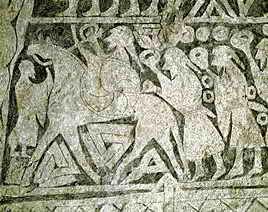 [1] [9]
Tangelgarda Odin. Photo: Wikimedia Commons. Source
A 2023 publication by Sigmund Oehrl has now reassessed parts of the imagery on Ardre VIII using digital imaging techniques, re-evaluating the possible depiction of Þórr and the Miðgarðsormr on the stone [17]. The stone was 3D-scanned in 2008 at Stockholm University and subjected to Reflectance Transformation Imaging (RTI) by Oehrl in 2013, leading to the detection of previously obscured details and a reassessment of conventional readings. Ardre VIII is currently exhibited at the Swedish History Museum in Stockholm, displayed alongside the Tjängvide stone as a paired reference for the corpus’s most recognisable mythological motifs. Despite this renewed material accessibility, mainstream scholarship itself remains internally divided on the eight-legged horse interpretation: the rider is read either as Óðinn himself or as a fallen warrior on his way to Valhǫll, and the literature has put forward competing readings from Buisson, Staecker, Hauck, Gjessing and Srigley. Oehrl’s 2011 study treats quadrupeds and binding iconography on Swedish runestones, and an earlier study of his treats ciphers of god-animal communication on a runestone and on Migration Period gold bracteates [7]. The point of contention is not the existence of the monument but the interpretation of its iconography, an unresolved methodological tension that mainstream scholarship acknowledges openly. [1]
Outside this mainstream framework, fringe interpreters treat the iconography on Ardre VIII quite differently. Fringe/alternative interpretations, such as those advanced by the Viking Superpowers YouTube channel, treat the motifs on Ardre VIII not as mythological iconography but as depictions of ‘real concrete events’ involving technology outside the understanding of the period. Related fringe commentary from the Institute for Natural Philosophy and The Roundtable Chronicles explicitly challenges mainstream archaeological interpretation, framing it as an ‘interpretative discipline’ driven by the interpreter’s framework rather than by the evidence itself. This fringe line of reasoning connects Ardre VIII to broader claims about natural features—such as ‘glacial scratch marks’—being misidentified as either natural or man-made depending on the cultural context of the finders. The methodological divide is therefore categorical: mainstream scholarship treats the iconography as religious/mythological cross-referenced with medieval Icelandic textual sources, while fringe interpreters approach the motifs as literal depictions involving technology outside conventional understandings of the period. The most important unresolved question is not whether either framework is correct, but whether the iconographic vocabulary on Ardre VIII can be read coherently at all once the medieval textual cross-references that mainstream scholarship relies on are set aside, as the fringe readings consistently do. [10] [11]
Connecting the Dots
Mainstream scholarship reads Ardre VIII as a Viking Age picture stone depicting scenes from Norse mythology: Odin riding Sleipnir, Wayland forging in his smithy with the captive Bodvild and the decapitated sons of King Niðhad, Thor fishing for Jörmungandr, and Loki bound for his part in Baldr’s death. The identification is confident and detailed, yet every label attached to the imagery comes from written Old Norse sources composed centuries after the stone was carved. The Völundarkviða and Snorri’s Gylfaginnings date from the 13th century onward; the stone itself is dated to the 8th or 9th century, with broader typological placement between ca. 700 and 1000 CE. The chronological gap between image and text is not a footnote. Erik Brate argued the monuments are Christian in character and that the eight legs of the horse may be artistic convention rather than a reference to Sleipnir at all. The mainstream reading is thus not a direct transcription but an inference, and a contested one. [12]
Fringe interpreters recast the Wayland figure as a “half-human, half-advanced humanoid” — the “Elf Astronaut” — and read the forge as alien technology rather than Norse mythology. On the surface this looks like a separate, sensationalist project. But it exploits the same methodological gap the mainstream reading leaves open: a 300-to-500-year distance between a carved image and the written narratives used to decode it. The fringe reading is not so much adding evidence as removing a chronological step — the imagery is “ancient” and “advanced” without needing Snorri. The mainstream and the fringe both start from the fact that the stone offers no runic text and no inscription that directly names its figures; they differ on whether to bridge that silence with eddic poetry or with speculation about prehistoric technology. [13] [14]
The composition itself points to a third possibility the two readings share a tendency to overlook. Ardre VIII arranges its scenes in vertical rectangular fields “as if on a pillar,” a layout the same passage parallels with stones on the Isle of Man and in north-west England, and its motifs — the mounted figure approaching a hall, the formal procession — can be traced to late Roman and Merovingian funerary imagery, including the adventus-principis tradition and parallels with the Magnentius medallion of AD 350 [3]. The stone’s visual vocabulary is older than the Norse mythological narratives later attached to it. The mainstream reading back-dates 13th-century literature onto an 8th- or 9th-century monument; the fringe reading back-dates modern technology onto it. Both may be missing the late-antique sepulchral layer — the journey-of-the-dead motif that scholars such as Brate and others situate within the Christianization process — which the iconographic parallels to Mediterranean funerary art suggest was the original compositional framework into which the Norse scenes were later set. [15]
The Other Side
Mainstream Scandinavian archaeology treats Ardre VIII as a mythological narrative carved by a craftsman working within a recognisable Viking Age iconographic tradition, not as encoded documentation of pre-historic technology. The conventional reading identifies the eight-legged mount as Sleipnir and the bound figure in the snake pit as Gunnarr, interpretations grounded in the surviving Poetic Edda textual corpus and refined over more than a century of scholarship since Sune Lindqvist’s foundational documentation work. Researchers at Stockholm University have built on this tradition using reflectance transformation imaging and 3D scanning to recover details invisible to the naked eye, establishing that the stones’ authorship, dating, and reuse history can be reconstructed through rigorous material analysis rather than narrative guesswork. The Gotlandic Picture Stones Online Edition project, hosted by Stockholm University, consolidates this work into a peer-reviewed digital corpus that treats each monument within its own iconographic program — explicitly avoiding the cross-stone conflation that fringe interpreters rely upon. [3] [8]
The methodological problems with the “Viking Superpowers” and “Institute for Natural Philosophy” interpretations are concrete. These channels treat Völundarkviða and the iconography of Bifröst as “real things, real concrete events” encoding advanced humanoid technology, but the sources themselves operate without peer review, without training in Old Norse philology, and without access to the primary material. When Viking Superpowers merges bird motifs from Ardre VIII and Tjängvide into a single “elf astronaut” identity, it violates the basic art-historical principle that each picture stone must be read within its own composition and dating context — a principle the authentic scholarly literature explicitly maintains. The “elf astronaut” framework falls squarely within the pattern Western scholarship classifies as pseudoarchaeology: selective use of evidence, resistance to standard dating methods, and the imposition of modern narrative categories onto ancient imagery without procedural accountability. [10] [16] [11]
Ardre Odin Sleipnir. Photo: Unknown authorUnknown author / Wikimedia Commons. Source
What We Actually Know
Ardre VIII is one of the most studied monuments on Gotland, and the investigation’s convergent findings put its basic identification on solid ground. The stone was recovered in 1900 during restoration at Ardre Church, where it had been reused as paving beneath a wooden floor, and it is now designated GP 21 in the Gotlandic Picture Stones database. The discovery chain — assistant vicar Karl Kristiansson documenting the find on 19 June 1900, Hugo Pipping’s examination on 25 June, and transfer to the Historical Museum in Stockholm later that year — is well documented, though the specific transport route via the steamer Wisby from Ljugarn rests on a single source. The stone is classified as Lindqvist Type C/D and dated typologically to approximately 700–1000 CE, placing it squarely in the Viking Age. [1]
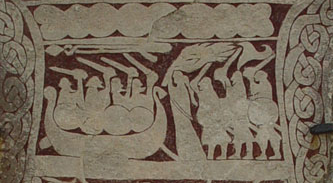
Detail from the Stora Hammars I stone, image stone on Gotland. Photo: The original uploader was Berig at English Wikipedia. / Wikimedia Commons. Source
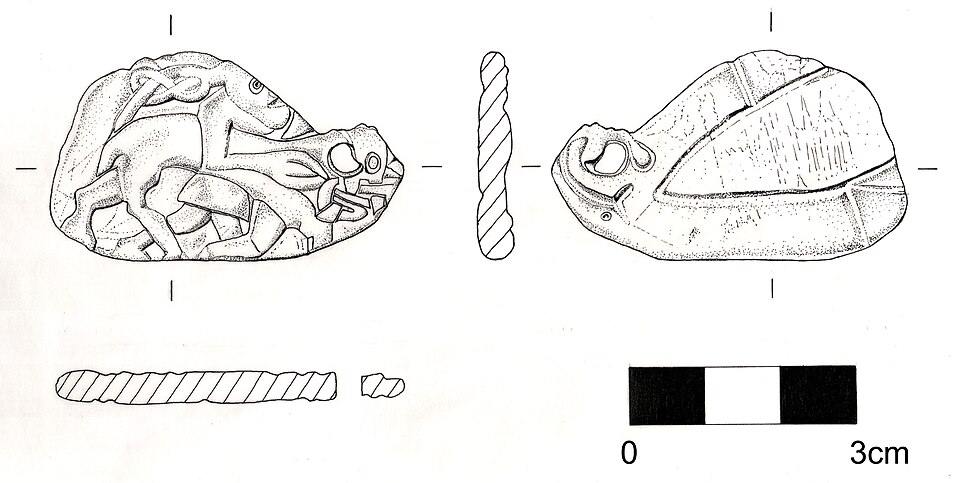
Early Medieval, Pendant. Line drawing Copyright Lisa Chapman (FindID 151371). Photo: None, Peter Reavill, 2008-02-14 12:30:45 / Wikimedia Commons. Source
The case for the Wayland (Völundr) forge reading is the investigation’s strongest convergent finding. The elements of the story of Wayland/Vǫlundr the smith, as known from the eddic poem Vǫlundarkviða, are read on the stone: the smithy, the decapitated corpses of the king’s sons, and the hero escaping in the shape of a giant bird. The stone carries no runic inscription, so the identification rests entirely on comparative iconography with related Gotlandic monuments (notably GP 5 Alskog Tjängvide I) and the broader Norse mythic corpus. [1] [3]
Several findings remain plausible but not yet settled. The stone’s distinctive vertical pillar-like panel arrangement, unusually structured for a Gotlandic picture stone, has been noted but not yet fully explained. Sigmund Oehrl’s 2023 re-evaluation of the Þórr and Midgard Serpent scene, and Cecilia Ljung’s dedicated study on the medieval church’s reuse of pagan stones, both indicate ongoing scholarly reassessment using new digital imaging techniques. Ljung’s observation that Pipping’s field drawing is schematic rather than spatially exact — and her conclusion that the first stone church and the picture stone reuse are contemporary (late 12th century) — limits the precision of any reconstructed find assemblage. The 1992 conservation by Solveig Marchner, the 2008 Stockholm University 3D scan, and Oehrl’s 2013 RTI documentation mark the stone as an object of sustained technical re-examination [1]. [17]
References
[1] GP 21 Ardre kyrka VIII — https://gotlandicpicturestones.se/s/index/item/2068 (accessed 2026-08-04)
[2] Ardre image stones — https://en.wikipedia.org/wiki/Ardre_image_stones (accessed 2026-08-04) [Reputable]
[3] Iconography · Gotlandic Picture Stones - The Online Edition — https://www.gotlandicpicturestones.se/s/index/page/iconography (accessed 2026-08-04)
[4] 3D scanning of Gotland picture stones with supplementary material — https://www.su.se/download/18.11777a0b1993704a0586b33/1758028079276/KitzlerJONAS18kitzlerJONAS18.pdf (accessed 2026-08-04)
[5] Ardre VIII - Viking Archaeology — http://viking.archeurope.com/art/sculpture/gotland-picture-stones/a-gallery-of-gotland-picture-stones/ardre/ (accessed 2026-08-04)
[6] Ardre image stones - Picture stones at Ardre Church, Sweden - Around Us — https://aroundus.com/p/9497815-ardre-image-stones (accessed 2026-08-04)
[7] Gotland’s Picture Stones — https://www.arild-hauge.com/PDF/New_Iconographic_Interpretations_of_Gotl.pdf (accessed 2026-08-04)
[8] The stones speak to us – and will become more understandable — https://www.su.se/english/news/articles/2024-05-15-the-stones-speak-to-us---and-will-become-more-understandable (accessed 2026-08-04)
[9] Sleipnir — https://en.wikipedia.org/wiki/Sleipnir (accessed 2026-08-04) [Reputable]
[10] Valhalla and The Elf Astronaut! [3:41-5:50] — Viking Superpowers (YouTube) — https://youtu.be/TKDviyKnY4U?t=221 (accessed 2026-08-04)
[11] The Elf Astronaut Who Flew To VALHALLA! [14:54-17:02] — Viking Superpowers (YouTube) — https://youtu.be/tis10x0O4zI?t=894 (accessed 2026-08-04)
[12] Ardre Image Stones. Viking era. Ardre VIII. 8th-9th century. Scenes from … — https://www.album-online.com/detail/en/NjhiMjFmMA/ardre-image-stones-viking-era-viii-century-scenes-from-norse-alb3156305 (accessed 2026-08-04)
[13] The Elf Astronaut Who Flew To VALHALLA! [3:32-5:48] — Viking Superpowers (YouTube) — https://youtu.be/tis10x0O4zI?t=212 (accessed 2026-08-04)
[14] Valhalla and The Elf Astronaut! [6:48-8:53] — Viking Superpowers (YouTube) — https://youtu.be/TKDviyKnY4U?t=408 (accessed 2026-08-04)
[15] Picture-stone workshops on Viking Age Gotland — https://www.arild-hauge.com/PDF/Picture-stone_workshops_on_Viking_Age_Go.pdf (accessed 2026-08-04)
[16] The Elf Astronaut Who Flew To VALHALLA! [10:08-12:10] — Viking Superpowers (YouTube) — https://youtu.be/tis10x0O4zI?t=608 (accessed 2026-08-04)
[17] Project-related publications — https://www.gotlandicpicturestones.se/s/index/page/publications (accessed 2026-08-04)
[18] Franks Casket — https://en.wikipedia.org/wiki/Franks_Casket (accessed 2026-10-04) [Reputable]
Corrections
- Every claim in this paper was re-checked against the sources it cites, by an independent audit that fetched and read each source rather than accepting the stored verdict. Of 64 verifiable assertions, 37 did not hold up: they were unsupported, attributed to the wrong reference, or contradicted by the very source cited. 23 were confirmed as written. 17 replace claim, 12 reattribute, 5 delete claim, 3 replace number were applied. Each correction narrows a claim to what its source actually says, moves it to a source that does support it, or removes it where no source could. An honest limit: 4 of the 64 assertions rest on sources that could not be read at all - paywalls, bot protection, video without a transcript. Those claims are neither confirmed nor corrected here, and a reader cannot check them either. They are the weakest part of this paper's evidence base. The audit was performed and applied by an AI agent fleet; no line of the corrected text has been read by a human editor. A reference that resolves is not thereby right - it was read before it was trusted. A note on provenance: this paper carried no model stamp at all, so which model wrote the original research cannot be recovered. The correction's own stamp is recorded; the original's is not guessed at.
- Every claim in this paper was re-checked against the sources it cites, by an independent audit that fetched and read each source rather than accepting the stored verdict. Of 64 verifiable assertions, 37 did not hold up: they were unsupported, attributed to the wrong reference, or contradicted by the very source cited. 23 were confirmed as written. 21 replace claim, 12 reattribute, 3 replace number, 1 delete claim were applied. Each correction narrows a claim to what its source actually says, moves it to a source that does support it, or removes it where no source could. An honest limit: 4 of the 64 assertions rest on sources that could not be read at all - paywalls, bot protection, video without a transcript. Those claims are neither confirmed nor corrected here, and a reader cannot check them either. They are the weakest part of this paper's evidence base. The audit was performed and applied by an AI agent fleet; no line of the corrected text has been read by a human editor. A reference that resolves is not thereby right - it was read before it was trusted.
Keep exploring
Every site on this page sits on the globe, and the people who research them are on the Discord.
3D Globe · Sites by country · Story Archive · Research Library · Weekly Journal · Search