 ANCIENT NERDS
Ancient Hermeticism and the Modern Kybalion
The paper concludes that the 1908 Kybalion is almost certainly a modern New Thought composition — most likely by William Walker Atkinson — rather than a transmission of genuine ancient Hermetic doctrine, since its seven principles cannot be located in the historical Corpus Hermeticum, its central axiom "as above, so below" is a modern English paraphrase of an Arabic-Latin alchemical verse, and the figure it invokes, Hermes Trismegistus, is a syncretic mythological construct with no verified historical existence. It acknowledges that the specific question of whether any of the seven principles have even an indirect pedigree in ancient Hermetic sources remains unresolved, as no systematic principle-by-principle mapping has yet been performed.
In 1908, a slim volume appeared from Chicago’s Yogi Publication Society, subtitled “A Study of the Hermetic Philosophy of Ancient Egypt and Greece”. It was called The Kybalion, and its authors identified themselves only as “Three Initiates”. Over the following decades, the writers behind the pseudonym were widely identified as a single figure: William Walker Atkinson (1862–1932), a New Thought movement pioneer. [1]
But the sage the Kybalion claimed to channel — Hermes Trismegistus — was a syncretic figure, a mythological blend of the Greek god Hermes and the Egyptian god Thoth with no verified historical existence. The Greek-language treatises that bear his name, the Corpus Hermeticum and the Asclepius, were composed in Roman Egypt between the 1st and 3rd centuries CE. And the most famous line the book attached to him — “As above, so below” — was in fact a modern English paraphrase of a Latin translation of an 8th-to-10th-century Arabic alchemical text, whose original Arabic read “from” rather than “like to”. [2] [3]
The 1908 Kybalion: Authorship and Publication
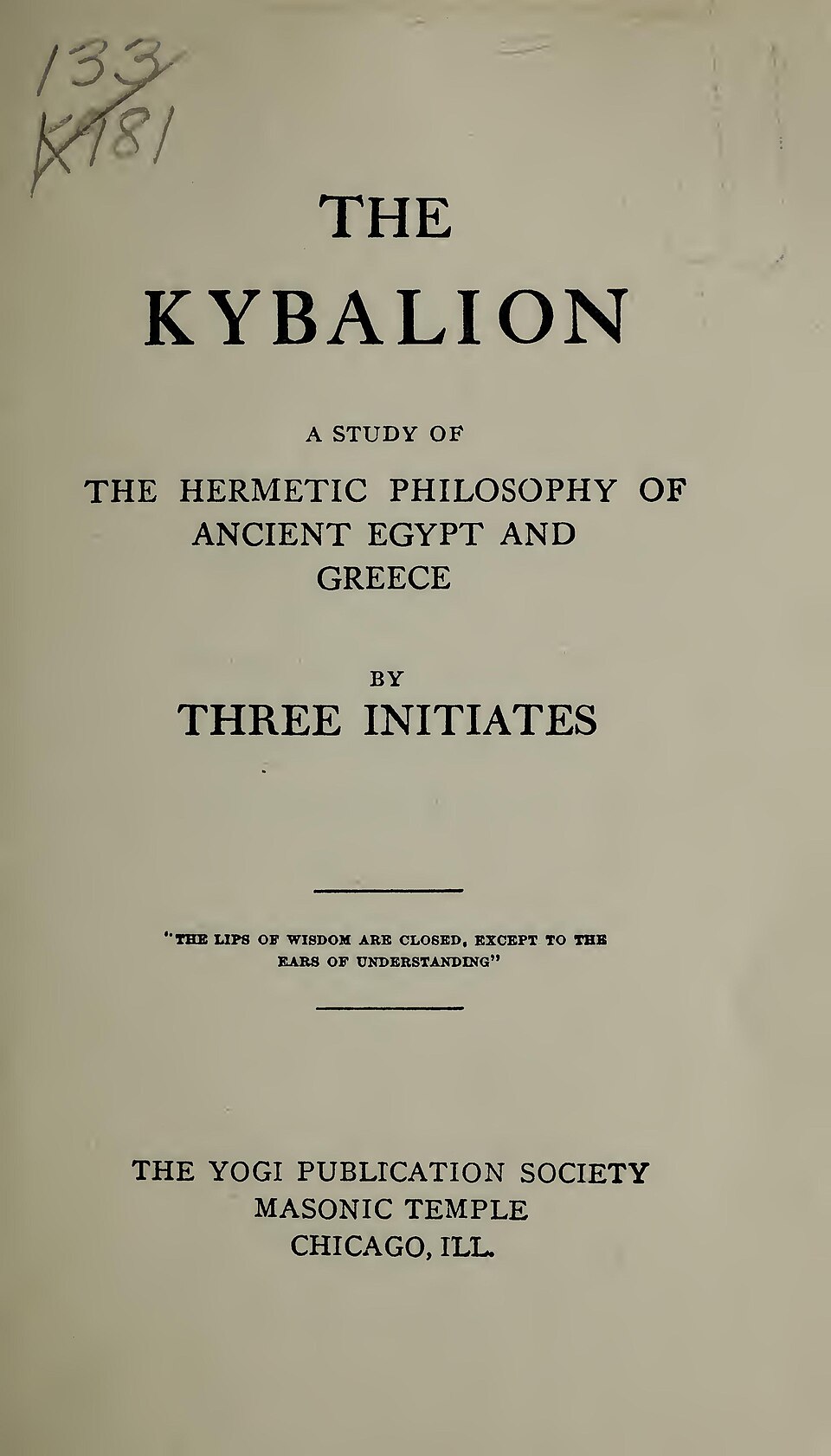
The Kybalion emerged in 1908 from the Yogi Publication Society in Chicago, Illinois. It was issued anonymously under the collective pseudonym “Three Initiates”.  [4] [5]
Kybalion 1908. Photo: American Libraries / Wikimedia Commons. Image placed by the paper writer as visual evidence for this passage. Source The volume enumerates exactly seven Hermetic principles: Mentalism, Correspondence, Vibration, Polarity, Rhythm, Cause and Effect, and Gender. The opening conceit — that the book merely elucidates an unpublished ancient text of the same name — has never been corroborated by any independent manuscript discovery.
Authorship now points overwhelmingly toward William Walker Atkinson (1862–1932), a New Thought movement pioneer. Atkinson published prolifically across the same press under a documented web of pseudonyms — Yogi Ramacharaka, Swami Panchadasi, Theron Q. Dumont, Magus Incognito — creating the illusion of a diverse spiritual authority network that was, in reality, largely one man. [6]
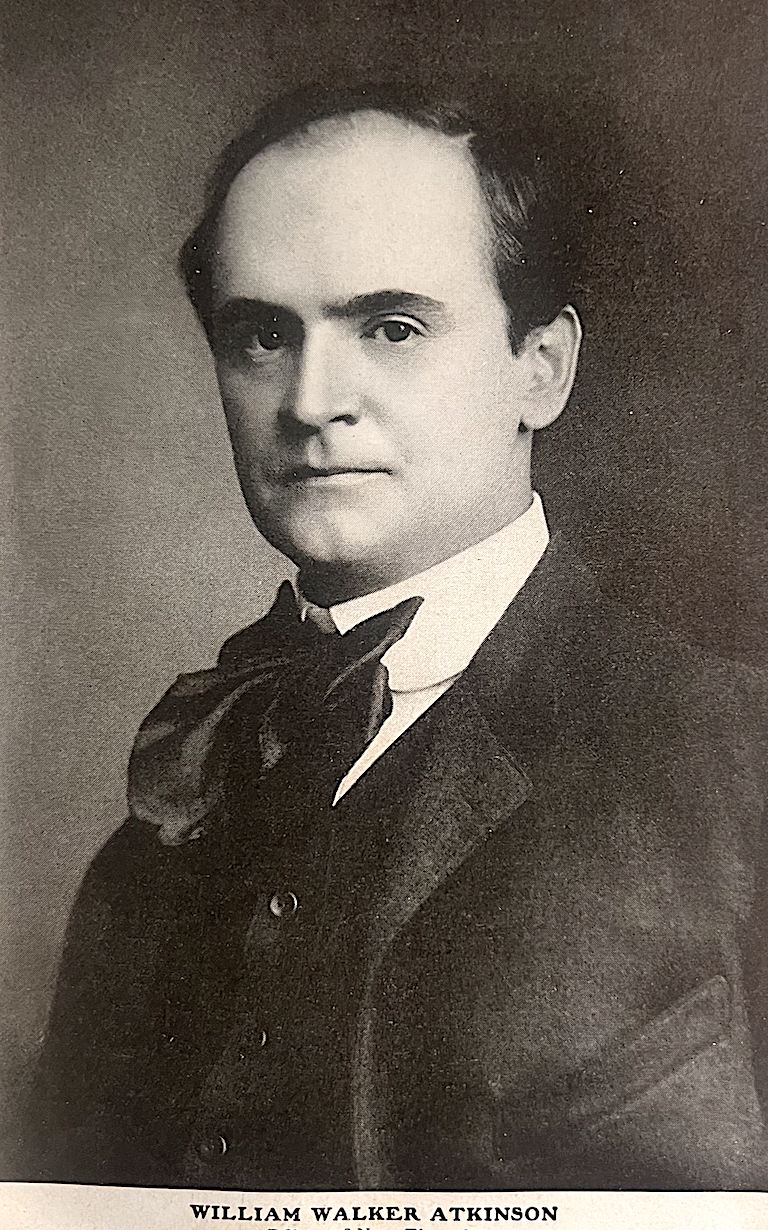
A portrait of Dr. Herbert A. Parkyn’s protégé and New Thought author, William Walker Atkinson, in 1901. Photo: A portrait of Dr. Herbert A. Parkyn’s protégé and New Thought author, William Walker Atkinson, in 1901 / Wikimedia Commons. A portrait of Dr. Herbert A. Parkyn’s protégé and New Thought author, William Walker Atkinson, in 1901. Source
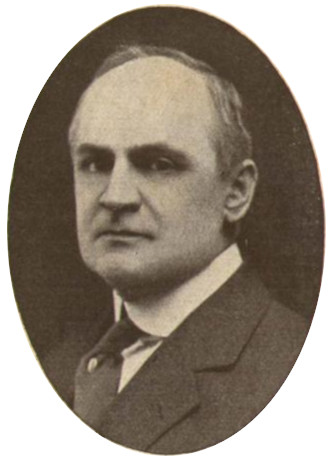
William Walter Atkinson 2 (cropped). Photo: Unknown authorUnknown author / Wikimedia Commons. William Walter Atkinson’s portrait extracted from another image. Source
Hatha yoga, or the Yogi philosophy of physical Wellbeing… / by Yogi Ramacharaka,…; published by Yogi publication society. Photo: Atkinson, William Walker (1862-1932). Author of the text / Europeana. Contient une table des matières. Source
But the attribution has never been conclusively proven. Co-authorship with Paul Foster Case and Michael Whitty has been speculated, and The Arcane Teachings may have served as an earlier draft of the same material. Atkinson’s own later work, The Seven Cosmic Laws, restated and rebranded the same seven principles without significant innovation — a fact critics cite as evidence the core material was New Thought rather than ancient doctrine. [5]
The maxim now most closely associated with the book — “As above, so below” — is itself a modern paraphrase, not an original formulation. It traces to the second verse of the Emerald Tablet, a short Hermetic text first attested in an Arabic source from the late eighth or early ninth century. The “like to” wording of the modern English paraphrase is peculiar to the Latin tradition and diverges from the original Arabic which reads “from” rather than “like to”. The modern formulation acquired its occult currency through Helena P. Blavatsky (1831–1891) and the anonymous author of the Kybalion, often taken to be William Walker Atkinson, and subsequently took on a life of its own as a New Age motto. [7]
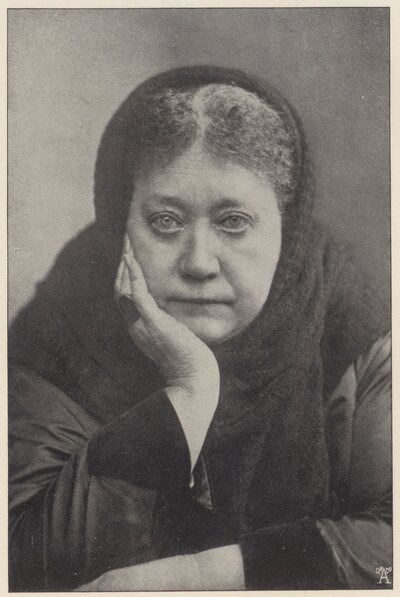
Fotografie von Helena Petrovna Blavatsky. Photo: Europeana. Blavatsky is named as the conduit who gave the paraphrased maxim its occult currency; a…. Source
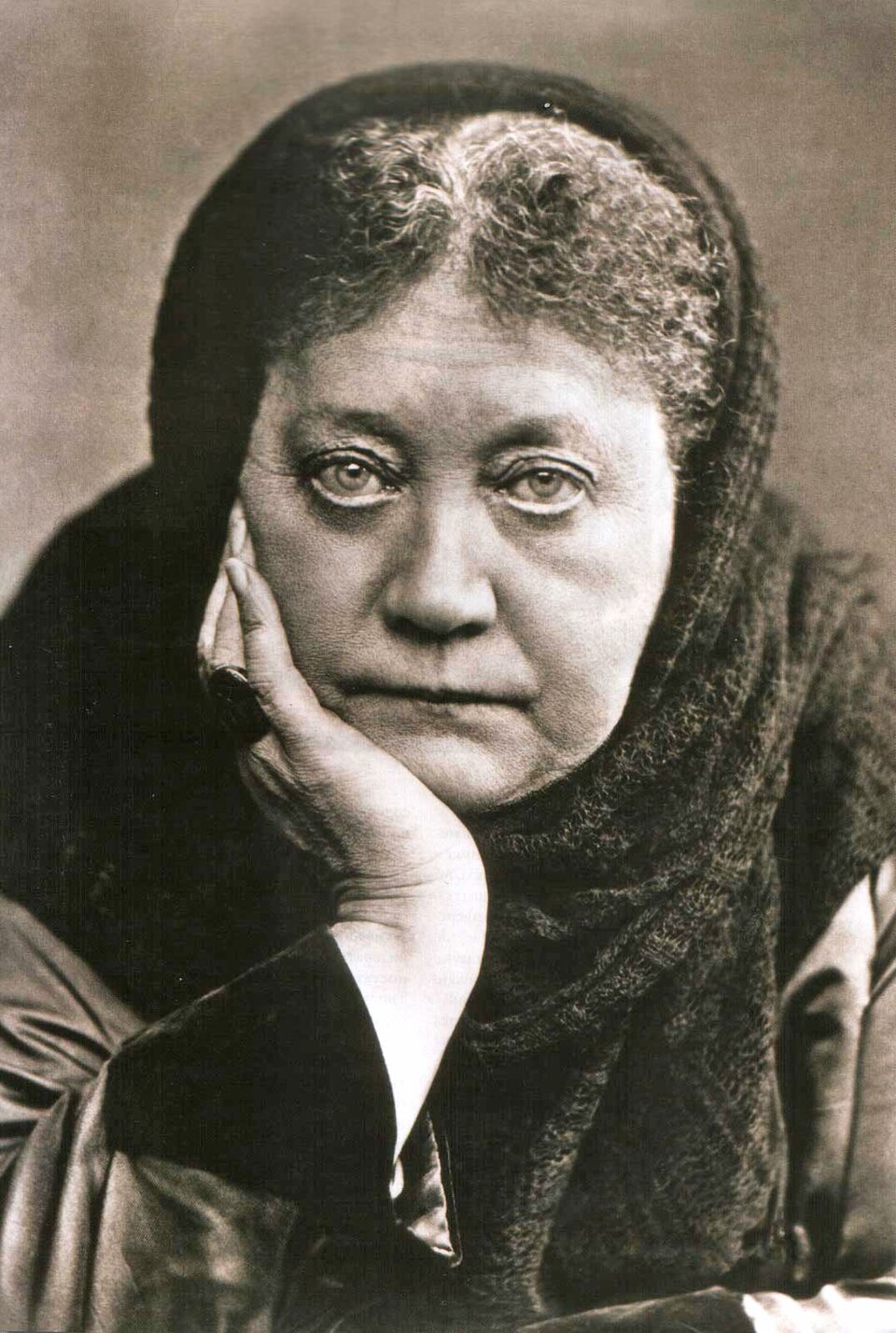
Blavatsky.006. Photo: unklar / Wikimedia Commons. Helena Petrovna Blavatsky (1831-1891). Source
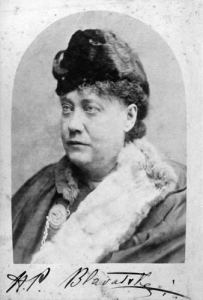
Blavatsky.005. Photo: unklar / Wikimedia Commons. Helena Petrovna Blavatsky (1831-1891) im Jahr 1878. Source
Here is the part that doesn’t sit right. The scholarly assessment now available holds that the Kybalion is not a Hermetic text at all — its seven principles bear little resemblance to authentic Hermetic texts like the Corpus Hermeticum and align more closely with 19th-century New Thought philosophy than with classical Hermetism. The title “Kybalion” is not found in any historical Hermetic corpus and was likely coined by the author(s); the book purports to elucidate an unpublished ancient text of the same name. The Kybalion draws identifiable influences from 19th-century occultism and Theosophy, particularly Helena Blavatsky and Éliphas Lévi, and from New Thought via Atkinson’s own prior writings. The book that has been used in modern esoteric and self-help contexts as a complete, near-canonical summary of Hermetic thought, frequently quoted alongside “as above, so below” as a foundational motto, is, by the most stringent scholarly assessment available, an early-20th-century New Thought text in a Hermetic costume. What remains genuinely unresolved is whether the book’s internal doctrinal coherence — coherence that even critics concede is real — emerged from Atkinson’s solitary authorship or from a circle of collaborators whose names, if they existed, have left no paper trail. [8] [7] [9]
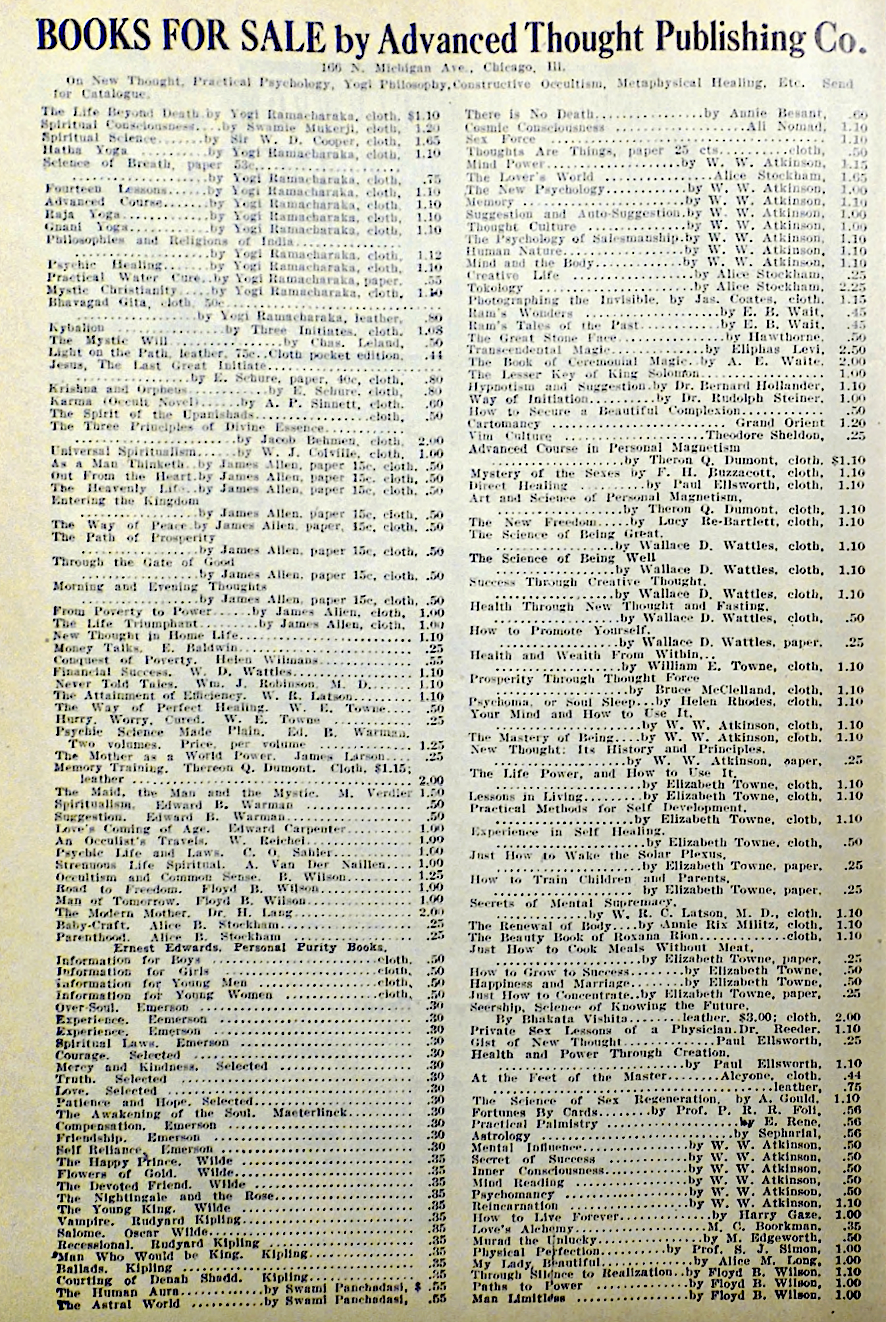
Catalog of books for sale by the Advanced Thought Publishing Company, including most of the back catalog of titles published by the Yogi Publication Society. 1916. Photo: Catalog of books for sale by the Advanced Thought Publishing Company, including most of the back catalog of titles published by the Yogi Publication Society. 1916 / Wikimedia Commons. Showing the title page of an Atkinson New Thought book preceding the Kybalion by a…. Source
Ancient Hermeticism: The Corpus Hermeticum and Hermes Trismegistus
Hermes Trismegistus is a legendary Hellenistic syncretic figure — a conflation of the Greek god Hermes and the Egyptian god Thoth that took shape in Ptolemaic and Roman Egypt. No archaeological evidence supports his historical existence. The religio-philosophical texts attributed to him are a relatively coherent body of Greek treatises composed in Roman Egypt, primarily during the second and third centuries CE, with the very earliest — the Definitions of Hermes Trismegistus to Asclepius — possibly going back to the first century CE. They combine philosophical anthropology, cosmology, and theology, addressing the relationship between human beings, the cosmos, and God. The Corpus Hermeticum comprises seventeen Greek treatises, and together with the closely related Latin Asclepius forms the foundational documents of the tradition. The works are fundamentally syncretic, mixing Platonic, Stoic, and Aristotelian elements with Egyptian, Jewish, and early Christian ideas from an Alexandrian milieu. The ‘technical’ Hermetica — treatises in alchemy, astrology, medicine, and magic — form a parallel branch, with the Emerald Tablet the most famous surviving example. [10]
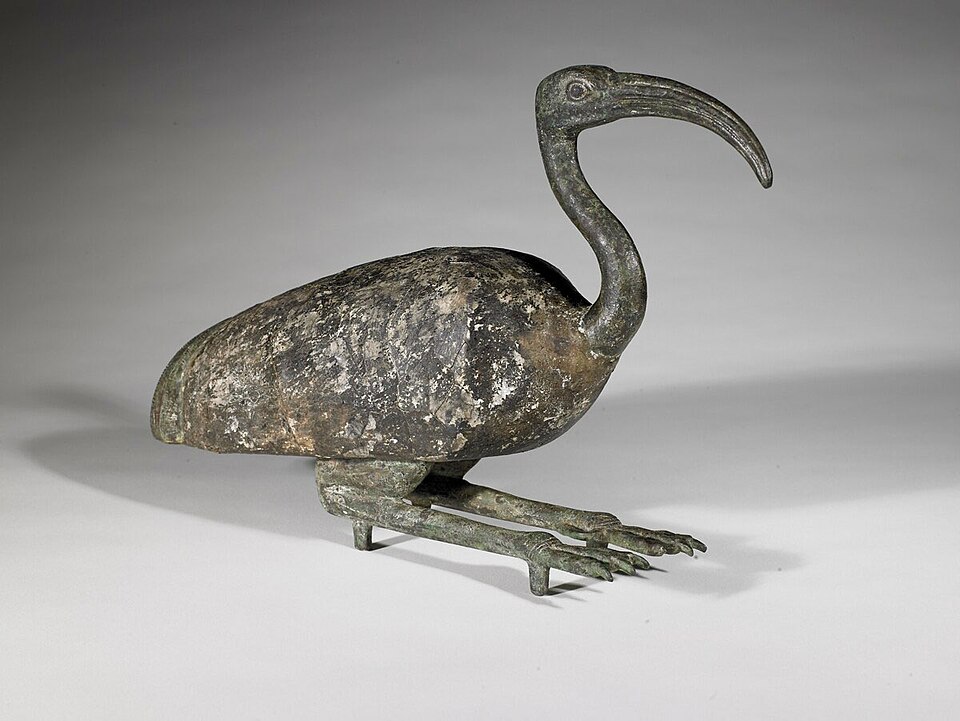
Ibis-BMA. Photo: Wikimedia Commons. A wooden and bronze statue of an ibis from the Late Period of Egypt. Source
The Poimandres opens the Corpus Hermeticum as its first and most famous treatise, presenting a revelatory vision in which Hermes Trismegistus is instructed by a divine being called Poimandres, the ‘Mind of Sovereignty’ or Nous. In the text, Poimandres declares ‘I am the light you saw, mind, your god,’ revealing cosmogony to Hermes. The soul’s ascent through seven planetary spheres is a central feature of the work — each sphere governed by one of the seven classical planetary deities (Sun, Moon, Mercury, Venus, Mars, Saturn, Jupiter) and corresponding to material attachments the soul must shed in order to return to divine Nous. The Hermetic path as described involves aligning human consciousness with this divine Nous through gnosis — direct experiential knowledge attained through meditation, ritual practice, and ecstatic altered states of consciousness that transcend rationality. [11]
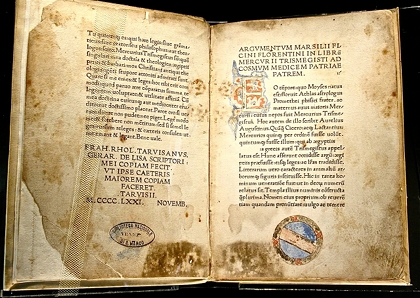
Corpus Hermeticum. Photo: Marsilio Ficino, Hermes Trismegistus / Wikimedia Commons. Allows the reader to verify that Poimandres is indeed the opening treatise and to see…. Source
The Corpus Hermeticum was lost to the Latin West after classical times, surviving only in Byzantine Greek manuscripts, until Marsilio Ficino translated it into Latin in 1471 under the patronage of Cosimo de’ Medici. That translation — the Pimander — became the seminal event fueling Renaissance Hermeticism. Modern scholarly re-evaluation, however, has argued that Ficino’s Latin text was corrupt in crucial respects, casting doubt on whether Renaissance readers actually understood the Hermetic message. The Coptic Nag Hammadi library, discovered in 1945, transformed scholarship from a different angle by preserving three previously unknown Hermetic texts: the Discourse on the Eighth and Ninth (NHC VI,6), the Prayer of Thanksgiving (NHC VI,7), and a Coptic excerpt from the Asclepius (NHC VI,8). 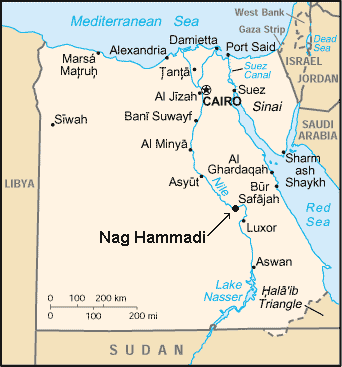 [12] [13] [14]
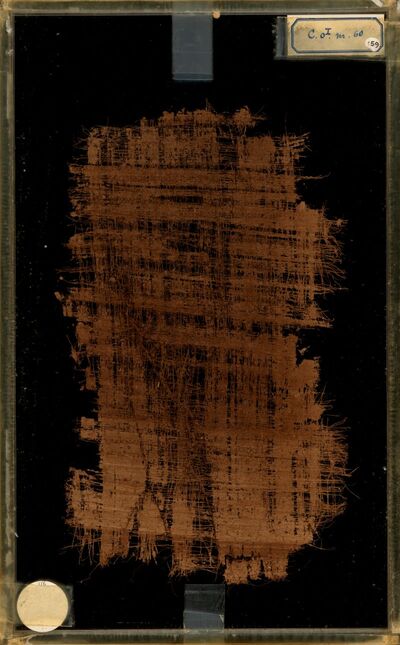
Folio from the Manichaean Kephalaia. Photo: Unknown / Europeana. A Coptic-language Asclepius fragment shows the text circulated in Egypt in ritualized Coptic translation, distinct…. Source
Eg-NagHamadi-map. Photo: Wikimedia Commons. Image placed by the paper writer as visual evidence for this passage. Source The Discourse on the Eighth and Ninth is an initiation text describing an ascent through the eighth and ninth spheres, providing rare evidence of liturgical and ritual dimensions within Hermetic communities — ritual vocalizations (vowel phrases based on the sacred name IAO), prescribed mystical ascent, and a sacramental close. This discovery provided evidence that Hermetic communities practiced actual ritual with experiential and visionary elements, not merely armchair philosophy.
André-Jean Festugière dominated twentieth-century study of the religio-philosophical Hermetica by emphasizing their Greek and philosophical elements while dismissing references to ecstatic visionary experience as ‘literary fictions’. Jean-Pierre Mahé’s work, using the Nag Hammadi discoveries, shifted the field toward recognizing Egyptian, religious, and ritual dimensions. The Nag Hammadi texts put what one commentator described as ‘a bombshell’ under Festugière’s earlier view, suggesting instead that Hermeticism included ritual communities with actual initiatory practices. Brian P. Copenhaver’s 1992 English translation became the standard scholarly edition of the Corpus Hermeticum and Latin Asclepius; he characterizes the texts as fundamentally ‘devotional’ rather than systematic philosophy, arguing for a non-unitary reading fractured along lines of ‘kosmic pessimism versus kosmic optimism’. Copenhaver’s edition is now the authoritative scholarly resource situating the Hermetic texts within their Hellenistic and Roman Egyptian cultural and intellectual context. The deepest unresolved question is whether the Greek philosophical architecture visible in the Corpus — the Nous cosmology, the seven-sphere ascent, the gnosis framework — describes an actual ritual tradition or a literary-philosophical system retrofitted with visionary vocabulary; the Nag Hammadi evidence tilts the balance toward ritual, but a Festugière-style defender could still argue that even the Discourse on the Eighth and Ninth is a meditative literary exercise rather than a script for community practice. [15] [16]
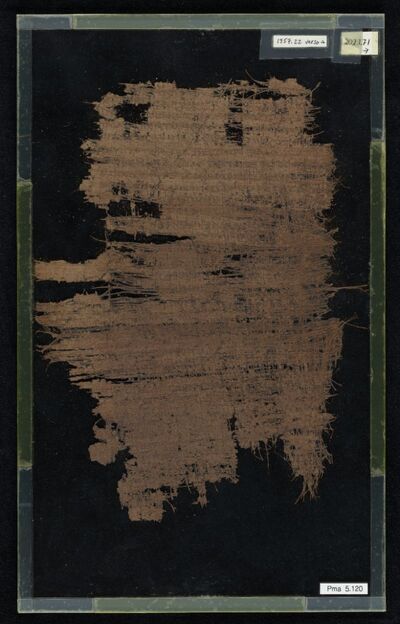
Folio from the Manichaean Synaxeis. Photo: Unknown / Europeana. The physical codex is the documentary evidence the paragraph’s whole argument turns on; showing it…. Source
The As Above, So Below Maxim and the Seven Principles Pedigree
The English phrase “As above, so below” circulates today as if it were an ancient Egyptian axiom handed down from Hermes Trismegistus himself. The Kybalion places it at the heart of its Principle of Correspondence, opening Chapter II with the formulation “As above, so below; as below, so above”. But the wording is a modern paraphrase of the second verse of the Emerald Tablet, and it derives specifically from the Latin vulgate translation rather than from the original Arabic source. The oldest known version of the Tablet appears in the Arabic Sirr al-Khalīqa wa-ṣanʿat al-ṭabīʿa, compiled in the late eighth or early ninth century and falsely attributed to Apollonius of Tyana under the name Balīnūs. The Latin vulgate, which became the basis for all later European versions, was produced in the first half of the twelfth century, with its translator tentatively identified as Plato of Tivoli (active c. 1134–1145). That Latin text reads “Quod est superius est sicut quod inferius” — “that which is above is like to that which is below” 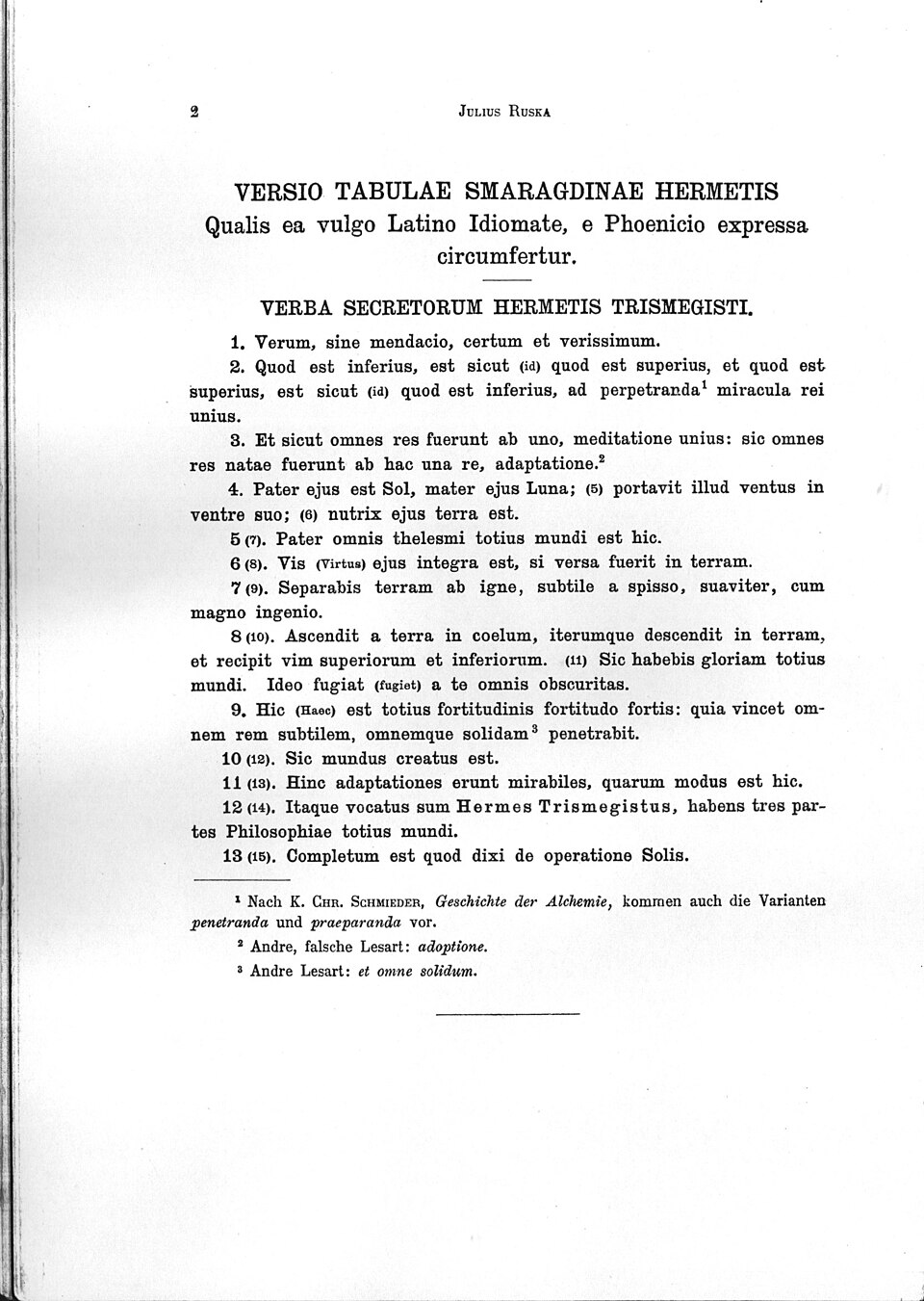 [17] [7]
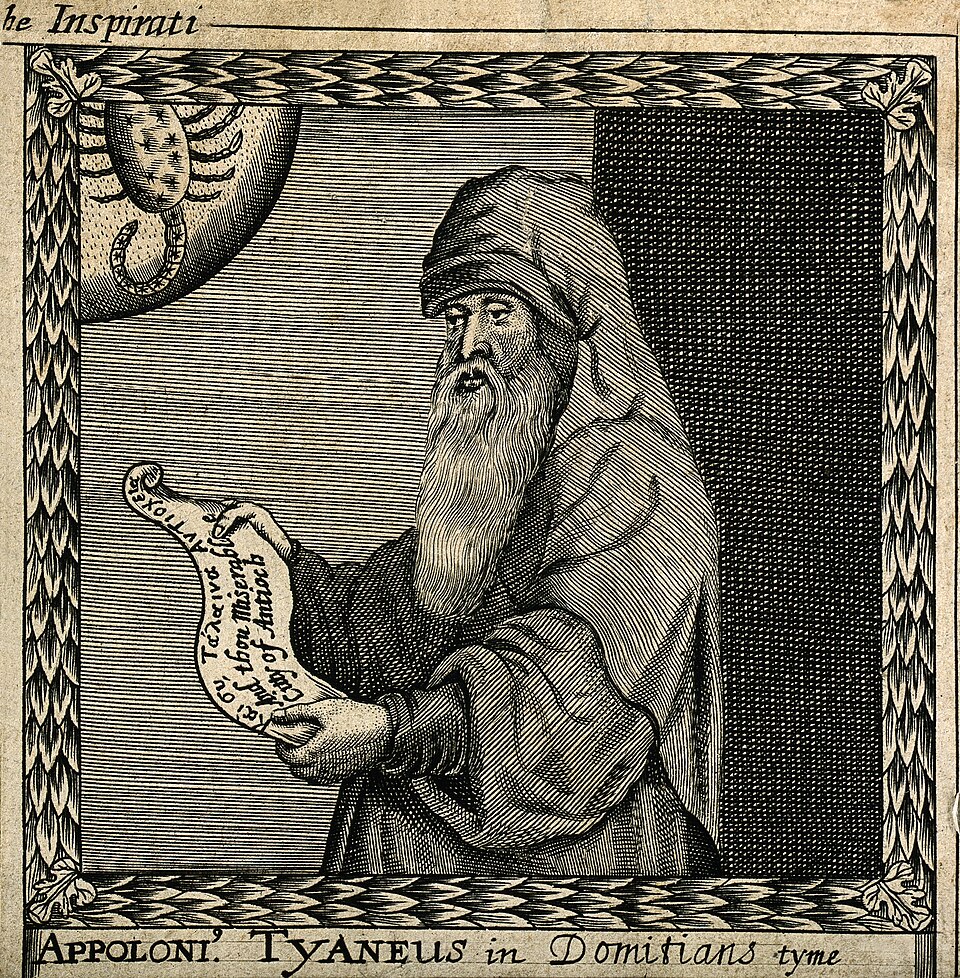
Apollonius of Tyana. Line engraving by F. Cleyn, 1659. Wellcome V0000175. Photo: Wikimedia Commons. An image of Apollonius makes the pseudepigraphic attribution concrete and lets the reader see why…. Source
Tabula latin. Photo: Unknown authorUnknown author / Wikimedia Commons. Tabula smaragdina in Latin. Source — while the original Arabic uses “from” (min) rather than “like to” (sicut), a subtle but consequential shift that the English paraphrase silently absorbs.
The Kybalion’s seven Hermetic principles — Mentalism, Correspondence, Vibration, Polarity, Rhythm, Cause and Effect, and Gender — present themselves as “the foundation of the entire Hermetic Philosophy”. But this enumeration does not appear in any pre-1908 Hermetic text. The genuine Corpus Hermeticum, written in Greek between roughly 100 and 300 CE, contains no such sevenfold scheme and uses none of these names. The Emerald Tablet itself, the closest ancient relative, sets out a brief alchemical cosmology rather than a list of seven laws. Only the Principle of Correspondence can claim genuine pre-modern pedigree, and even that connection runs through a medieval Latin alchemical treatise rather than through any classical Greek source. Modern encyclopedic scholarship now classifies the Kybalion as a “modern offshoot” of Hermeticism, distinct from both the religio-philosophical Corpus Hermeticum and the technical/alchemical Hermetica. [4] [18] [19] [20] [21]
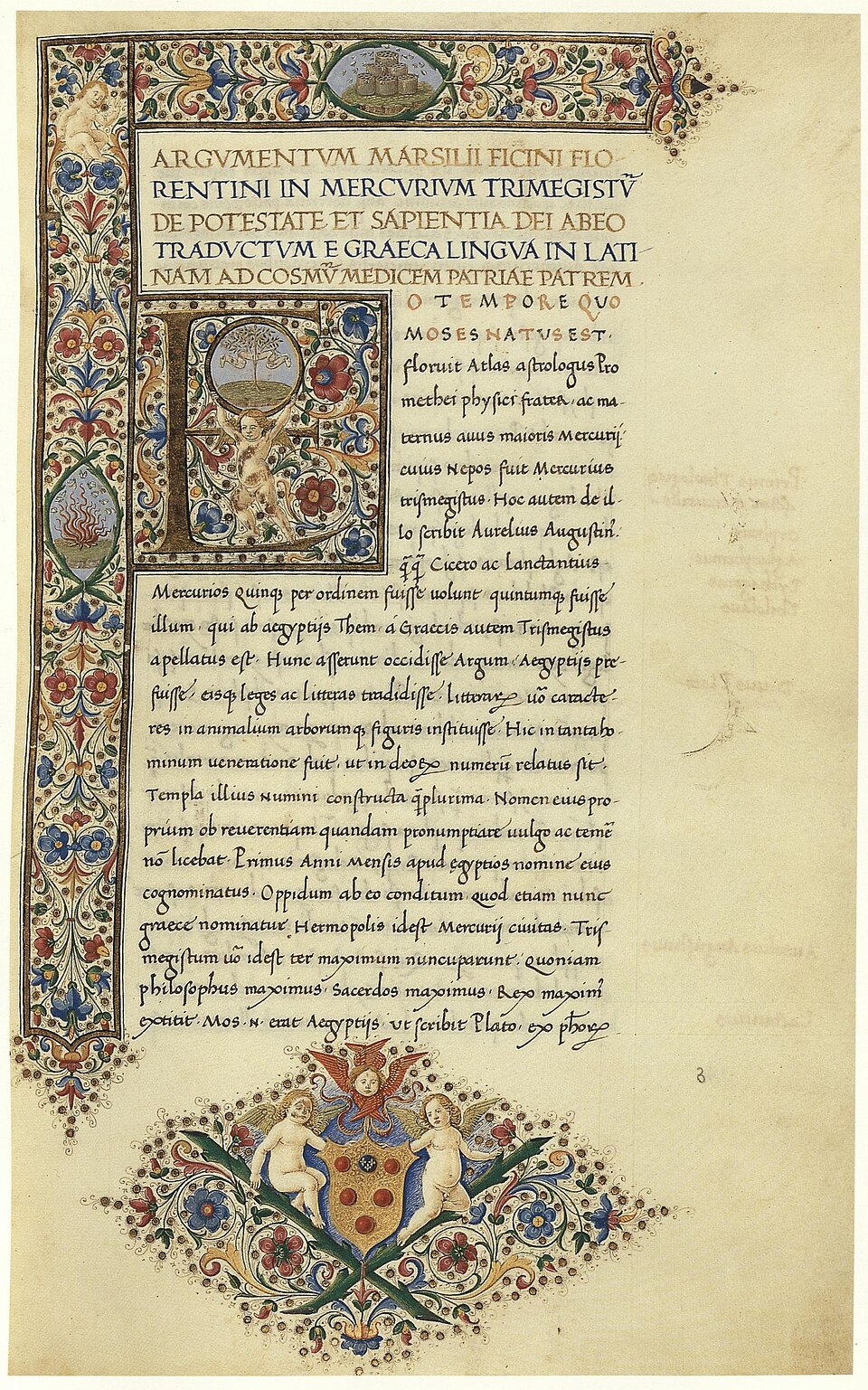
Ficino, Pimander. Photo: Marsilio Ficino / Wikimedia Commons. Visually establishes the Renaissance Latin transmission point for the Corpus Hermeticum and underlines that the…. Source
The remaining six principles reveal their modern provenance once traced. The Principle of Vibration, with its axiom “Nothing rests; everything moves; everything vibrates,” originates not in ancient Hermeticism but in the mid-eighteenth century, with the British philosopher and physician David Hartley (1705–1757). The Principle of Mentalism — “THE ALL IS MIND; The Universe is Mental” — echoes the New Thought conviction that “thoughts create reality” rather than the classical Hermetic treatment of divine Nous, which is theologically more nuanced. William Walker Atkinson’s 1906 treatise Thought Vibration: or the Law of Attraction in the Thought World developed this vibrational vocabulary two years before the Kybalion appeared, equating thought with a vibratory force operating through “the Law of Attraction in the Thought World” — terminology the Kybalion would recast in Hermetic language. A close textual precursor for the seven-principle scheme itself exists in Anna Kingsford and Edward Maitland’s 1885 introduction to The Virgin of the World of Hermes Mercurius Trismegistus, which lists seven unnumbered Hermetic laws (Unity of Spirit/Mind, Correspondence, Duality, Cause and Effect, Gravitation/Affinity, Gender/Generation, and Eternal Movement in Equilibrium) that map onto the Kybalion’s seven with striking precision. [22]
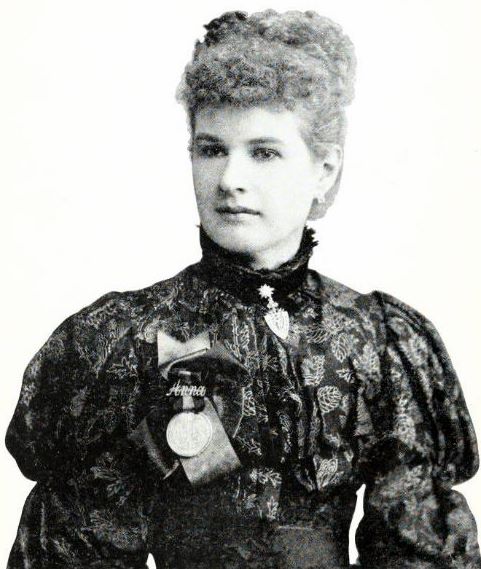
Anna Kingsford 2. Photo: Maitland, Edward / Wikimedia Commons. A portrait of Kingsford humanizes the lesser-known co-author of the 1885 precursor and helps the…. Source
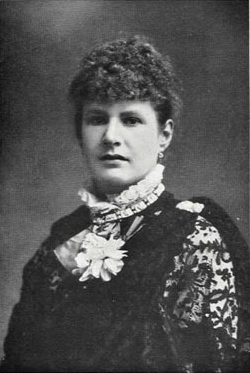
Anna Kingsford.002. Photo: unklar / Wikimedia Commons. Anna Bonus Kingsford (1846-1888). Source
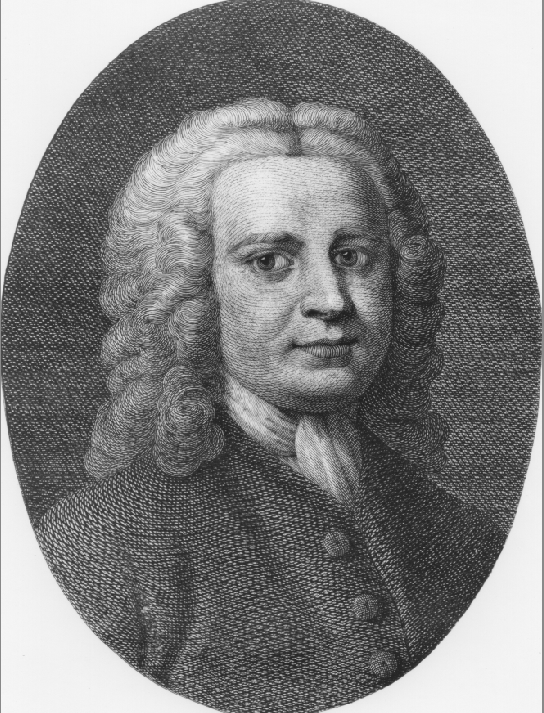
David Hartley1. Photo: Engraving by William Blake / Wikimedia Commons. A contemporary portrait anchors the claim that the Principle of Vibration’s ‘everything vibrates’ axiom originates…. Source
The microcosm-macrocosm analogy underlying the Correspondence principle is itself older than any Hermetic text. It is found in Plato’s Timaeus, was elaborated by the Stoics, and was adopted by the authors of the religio-philosophical Hermetica — not the other way around. The Kybalion therefore borrows the prestige of an ancient philosophical doctrine while supplying none of its specific textual content. Hermes Trismegistus himself — the syncretic combination of the Greek god Hermes and the Egyptian god Thoth to whom both the Corpus Hermeticum and the Emerald Tablet are pseudepigraphically attributed — never existed as a historical individual, a point that the philologist Isaac Casaubon demonstrated in 1614 by linguistic analysis of the Greek Hermetica. The figures behind “Three Initiates” (the collective pseudonym on the 1908 title page) are widely attributed to Atkinson, a pioneer of the New Thought movement who published under multiple invented identities including Yogi Ramacharaka, Theron Q. Dumont, Swami Panchadasi, and Magus Incognito. [23] [24] [25] [26]
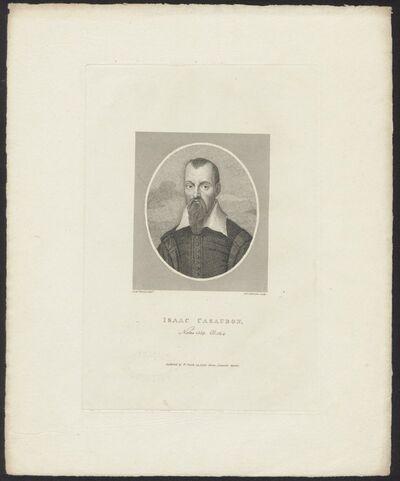
Portrait of Isaac Casaubonus, scholar in the humanities. Photo: Sherlock, W.P., (1770-1840) / Europeana. etching and stipple. Source
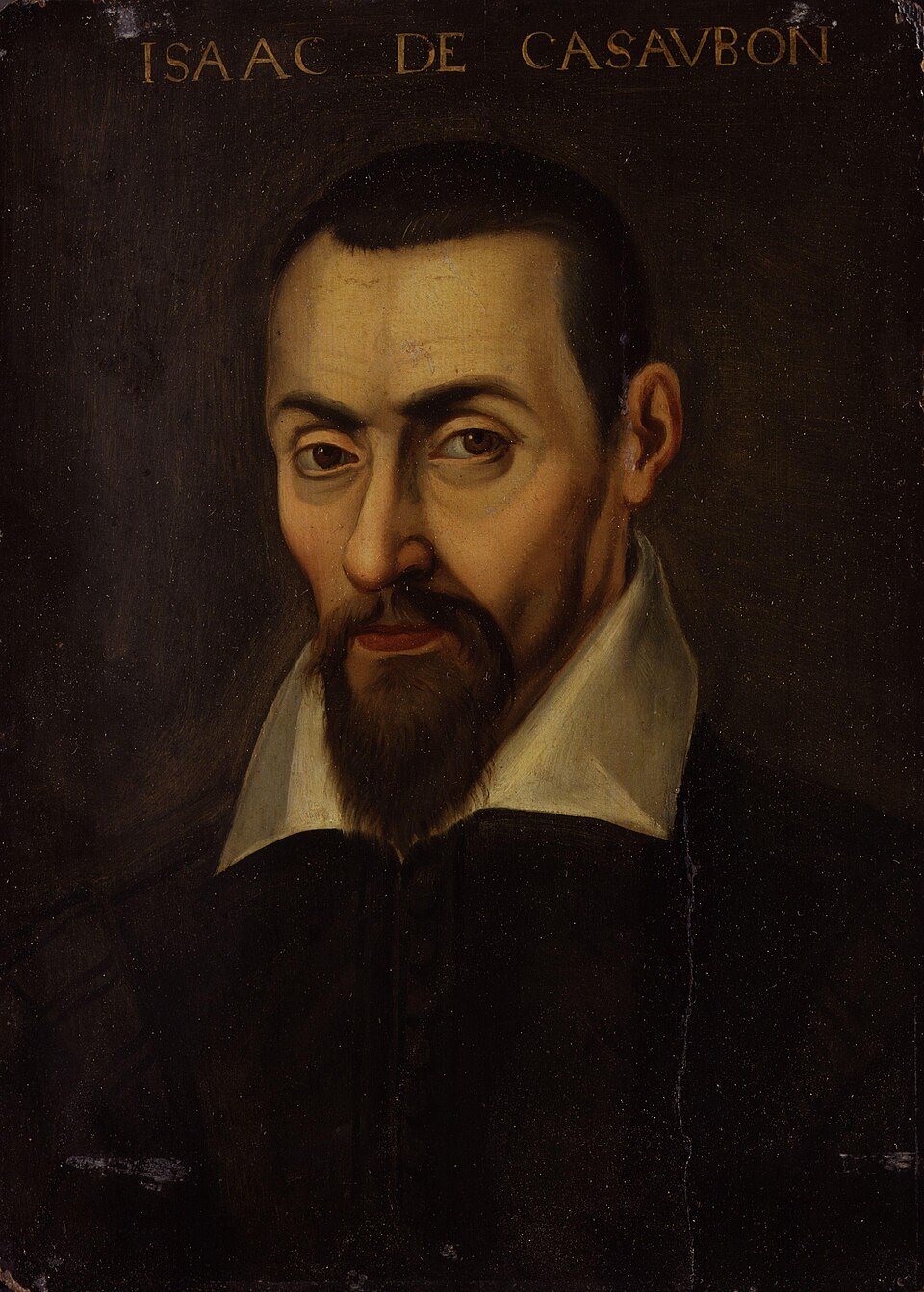
Isaac Casaubon from NPG. Photo: anonymous / Wikimedia Commons. The paragraph credits Casaubon specifically with the 1614 linguistic demonstration that Hermes Trismegistus never existed;…. Source
The investigation closes on a paradox that the evidence does not resolve. The Kybalion’s self-presentation as a transmission of ancient wisdom from “the Masters of Ancient Egypt” survives intact in popular consciousness, even as scholarly analysis has established its 1908 American composition by a single New Thought writer operating from his own publishing house. The phrase “As above, so below” — the single element with genuine pre-modern pedigree — traces not to pharaonic Egypt but to a medieval Arabic alchemical compendium and a twelfth-century Latin translation. The seven principles as an enumerated system are absent from the genuine Hermetica, and the title “Kybalion” itself appears in no historical Hermetic text. The most famous “Hermetic” teaching in the modern world thus turns out to be a twentieth-century New Thought composition in Hermetic costume, with one borrowed medieval Arabic-Latin phrase standing in for an entire lost tradition — a substitution so successful that the disguise has, for over a century, become the public face of the thing it was meant to evoke. [27]
Modern Esoteric Reception and Scholarly Assessment
The Kybalion was first published in 1908 under the pseudonym “Three Initiates,” presenting seven enumerated principles — Mentalism, Correspondence, Vibration, Polarity, Rhythm, Cause and Effect, and Gender — as a distillation of ancient Egyptian and Greek Hermetic philosophy. The text bears the subtitle “A Study of the Hermetic Philosophy of Ancient Egypt and Greece” and frames its teachings as derived from ancient Egyptian authorities, claiming the principles “were enunciated thousands of years ago”. The text explicitly acknowledges that the terms of its seven principles were “passed down by word-of-mouth from teacher to student” before being compiled into book form in the early 20th century. No source predates 1908 in documenting these seven principles as a numbered set, and the text’s claims of derivation cite no specific ancient passages or manuscripts. [28]
More than a century later, those seven principles circulate through formal esoteric institutions. The Ancient Mystical Order Rosae Crucis (AMORC) held a members-only event in 2023 explicitly framed as teaching “the seven Hermetic Principles … applicable to Kabbala and your life experience”. In modern esoteric and self-help usage, the seven principles are applied as a framework for manifestation, mindfulness, neuro-regulation, and psychological self-mastery, rather than treated as historical doctrine. [29] [30] [31] [32]
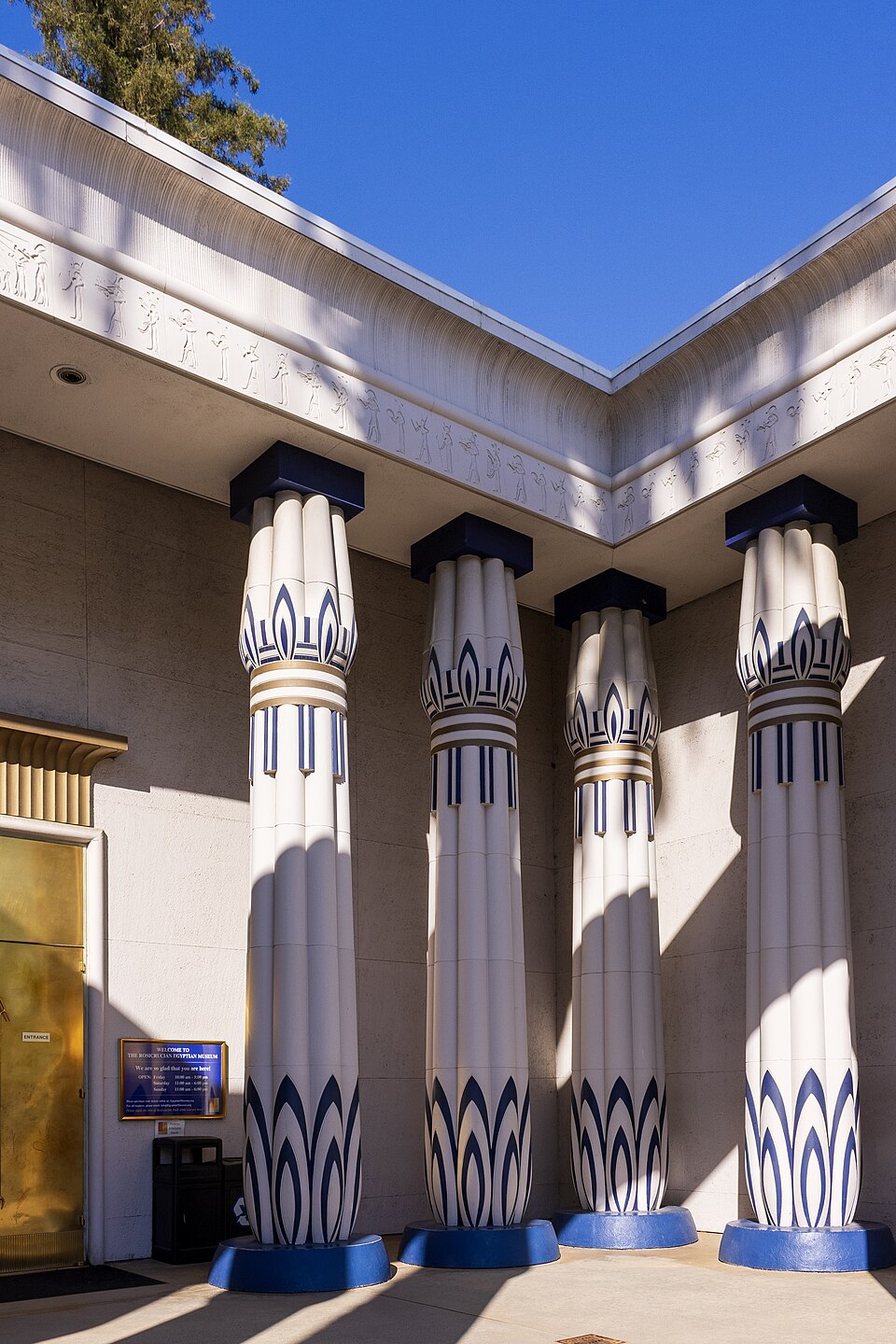
Rosicrucian Park 2023-07-15 02. Photo: The wub / Wikimedia Commons. Rosicrucian Park, San Jose, California. Source
But here’s the part that doesn’t sit right: the scholarly assessment is unforgiving. The “Three Initiates” is identified in modern reception as the pseudonym of William Walker Atkinson, a late 19th/early 20th-century American occult writer of the New Thought movement. The Kybalion is widely treated in late 19th/early 20th-century occultism as a coherent restatement of Hermetic tradition rather than as a primary Hermetic text; the Hermetic Order of the Golden Dawn, active 1887–1903, represents the broader esoteric milieu of the period in which Atkinson wrote. [33] [34] [35]
The actual historical Hermeticism is something quite different. The Corpus Hermeticum is a collection of seventeen Greek Hermetic treatises; the religio-philosophical subgroup of the Hermetica dates roughly to 100–300 CE in Roman Egypt. Hermes Trismegistus is described as a syncretic figure combining the Greek god Hermes and the Egyptian god Thoth. [36] [28] [31]
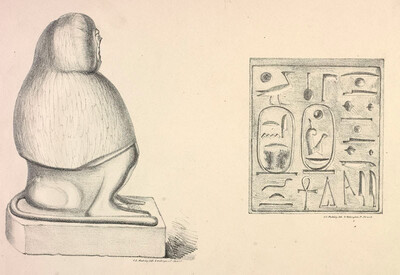
Egyptian sculpture and tablet. Photo: Lee, John, Dr / Europeana. The paragraph identifies Thoth as the Egyptian half of the Hermes Trismegistus syncretism; showing the…. Source
And the Kybalion’s central maxim — “As above, so below; as below, so above” — appears in the text as the wording of the Principle of Correspondence, framed there as “the old Hermetic axiom”. [37]
Connecting the Dots
On its surface, The Kybalion is a coherent teaching text: published in 1908 under the pseudonym “Three Initiates” through the Yogi Publication Society in Chicago, it lists seven principles — Mentalism, Correspondence, Vibration, Polarity, Rhythm, Cause and Effect, and Gender — each with a one-line maxim. Scholarly evidence identifies William Walker Atkinson (1862–1932), a New Thought movement pioneer, as its sole author. The Kybalion itself claims to rest on an ancient unpublished Hermetic tractate also called “The Kybalion,” but no such source has ever been discovered, and the title does not appear in any historical Hermetic literature. The exception is striking: of the seven principles, only Correspondence — “As above, so below; as below, so above” — has a genuine pre-1908 textual pedigree, and even that is a modern English paraphrase of the second verse of the Emerald Tablet, derived from the Latin vulgate rather than the original Arabic, which reads “from” rather than “like to”. The other six principles have no traceable ancient source and appear to be original constructions by Atkinson within the New Thought milieu of mesmerism, occultism, science, and Theosophy. [6]
Genuine ancient Hermeticism looks strikingly different. The Corpus Hermeticum and the Latin Asclepius, the religio-philosophical Hermetica, were written in Roman Egypt primarily between the 1st and 3rd centuries CE. Their legendary author, Hermes Trismegistus, is a syncretic figure combining the Greek god Hermes and the Egyptian god Thoth, with the conflation emerging in Hellenistic Alexandria. The first treatise, the Poimandres, presents a revelatory vision in which Hermes Trismegistus is guided by a divine being called Poimandres (“Shepherd of Men” / “Mind of Sovereignty”) toward contemplative ascent through the seven planetary spheres as the soul returns to the divine. The Corpus Hermeticum was lost to the Latin West after classical times, surviving only in Byzantine Greek manuscripts until Marsilio Ficino translated it into Latin in 1471 for Cosimo de’ Medici. Where the ancient texts place Nous (Mind) at the center of a revelatory ascent that liberates the soul from bodily imprisonment, the Kybalion reframes this into Mentalism — “THE ALL IS MIND; the Universe is Mental” — and turns the ascent into a program of positive-thinking mental mastery, a theological inversion that maps directly onto New Thought priorities. [12] [13] [14]
The conflation is not arbitrary. Both the Kybalion’s self-presentation as ancient Hermetic wisdom and the scholarly rediscovery of the Corpus Hermeticum emerged from the same nineteenth-century Western esoteric milieu that produced Blavatsky’s Theosophy and the Hermetic Order of the Golden Dawn. The same currents that revived genuine Hermetic studies also supplied Atkinson with his raw material. From that shared well, a clean causal chain runs: Atkinson’s 1908 Kybalion became the operational backbone of modern manifestation culture, where Mentalism became “law of attraction,” Vibration became “thought vibration,” and the seven principles became the curriculum of Science of Mind, The Secret, and prosperity-gospel teaching. The title was coined in Chicago, its author a New Thought writer who never claimed ancient lineage until after publication, and its principles are modern composites — yet because the book carries the word “Hermetic,” readers who have never opened the Poimandres or the Emerald Tablet treat it as a summary of antique Egyptian-Greek mystery teaching. [38]
The Other Side
The mainstream scholarly position holds that the Kybalion is a product of late-nineteenth and early-twentieth century American New Thought, and that its claimed lineage from ancient Egyptian Hermeticism does not survive contact with the actual historical record. William Walker Atkinson was a Chicago-based New Thought author writing under the Yogi Publication Society imprint, a milieu saturated with Theosophical, Mesmeric, and Protestant-metaphysical vocabularies rather than primary Hermetic scholarship. The seven principles do not appear in any extant ancient Hermetic text. The corpus of authentic Hermetic writings consists of the Greek Corpus Hermeticum (a set of dialogues from the 2nd–3rd centuries CE), the Latin Asclepius, and the fragments preserved in Stobaeus, none of which enumerate seven universal principles or use the Kybalion’s distinctive terminology of “Mentalism,” “Vibration,” “Polarity,” or “Rhythm” as a doctrinal scheme. Defenders like Mitch Horowitz and the Builders of the Adytum argue for “an authentic if dramatized retention of certain classical Hermetic themes,” but this is a devotional claim rather than a philological one, and Atkinson himself never produced manuscript evidence, source citations, or scholarly apparatus supporting his seven-principle framework. The deeper problem is that the Hermetic texts the Kybalion claims to inherit were themselves demonstrably not ancient Egyptian. Isaac Casaubon’s 1614 De rebis sacris et ecclesiasticis exercitationes demonstrated that the Greek Corpus Hermeticum could not predate the New Testament and must be located in the 2nd–3rd century CE at the earliest, settling the question through internal linguistic and historical evidence that scholars continue to accept. Renaissance readers had treated Ficino’s 1471 Latin Pimander as a genuine Egyptian text coeval with Moses, but Casaubon’s dating, confirmed and refined by modern scholarship, dissolved that continuity. Anthony Grafton’s 1983 Warburg Institute study of Casaubon’s critique remains the standard account of how the Hermetic tradition was forced to relocate from sacred antiquity into Late Antique syncretism. The Kybalion’s pretense of recovering a “Hermetic Philosophy of Ancient Egypt and Greece” thus inherits a chronology that was already obsolete by 1614 and that no peer-reviewed classicist or historian of religion accepts today. Specific resonances invoked on the Kybalion’s behalf do exist but are weaker than they appear. The Principle of Mentalism is said to echo the Poimandres’ doctrine of Divine Mind (Nous) creating and pervading the cosmos, and the Principle of Gender finds a partial parallel in Asclepius 21’s statement that all things are ensouled and participate in fertility. However, the microcosm-macrocosm correspondence underlying the Principle of Correspondence predates even the Emerald Tablet: it is developed in Plato’s Timaeus and elaborated by the Stoics, so the principle’s intellectual pedigree is older than any Hermetic text [39]. The Kybalion’s signature framework of “vibration” derives from nineteenth-century physics, associationist psychology (David Hartley), and Theosophical/New Thought vocabulary, not from Greek or Latin Hermetic sources. Whether Ficino’s 1471 Latin translation of the Corpus Hermeticum faithfully transmitted the ancient texts remains contested between the Yates 1964 thesis and modern revisionist scholarship associated with the Brill volume “How Hermetic was Renaissance Hermetism?” Finally, the argument from continuous transmission cuts the other way. The Kybalion has indeed remained in print since 1908, sold millions of copies, and structured the practice of multiple living traditions including AMORC, the Builders of the Adytum, and modern witchcraft lineages, which suggests it captures something functionally real for practitioners independent of its disputed ancient pedigree. But devotional and commercial success since 1908 is evidence only of modern reception; it does not establish that the text transmits content from ancient Egypt. The “Three Initiates” pseudonym itself, analyzed in Nicholas E. Chapel’s critical-historical study of twelve proposed authorship candidates, was a New Thought marketing device, and the 1908 first edition was published by the Yogi Publication Society at the Masonic Temple in Chicago. By the standards of classical philology and the history of religions, the Kybalion is best classified as an early-twentieth-century American metaphysical work that borrowed Hermetic vocabulary for New Thought purposes, not as a retrieval of ancient esoteric doctrine.
What We Actually Know
Most of what the Kybalion claims about itself holds up. The 1908 text was published by “Three Initiates” through the Yogi Publication Society, located in the Masonic Temple of Chicago, presenting seven self-styled “Hermetic” principles — Mentalism, Correspondence, Vibration, Polarity, Rhythm, Cause and Effect, and Gender — each with a canonical one-line formulation. The Principle of Correspondence is explicitly paired in the text with “As above, so below; as below, so above,” framed as “the old Hermetic axiom”. William Walker Atkinson (1862–1932), a New Thought pioneer, is the widely presumed author, with attribution resting on his own 1912 Who’s Who entry claiming sole authorship, the 1917 French edition’s translator’s introduction crediting him, and his ownership of the Yogi Publication Society itself. [6] [40]
The historical context, however, sits clearly apart from what the Kybalion claims. “As above, so below” is a modern English paraphrase of the second verse of the Emerald Tablet, derived specifically from the Latin vulgate “Quod est superius est sicut quod inferius” — the original Arabic reads “from” rather than “like to”. The religio-philosophical Hermetica (Corpus Hermeticum and Asclepius) were primarily written in Greek in Roman Egypt between the 1st and 3rd centuries CE, and Hermes Trismegistus is a syncretic figure combining Greek Hermes and Egyptian Thoth, with no verified historical existence. The earliest known versions of the Emerald Tablet are four Arabic recensions preserved in mystical and alchemical treatises between the 8th and 10th centuries CE, chiefly within the Sirr al-Khalīqa and Sirr al-Asrār, and the text is classified as “technical” Hermetic literature. The title “Kybalion” appears in no historical Hermetic corpus, and the work claims to elucidate an unpublished ancient text of the same name that has never been discovered. Three additional Hermetic texts recovered at Nag Hammadi in 1945 — the Discourse on the Eighth and Ninth, the Prayer of Thanksgiving, and an Asclepius excerpt — correspond to none of the Kybalion’s content. [41]
Several findings remain plausible but uncertain. The Kybalion frames its seven principles as derived from “the Masters of Ancient Egypt” and acknowledges they were “passed down by word-of-mouth from teacher to student” before being compiled in the early 20th century, but cites no specific ancient passages or manuscripts. Atkinson drew “substantially from the ideological ocean of mesmerism, science, and the occult” between Theosophy and New Thought, with identifiable influences from Blavatsky, Éliphas Lévi, and his own prior writings including The Arcane Teachings. His later The Seven Cosmic Laws reused the same seven-principle schema — described as “repetition without innovation” — and the Kybalion shifted Hermetic motifs away from the Corpus’s body-denying emphasis on re-merging with Nous toward pragmatic self-help terms. The popularization of “as above, so below” in modern Western occultism traces specifically to Helena P. Blavatsky and the Kybalion’s anonymous author. [42]
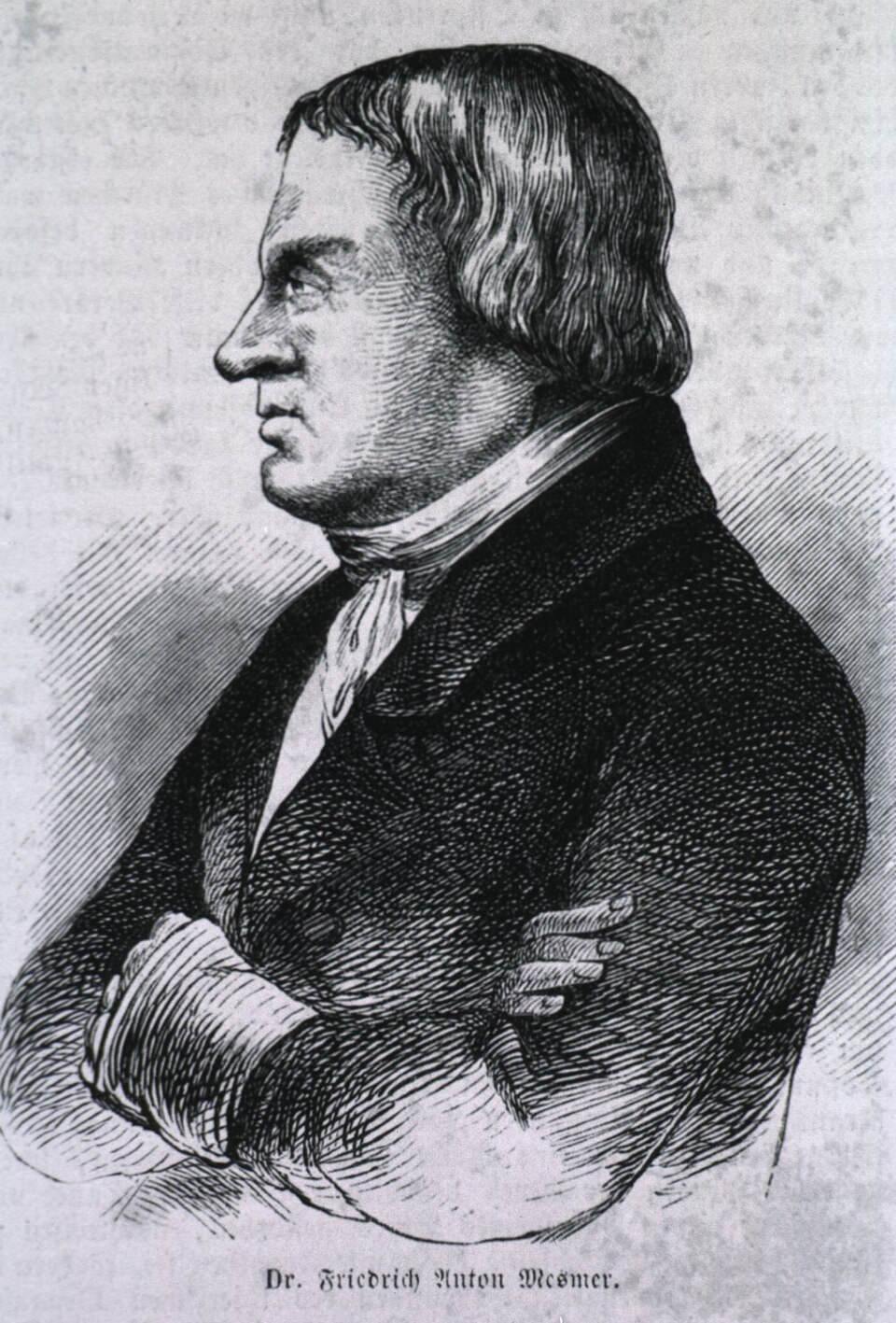
Friedrich Anton Mesmer. Photo: Unknown authorUnknown author / Wikimedia Commons. Portrait of Friedrich Anton Mesmer, 1734-1815. Left pose, arms folded. Wood engraving. Source
Speculative territory includes the co-authorship question — whether Atkinson wrote the Kybalion alone or with Paul Foster Case and Michael Whitty — and whether the principles show any genuine fingerprints of the ancient Corpus Hermeticum reinterpreted in a New Thought direction, or are entirely modern invention. Modern appropriations, such as Bruce Lipton’s invocation of the principles alongside fractal geometry and wave-particle duality, represent reception-history phenomena rather than textual claims about the Kybalion’s scientific legitimacy. Scholarly analyses (Nicholas E. Chapel, Dan Attrell) argue the principles are not found in historical Hermetic corpora and the Kybalion’s worldview is “fundamentally at odds with those of all the rest of the Hermetic texts combined”. [43]
The biggest question the research surfaced remains open: no specialist provided a systematic, principle-by-principle mapping of the seven Kybalion principles to specific ancient passages in the Corpus Hermeticum, the Stoic or Neoplatonic traditions, or elsewhere in the Hermetica. Whether each of the seven has even an indirect pedigree in genuine ancient Hermetic sources, or whether all seven are Atkinson’s modern syntheses repackaged under the prestige of antiquity, is a question the evidence currently cannot resolve. [44] [45]
References
[1] The Kybalion: The Seven Hermetic Principles by Three Initiates — https://www.goodreads.com/book/show/218023215-the-kybalion (accessed 2026-07-27)
[2] The Legend of the Emerald Tablets — https://blog.philosophicalsociety.org/2020/11/02/legend-of-the-emerald-tablets/ (accessed 2026-07-27)
[3] ‘As above, so below’ : The Mystics of Arabia by Meghna N. Desai — https://www.themedievalmagazine.com/past-issue-features/the-mystics-of-arabia (accessed 2026-07-27)
[4] The Kybalion — https://en.wikipedia.org/wiki/The_Kybalion (accessed 2026-07-27) [Reputable]
[5] The Kybalion - Initiates, The Three: 9781470126384 — https://www.abebooks.com/9781470126384/Kybalion-Initiates-Three-1470126389/plp (accessed 2026-07-27)
[6] The Kybalion: Hermetic Philosophy Of Three Initiates? — https://templarkey.com/the-kybalion-hermetic-philosophy-of-three-initiates/ (accessed 2026-07-27)
[7] As above, so below — https://en.wikipedia.org/wiki/As_above,_so_below (accessed 2026-07-27) [Reputable]
[8] The Kybalion by Three Initiates — https://www.goodreads.com/book/show/46002119 (accessed 2026-07-27)
[9] The Kybalion by Three Intiates — https://www.audible.com/blog/summary-the-kybalion-by-three-intiates?srsltid=AfmBOor56a9vnOj92o9tYaqx5SYHN2AcjT7tFaDzzhFu2GuJ-GwRR7rt (accessed 2026-07-27)
[10] The Secret History of Hermes: Hermeticism from Ancient Times to … — https://www.tandfonline.com/doi/full/10.1080/00033790701830249 (accessed 2026-07-27) [Academic]
[11] The Kybalion And New Thought: Rediscovering True Hermeticism — https://templarkey.com/the-kybalion-and-new-thought/ (accessed 2026-07-27)
[12] The Corpus Hermeticum & Hermetic Tradition – The Gnostic Society Library — http://www.gnosis.org/library/hermet.htm (accessed 2026-07-27)
[13] Hermes Trismegistus – Greek God, Symbol, Mythology, and History — https://tosalem.com/hermes-trismegistus-greek-god-symbol-mythology-history/ (accessed 2026-07-27)
[14] Wouter J. Hanegraaff (2015). How Hermetic was Renaissance Hermetism?. Aries. DOI: 10.1163/15700593-01502001 (accessed 2026-07-27)
[15] Wouter J. Hanegraaff (2008). Altered States of Knowledge: The Attainment of Gnōsis in the Hermetica. The International Journal of the Platonic Tradition. DOI: 10.1163/187254708x335728 (accessed 2026-07-27)
[16] Reading the Hermetica: Discourse on the Eighth and Ninth (NHC VI,6) (part 1) — https://digitalambler.com/2024/08/12/reading-the-hermetica-discourse-on-the-eighth-and-ninth-nhc-vi6-part-1/ (accessed 2026-07-27)
[17] Latin Translation of the Emerald Tablet of Hermes — https://www.universalfreemasonry.org/en/library/emerald-tablet-of-hermes/latin-translation-emerald-tablet-hermes (accessed 2026-07-27)
[18] Book Intro – The Kybalion — https://www.thesquaremagazine.com/mag/article/202308book-intro-the-kybalion/ (accessed 2026-07-27)
[19] The Kybalion by Three Intiates — https://www.audible.com/blog/summary-the-kybalion-by-three-intiates?srsltid=AfmBOooF1qrkiyP7aDQk_C3SnSzH9Aalc4zQzuF0YG4tQMZvWPsdMgl9 (accessed 2026-07-27)
[20] The Kybalion in Light of Western Esotericism: Principles, Critique … — https://reflective-online-teaching.blogspot.com/2025/10/the-kybalion-in-light-of-western.html (accessed 2026-07-27)
[21] Foundations Of Modern Witchcraft: The Kybalion, A Hermetic Philosophy — https://www.patheos.com/blogs/witchonfire/2020/02/foundations-modern-witchcraft-kybalion-hermetic-philosophy/ (accessed 2026-07-27)
[22] Source of The Kybalion in Anna Kingsford’s Hermetic System — https://marykgreer.com/2009/10/08/source-of-the-kybalion-in-anna-kingsford%E2%80%99s-hermetic-system/ (accessed 2026-07-27)
[23] Hermes Trismegistus — https://en.wikipedia.org/wiki/Hermes_Trismegistus (accessed 2026-07-27) [Reputable]
[24] Hermetica — https://en.wikipedia.org/wiki/Hermetica (accessed 2026-07-27) [Reputable]
[25] The Roman obsession with the Egyptian God Thoth — https://www.thecollector.com/greek-god-hermes-obsession-with-egyptian-god-thoth/ (accessed 2026-07-27)
[26] Interpretatio graeca — https://en.wikipedia.org/wiki/Interpretatio_graeca (accessed 2026-07-27) [Reputable]
[27] AS IS ABOVE SO IS BELOW — https://www.cannacompanionusa.com/guide/Y52/962/go0JLVIg-as-is-above-So-Is-below (accessed 2026-07-27)
[28] The 7 Hermetic Principles & How To Use Them To Improve Your Life — https://www.mindbodygreen.com/articles/7-hermetic-principles?srsltid=AfmBOorkrt8huYSm06GAdIsej1otoHoebFHNNWPVI4kxmOwoj4omxFLA (accessed 2026-07-27)
[29] The 7 Hermetic Principles: A Guide to Hermetic Philosophy — https://mistikist.com/blog/the-7-hermetic-principles-a-guide-to-hermetic-philosophy/ (accessed 2026-07-27)
[30] The 7 Hermetic Principles as a Key to Life, the Universe and Everything — https://www.collegeofpsychicstudies.co.uk/enlighten/the-7-hermetic-principles/ (accessed 2026-07-27)
[31] Seven hermetic principles — https://mortenbonde.dk/en/seven-hermetic-principles/ (accessed 2026-07-27)
[32] The Seven Hermetic Principles and Their Modern Applications — https://metaphysicsuniversity.com/the-seven-hermetic-principles-and-their-modern-applications/ (accessed 2026-07-27)
[33] The Seven Principles of Hermeticism — https://www.theresearchlodge.com/further-light/the-seven-principles-of-hermeticism (accessed 2026-07-27)
[34] The Hermetic Order of the Golden Dawn in the 19th and 20th Centuries — https://brewminate.com/secretly-metaphysical-the-hermetic-order-of-the-golden-dawn-in-the-19th-and-20th-centuries/ (accessed 2026-07-27)
[35] Hermetic Order of the Golden Dawn — https://en.wikipedia.org/wiki/Hermetic_Order_of_the_Golden_Dawn (accessed 2026-07-27) [Reputable]
[36] Hermeticism — https://en.wikipedia.org/wiki/Hermeticism (accessed 2026-07-27) [Reputable]
[37] The Kybalion: Chapter II. The Seven Hermetic Principles — https://sacred-texts.com/eso/kyb/kyb04.htm (accessed 2026-07-27)
[38] The Emerald Tablet of Hermes & The Kybalion: Two Classic Books on … — https://booksoup.com/book/9781946774811 (accessed 2026-07-27) [Academic]
[39] Microcosm–macrocosm analogy — https://en.wikipedia.org/wiki/Microcosm–macrocosm_analogy (accessed 2026-07-27) [Reputable]
[40] The Kybalion Without Tears — https://mitchhorowitz.substack.com/p/the-kybalion-without-tears (accessed 2026-07-27)
[41] Emerald Tablet — https://en.wikipedia.org/wiki/Emerald_Tablet (accessed 2026-07-27) [Reputable]
[42] Chapter 1 Historical Roots of ‘Subtle Energies’: Occult Physicalism in — https://brill.com/display/book/9789004736221/BP000011.xml?language=en&srsltid=AfmBOooTmy3fXEDzOwRc-B7kuDQJXTDftHCR8oLaz0HM3kC6kJmcwiYK (accessed 2026-07-27)
[43] Hermeticism and the 7 Principles of the Kybalion - The Way of Hermes — https://wayofhermes.com/hermeticism/hermeticism-and-7-principles-of-the-kybalion/?srsltid=AfmBOopB-BZmByuwDSCyEsS9_SpFIHZpqjRV58foyKVj4VvN8yXNOqwA (accessed 2026-07-27)
[44] The Kybalion: Ancient Egyptian Wisdom, Written in Chicago — https://theesotericcanon.com/essays/kybalion-fake-hermetic-book.html (accessed 2026-07-27)
[45] Kybalion — Source Text | Satyori — https://satyori.com/source-texts/kybalion/ (accessed 2026-07-27)
Keep exploring
Every site on this page sits on the globe, and the people who research them are on the Discord.
3D Globe · Sites by country · Story Archive · Research Library · Weekly Journal · Search