

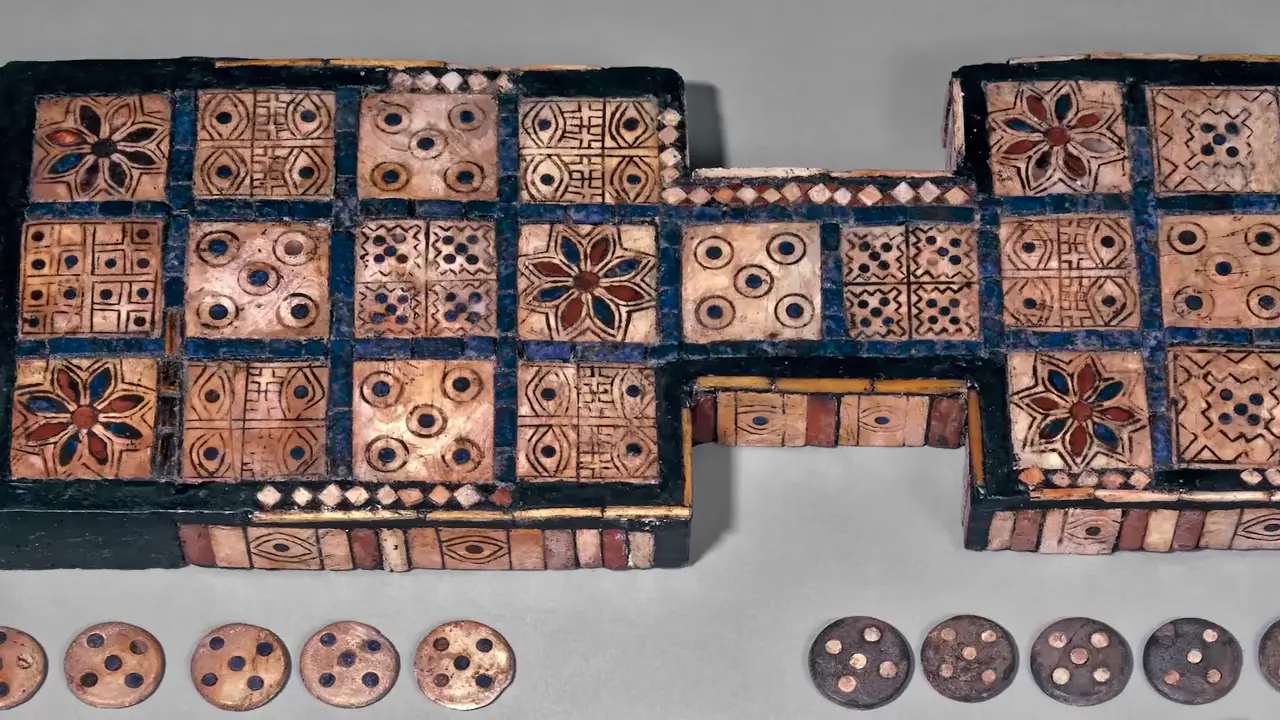
The video argues that cuneiform developed from clay tokens and that grid-based board games may have grown from token-counting exercises. It compares the grid on the Royal Game of Ur board, excavated by Leonard Woolley at Ur, with the cuneiform sign SA. A board dates to about 2600–2400 BCE, and part of the game's rules survives on a cuneiform tablet dated 177–176 BCE.
Video links clay tokens to cuneiform and suggests they may have inspired board games
Key facts
- The video argues that increasingly complex clay tokens, apparent by about 3500 BCE, were precursors to cuneiform.
- It compares cone-shaped tokens with an early cuneiform sign it identifies as silver, and compares the grid-like sign SA with counting grids and game boards.
- A Royal Game of Ur board excavated by Leonard Woolley at Ur in modern Iraq is dated to about 2600–2400 BCE.
- Part of the game's rules survives on a cuneiform tablet dated 177–176 BCE.
- The video cites grid-patterned school materials and proposes that board games developed from counting exercises using tokens on grids.
- The connection between the SA sign, token counting and the origin of board games is the video's interpretation, not an established conclusion.
Sources
Clay Tokens — PrepTest 146, Q15 Explanationlsatlab.com
An Artifact Speaksweb.extension.illinois.edu
Record Keeping and the Origins of Writing in Mesopotamiasemiramis-speaks.com
From Accounting to Writing | Denise Schmandt-Besseratsites.utexas.edu
Clay Tokens: Neolithic Seeds of Mesopotamian Writingthoughtco.com
The Game of URwoodexpressions.com
ROYAL GAME OF URgetty.edu
Was this story useful?
Keep exploring
Every site on this page sits on the globe, and the people who research them are on the Discord.
3D Globe · Sites by country · Story Archive · Research Library · Weekly Journal · Search
AI-generated text · images from the original sources · always verify with the sources.