

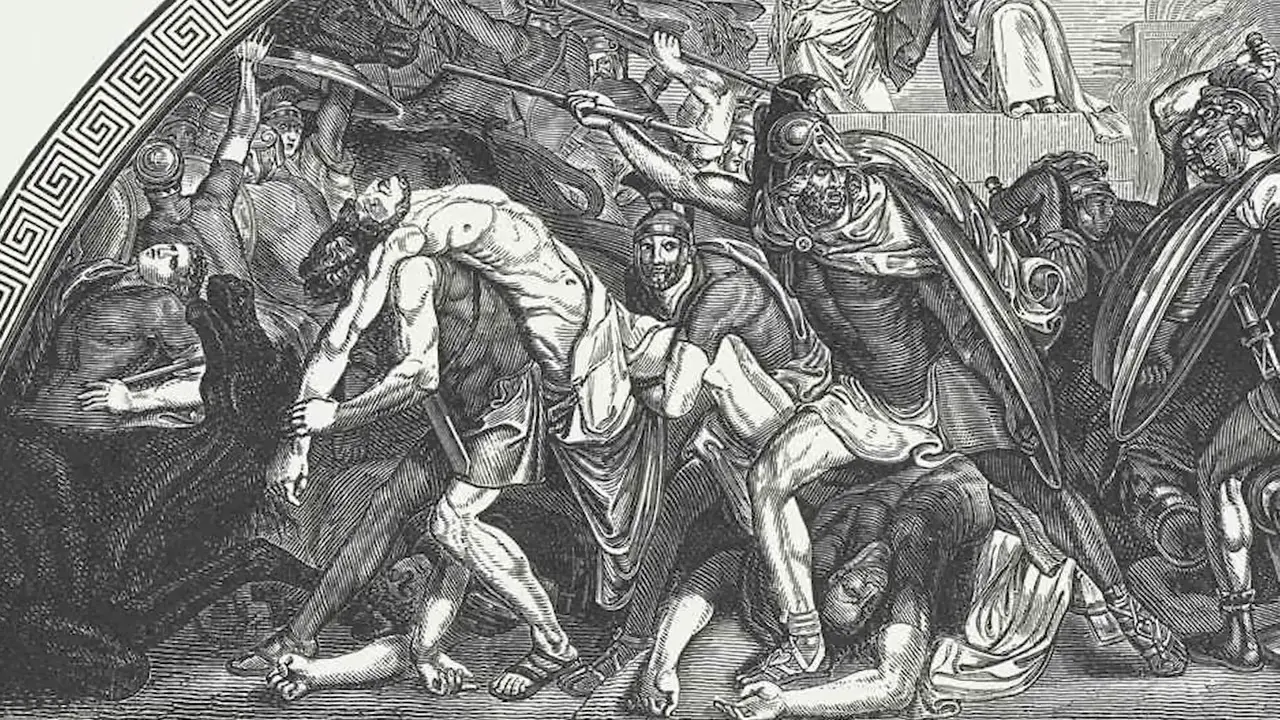
The Iliad’s Book 7 describes nine Achaean leaders casting marked lots for a fight with Hector. Each knew his own emblem. The video argues that these personal symbols formed an identity system and possible proto-writing among pre-literate Greeks. That is an interpretation of a literary scene, not proof of a prehistoric writing system. The listed emblems are not circles, crosses and lines. Vinča and Göbekli Tepe symbols remain debated, and a 40,000-year European proto-writing tradition has not been demonstrated.
Video argues Iliad lot emblems may be proto-writing
Key facts
- Iliad Book 7 describes nine Achaean leaders casting marked lots to choose a fighter for Hector; Homer says each man knew his own mark.
- The passage does not say the emblems were created without coordination or explain how the tokens were made.
- The listed emblems are a handled vessel, serpent's head, bull's horn, club, dove, fish, helmet, hilted sword and large stone; the passage does not identify them as circles, crosses and lines.
- The video interprets the emblems as an identity system and possible proto-writing; this is not demonstrated by the passage or established by the cited sources.
- The Iliad, traditionally dated to about 750 BCE, is a literary account of the Trojan War, not direct archaeological evidence of prehistoric Greek writing.
- Vinča symbols, generally dated to about 5300–4500 BCE, and marked Göbekli Tepe pillars, dated to about 9600–8200 BCE, remain debated as possible writing.
- Chinese characters represent words or morphemes rather than individual sounds, but that general feature of script does not make the Homeric emblems writing.
- A continuous European proto-writing tradition extending 40,000 years has not been demonstrated.
Sources
The Iliad Book 7 Summarystudy.com
It's decided that they should each scratch a mark on a lot and cast all the lots into a helmet. Nestor then shakes the helmet (after praying for his ...
Homer (c.750 BC) - The Iliad: Book VIIpoetryintranslation.com
The Gerenian horseman, Nestor, then spoke again: 'Cast lots now, each of you, that one might be chosen. He will serve the Achaean cause well, and himself ...
The Iliad: Book VII.sparknotes.com
Nine of the princes accepting the challenge, the lot is cast and falls upon Ajax. These heroes, after several attacks, are parted by the night. The Trojans ...
Summary and Analysis Book VII - The Iliadcliffsnotes.com
The Greeks cast lots and Telamonian Aias is chosen as the Achaian champion. He and Hektor engage in a ferocious duel, but neither warrior is able to ...
HOMER, ILIAD BOOK 7 - Theoi Classical Texts Librarytheoi.com
The lot then he cast upon the ground beside his foot, and spake: "My friends, of a surety the lot is mine, and mine own heart rejoiceth, for I deem that I shall ...
THE ILIAD of Homeruh.edu
[68] The sire of gods and men heeded her words, and said to Athena, "Go at once into the Trojan and Achaean hosts, and contrive that the Trojans shall be the ...
Iliaden.wikipedia.org
is one of two major surviving ancient Greek epic poems attributed to Homer. divided into 24 books. It contains 15,693 lines in its standard edition.
The Internet Classics Archive | The Iliad by Homerclassics.mit.edu
Tell him to get the Achaeans instantly under arms, for he shall take Troy. There are no longer divided counsels among the gods; Juno has brought them to her own ...
Was this story useful?
Keep exploring
Every site on this page sits on the globe, and the people who research them are on the Discord.
3D Globe · Sites by country · Story Archive · Research Library · Weekly Journal · Search
AI-generated text · images from the original sources · always verify with the sources.