

The video argues that the front few ranks of a hoplite phalanx bore the main combat, while the formation normally remained in close order. It presents Greek warfare as combined arms: phalanxes supported by cavalry and missile troops, using terrain to open or exploit gaps, with pitched battles comparatively rare. It places the high point of this approach in the Delian War, not the Peloponnesian War. Spartan citizens were the notable full-time force; most other hoplites were citizen levy soldiers.
Video argues Greek phalanxes used combined arms
Key facts
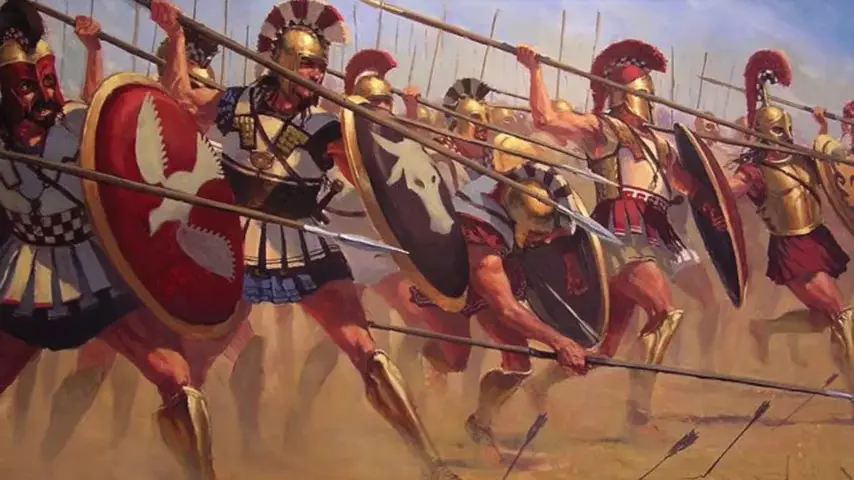
- The front ranks of a hoplite phalanx projected their spears beyond the leading shields and bore the main combat; the results do not establish a universal limit of exactly 2–3 ranks.
- Greek phalanxes generally formed in close order, although spacing could vary with tactical circumstances. Routine loose spacing and limited dueling are not established by these results.
- The video argues that phalanxes were supported by cavalry and missile troops and that Greek tactics used terrain to open or exploit gaps in enemy formations.
- The claim that pitched battles were comparatively rare, with skirmishes, sieges and raids more common, is the video's interpretation.
- The key facts identify the Delian War as the culmination of this approach; the post incorrectly substituted the Peloponnesian War.
- Spartan citizens were the notable full-time soldiers; most other Greek hoplites were citizen levy troops rather than permanent professionals.
Sources
Weaponry: Greek Phalanxhistorynet.com
What is the point of 16 ranks in a pike phalanx?forum.soa.org.uk
Phalanx warfare: Closing of the ranksromanarmytalk.com
Phalanxen.wikipedia.org
About History: Othismos and the ancient Greek phalanxtastesofhistory.co.uk
Was this story useful?
Keep exploring
Every site on this page sits on the globe, and the people who research them are on the Discord.
3D Globe · Sites by country · Story Archive · Research Library · Weekly Journal · Search
AI-generated text · images from the original sources · always verify with the sources.